

Then the hallway filled with men in dark suits.
Not police.
Not guests.
Lawyers.
Tom’s face changed before anyone said a word.
His perfect Wall Street confidence cracked right there in Claire’s two-bedroom apartment, between a grocery-store birthday cake and a pile of paper plates.
George stood at the end of the table, one hand on the back of his grandson’s chair.
For three weeks, he had moved like a confused old man.
Slow steps.
Soft voice.
Empty stares.
But now his eyes were clear enough to cut glass.
Tom looked at him and whispered, “Dad?”
George didn’t answer him.
He looked at the lawyer in front.
“Mr. Whitaker,” George said calmly, “you may begin.”
That was the moment Tom realized the old man he had thrown out of his penthouse had not been lost.
He had been watching.
And everyone had watched Tom fail.
Three weeks earlier, George Ellison had stood in the lobby of his son’s penthouse on Michigan Avenue like a man erased from his own life.
Outside, Chicago wind came off Lake Michigan sharp enough to burn.
Inside, the lobby smelled like polished marble, expensive perfume, and money that looked down on everyone.
George’s coat was old.
His shoes were wet.
His cloth bag hung from one hand.
He had spent forty-seven years building Ellison Freight & Logistics from three trucks and a borrowed warehouse into one of the biggest privately owned logistics companies in the Midwest.
But nobody in that lobby knew that.
Or maybe Tom hoped they had forgotten.
Tom Ellison stepped out of the elevator in a navy suit, phone in one hand, annoyance already written across his face.
“Dad,” he said under his breath. “Why are you here?”
George blinked.
“Tommy,” he said softly, “I think I got turned around.”
The doorman shifted.
A woman near the mailroom paused with her coffee.
Vanessa, Tom’s new girlfriend, stepped out behind him wearing a white coat and diamonds that made her look colder than the weather outside.
She smiled at George the way people smile at an inconvenience.
“So this is him?” she said. “The famous confused father?”
Tom’s jaw tightened.
“Go upstairs, Vanessa.”
“No,” she said. “I want to see how you handle this.”
George looked from Tom to Vanessa.
“I lost my wallet,” he murmured. “And I couldn’t remember the code.”
Tom laughed once.
Not because it was funny.
Because he wanted the people watching to know he was above this.
“You couldn’t remember the code because you don’t live here,” Tom said. “This is my building.”
George’s fingers tightened around the cloth bag.
“I thought maybe I could sit down for a while.”
Vanessa tilted her head.
“Sit down? In our home?”
Our.
That word landed hard.
Tom had bought nothing in that penthouse with his own sweat.
The down payment had come from family money.
The connections had come from George.
Even Tom’s first job on Wall Street had come from George calling an old friend and asking for one favor.
But now Tom looked at his father like a stain.
“You need to stop showing up,” Tom said. “You wander, you mumble, you make scenes. I have meetings. I have a reputation.”
George swallowed.
“I’m sorry.”
That should have been enough for any son with a soul.
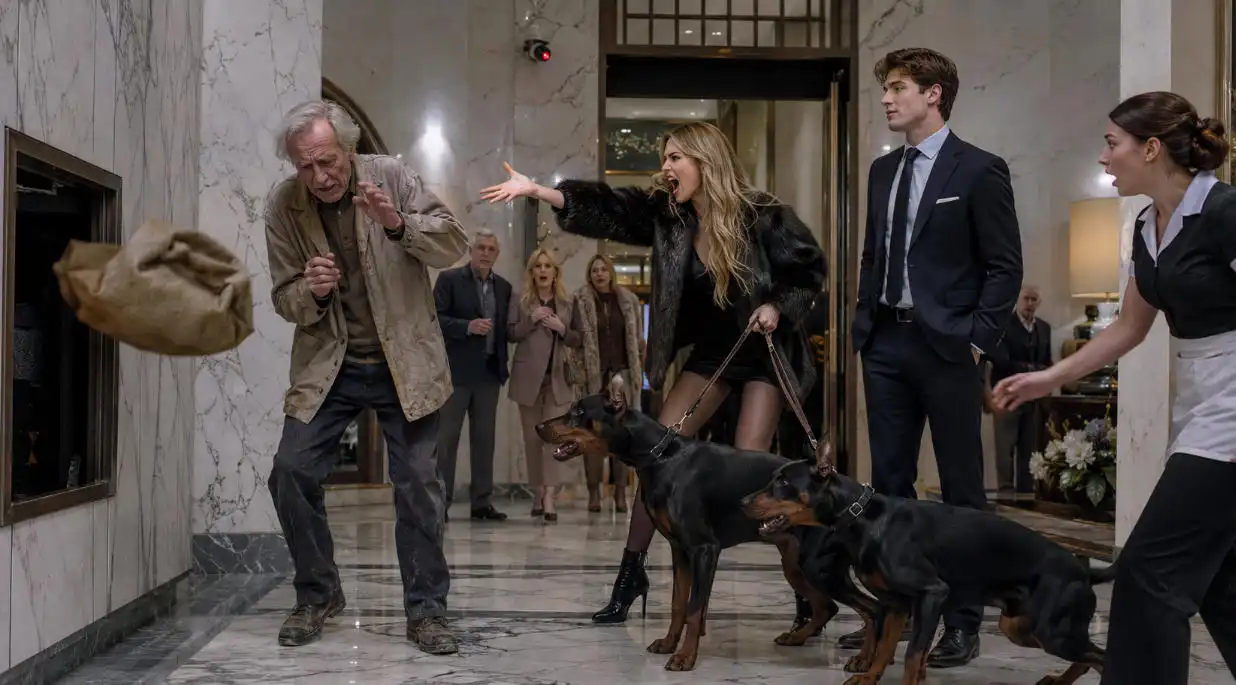
But Vanessa stepped forward and snatched the cloth bag from George’s hand.
George reached for it.
“Please, that has my things.”
Vanessa held it away.
“What things? Old pills? Trash? Receipts?”
George’s voice broke.
“My grandson’s picture.”
She walked to the trash chute beside the service hall.
The doorman said, “Ma’am, maybe—”
“Stay out of it,” Tom snapped.
Vanessa dropped the bag.
The metal door clanged shut.
George stared at it like she had buried a person.
Then came the dogs.
Two Dobermans on thick leather leashes.
Vanessa’s pride and joy.
She tugged them from the private elevator vestibule, smiling as they barked and lunged.
George stepped back.
One dog snapped near his coat.
The other tore a loose corner of the cloth that had caught outside the chute.
No blood.
No injury.
But the message was clear.
You are not family.
You are not human.
You are something to chase away.
People watched.
A neighbor lifted her phone.
A delivery man froze with a bouquet in his hands.
Tom looked at George and said, “Maybe now you’ll remember not to come back.”
That sentence was the first nail in Tom’s coffin.
Claire heard it from the revolving door.
She had just finished a breakfast shift at a diner six blocks away.
Her hair was pulled back.
Her feet hurt.
Her winter coat had a missing button.
She had custody of her eight-year-old son, Noah, and a stack of bills on her kitchen counter that made sleep feel like a luxury.
Tom used to introduce her as “my wife.”
After the divorce, he called her “a mistake.”
When she saw George in that lobby, pale and shaking, she did not see a billionaire.
She saw her son’s grandfather.
She pushed past the watching neighbors.
“What did you do?” she asked Tom.
Tom rolled his eyes.
“Claire, this is not your business.”
“He’s Noah’s grandfather.”
“He is my father,” Tom said. “And I’ll handle him.”
Claire looked at the trash chute.
Then at Vanessa holding the barking dogs.
Then at George, whose eyes were wet but strangely steady.
“George,” Claire said gently, “come with me.”
Vanessa laughed.
“To your little apartment?”
Claire looked at her.
“Yes.”
Tom stepped closer, lowering his voice.
“You can’t even afford organic milk. Don’t play saint.”
Claire didn’t blink.
“I can afford soup.”
That made one of the neighbors look down.
Claire took George’s arm.
He leaned on her like a tired man.
But as they walked out, he turned his head slightly toward the lobby ceiling.
Toward the security cameras.
Claire noticed.
She also noticed the small black recorder clipped inside his coat.
That night, George slept in Noah’s room.
Noah insisted on the couch.
“Grandpa gets the bed,” he said.
Claire made chicken soup from a discount rotisserie chicken and vegetables she had stretched for three meals.
George ate slowly.
Sometimes he seemed confused.
Sometimes he forgot names.
Sometimes he asked the same question twice.
But every now and then, when Claire turned away, she felt him watching the room with heartbreaking focus.
On the third night, she found him sitting at her tiny kitchen table at 2:17 a.m.
The lights were off.
His hands were folded.
The man who had seemed helpless whispered, “Claire.”
She nearly dropped the glass of water.
“George?”
“I need you to listen carefully.”
His voice was different.
Not louder.
Not dramatic.
Just steady.
“I am not as sick as Tom thinks I am.”
Claire sat down slowly.
George continued.
“My doctor says I have mild memory issues under stress. Not Alzheimer’s. Not legal incapacity. Tom wanted a diagnosis he could use.”
Claire stared at him.
George looked ashamed.
“I suspected him months ago. Missing signatures. Strange trust amendments. Pressure from his attorneys. He started telling people I was declining faster than I was.”
“So you pretended?”
“I tested him.”
Claire’s eyes filled with tears.
“George, he threw you away.”
“Yes,” George said. “And you picked me up.”
He reached into his coat and removed a small envelope.
Inside were copies of receipts, prescriptions, appointment cards, and a handwritten list.
“From now on,” he said, “save everything you spend on me. Every meal. Every ride. Every pill. Every hour of care.”
“I don’t want your money.”
“I know,” George said. “That is why it matters.”
For three weeks, Claire did what she had always done.
She survived.
She worked breakfast shifts.
Then evening shifts.
She came home with swollen ankles and still checked George’s medication.
She helped him shave.
She washed his clothes.
She called his doctor.
She drove him to a private appointment two towns over, using gas money she had planned to save for Noah’s birthday gift.
She never posted about it.
Never called reporters.
Never begged Tom.
But she recorded voicemails.
She saved texts.
She kept receipts in a blue folder.
Tom texted once.
Tell the old man to stop embarrassing me.
Then again.
If he signs anything, I’ll know.
Then Vanessa texted from Tom’s phone by mistake.
Has the corpse left yet?
Claire stared at that one for a long time.
George saw her face.
“Print it,” he said.
Meanwhile, Tom was not just ignoring his father.
He was moving.
He filed papers claiming George was missing, mentally unfit, and possibly deceased for business purposes.
Not a true death certificate yet.
Something colder.
A legal petition designed to lock down assets, control company voting rights, and push the court toward emergency authority over George’s estate and trust.
Tom’s plan was simple.
If George looked confused enough…
If enough people believed he had disappeared into the streets…
If Claire looked too poor to be credible…
Then Tom could step into the family empire before anyone stopped him.
There was only one problem.
George had built Ellison Freight & Logistics.
And men like George do not build empires by forgetting where the locks are.
Long before the lobby humiliation, George had quietly changed the trust.
Not to punish Tom.
To protect the company.
The trust had a morality clause.
A care clause.
A beneficiary conduct clause.
If any heir attempted to exploit George’s health, abandon him while knowingly creating danger, interfere with his medical care, or manipulate court filings for financial gain, that heir could be removed.
Tom had never read the whole thing.
He had skimmed the parts about money.
That was his second mistake.
The third mistake was coming to Noah’s birthday party.
Noah wanted a small party.
Chocolate cupcakes.
A plastic tablecloth.
A dinosaur candle.
George wore a clean sweater Claire had found at a thrift store.
He looked at Noah like the boy was the one honest investment he had ever made.
Claire had invited nobody from Tom’s world.
But Tom arrived anyway.
He knocked once and opened the door like he still owned every room Claire stood in.
Vanessa came behind him in high heels, holding a folder like a weapon.
Noah’s smile disappeared.
“Dad?”
Tom barely looked at him.
“Happy birthday, buddy. We’ll celebrate properly another time.”
Claire stood up.
“What are you doing here?”
Tom placed the folder on the table.
“Solving a problem.”
George sat quietly.
Tom glanced at him.
“You look comfortable.”
George said nothing.
Vanessa wrinkled her nose at the apartment.
“This is depressing.”
Claire’s hands curled.
Noah moved closer to George.
Tom tapped the papers.
“I need documentation that Dad has been here. Dates. Condition. Episodes. Anything showing he can’t manage himself.”
Claire laughed once.
“You want me to help you?”
“I want you to be realistic,” Tom said. “You’re broke. You work for tips. You can’t care for him.”
“I have cared for him.”
“And that’s adorable,” Vanessa said. “But adults are handling the estate now.”
Estate.
Not father.
Not family.
Estate.
Tom pulled out a pen.
“Sign a statement saying he wandered here, seemed confused, and required constant supervision.”
Claire looked at George.
George looked at the birthday candle.
Tom leaned in.
“Claire, don’t be stupid. Help me, and I’ll make sure Noah is taken care of.”
That was the first time George’s face changed.
Not anger.
Grief.
Because Tom had just tried to buy a mother with her child’s future.
Claire pushed the papers back.
“No.”
Tom’s smile vanished.
“You always were emotional.”
“No,” she said. “I was always paying attention.”
Vanessa scoffed.
“To what? Your little receipts?”
George stood.
The room went silent.
His hand rested on Noah’s chair.
His voice was calm.
“Before you file that petition, Tommy… you should know who still owns the company.”
Tom stared.
Then came the knock.
Not one knock.
Three.
Claire opened the door.
The hallway was filled with attorneys in dark suits, two private investigators, George’s longtime physician, and the corporate trustee who had managed Ellison family assets for twenty-six years.
Mr. Whitaker entered first.
He was silver-haired, polite, and terrifying in the way only an old lawyer with clean paperwork can be.
“Thomas Ellison,” he said, “you have been served.”
Tom stood frozen.
Vanessa whispered, “Tom, what is this?”
George looked at her.
“This is the part you didn’t think an old man would survive long enough to arrange.”
Mr. Whitaker opened the black folder.
He did not shout.
He did not insult.
He simply read.
Security footage from the Michigan Avenue lobby.
Witness statements from the doorman, three residents, and one delivery driver.
Video of Vanessa throwing George’s bag into the trash chute.
Audio of Tom refusing him entry.
Photos of the dogs lunging.
Printed texts.
Medical records confirming George was not legally incapacitated.
Receipts showing Claire had provided food, medication, transportation, and care.
Copies of Tom’s filings.
Copies of trust provisions.
Copies of emails between Tom and a private attorney discussing how to “accelerate control before the old man complicates things.”
Tom’s mouth opened.
Nothing came out.
Vanessa stepped backward.
“That was taken out of context.”
George looked at her.
“You dropped my grandson’s photograph into the trash.”
She swallowed.
Tom snapped, “Dad, this is insane. You set me up.”
George’s voice stayed quiet.
“No, Tom. I gave you a choice.”
He looked around Claire’s little apartment.
The cupcakes.
The paper plates.
The boy holding his breath.
“This woman owed me nothing,” George said. “You owed me everything.”
Nobody spoke.
Then Noah, small and shaking, asked, “Grandpa… were you really sick?”
George turned to him.
His face softened.
“A little forgetful sometimes,” he said. “But not too forgetful to know who loves me.”
That broke Claire.
She covered her mouth.
The legal hammer fell fast.
Tom’s emergency petition was dismissed.
Then the court ordered a review of his filings.
George’s legal team filed civil claims for elder neglect, financial exploitation attempts, intentional emotional distress, and interference with medical care.
The animal incident brought separate consequences for Vanessa.
Not because the dogs had injured George.
They hadn’t.
But because using trained animals to intimidate an elderly person in a residential lobby was enough to trigger investigation, charges related to reckless endangerment, and removal of the dogs pending review.
Vanessa was photographed leaving the building without diamonds, without confidence, and without Tom holding her hand.
People who once smiled at her in the elevator suddenly remembered urgent phone calls.
Tom’s fall was worse.
George did not need to curse him.
He used documents.
The trust committee met behind closed doors.
By unanimous vote, Thomas Ellison was removed as a beneficiary under the conduct clause.
His voting rights were suspended.
His access to family accounts was frozen.
His seat on the logistics company advisory board was terminated.
The Wall Street firm that had celebrated Tom’s “family business connections” opened its own ethics review after court filings became public.
Tom’s friends stopped calling.
His apartment board demanded hearings.
His reputation, the thing he had protected more fiercely than his father, cracked in front of everyone.
At the courthouse, the real public collapse happened.
Tom arrived expecting paperwork.
He found cameras.
Reporters.
Former employees of Ellison Freight.
Drivers who remembered George eating lunch beside them in the warehouse.
An old mechanic who had once received help from George when his wife got sick.
And Claire.
Not in designer clothes.
Not pretending to be rich.
Just standing straight in a navy dress she had bought on clearance, holding Noah’s hand.
George arrived in a wheelchair because his doctor insisted, not because he needed drama.
Behind him came his legal team.
Not one hundred exactly, despite what people later said online.
But enough attorneys, trustees, investigators, and corporate officers to fill the hallway and make Tom look very small.
Tom saw them and whispered, “Dad, please.”
George stopped.
For a second, the old father was still there.
The man who had taught Tom to ride a bike.
The man who had clapped at graduations.
The man who had paid for schools, internships, mistakes, and second chances.
“I loved you,” George said.
Tom’s eyes watered.
“Then don’t do this.”
George looked at Claire.
Then at Noah.
Then at the courthouse doors.
“I loved you,” George repeated. “But I will not let you teach my grandson that love means surrendering to cruelty.”
Inside, the judge reviewed the evidence.
Tom’s attorney tried to argue stress.
Miscommunication.
Family complexity.
Vanessa’s attorney claimed the dogs were “excited.”
But the lobby video played.
Everyone heard Tom’s voice.
Maybe now you’ll remember not to come back.
The courtroom went still.
Even the judge’s face hardened.
George did not smile.
Claire did not celebrate.
Noah leaned against his mother.
Justice did not feel loud in that room.
It felt clean.
In the months that followed, Tom faced criminal proceedings tied to elder neglect and attempted financial exploitation.
His final sentence was not the wild revenge people online imagined.
It was real.
Probation on some counts.
A custodial sentence on others after related financial misconduct surfaced during the investigation.
Restitution.
Disbarment from family control.
A name that no boardroom wanted near it.
When he cried, it was not because he suddenly understood love.
It was because consequences had finally reached him.
Vanessa accepted a plea related to the lobby incident and lost access to the life she had tried to guard with cruelty.
The dogs were rehomed through a certified program after evaluation.
George insisted on that.
“Animals follow the hand that trains them,” he said. “People choose what kind of hand to be.”
As for Claire, George did something that made her angry at first.
He reimbursed every receipt.
Every soup ingredient.
Every prescription.
Every mile.
Every missed shift.
Then he created a care trust for Noah.
Claire refused the first version.
“It’s too much,” she said.
George looked at her across the same little kitchen table where the plan had begun.
“You taught my grandson what family looks like,” he said. “Do not insult me by calling that cheap.”
Claire cried then.
Not pretty tears.
Tired tears.
The kind a woman cries after years of being strong because nobody gave her permission to be soft.
George did not bring Claire “back to society” like a rescued ornament.
He did something better.
He gave her choice.
He offered her a role at the Ellison Family Foundation overseeing worker hardship grants, college scholarships for drivers’ children, and emergency aid for families who had fallen through cracks.
Claire said, “I don’t know anything about foundations.”
George smiled.
“You know everything about needing help without losing dignity.”
She took the job.
She learned fast.
People respected her because she had earned every inch of her voice.
At the first foundation dinner, Claire walked into a ballroom overlooking the Chicago River.
Some people whispered.
A former waitress.
The ex-wife.
The woman from the apartment.
George heard it.
He tapped his glass.
The room quieted.
“This company was built by people who carried heavy things,” he said. “Freight. Families. Grief. Pride. Tonight, the heaviest thing in this room is not money. It is character.”
He turned to Claire.
“And Claire Ellison carried what my own son dropped.”
The applause started slow.
Then rose.
Claire looked down, embarrassed.
Noah stood beside George in a little suit, grinning so hard he almost burst.
Years later, people still argued about whether George’s test was too harsh.
Some said a father should never test his child.
Some said Tom revealed exactly what was already inside him.
George never argued.
He kept one thing from that terrible day.
The framed photo from the cloth bag had been recovered from the building’s trash room.
The glass was cracked.
The corner was bent.
But Noah’s smile was still there.
George placed it on his desk at Ellison Freight headquarters.
Right beside a new photo.
Claire, Noah, and George at Noah’s birthday table.
Cupcakes.
Paper plates.
One candle.
The day a poor waitress became the richest person in the room.
Not because of money.
Because when everyone else saw a burden, she saw a human being.
And when Tom tried to bury his father’s dignity, he buried his own future instead.
So choose a side:
Team Claire — kindness is never weakness. Team Tom — family loyalty ends when money begins.
Share this if you believe the way someone treats the powerless tells you exactly who they are. ⚖️
Disclaimer: Mention of any brand or trademark is for identification only and does not imply partnership or endorsement
They Laughed While Security Beat the “Alley Thief”… Then One Video Made Everyone REGRET It
A Diner Owner Called Him a “VAMPIRE” and Kicked Him Into the Rain… Then KARMA Pulled Up in 18 Wheels
A Hollywood Producer Humiliated a Quiet Crew Worker on LIVE Video… Then KARMA Walked In Holding a Sealed Trust File