


The judge looked at me over the top of her glasses and asked, “Mr. Reynolds, do you have proof this design was yours before Mr. Hayes touched it?”
The courtroom went still.
Daniel sat at the other table with his hands folded, pretending he wasn’t worried.
Kevin, our old mutual friend, leaned back like he was watching a movie where he already knew the ending.
I didn’t look at either of them.
I just placed the sealed folder on the table and slid it toward the clerk.
Three weeks earlier, those same men had laughed at me in a top-floor office like I was a dog that wandered into a country club.
That office was the kind of place Daniel always dreamed about.
Marble floors.
Glass walls.
A receptionist with perfect teeth.
A conference room that looked down over the city like everybody else was beneath it.
Daniel loved that view.
He said it made clients “understand the scale of the company.”
What he meant was simple.
He liked people feeling small.
Especially me.
I had known Daniel Hayes for almost twelve years.
We met at a church fundraiser, back when neither of us had much more than ambition and cheap coffee. He was charming then. Funny. The guy who remembered your kid’s birthday and offered to help you move a couch.
When I started working on a commercial security device for small warehouses, Daniel was the first person I called.
I was the builder.
He was the talker.
That was the arrangement.
I designed the hardware.
I wrote the early firmware.
I built three ugly prototypes in my garage with a borrowed soldering station and a folding table that had one bad leg.
Daniel pitched.
He shook hands.
He talked about “vision” and “market disruption” and “enterprise-level protection for everyday business owners.”
And for a while, it worked.
We called the device GateCrest.
It was simple on the outside.
A compact access-control module that could attach to older warehouse doors without replacing the entire locking system.
But inside, there was one part that mattered.
A small mechanical fail-safe I had designed after watching a delivery warehouse lose power during a storm.
Most systems failed open or failed locked.
Mine did something different.
It isolated the manual release from the electronic control without killing emergency access.
It was boring to explain.
But it was valuable.
Daniel knew it.
The investors knew it.
And eventually, Daniel decided he knew it better than I did.
The first sign came when his expenses got larger.
Business lunches.
Private club memberships.
A leased SUV he called “client-facing.”
Then he came to me one night looking pale.
His mother had a medical bill, he said.
He was short.
He was embarrassed.
He asked for $18,000.
I didn’t make him sign anything fancy.
I didn’t charge interest.
I wired the money the next morning and told him, “Take care of your mom. We’ll figure it out later.”
He hugged me.
I still remember that.
I wish I didn’t.
Two months after that, he stopped calling it my design.
First it became “our design.”
Then “the company’s design.”
Then, in investor meetings, it became “Daniel’s architecture.”
I corrected him once.
He laughed and said, “Don’t be sensitive, Mark. Nobody wants a technical lecture.”
Then the board conversations started happening without me.
Calendar invites disappeared.
Files moved.
Passwords changed.
A junior engineer I had trained stopped answering my messages.
When I asked Daniel what was going on, he sighed like I was a child.
“You’re brilliant in a garage,” he said. “But this is a real company now.”
I said, “A real company doesn’t erase its founder.”
He smiled.
“You’re not being erased. You’re being repositioned.”
That word stayed with me.
Repositioned.
It sounded clean.
Respectable.
Like betrayal wearing a pressed shirt.
A week later, he offered me a buyout.
It was insulting.
Less than what I had spent building the first three prototypes.
Less than the loan he still hadn’t repaid.
I told him no.
His face changed.
Not much.
Just enough for me to see the man behind the smile.
“You should think carefully,” he said. “People who overestimate their value usually end up alone.”
Then came the meeting in the luxury office.
Daniel told me it was a “final alignment conversation.”
I knew better.
Still, I went.
You don’t avoid a room just because you know it’s full of snakes.
You go in carefully.
When I walked in, everyone was already seated.
Investors on one side.
Daniel’s new legal advisor near the screen.
Kevin near the back, wearing a blazer he definitely bought for the occasion.
Kevin and I used to barbecue on Sundays.
Our kids had played together.
That day he looked through me like I was a delivery guy.
Daniel didn’t offer me a seat.
He clicked the remote.
My design appeared on the screen.
Not a similar design.
Not an inspired design.
Mine.
Same assembly angle.
Same release channel.
Same tolerance note I had written after burning my thumb on the second prototype.
Daniel said, “This is the foundation of our new licensing strategy.”
I said, “That is my core design.”
He chuckled.
The kind of chuckle men use when they want a room to know you are beneath them.
“Mark,” he said, “please don’t do this.”
I stepped closer to the table.
“Daniel, you borrowed my money, locked me out of company files, and now you’re presenting my invention as yours.”
The room tightened.
Nobody wanted truth in there.
Truth was bad for valuation.
Kevin leaned back and said, “Come on, Mark. Don’t turn into one of those bitter guys who can’t accept the company outgrew him.”
A few people laughed.
Daniel enjoyed that.
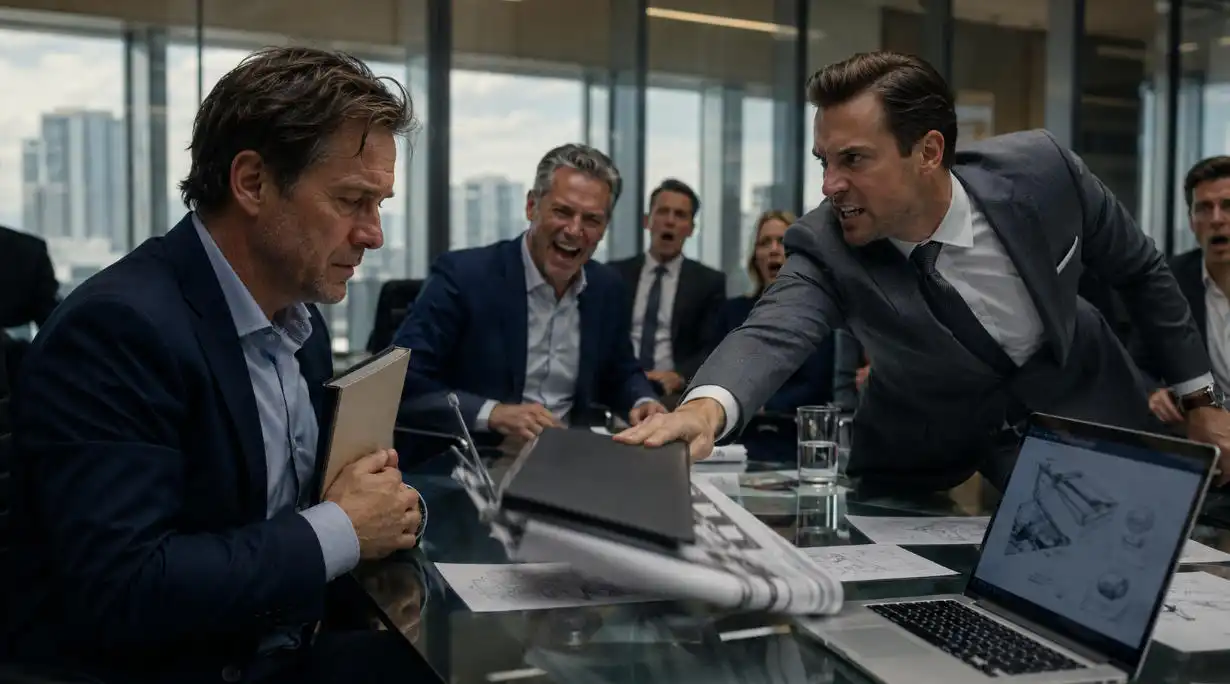
He picked up the prototype binder from the table, the one with my original notes photocopied inside, and shoved it toward me.
It skidded across the glass, hit my hand, and spilled pages onto the floor.
“There,” he said. “Take your little binder. That’s about all you can prove.”
One investor looked away.
Another pretended to check his phone.
The receptionist outside the glass wall had stopped typing.
People were watching.
Daniel lowered his voice, but not enough.
“You’re broke, Mark. You can’t afford a lawyer. You can’t afford a fight. You should’ve taken the buyout.”
Kevin laughed again.
“Leaving the team was the best thing that ever happened to us.”
I bent down and picked up the papers.
Slowly.
One by one.
Daniel thought my silence was defeat.
That was his mistake.
I had learned years earlier that some men don’t confess when you accuse them.
They confess when they feel safe.
So I let him feel safe.
I stood up, straightened the pages, and said, “I’ll see you in court.”
Daniel smiled for the room.
“You do that.”
Kevin muttered, “Good luck finding someone to take the case.”
They laughed as I walked out.
Not everyone.
But enough.
Enough to make the humiliation public.
Enough to make Daniel brave.
And brave men make sloppy liars.
What Daniel didn’t know was that I had been quiet for a reason.
Six months before that meeting, before the marble office and the investor applause, I had filed a provisional patent application.
Not because I didn’t trust Daniel then.
Because my late father taught me something after running a small machine shop for thirty years.
“Trust people,” he used to say, “but write things down like one day a stranger will read them.”
So I wrote things down.
Every sketch.
Every revision.
Every failed test.
Every email.
Every timestamped CAD export.
Every supplier invoice.
Every video of the prototype working on my garage door.
And when Daniel started changing passwords and calling my design “company architecture,” I stopped arguing.
I started documenting.
I downloaded what I was legally allowed to access.
I saved meeting notes.
I kept copies of emails where Daniel called it “Mark’s fail-safe.”
I found the text message where he wrote, “Your release mechanism is the only reason this thing has a shot.”
I printed the wire receipt for the $18,000 loan.
I kept the voicemail where he promised, “I’ll pay you back after Series A. You saved my family.”
But the most important piece was not emotional.
It was technical.
Daniel thought he had stolen the final version.
He hadn’t.
After I suspected what he was doing, I created two different design packages.
One was the real design.
The one protected by my provisional filing and later converted into a full utility patent application with my attorney.
The other was a decoy revision.
It looked complete.
It looked polished.
It had a tiny manufacturing flaw buried in the hinge geometry, something only the original designer would recognize.
Not dangerous.
Not harmful.
Just wrong enough to prove who copied what.
I uploaded that decoy package into a shared folder Daniel’s new team still had access to.
Then I waited.
Two days later, Daniel’s engineer downloaded it.
A week later, Daniel’s investor deck showed the same flawed geometry.
Three weeks later, their patent draft included the same wrong tolerance.
Even the same mislabeled internal part number.
A part number I had invented for the decoy.
That was the trap.
Not a dramatic trap.
Not a movie trap.
A paper trail.
The kind that ruins a liar because it speaks in dates, signatures, and metadata.
My attorney, a calm woman named Mrs. Alvarez, understood immediately.
She had spent twenty-two years in intellectual property law and had the gentle voice of someone who had watched too many arrogant men underestimate paperwork.
When I showed her the files, she didn’t smile.
She just said, “Mr. Reynolds, do not contact them again. We are going to let them keep talking.”
So we did.
Daniel talked on LinkedIn.
He talked in investor calls.
He gave an interview to a local business magazine about “his” breakthrough design.
Kevin reposted it with the caption: “Some people build. Some people complain.”
I screenshotted everything.
Mrs. Alvarez filed the complaint.
Patent infringement.
Misappropriation of trade secrets.
Breach of fiduciary duty.
Fraud connected to the loan.
And because Daniel had used falsified authorship documents in an attempt to secure investor funds, the complaint also opened the door for a criminal referral.
Daniel still didn’t understand.
He thought court was just another room where confidence could beat truth.
That morning, he walked in looking expensive.
I walked in wearing the same navy suit he had mocked.
Not because I couldn’t buy another one.
Because I wanted him to remember the day he laughed.
His lawyer started strong.
He called me unstable.
Resentful.
A former founder angry about losing control.
He said GateCrest’s designs were “collaborative company property.”
He said Daniel had “led the commercial development.”
He said my role had been “supportive.”
Supportive.
That word almost made me laugh.
Then Kevin testified.
He placed his hand on the Bible and lied like it was a job interview.
He said I had voluntarily stepped away.
He said Daniel was the “creative driver.”
He said everyone knew I had no claim to the device.
Mrs. Alvarez asked him, “Mr. Cole, did you ever personally see Mr. Hayes create the fail-safe mechanism?”
Kevin shifted.
“Well, Daniel discussed it often.”
“That was not my question.”
“No. I didn’t see him create it.”
“Did you ever see Mr. Reynolds work on it?”
Kevin’s jaw tightened.
“We all worked hard.”
“Did you ever see Mr. Reynolds work on it?”
“Yes.”
“How often?”
Kevin looked at Daniel.
Daniel stared straight ahead.
Kevin swallowed.
“A lot.”
That was the first crack.
Then Daniel testified.
He was smooth.
I’ll give him that.
He described himself as “the strategic mind behind GateCrest.”
He said I had “technical contributions,” but that the final invention was created under company direction.
Mrs. Alvarez let him talk.
She let him sound important.
Then she walked him through the dates.
“Mr. Hayes, when did you first claim ownership of the release-channel fail-safe?”
“During the company’s second development phase.”
“What month?”
“March.”
She nodded.
“And you are certain Mr. Reynolds had not completed that mechanism before March?”
Daniel smiled slightly.
“Yes.”
Mrs. Alvarez picked up a document.
“Your Honor, we’d like to enter Plaintiff’s Exhibit 14.”
Daniel’s lawyer objected.
The judge allowed it.
On the screen appeared a photo from my garage.
Me.
In an old sweatshirt.
Holding the second prototype.
The date stamp was January 12.
Two months before Daniel claimed the idea existed.
Daniel blinked.
Mrs. Alvarez continued.
“Mr. Hayes, is that the release-channel fail-safe?”
Daniel said, “It appears to be an early concept.”
“An early concept you said did not exist yet.”
His lawyer stood.
The judge told him to sit down.
Then came the email.
Daniel to me.
Subject line: “Your mechanism.”
His own words on the courtroom screen:
“Mark, your fail-safe is the only thing separating us from every generic access-control box on the market.”
The courtroom got quieter.
Kevin stopped leaning back.
Mrs. Alvarez didn’t raise her voice.
She never needed to.
She showed the provisional patent filing receipt.
She showed the lab notebook pages.
She showed the supplier invoices.
She showed the videos.
Then she opened the decoy file.
That was when Daniel finally looked at me.
Not angry.
Afraid.
Mrs. Alvarez said, “Mr. Hayes, do you recognize this part number?”
He cleared his throat.
“I’m not an engineer.”
“You presented it in your investor deck.”
“Our team prepared that deck.”
“Under your direction?”
“Yes.”
“And you filed a patent application using that same part number?”
“I relied on counsel.”
Mrs. Alvarez clicked again.
The screen split into two images.
On the left: my decoy file.
On the right: Daniel’s investor deck.
Same geometry.
Same wrong tolerance.
Same fake part number.
Same hidden watermark embedded in the CAD layer name: MR-DRAFT-TRAP-07.
A murmur moved through the courtroom.
The judge leaned forward.
Daniel’s lawyer went pale.
Mrs. Alvarez said, “Mr. Hayes, can you explain why your allegedly original design contains a hidden marker created by Mr. Reynolds after he suspected you were stealing his work?”
Daniel opened his mouth.
Nothing came out.
Mrs. Alvarez waited.
The judge waited.
Everyone waited.
Finally Daniel said, “I don’t know.”
But he did know.
Everyone knew.
Then Mrs. Alvarez played the voicemail.
Daniel’s voice filled the courtroom.
“Mark, I swear I’ll pay back the eighteen. You saved my family. And your mechanism is going to save the company too.”
Kevin closed his eyes.
Daniel whispered something to his lawyer.
The judge’s expression did not change, but her pen stopped moving.
That was the moment I understood something.
Public humiliation feels enormous when it happens.
It feels like the whole world has decided you are small.
But truth does not need a crowd at first.
Truth only needs a record.
By the afternoon, the courtroom had seen enough for the civil case to turn very serious.
The judge granted a preliminary injunction.
Daniel’s company could not manufacture, market, license, or sell any product using my protected design.
Their investor deal froze immediately.
Their patent application was flagged.
Their biggest pending contract collapsed within forty-eight hours.
But it didn’t stop there.
During discovery, we learned Daniel had done more than steal a design.
He had forged my initials on an internal assignment memo.
He had told investors I had been paid out.
He had listed my loan to him as a “founder contribution” to hide the debt.
Kevin had helped circulate the false story that I quit because I “couldn’t handle growth.”
The criminal referral went forward because Daniel had used those documents to secure financing.
A month later, I saw him again.
Not in a boardroom.
Not behind a glass table.
Outside the courthouse.
Two officers escorted him from the building after a hearing on fraud-related charges and evidence tampering.
No dramatic speech.
No shouting.
Just Daniel in an expensive suit, wrists lowered in front of him, face gray, while the same local business reporter who once praised him stood nearby with a camera.
Kevin was there too.
He didn’t laugh that day.
He avoided my eyes.
Later, Kevin sent me a long message.
He said he was sorry.
He said Daniel had pressured him.
He said he had a family.
He asked if I could “show mercy” and tell the court he was just confused.
I read the message twice.
Then I sent one sentence back.
“Tell the truth under oath.”
He did.
Not because he became brave.
Because he became scared.
His testimony helped confirm the fake documents and the plan to push me out before the licensing deal closed.
Daniel’s company filed for bankruptcy protection within months.
The marble office emptied.
The expensive furniture was sold.
The leased SUV disappeared.
Investors sued.
Employees left.
The magazine quietly deleted the article calling him a visionary.
As for the $18,000, the court included it in the judgment.
With damages, legal fees, and the licensing value of the stolen design, the award was more money than I had ever imagined seeing at once.
But the first check I wrote was not for a car.
Not for a watch.
Not for revenge.
I wrote it to pay Mrs. Alvarez.
Then I wrote one to my mother, who had covered my mortgage for two months when Daniel locked me out.
Then I hired back two engineers who had refused to lie for him and had been quietly pushed aside.
We relaunched under a new company name: Reynolds SafeWorks.
No marble lobby.
No glass table.
Just a clean workshop, good coffee, honest contracts, and a rule printed near the entrance:
“Build it right. Write it down. Treat people like they matter.”
The first major client was a family-owned warehouse business in Ohio.
The owner told me, “We chose you because you understand small businesses can’t afford one bad lockout.”
I almost cried in the parking lot.
Not because of the money.
Because someone finally saw the point.
A year later, Reynolds SafeWorks had contracts in six states.
Then twelve.
Then twenty-one.
We didn’t become flashy.
We became trusted.
That mattered more.
One afternoon, a young founder came to visit our workshop. He looked exhausted. Same eyes I used to have. He said a partner was trying to push him out of something he built.
I didn’t give him a speech.
I handed him a notebook.
Then I said, “Start writing everything down today.”
He nodded like I had handed him a weapon.
Maybe I had.
People love to say forgiveness means pretending nothing happened.
I don’t believe that.
Sometimes forgiveness means you stop letting the wound run your life.
But justice means the wound still gets named.
Daniel took my money.
He took my trust.
He tried to take my work.
And because he thought dignity was weakness, he handed me everything I needed to prove who he really was.
The last time I heard his name, it was from an attorney handling the final bankruptcy distribution.
There wasn’t much left.
A few accounts.
Some office equipment.
A reputation no investor wanted to touch.
I felt no joy.
Not exactly.
I felt peace.
The kind of peace that comes when the room that laughed at you finally has to read the truth out loud.
I still have the navy suit.
It hangs in my office.
Not because I’m bitter.
Because every time a new employee asks about it, I tell them the same thing:
“That’s the suit I wore when a man mistook silence for surrender.”
Then I point to the workshop floor, where real people build real things with their own names on the paperwork.
Daniel wanted the world to believe I walked away with nothing.
He was wrong.
I walked away with the truth.
And once the truth had a court date, he never stood a chance. ⚖️
Choose a side: Mark was RIGHT to let Daniel expose himself publicly — or Mark should have confronted him sooner. Share this if you believe stealing someone’s work should never be rewarded.
Disclaimer: Mention of any brand or trademark is for identification only and does not imply partnership or endorsement

They Laughed While Security Beat the “Alley Thief”… Then One Video Made Everyone REGRET It
A Diner Owner Called Him a “VAMPIRE” and Kicked Him Into the Rain… Then KARMA Pulled Up in 18 Wheels

A Hollywood Producer Humiliated a Quiet Crew Worker on LIVE Video… Then KARMA Walked In Holding a Sealed Trust File