

The word “Sir” hung in the hardware store like a gunshot.
Todd Mercer looked from the state trooper to the old clerk on the floor.
Then he laughed, but it came out thin.
“Sir?” Todd said. “You saluting him?”
Samuel didn’t answer.
He was still on one knee, one hand pressed against the side of his head where his hearing aid had been crushed into silver crumbs.
The aisle smelled like dust, motor oil, and spilled paint.
A white can had burst open near his boot, spreading across the concrete like a wound.
For fifteen years, most people in Crossbend, Texas, had known Samuel Harlan as the slow old man in the back of Miller’s Hardware.
He stocked screws.
Cut rope.
Mixed paint.
Carried bags of soil in both arms even when his left leg dragged a little behind the right.
He was polite to everybody.
“Morning, ma’am.”
“Yes, sir.”
“God bless.”
That was his whole public life.
At least, that was what Todd Mercer believed.
Todd was the mayor’s son, and he had built his whole adult life on that last name.
Mercer Construction painted its trucks in patriotic colors.
Todd wore a shiny belt buckle the size of a dessert plate.
He shook hands at church.
He donated ten folding chairs to the Little League auction and made sure the local paper printed his picture.
But anyone who worked under him knew the truth.
Todd didn’t ask.
He ordered.
He didn’t negotiate.
He threatened.
And when he walked into Miller’s Hardware that Thursday afternoon, he walked in like the place owed him oxygen.
Three of his workers followed him.
Dusty boots.
Hard hats pushed back.
Big men who laughed when Todd laughed because their paychecks depended on it.
Samuel was kneeling in aisle six, sorting heavy boxes of bolts onto the bottom rack.
His bad leg was braced under him.
His cane leaned against a shelf.
Todd stopped over him and sighed like Samuel was a stain on the floor.
“Unbelievable,” Todd said. “They got a corpse running inventory now?”
Samuel looked up.
His face was lined, sun-browned, and calm.
“I’ll move out of your way in just a second.”
Todd pointed at the shelf.
“I need twelve boxes of galvanized brackets, six contractor packs of lag screws, and whatever else my crew needs. Now.”
Samuel nodded.
“I can help you at the counter.”
Todd smiled at his men.
“You hear that? He can help me at the counter.”
The workers chuckled.
A cashier named Becky stopped scanning a customer’s order.
An older woman near the seed packets looked over her glasses.
Samuel reached for his cane.
Todd kicked it away.
Not hard enough to break it.
Hard enough to humiliate him.
The cane spun across the aisle and smacked into a stack of orange buckets.
“Come on,” Todd said. “Get it.”
Samuel’s hand paused in the air.
The store went quiet.
Even the old ceiling fan seemed to slow down.
Samuel looked at Todd with tired eyes.
“Son, don’t do this.”
Todd’s face tightened.
People like Todd hated calm more than anger.
Anger gave them a fight.
Calm made them feel small.
“Don’t do what?” Todd asked. “Tell the truth? That you’re too old to work? That nobody in this town has the guts to say it because they all feel sorry for you?”
Samuel slowly pushed himself up without the cane.
His left knee buckled once.
He caught the shelf.
Todd’s workers laughed.
One of them said, “Careful, grandpa.”
Todd stepped closer.
“You know what your problem is, old man? You think respect comes free.”
Samuel’s jaw moved slightly.
“Respect is earned,” he said.
Todd leaned in.
“Then earn it faster.”
He shoved Samuel in the shoulder.
Samuel hit the shelf.
A few boxes dropped.
The cashier gasped.
“Todd, stop,” Becky said.
Todd turned on her.
“You want city inspection finding code problems in this dump next week?”
Becky shut her mouth.
That was how Todd ruled Crossbend.
Not with fists first.
With fear first.
The fists came later.
Samuel bent down to pick up the fallen boxes.
Todd stepped on one.
“Look at him,” Todd said loudly. “This is why my father says small towns die. Everybody keeps dead weight around because it makes them feel kind.”
A teenage boy near the paint counter had his phone halfway up.
Todd saw him.
“Put that down.”
The boy lowered it.
But his mother had already started recording from behind a rack of garden gloves.
Samuel saw it.
So did Todd.
That made Todd angrier.
He grabbed Samuel by the front of his faded store vest and yanked him forward.
“You going to make me look bad in my own town?”
Samuel’s hearing aid whistled.
He raised one hand toward his ear.
Todd slapped the hand away.
The hearing aid popped loose and landed on the concrete.
A tiny beige piece of plastic.
Not expensive-looking.
Not powerful-looking.
Just necessary.
Samuel reached for it.
Todd looked down.
Then he smiled.
“No wonder you don’t listen.”
His boot came down.
Crunch.
The sound was small.
The reaction was not.
A woman whispered, “Oh my God.”
Becky covered her mouth.
Samuel froze.
For the first time, something in his face changed.
Not fear.
Not even pain.
Memory.
Todd didn’t recognize it.
He thought he had finally broken the old man.
“Clean it up,” Todd said.
Samuel looked at the crushed hearing aid.
Then at Todd.
“Last warning.”
Todd laughed.
“Last warning from who?”
He nodded at his workers.
“Move the rack.”
One worker pushed from the left.
Another pushed from the right.
They didn’t mean to kill him.
That was the kind of excuse men like Todd used later.
They only meant to scare him.
They only meant to teach him.
They only meant to show everyone who was in charge.
The shelf groaned.
Samuel tried to step back.
His bad leg caught.
The whole rack tipped.
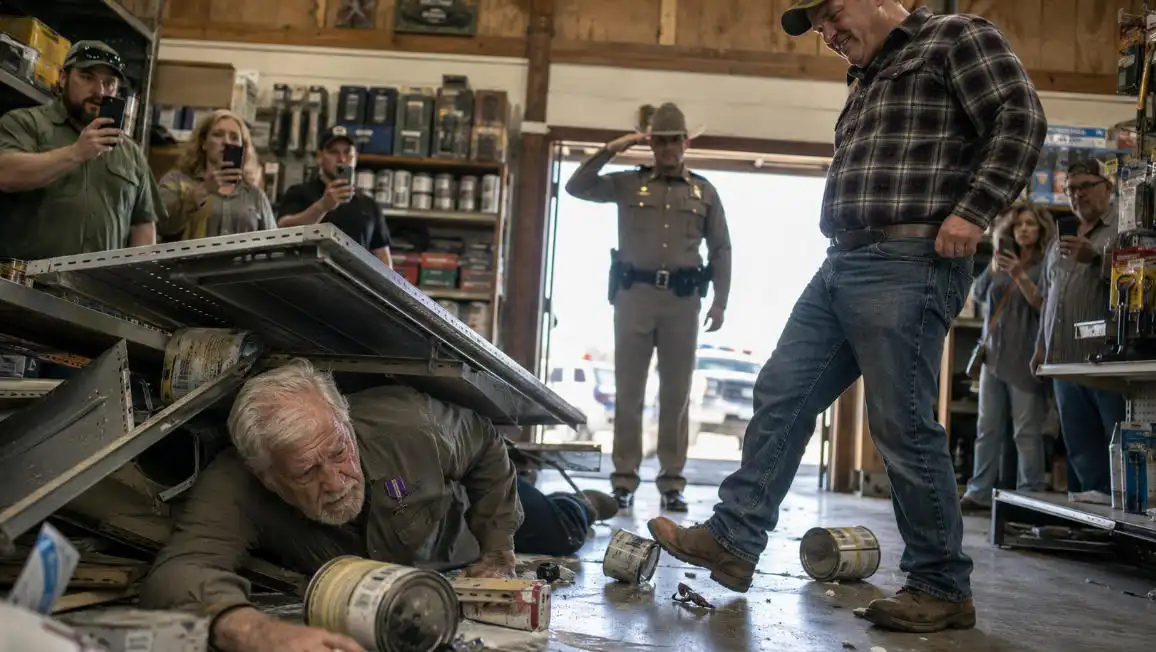
Paint cans, toolboxes, brackets, bags of nails, and metal drawers came down in a crashing wave.
Samuel disappeared under it.
The scream came from the cashier.
Then everyone moved at once.
Becky ran from behind the counter.
The mother filming shouted for someone to call 911.
Todd’s workers suddenly didn’t look amused.
Todd did.
He stood over the fallen shelf and said, “That’s what happens when you block progress.”
Samuel pushed one arm through the wreckage.
His knuckles were scraped.
A thin line of blood ran from his temple.
Around his neck, a chain had slipped free.
On it hung a small, old ribbon bar.
Purple.
Todd barely glanced at it.
He didn’t understand what he was looking at.
He crouched and grabbed Samuel by the collar.
“Look at me when I talk to you.”
That was when the front door slammed open.
Texas State Trooper Daniel Reeves came in fast.
He had been five miles away when the call came over the radio.
Disturbance.
Elderly man assaulted.
Possible serious injury.
Hardware store.
Daniel was forty-six, broad-shouldered, and still carried himself like the Marine he had once been.
He saw the mess first.
Then Todd.
Then Samuel.
His baton came halfway up.
“Everybody back!” he shouted.
Todd straightened, relieved.
“Officer, perfect timing. This old fool caused a scene. He fell because he couldn’t keep his balance. I want him removed.”
Daniel took two steps forward.
His eyes dropped to the crushed hearing aid.
Then to the purple ribbon on Samuel’s chest.
Then to Samuel’s face.
The color left him.
His heels snapped together.
His spine went straight.
In the middle of Miller’s Hardware, with phones recording and Todd Mercer standing there with paint on his expensive boots, Trooper Reeves raised his hand in a hard salute.
“Sir.”
No one breathed.
Todd’s mouth opened.
“What the hell is this?”
Daniel did not look at him.
His eyes stayed on Samuel.
“General Harlan?”
The store went silent in a different way.
Not scared now.
Stunned.
Samuel closed his eyes for half a second.
“Trooper Reeves,” he said quietly.
Daniel’s salute trembled.
“I served under your command in Helmand, sir.”
Todd let out a short laugh.
“No. No, no, no. This is some small-town theater.”
Daniel turned then.
Slowly.
Every bit of respect he had shown Samuel vanished from his face when he looked at Todd.
“Step away from him.”
Todd lifted his hands.
“Careful, officer. My father—”
Daniel cut him off.
“Step. Away.”
One of Todd’s workers muttered, “Boss, maybe we should—”
Todd snapped, “Shut up.”
He made the second mistake of the day.
He reached down toward Samuel again.
Daniel moved so fast nobody saw the first step.
He knocked Todd’s hand away, drove him back against a rack of plumbing pipe, and pinned him there with one forearm across his chest.
Todd struggled.
Daniel’s other hand went to his radio.
“Dispatch, send backup and EMS to Miller’s Hardware. Aggravated assault on an elderly disabled veteran. Multiple suspects. Store cameras and civilian recordings on scene.”
Todd’s face changed.
Not fully.
Men like Todd don’t understand consequences at first.
They only understand inconvenience.
“You can’t arrest me,” he said.
Daniel leaned closer.
“You just assaulted a retired Marine Corps major general in front of witnesses.”
Todd blinked.
Major general.
The words landed harder than the falling shelf.
Becky knelt beside Samuel.
“Mr. Harlan, I’m so sorry. I didn’t know.”
Samuel gave her the smallest smile.
“Nothing to be sorry for, Becky.”
The mother who had recorded the whole thing stepped forward.
“I have it all,” she said.
Her voice shook, but she held her phone high.
“From when he kicked the cane.”
A teenage boy raised his phone too.
“I got him crushing the hearing aid.”
Another customer said, “I heard the threat about inspection.”
Todd looked around.
The store had turned on him.
Not loudly.
Worse.
Calmly.
One by one.
With evidence.
Backup arrived within minutes.
Two deputies came in.
Then EMS.
Then, because Crossbend was small and gossip traveled faster than sirens, half the town seemed to gather outside the glass door.
Todd kept saying the same things.
“My father will fix this.”
“You people don’t understand who I am.”
“He fell.”
“It was an accident.”
The phones kept recording.
Samuel was lifted carefully onto a stretcher, but he refused to lie all the way down.
“I can sit,” he said.
Daniel stood beside him.
“Sir, let the medics work.”
Samuel looked at Todd.
Todd was now in cuffs.
His workers stood pale against the wall.
The old general’s voice stayed quiet.
“You boys made a choice.”
One worker started crying.
“I didn’t mean—”
Samuel raised one hand.
“Meaning less harm doesn’t erase harm.”
That sentence followed them all the way to the courthouse.
By sundown, the video was everywhere in Crossbend.
By morning, it had reached the county.
By Friday night, it had reached Austin.
The headline was simple:
Mayor’s Son Arrested After Hardware Store Attack on Decorated Retired Marine General
That was when Crossbend learned who Samuel Harlan had been before aisle six.
He had not been “just the clerk.”
He had served thirty-eight years in the United States Marine Corps.
He had led men in places most people could not pronounce.
He had received a Purple Heart, a Silver Star, and commendations that were never framed in his home because, as he once told Becky, “A wall doesn’t need to know what a man did.”
He had come to Crossbend after his wife died because she had grown up there.
He took the job at Miller’s Hardware because the owner, old Mr. Miller, was a friend from long ago and needed help keeping the place open.
Samuel didn’t need the paycheck.
He needed the routine.
He needed the people.
He needed a place where he could carry small things after a lifetime of carrying impossible ones.
Todd’s father, Mayor Calvin Mercer, called a press conference the next morning.
He came out in a navy suit, face gray, hands folded like a church deacon.
His first sentence was a lie.
“As a father, my heart is broken.”
His second sentence was survival.
“As mayor, I believe no person is above the law.”
No one missed the order.
Father first.
Mayor second.
Human being nowhere.
A reporter asked, “Did your office ever pressure local businesses on behalf of Mercer Construction?”
Calvin swallowed.
“No.”
Then Becky released the store security audio.
Todd’s threat about city inspection was clear.
Then two former subcontractors came forward.
Then a retired bookkeeper brought contracts.
Then the county attorney opened a review of every public job Mercer Construction had won in the past seven years.
Todd’s assault had cracked open a door.
Behind it was rot.
Inflated bids.
Pressure on inspectors.
Kickbacks disguised as consulting fees.
Permits approved in hours for Mercer projects while others waited weeks.
The legal hammer did not fall all at once.
It fell like Texas thunder.
First, Todd was charged with aggravated assault causing bodily injury to an elderly and disabled person, criminal mischief, witness intimidation, and organized coercion related to the workers helping him topple the shelf.
Then the county added charges connected to threats against the store.
Then the state opened a contracting fraud investigation.
Then federal investigators requested records because some of those contracts touched disaster-repair funds.
That was when Mayor Mercer stopped saying “my son.”
He said “Mr. Mercer.”
On camera.
Cold as a courthouse floor.
“My administration will cooperate fully,” he announced.
Todd watched it from a holding room.
For the first time in his life, his father did not reach down to pull him out.
He stepped over him.
Mercer Construction lost three pending contracts in one week.
Two banks froze credit lines.
Vendors demanded payment in full.
Workers quit.
The trucks with the patriotic paint sat idle behind a locked fence.
Todd’s wife took their children to her sister’s house.
His friends stopped answering calls.
Even the men who used to laugh with him in the hardware store gave statements through attorneys.
In the end, the town did not destroy Todd.
Todd had simply spent years building his life out of borrowed power.
The day he pushed an old man into a shelf, the whole thing lost its balance and fell on him.
Samuel spent two nights in the hospital.
A bruised shoulder.
A cut at the temple.
Two cracked ribs.
A swollen knee.
He hated the hospital bed.
He hated the fuss.
He hated that every nurse called him “General.”
On Sunday morning, Daniel Reeves visited in uniform.
He carried a small velvet case.
Samuel looked at it and frowned.
“No.”
Daniel smiled.
“Sir, with respect, you don’t get to order me around anymore.”
“I outrank you.”
“Retired, sir.”
Samuel sighed.
Daniel opened the case.
Inside was Samuel’s Purple Heart ribbon, cleaned and mounted, along with a replacement hearing aid paid for by donations from local veterans before Samuel even knew there was a fund.
Samuel stared at it.
His eyes shone.
“I didn’t ask for this.”
“No, sir,” Daniel said. “That’s why people wanted to give it.”
The next Saturday, Miller’s Hardware reopened.
Nobody planned an event.
That was what they all said later.
It just happened.
The VFW showed up first.
Then firefighters.
Then teachers.
Then farmers.
Then moms with kids.
Then men who had not stepped inside that store in years because the big warehouse outside town was cheaper.
By ten in the morning, the parking lot was full.
A hand-painted sign hung in the window:
RESPECT IS STILL SOLD HERE.
Samuel hated the sign.
He pretended to hate it harder than he did.
Becky caught him reading it three times.
At noon, Mr. Miller rolled out an old wooden chair near the counter.
“You can sit there,” he said.
Samuel looked offended.
“I work here.”
“You can work from there.”
“Coward.”
“Owner,” Mr. Miller said.
The two old men stared at each other.
Then Samuel sat down.
Outside, the crowd parted when Trooper Reeves arrived.
Not with lights.
Not with sirens.
Just Daniel in dress uniform, carrying a small box.
He stepped inside.
Behind him came four older veterans and the county judge.
Samuel’s face tightened.
“Daniel.”
“Sir,” Daniel said, “the community requested a formal moment.”
“I declined a formal moment.”
“Yes, sir. We ignored that.”
People laughed softly.
Daniel opened the box.
Inside was the Purple Heart medal itself.
Not the ribbon.
The medal.
Samuel’s wife had kept it wrapped in cloth for years.
After she died, Samuel locked it away.
Mr. Miller had known where.
He had also known when to bring it back.
Daniel’s voice thickened as he spoke.
“Major General Samuel Harlan, United States Marine Corps, this town failed to recognize what stood quietly among us. We cannot undo that. But we can make sure it never happens again.”
Samuel stared at the medal.
For a moment, the old hardware store was not a store.
It was every battlefield.
Every folded flag.
Every young face that had trusted him.
Every letter he had written to a mother.
Every night he had lived through and never described.
Daniel pinned the Purple Heart to Samuel’s vest.
No music played.
No one cheered.
They just stood.
The kind of silence that means more than applause.
Then a little boy from aisle three walked up with a package of screws in both hands.
“Mr. Samuel?”
Samuel blinked and looked down.
“Yes, son?”
“My mom says you’re a hero.”
Samuel’s mouth trembled.
He placed one big, scarred hand over the boy’s small fingers.
“Your mom is kind,” he said. “But heroes are usually the ones who don’t come home. I just did my job.”
The boy thought about that.
Then he said, “Can you help me build a birdhouse?”
Samuel smiled.
“That I can do.”
Business at Miller’s Hardware tripled that month.
Not because people needed more nails.
Because people needed to stand somewhere decent.
Contractors who had once followed Todd started buying there.
Church ladies brought pies.
Teenagers volunteered to restock shelves.
A local carpenter repaired aisle six and carved a tiny eagle into the bottom of the new shelf where no customer would notice unless they looked closely.
Samuel noticed.
He said nothing.
But he touched it once every morning.
Todd Mercer’s trial took longer.
Men like Todd always believe delay is victory.
It was not.
His own workers testified.
The videos played in court.
The crushed hearing aid sat in a clear evidence bag.
The jury watched Todd kick the cane.
They watched him shove Samuel.
They watched the shelf fall.
They watched his boot come down.
Crunch.
Todd’s lawyer argued it was a prank gone wrong.
One juror shook her head before the judge corrected her.
Samuel testified for twelve minutes.
He did not perform.
He did not rage.
He simply told the truth.
When asked what he felt when Todd crushed his hearing aid, Samuel looked toward the jury.
“I felt old,” he said. “Not because of my age. Because I realized some people still think power means making someone smaller.”
The courtroom was silent.
Todd was convicted on the main assault and intimidation charges.
The contracting cases took down the rest.
Mayor Mercer resigned before a recall vote could finish him.
Mercer Construction filed for bankruptcy.
The family name that once opened every door in Crossbend became a warning people spoke quietly.
And Samuel?
He went back to work.
That was the part people loved most.
No mansion.
No revenge speech.
No victory tour.
Just an old Marine with a limp, cutting rope cleanly with a pocketknife, telling customers which screws would hold and which cheap ones would strip.
But something had changed.
Not in Samuel.
In the town.
People held doors longer.
They stopped laughing at slow hands.
They started asking older men where they had served.
They corrected their kids when they saw cruelty dressed up as confidence.
And when strangers came into Miller’s Hardware acting loud, impatient, and important, someone always pointed toward aisle six.
They didn’t have to explain.
The new shelf did it for them.
One afternoon, months later, Samuel found Daniel Reeves standing there, staring at the tiny carved eagle.
“You doing all right, son?” Samuel asked.
Daniel nodded.
“Just thinking.”
“Dangerous habit.”
Daniel smiled.
“Seeing you on that floor brought back things.”
Samuel leaned on his cane.
“Me too.”
Daniel looked at him.
“I wanted to hurt him worse.”
“I know.”
“I almost did.”
Samuel nodded.
“But you didn’t.”
Daniel’s jaw tightened.
“He deserved it.”
Samuel looked down the aisle, past the paint cans, past the screws, toward the front window where sunlight came in warm and gold.
“Maybe,” he said. “But justice that forgets discipline becomes revenge. And revenge is how men like Todd think.”
Daniel absorbed that.
Then he nodded.
“Yes, sir.”
Samuel smiled.
“Now help me move these brackets. My knee’s acting up.”
Daniel laughed.
“Yes, sir.”
That was how the story ended in Crossbend.
Not with Todd crying in a courtroom.
Not with the mayor resigning.
Not with the headlines.
It ended with a town remembering that dignity does not always wear a uniform.
Sometimes it wears a faded hardware vest.
Sometimes it walks with a limp.
Sometimes it says “son, don’t do this” three times before the whole world finds out why it should have listened the first time.
So pick a side:
Todd thought an old man was weak because he moved slowly.
Samuel proved restraint was not weakness — it was command.
If you believe the town was right to turn its back on the bully and stand behind the forgotten veteran, share this. 🇺🇸
Disclaimer: Mention of any brand or trademark is for identification only and does not imply partnership or endorsement
They Laughed While Security Beat the “Alley Thief”… Then One Video Made Everyone REGRET It
A Diner Owner Called Him a “VAMPIRE” and Kicked Him Into the Rain… Then KARMA Pulled Up in 18 Wheels
A Hollywood Producer Humiliated a Quiet Crew Worker on LIVE Video… Then KARMA Walked In Holding a Sealed Trust File