



The speakers cracked once.
Then again.
Every champagne glass on the upper deck seemed to freeze halfway to someone’s lips.
Donald stood near the railing with his hands still shaking from the shove, staring at the black water where Arthur had disappeared only minutes earlier.
Then that calm voice filled the entire ship.
“This is Arthur.”
Nobody breathed.
Donald’s wife grabbed his sleeve.
“Donald,” she whispered. “Why does he have access to the ship broadcast?”
Donald swallowed hard.
“He doesn’t.”
But the voice continued.
“Security deck team, stand down. Engine room, hold current speed. Hospitality division, freeze all VIP account privileges under Donald Reynolds and family.”
A waiter dropped a tray.
Somewhere down the corridor, a card reader gave a sharp red beep.
Then another.
Then dozens.
Donald turned toward the glass doors of the first-class lounge just in time to see his teenage daughter slap her gold suite card against the scanner.
Red light.
Denied.
She tried again.
Denied.
“Dad!” she screamed. “It’s not working!”
Arthur’s voice came through again.
“Bridge, prepare a full incident report. Legal, upload all deck footage. Crew services, nobody deletes passenger videos.”
Donald’s face lost all color.
The man he had called “trash” was now giving orders to the whole ship.
And every employee was obeying.
Arthur had always looked like the kind of man people ignored.
That was how he wanted it.
For three weeks, he had moved through the ship in a cleaner’s uniform, pushing carts, polishing rails, emptying bins, and listening.
Nobody hid anything from a man with a mop.
Executives bragged near him.
Managers complained near him.
Passengers insulted him like he was furniture.
And Donald Reynolds, the newly appointed regional executive, had been the loudest of all.
Donald had joined the company only six months earlier after a flashy career in luxury hotels.
He wore Italian loafers on wet decks.
He called crew members by the wrong names.
He snapped his fingers at housekeepers.
He said things like, “A ship runs better when the staff is scared.”
Arthur heard him say it on the second night.
He was wiping fingerprints from the brass outside the private dining room.
Donald was inside with two senior managers and a bottle of champagne that cost more than most crew members made in a week.
“These people are replaceable,” Donald said. “You want loyalty? Make them afraid of losing meals and beds.”
One manager laughed.
The other stayed quiet.
Arthur kept wiping.
Donald saw him through the glass and smirked.
“See? That one knows his place.”
Arthur said nothing.
That was the first rule of his quiet inspections.
Listen first.
Act later.
The cruise line was not just a company to Arthur.
It was his life.
Forty-one years earlier, he had bought one rusted ferry with money borrowed from his brother and a church friend who believed in him.
He slept in the engine room.
He fixed toilets himself.
He carried luggage when staff called in sick.
He learned every job because, back then, there was nobody else to do it.
That little ferry became two ships.
Then six.
Then a fleet.
Then a global cruise group with thousands of employees, ports across continents, and a reputation built on one promise Arthur repeated at every annual meeting:
“Nobody who works on my ships is invisible.”
But success had made the company too large for Arthur to see every corner.
Reports became polished.
Complaints became numbers.
Executives smiled during audits.
Employees stayed silent because they were afraid.
So Arthur did what he had done in the old days.
He put on the uniform.
Not a costume.
A real uniform.
A real badge.
A real crew assignment under a temporary internal identity known only to three people: the group general counsel, the fleet captain, and Arthur himself.
He wanted to know what life felt like at the bottom of his own company.
By the fifth day, he knew enough to be angry.
By the tenth day, he knew enough to be ashamed.
By the twentieth day, he knew Donald was not just arrogant.
He was dangerous.
Donald had been using his new position like a crown.
He moved his family into the largest owner’s suite without approval.
He billed private dinners to “regional training.”
He ordered crew to give his children unlimited arcade credits and spa access.
He threatened a young bartender with termination for refusing to serve his underage son champagne.
He made housekeeping re-clean his suite three times because his wife “didn’t like the smell of poor people’s soap.”
The crew whispered about him in corners.
But nobody filed a formal complaint.
Not until Donald’s daughter started filming the staff.
She had a social media account full of “luxury life” videos.
On the second day of the Caribbean crossing, she posted a clip of a room steward picking up towels after her brother threw them across the hallway.
The caption was cruel.
The comments were worse.
Arthur saw the steward crying in a supply room.
She was nineteen.
Her name was Mia.
She had joined the ship to help pay her mother’s medical bills.
Arthur found her sitting beside a cart of folded sheets, trying to breathe.
“I’m sorry,” she said when she saw him. “I know I’m not supposed to sit.”
Arthur handed her a clean towel.
“You’re allowed to be human.”
She wiped her eyes.
“They said if I complain, Mr. Reynolds can blacklist me from the whole fleet.”
Arthur’s jaw tightened.
“Who told you that?”
“Security Chief Brandt.”
That name mattered.
Brandt was the man with the baton.
He was supposed to protect crew and passengers.
Instead, he had become Donald’s shadow.
Arthur started documenting everything.
Quietly.
Legally.
He saved duty logs.
He asked the bridge to preserve access records.
He noted every unauthorized charge Donald made to executive accounts.
He watched Brandt move security reports into private folders.
He listened as Donald told a manager, “Make the numbers disappear. I’m not paying for my own vacation on a ship I control.”
That sentence became one of many.
Because Arthur’s badge looked simple, but it was not.
The badge carried an internal compliance recorder.
Not for spying on private passengers.
Only for documenting workplace abuse and executive misconduct during an authorized investigation.
The company lawyers had approved every step.
Arthur was not looking for revenge.
He was looking for proof.
Then the trash hit his face.
It happened on the open deck, under the hard Caribbean sun.
The ship was moving through clear blue water.
Passengers were stretched out under white umbrellas.
A steel band played near the pool.
Children ran past with melting ice cream.
Arthur was sweeping near the starboard railing when Donald’s son walked over with a plate piled with shrimp shells, napkins, and half-melted dessert.
“Hey, cleaner,” the boy said.
Arthur looked up.
The daughter already had her phone raised.
Donald sat nearby with his wife, sunglasses on, smiling like he knew a show was coming.
“Trash goes in the bin,” Arthur said gently.
The boy grinned.
“Exactly.”
Then he dumped the plate onto Arthur’s face.
Sauce ran down Arthur’s cheek.
Shrimp shells stuck to his collar.
A wet napkin slid down the front of his uniform.
The daughter laughed so hard the phone shook.
“Oh my God,” she said. “This is perfect.”
Passengers turned.
Some gasped.
Most stared.
Arthur slowly wiped his eyes.
He bent down and picked up the trash.
Donald stood and clapped slowly.
“There it is,” he said. “That’s the attitude I like. Humble.”
Arthur looked at him.
Just once.
Donald did not like that look.
He stepped closer.
“Don’t stare at me.”
Arthur’s voice stayed low.
“I’m doing my job.”
Donald leaned in, loud enough for everyone to hear.
“Your job is whatever I say it is.”
Arthur straightened.
“No, sir. My job is what the company rules say it is.”
That one sentence hit Donald like a slap.
Rules.
The one thing men like Donald hated when rules were not serving them.
He looked toward Brandt, who had already appeared near the pool entrance.
“Security,” Donald barked. “This employee is being aggressive.”
Arthur did not move.
Mia, the young cabin attendant, stood at the far stairwell holding a stack of towels.
Her eyes widened.
Brandt walked over, baton in hand.
“Apologize to Mr. Reynolds,” he said.
Arthur looked at the baton.
Then at Brandt.
“Put that away.”
Brandt’s mouth twisted.
“You don’t give orders here.”
Donald’s son laughed.
“Make him kneel.”
A few passengers murmured.
One older woman said, “This has gone too far.”
Donald turned on her.
“Ma’am, this is an internal staff matter.”
Arthur looked around the deck.
Phones were up now.
Not one.
Not two.
Dozens.
He could feel the fear coming from the crew.
They wanted to help.
But Donald controlled schedules, promotions, assignments, and transfers.
Or at least he had made them believe he did.
Donald stepped close enough that Arthur could smell expensive cologne over the salt air.
“You embarrassed me in front of my family,” Donald whispered.
Arthur answered, “You did that yourself.”
Donald snapped.
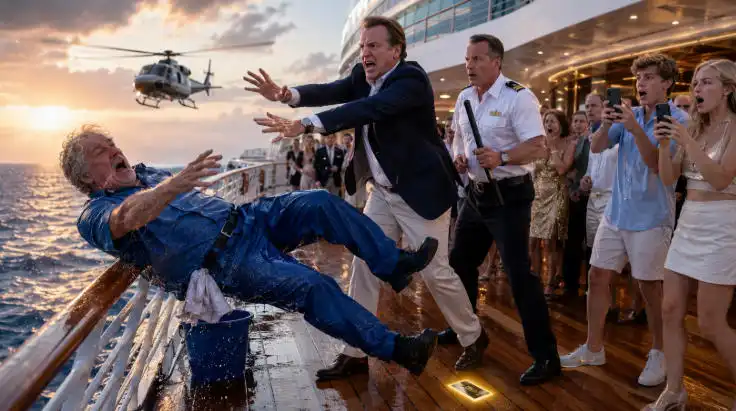
He shoved Arthur with both hands.
Arthur staggered backward.
His heel hit a wet patch near the rail.
Mia screamed.
Arthur grabbed the railing, but Brandt moved forward with the baton, blocking the nearest crewman who tried to help.
Donald shoved again.
This time, Arthur went over.
For one terrible second, he hung against blue sky.
Then he dropped.
A splash rose against the side of the ship.
The deck exploded into screams.
“Man overboard!”
“Stop the ship!”
“Call the bridge!”
Donald’s wife grabbed the daughter’s phone.
“Delete it,” she hissed. “Delete it now!”
The daughter cried, “Everyone filmed it!”
Donald’s son backed away, suddenly pale.
Brandt lowered the baton.
His face said he finally understood the difference between bullying a cleaner and explaining a body in the sea.
But Arthur was not helpless.
Before he hit the water, he had pulled the emergency beacon clipped inside his belt.
Every undercover inspection uniform carried one.
The signal went directly to the bridge, medical response, maritime safety, and the private aviation team stationed aboard the fleet support vessel five nautical miles away.
The ship slowed.
Emergency alarms sounded.
Crew moved with disciplined speed.
A rescue boat prepared.
But the helicopter was faster.
Passengers watched the aircraft rise from the rear service platform, blades hammering the air.
Donald stared like he was watching a ghost return early.
The helicopter reached Arthur in minutes.
A rescue diver dropped.
A harness went down.
Arthur came up soaked, breathing hard, but alive.
When the helicopter turned back toward the ship, nobody cheered yet.
They were still too stunned.
On the bridge, Captain Elaine Mercer had already opened the sealed protocol Arthur had left with her.
It had one condition.
Use only if Arthur was physically harmed, unlawfully detained, or prevented from communicating during the inspection.
Captain Mercer read the first line twice.
Then she picked up the secure phone.
“Yes,” she said to the general counsel onshore. “It has happened.”
Three minutes later, the shipwide broadcast system unlocked under Arthur’s founder access code.
Donald did not know such a code existed.
Most executives did not.
Arthur insisted on it after a fire years earlier nearly trapped crew below deck because a careless manager delayed an order.
No executive privilege could override safety again.
Not on his ships.
When Arthur’s voice came over the speakers, every employee recognized something in it.
Not the cleaner.
The authority.
“This is Arthur.”
Mia’s hand flew to her mouth.
The chief engineer down in the engine room stood straight.
The head chef froze with a knife above a cutting board.
Housekeepers in corridor nine looked at one another.
The casino dealers stopped mid-shuffle.
And Donald Reynolds whispered, “No.”
Arthur’s next words were not loud.
They did not need to be.
“Effective immediately, Donald Reynolds is suspended from all executive authority pending investigation. Security Chief Martin Brandt is relieved of duty. All staff are instructed to preserve evidence and refuse unlawful orders.”
Brandt reached for his radio.
It went dead in his hand.
Arthur continued.
“Bridge, confine Mr. Reynolds and his party to public areas only until port authority transfer. Do not allow access to crew decks, executive offices, or restricted systems.”
Donald spun toward the lounge.
“My suite,” he said. “We’re going to my suite.”
His wife ran ahead.
She slapped the gold card against the owner’s suite elevator.
Red light.
Denied.
She tried again.
Denied.
The children tried theirs.
Denied.
Donald stormed to a guest services kiosk.
“Open my suite,” he shouted at the young woman behind the desk. “Do you know who I am?”
She looked terrified for half a second.
Then Arthur’s voice came through the speaker above her.
“Guest services, you are protected under whistleblower policy. You will not be punished for obeying company rules.”
The young woman lifted her chin.
“I’m sorry, Mr. Reynolds,” she said. “Your privileges have been suspended.”
Passengers gasped.
Someone laughed once, then covered their mouth.
Donald slammed his palm on the counter.
“I can fire you.”
“No,” said a voice behind him.
Mia stepped forward, still holding towels.
Her voice shook, but she did not back down.
“You can’t.”
Donald turned slowly.
“You should be very careful.”
Mia looked up at the nearest camera dome.
“I am.”
That was the moment the ship changed sides.
Not because Arthur owned anything.
Not yet.
Not because Donald had lost.
But because one frightened young worker realized the bully’s power had been unplugged.
Then others followed.
A bartender stepped forward.
“He made me serve his son champagne.”
A housekeeper said, “His wife made us clean their room off the clock.”
A pool attendant said, “Security Chief Brandt told us not to report the daughter’s videos.”
A finance clerk near the service corridor lifted a tablet.
“I have the unauthorized charges.”
Donald backed away.
“This is a setup.”
Arthur’s helicopter landed.
The door opened.
He stepped out wrapped in a gray emergency blanket.
Water dripped from his hair.
His uniform clung to him.
He looked older now.
Not weaker.
Older in the way mountains look older than houses.
Two medical crew members tried to guide him toward the infirmary.
Arthur raised one hand.
“I’ll go after one announcement.”
Captain Mercer stood beside him.
So did the company’s onboard legal officer, who had been waiting quietly for days.
Donald saw the captain and tried one last performance.
“Captain,” he said sharply. “I demand you remove this employee from operational communication.”
Captain Mercer looked at Arthur.
Then she looked at Donald.
“Mr. Reynolds, that employee founded this cruise line.”
The deck went silent.
Donald blinked.
His wife whispered, “What?”
The legal officer stepped forward.
“Arthur Hale is the founder, sole owner of the holding company, and controlling shipowner of this vessel.”
Donald looked like he had been struck without being touched.
Arthur walked toward him slowly.
No shouting.
No theatrics.
Just wet shoes against polished deck.
“You told my crew they were replaceable,” Arthur said.
Donald’s mouth opened.
Nothing came out.
Arthur looked at Brandt.
“You used a weapon to protect an executive’s ego instead of a passenger’s safety.”
Brandt stared at the floor.
Arthur looked at Donald’s children.
“And you thought humiliation was entertainment.”
The daughter began crying.
“I didn’t know—”
Arthur cut her off.
“You didn’t know he was important?”
She froze.
Arthur’s face hardened.
“That is not an apology. That is the problem.”
A few passengers nodded.
One older man said, “Amen.”
Arthur turned back to Donald.
“You pushed a man into the ocean because you believed his uniform made him powerless.”
Donald found his voice.
“You can’t destroy my career over one misunderstanding.”
Arthur nodded once to the legal officer.
A tablet was handed to him.
“One misunderstanding?”
He tapped the screen.
The deck speakers played Donald’s own recorded voice from the private dining room.
“These people are replaceable. You want loyalty? Make them afraid of losing meals and beds.”
Donald’s wife covered her mouth.
Arthur tapped again.
Donald’s voice came through.
“Make the numbers disappear. I’m not paying for my own vacation on a ship I control.”
A murmur moved across the deck.
Arthur tapped again.
Brandt’s voice.
“If any of you file complaints, Mr. Reynolds can blacklist you from the fleet.”
Brandt closed his eyes.
Donald shouted, “Those recordings are illegal!”
The legal officer answered calmly.
“They were collected during an authorized internal compliance investigation in company-controlled workspaces regarding workplace misconduct and financial misuse. You signed the executive monitoring policy when you accepted your appointment.”
Donald looked around for support.
There was none.
The passengers who had laughed earlier now avoided his eyes.
His son sat on a deck chair, shaking.
His daughter held her phone like it had burned her hand.
Arthur did not smile.
That mattered.
He was not enjoying it.
He was cleaning something larger than a deck.
“Captain,” Arthur said, “what is the next scheduled port?”
Captain Mercer answered, “Santa Isadora service port. Population under three hundred. No luxury terminal. Coast guard liaison available.”
Donald’s wife looked horrified.
“That is not even a real stop for passengers.”
Arthur said, “It is today.”
Donald stepped forward.
“You can’t put us off on some island.”
Arthur looked at him.
“I can remove suspended personnel and noncompliant guests at the nearest safe port under the passenger conduct agreement, maritime safety policy, and executive ethics contract. Legal has already confirmed it.”
Donald turned to the legal officer.
She held up a folder.
“Your signed agreements are inside. So are the preliminary audit findings.”
“Preliminary?” Donald repeated.
Arthur’s voice dropped.
“Yes. The full audit begins when we dock.”
The next six hours were the longest hours of Donald’s life.
His family was moved from the owner’s suite to a monitored public lounge.
Not a cell.
Not cruelty.
Just rules.
They were given food, water, medical attention, and access to a phone.
They were not given champagne.
They were not given staff to scream at.
They were not given power.
Every time Donald tried to use his title, someone politely said, “That authority has been suspended.”
That sentence became its own kind of punishment.
Meanwhile, the ship came alive.
Crew members who had been silent for months started submitting reports.
Not gossip.
Not revenge.
Facts.
Dates.
Receipts.
Screenshots.
Cabin access logs.
Unauthorized upgrades.
Threats.
Deleted complaint tickets restored from the system backup.
A cook produced a photo of Donald’s family eating a private chef dinner billed as “staff morale training.”
A steward produced messages from Donald’s wife demanding imported sheets from inventory reserved for medical cabins.
A junior accountant produced the strongest evidence of all: a spreadsheet showing Donald had redirected vendor rebates into a private shell account disguised as “regional hospitality incentives.”
That was no longer arrogance.
That was fraud.
Arthur sat in the infirmary with a blanket over his shoulders while doctors checked his lungs and blood pressure.
Mia stood outside the door, twisting her hands.
Arthur noticed her through the glass.
“Let her in,” he said.
She entered slowly.
“I’m sorry,” she said.
Arthur looked confused.
“For what?”
“For not helping sooner.”
Arthur softened.
“You screamed when others stayed quiet.”
“I was scared.”
“So was I.”
She looked at him.
“You were?”
Arthur gave a tired smile.
“Only fools aren’t scared of the ocean.”
Mia almost laughed, then cried instead.
Arthur handed her a tissue.
“You told the truth when it could cost you something. That matters.”
She shook her head.
“I’m just a cabin attendant.”
Arthur’s eyes sharpened.
“Don’t ever say ‘just’ before honest work.”
That sentence stayed with her for the rest of her life.
At sunset, the ship reached Santa Isadora.
It was not the kind of port Donald’s family posted online.
No marble terminal.
No VIP lounge.
No champagne greeting.
Just a concrete pier, two customs officers, one coast guard truck, and warm wind blowing dust across the dock.
Passengers lined the upper rails.
Crew lined the lower deck.
Nobody cheered when Donald appeared.
This was not a circus.
It was a consequence.
Donald wore the same linen shirt he had worn when he shoved Arthur.
It looked wrinkled now.
His wife clutched a designer bag.
His son stared at his shoes.
His daughter kept her face hidden behind sunglasses.
Brandt walked behind them without his security badge.
Arthur stood near the gangway in a dry navy jacket the captain had given him.
The legal officer handed Donald a sealed packet.
“Notice of suspension. Notice of internal investigation. Notice of preservation of evidence. Notice of civil claims. You will also be contacted by maritime authorities regarding the overboard incident.”
Donald’s wife snapped, “You’re ruining us.”
Arthur looked at her.
“No. I stopped letting you ruin other people.”
Donald tried one final time.
“Arthur, listen. We can settle this quietly.”
Arthur shook his head.
“You had quiet. You used it to scare people.”
The coast guard liaison stepped forward.
Donald’s face tightened.
“Am I being arrested?”
The liaison said, “You are being questioned. Further action depends on the evidence and jurisdiction.”
The legal officer added, “And there are several jurisdictions.”
Donald looked back at the ship.
At the decks.
At the passengers.
At the employees he had treated like furniture.
For the first time, he saw them all looking back.
Not beneath him.
At him.
Arthur stepped close enough that only Donald and those near the gangway could hear.
“You wanted my crew afraid,” he said. “Remember how that felt today.”
Donald said nothing.
His family walked down the gangway.
Their gold cards no longer worked.
Their suite no longer belonged to them.
Their videos were no longer jokes.
Their names were now attached to a corporate investigation, a maritime safety incident, and a public scandal they could not buy their way out of.
When Donald reached the pier, a passenger above called out, “That old cleaner still needs an apology.”
Donald stopped.
For a second, pride fought fear on his face.
Then he turned toward Arthur.
“I’m sorry,” he said stiffly.
Arthur waited.
Donald swallowed.
“I’m sorry I pushed you.”
Arthur said, “And?”
Donald looked at the crew.
“I’m sorry I treated the staff badly.”
Mia stood near the crew rail.
Her eyes were full.
Arthur nodded once.
“Apology heard. Consequences remain.”
That line spread through the ship before dinner.
By morning, it was everywhere.
Apology heard.
Consequences remain.
After Donald’s family was removed, Arthur finally went to the bridge.
The crew had gathered quietly along the passage.
Engineers.
Housekeepers.
Servers.
Deckhands.
Laundry workers.
Cooks.
People who kept the floating city alive while others drank by the pool.
When Arthur appeared, they started clapping.
Soft at first.
Then louder.
Not wild.
Not performative.
Grateful.
Arthur stopped in the middle of the hallway.
His eyes shone, but he did not cry.
“I owe you all an apology,” he said.
The clapping faded.
“I built this company promising no worker would be invisible. Somewhere along the way, I trusted reports more than people. That ends now.”
Nobody moved.
Arthur looked at Mia.
“Step forward, please.”
Mia froze.
A cook nudged her gently.
She walked forward, cheeks red.
Arthur said, “This young woman told the truth while afraid. She protected the dignity of this ship better than the man paid to lead a region.”
Mia whispered, “Sir, I didn’t do anything special.”
Arthur smiled.
“That’s what decent people always say.”
The crew laughed softly.
Arthur turned to the captain.
“Create an interim crew welfare and hospitality oversight role. Direct report to the captain and group ethics office. Mia will serve temporarily until we complete interviews.”
Mia’s eyes went wide.
“Me?”
Arthur nodded.
“You know what fear sounds like in the hallways. I need someone who won’t ignore it.”
She started crying again.
This time, she did not apologize.
Two weeks later, Donald Reynolds was formally terminated for cause.
Brandt was terminated and referred to maritime authorities.
The audit uncovered enough financial misconduct for the company to file civil claims in multiple jurisdictions.
Donald’s name disappeared from the executive directory.
His luxury hotel friends stopped returning calls.
The family’s viral prank account went dark after the daughter’s video was used as evidence in the internal case.
Not because Arthur leaked it.
He didn’t need to.
Passengers had recorded everything.
The internet had seen the shove.
But what mattered most to Arthur was not Donald’s humiliation.
It was the changes that followed.
Anonymous crew reporting was rebuilt from scratch.
Retaliation protections were expanded.
Executive family travel rules were tightened.
Security staff were retrained under independent oversight.
Every ship received a simple framed line in crew areas and guest service offices:
Respect is not a luxury amenity. It is company policy.
Arthur returned to headquarters a month later.
He could have gone back to boardrooms only.
Instead, he scheduled one week every quarter to work undercover somewhere in the fleet.
Kitchen.
Laundry.
Baggage.
Guest services.
Not to play hero.
To stay honest.
As for Mia, she did more than fill the temporary role.
She earned it.
Within a year, she became the youngest crew welfare director in the company’s history.
Her first policy was simple:
No complaint from a low-ranking worker could be closed by the same manager accused in it.
Arthur approved it without changing a word.
On the anniversary of the incident, the Caribbean ship held a crew dinner on the same deck where Arthur had been shoved.
No speeches were planned.
But near sunset, Mia stood up with a glass of lemonade.
She looked nervous.
Then she looked at Arthur.
“I used to think uniforms told people how much respect they deserved,” she said. “Now I know uniforms tell us what kind of service someone gives. Not what kind of soul they have.”
The crew went quiet.
Mia raised her glass.
“To the people who clean the messes nobody wants to see.”
Arthur raised his glass back.
“And to the people brave enough to say when the mess starts at the top.”
They drank as the sun dropped into the Caribbean.
No helicopters.
No shouting.
No revenge left to serve.
Just a ship moving forward, cleaner than before.
And somewhere on shore, Donald Reynolds had finally learned the lesson he tried to teach everyone else:
Power is not proven by how hard you can shove someone down.
It is proven by what happens when they get back up.
So pick a side:
Was Arthur right to remove Donald’s whole family at the next port after what they did…
Or should powerful people get a second chance before losing everything?
Disclaimer: Mention of any brand or trademark is for identification only and does not imply partnership or endorsement

They Laughed While Security Beat the “Alley Thief”… Then One Video Made Everyone REGRET It
A Diner Owner Called Him a “VAMPIRE” and Kicked Him Into the Rain… Then KARMA Pulled Up in 18 Wheels

A Hollywood Producer Humiliated a Quiet Crew Worker on LIVE Video… Then KARMA Walked In Holding a Sealed Trust File