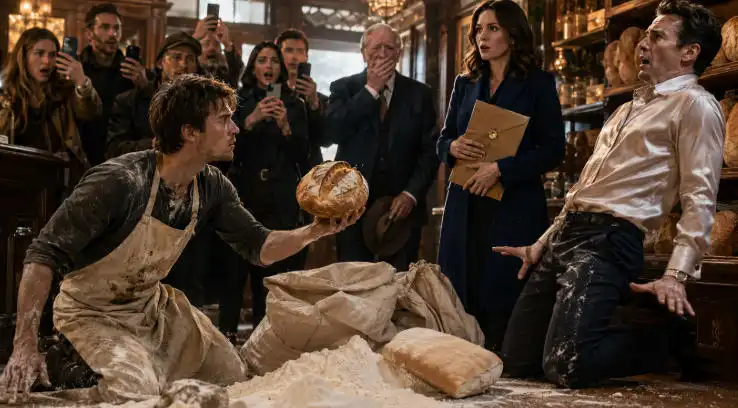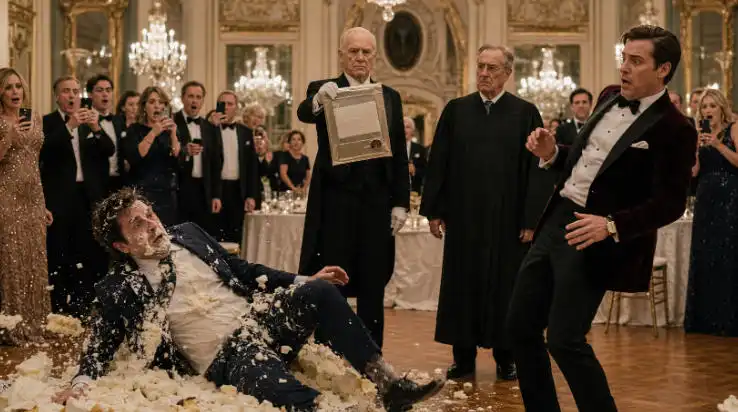
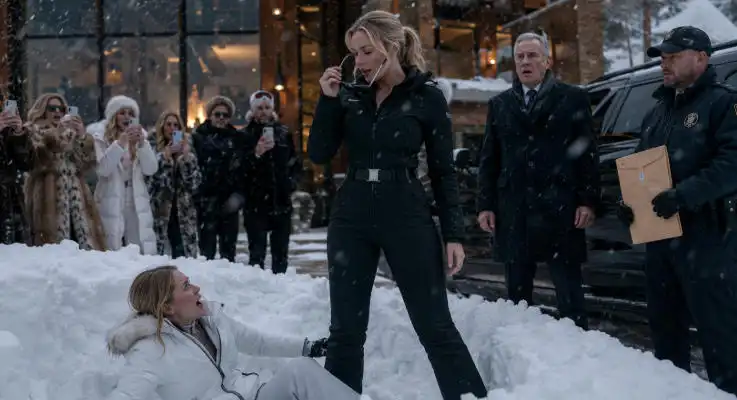
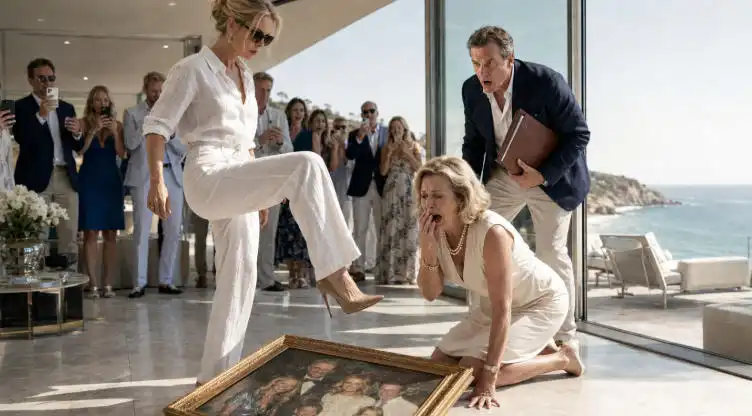

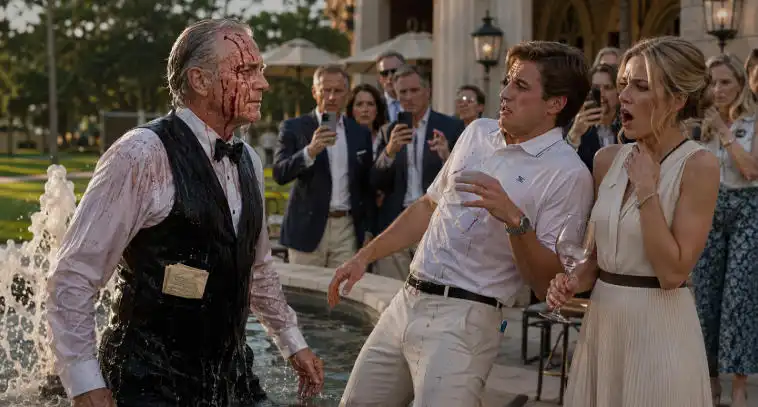
The chairman removed his hat.
Then another board member did the same.
Then another.
Within ten seconds, the richest men in the country club were standing in a neat line beside the central fountain, their heads lowered toward the soaked old waiter Chad Beaumont had just shoved into the water.
Nobody laughed anymore.
Not Chad.
Not Madison.
Not Vince, the catering manager who had ordered me to kneel.
Not the golfers who had lifted their phones to record my humiliation.
The only sound was the fountain splashing behind my shoulders.
And my breathing.
Slow.
Steady.
Cold water ran from my sleeves onto the white stone patio.
Red wine still dripped from my eyebrows.
Chad looked from the board to me, then back again.
“What is this?” he snapped. “Some kind of joke?”
The chairman, Mr. Halbrook, did not answer him.
He looked at me with a kind of fear I had seen before.
Not fear of violence.
Fear of contracts.
Fear of signatures.
Fear of old Texas land records that had been forgotten by arrogant men with new money.
“Mr. Callahan,” he said quietly, “we are deeply ashamed.”
The terrace went silent.
Madison’s smile disappeared.
Vince’s face turned the color of chalk.
Chad blinked.
“Mr. what?”
I stood slowly from the fountain.
My knees were sore.
My shirt clung to my back.
One of the younger servers tried to hand me a towel, but his hand was shaking so badly the towel almost fell.
I took it gently.
“Thank you, son.”
That made Chad even angrier.
He hated that I was calm.
Bullies always do.
They expect crying.
They expect begging.
They expect rage, so they can point at you and say, “See? He’s unstable.”
But I gave him nothing.
Just silence.
Just water dripping onto stone.
Just the truth getting closer.
Chad stepped toward the chairman.
“Halbrook, explain yourself.”
The chairman finally looked at him.
“Mr. Beaumont, I would strongly advise you to stop talking.”
Chad laughed once.
Sharp.
Ugly.
“My father got you your zoning approvals.”
Halbrook swallowed.
“Yes.”
“My father got half your donors on this board.”
“Yes.”
“My father is speaking at the governor’s fundraiser here tonight.”
Halbrook’s eyes flicked toward me.
“Not anymore.”
That was the first crack.
You could feel it move through the terrace.
The wealthy guests shifted in their chairs.
A woman in pearls lowered her champagne glass.
A retired judge leaned forward.
Three young caddies stood frozen near the cart path.
Madison whispered, “Chad…”
He ignored her.
“You don’t get to embarrass me in front of my fiancée,” Chad said.
I almost smiled.
Embarrass him.
That was what he called it.
He had made an old man kneel on hot stone.
He had laughed while red wine ran down my face.
He had shoved me into a fountain in front of Houston’s elite.
But now that someone bowed to me, Chad felt injured.
That is how entitlement works.
It mistakes consequence for cruelty.
I stepped out of the fountain.
My boots squished.
My apron hung heavy.
I reached into the inside pocket of my vest and pulled out the folded document wrapped in oilskin.
The paper was old, but the clause was not dead.
Some things in Texas outlive arrogance.
Land.
Water rights.
Mineral rights.
And signatures written by men who knew that someday their grandchildren might have to deal with fools in linen pants.
I unfolded the lease.
Vince stared at it like it was a rattlesnake.
He had seen that document before.
Or at least, he had seen the copy I left on his desk six months earlier.
Back when I first came to work at the club under the name Wyatt Cole.
Not Wyatt Callahan.
Not the old oil man.
Not the landholder.
Not the largest private donor behind half of Houston’s civic projects.
Just Wyatt.
A quiet waiter with a stiff knee and a slow walk.
That was the point.
I had not come to be admired.
I had come to watch.
My grandfather used to say a man’s true character shows in only two places.
When he has nothing.
And when he thinks the person in front of him has nothing.
For three generations, my family leased that land to the club.
Ninety-nine years.
One dollar a year at the beginning.
A handshake deal turned into a legal empire.
The club was built on Callahan land.
Its fairways.
Its tennis courts.
Its ballroom.
Its fountain.
Even the private road where valets parked the Bentleys.
The board knew.
The lawyers knew.
The old families knew.
But men like Chad only knew what they could buy.
And Vince only knew who tipped big.
I looked at him first.
“Vince,” I said.
His lips trembled.
“Mr. Callahan, I didn’t—”
“You did.”
He stopped.
I kept my voice low.
“You ordered a staff member to kneel in front of guests because a donor’s son demanded it.”
His eyes darted toward the board.
“I was trying to protect the club.”
“No,” I said. “You were trying to protect your place near power.”
That hit him harder than shouting would have.
He looked down.
Chad scoffed.
“This is insane. You’re a waiter.”
I turned to him.
“No, Chad. I was a test.”
A few people gasped.
Madison backed up one step.
Her wineglass was still in her hand, empty now.
The same glass she had tilted over my face.
The same glass that had turned a crowd of grown adults into cowards.
I pointed at the black domes under the patio awning.
“Four cameras.”
Then at the terrace.
“Twenty-seven phone recordings, at least.”
Then at the board.
“And twelve witnesses with voting authority.”
Chad’s face tightened.
“You can’t use that against me.”
I nodded toward the chairman.
“Mr. Halbrook, read Section 14.”
Halbrook opened the copy in his hand.
He did not need to find it.
He had been staring at it for weeks.
His voice shook.
“Section 14. Public misconduct clause. The lessor may terminate the lease immediately if the club, its agents, officers, members, or sponsored guests engage in conduct that brings material dishonor, unlawful intimidation, physical assault, or abusive treatment of staff upon the premises, provided said conduct is witnessed, recorded, or acknowledged by club management.”
A hush fell so hard it felt like thunder.
Chad looked at Vince.
Vince looked like he might faint.
Madison whispered, “Physical assault?”
I touched the bruise forming on my shoulder.
Then I looked down at the fountain water still pouring from my apron.
“Yes.”
Chad’s mouth opened, but no words came out.
For the first time that afternoon, he understood.
Not fully.
But enough.
Enough to know this was bigger than a complaint.
Bigger than a viral video.
Bigger than his father yelling into a phone.
I folded the document again.
“My family has tolerated a lot from this club,” I said. “Arrogance. Waste. Whispered cruelty. Staff treated like furniture. Contractors underpaid until they begged. Caddies fired for looking a member in the eye.”
A young caddy near the cart path lowered his head.
I saw it.
So did everyone else.
“But today,” I continued, “you made an old man kneel because you thought he was beneath you.”
Madison’s eyes filled with panic.
“I didn’t know who you were.”
That sentence told the whole story.
Not “I’m sorry I humiliated you.”
Not “I’m sorry I poured wine on your face.”
Not “I’m sorry I laughed.”
I didn’t know who you were.
I looked at her.
“That is exactly the problem.”
The phones were still recording.
This time, I wanted them to.
Chad tried to recover.
He straightened his collar and forced that Beaumont smile back onto his face.
The one he had learned from campaign dinners.
The one that said rules were for the poor and consequences were for enemies.
“Mr. Callahan,” he said, suddenly polite, “there’s clearly been a misunderstanding.”
I waited.
He took a breath.
“I’m sure we can settle this privately.”
There it was.
The rich man’s second favorite word.
Privately.
After publicly humiliating someone, they always want privacy for the apology.
I shook my head.
“No.”
Chad’s jaw hardened.
“My father will hear about this.”
“He already has.”
That was when a black SUV rolled slowly up the private drive.
Then another.
Then two more.
They stopped near the clubhouse entrance.
Men and women in suits stepped out.
Not police.
Lawyers.
Accountants.
Trust officers.
My people.
Chad stared at them.
The chairman took a step back.
Even the board seemed startled by how fast they had arrived.
But they should not have been.
I had not come unprepared.
For six months, I had worked breakfast shifts, lunch service, charity dinners, and donor receptions.
I had listened.
I had carried trays past men who spoke too freely.
I had watched Chad throw a cigar butt into a flower bed and tell a groundskeeper, “That’s what you’re paid for.”
I had watched Madison mock a teenage hostess for having thrift-store shoes.
I had watched Vince change schedules so older staff lost tips and younger staff stayed silent.
I had watched Chad’s father, Senator Beaumont, hold private meetings in the wine room with developers who wanted easements across protected prairie land.
They thought waiters were invisible.
Invisible people hear everything.
My attorney, Grace Whitcomb, walked onto the patio holding a leather folder.
She was seventy-two, silver-haired, and dangerous in the way only old Texas lawyers can be.
She looked at me.
“Mr. Callahan.”
I nodded.
“Grace.”
She glanced at my wet clothes.
Her eyes narrowed.
“Do you require medical attention?”
“Later.”
She turned toward the board.
“Then we proceed.”
Chad stepped in front of her.
“You don’t proceed with anything. This is a private club.”
Grace looked at him the way a schoolteacher looks at a child holding scissors.
“No, Mr. Beaumont. This is a tenant occupying Callahan land under a lease now subject to immediate termination.”
“I didn’t assault anyone.”
Grace raised one eyebrow.
“You shoved him into a fountain while half the terrace recorded it.”
Chad pointed at me.
“He provoked me.”
A murmur went through the crowd.
That lie was too ugly even for them.
The retired judge stood up.
“No, he did not.”
A woman near the front lifted her phone.
“I recorded the whole thing.”
A caddy said, “Me too.”
One by one, people who had been silent found their voices only after it was safe.
I did not admire that.
But I accepted it.
Sometimes courage arrives late.
Late is still better than never.
Grace opened the folder.
“Mr. Callahan, under your authority as lessor and managing trustee, do you wish to exercise termination under Section 14?”
Chad’s eyes widened.
“Wait.”
Madison grabbed his arm.
“Chad, stop talking.”
He shook her off.
“No. This old man is bluffing.”
I looked at the clock above the clubhouse doors.
Then at the terrace full of Houston’s finest.
“No, Chad. I’m done bluffing.”
I took the pen from Grace.
Signed once.
The scratch of ink on paper sounded louder than the fountain.
Grace turned to the board.
“The lease is terminated effective immediately.”
Madison covered her mouth.
Vince whispered, “Oh my God.”
Grace continued.
“All club operations cease now. Staff will be paid through a transition fund provided by the Callahan Trust. Members and guests have ten minutes to collect personal belongings and exit the premises. Security will assist.”
Chad’s face went red.
“You can’t kick us out in ten minutes.”
I looked at him.
“You gave me less than ten seconds to keep my dignity.”
That line landed.
Even the people who did not like me felt it.
Chad turned toward the board.
“You’re going to let him do this?”
Halbrook looked older than he had ten minutes ago.
“We have no legal position to stop him.”
“My father—”
“Your father,” Grace said, “has already been notified that all Callahan political contributions, development partnerships, and private investment commitments tied to his committees are being withdrawn.”
That was the second crack.
Bigger.
Sharper.
Chad went still.
“What?”
Grace removed another page.
“In addition, documentation regarding donor pressure, zoning favors, and misuse of private club facilities for campaign activity has been forwarded to the appropriate ethics authorities.”
Now the terrace truly froze.
The name Beaumont had ruled local politics for almost twenty years.
Not by brilliance.
By favors.
By intimidation.
By private money dressed up as community leadership.
My money had been part of that machine for too long.
That was my shame.
I had believed Senator Beaumont was useful.
Practical.
A man who could get roads built and permits signed.
Then I watched what his son had become.
And I understood something I should have seen earlier.
Corruption does not stay in offices.
It leaks into sons.
Into clubs.
Into managers.
Into fiancées who laugh while old men kneel.
Chad pulled out his phone.
He called his father.
No answer.
He called again.
No answer.
Then his phone buzzed.
Once.
Twice.
Again.
His face changed as messages flooded in.
Madison leaned over.
“What is it?”
He did not answer.
But everyone could see.
The Beaumont name was already burning.
Someone had posted the video.
Not the part where the board bowed.
The first part.
The kneeling.
The wine.
The shove.
The laughter.
America does not forgive rich men easily when the camera shows exactly who they are.
Vince tried to slip away.
Grace saw him.
“Mr. Danner.”
He stopped.
“You will remain available for statements regarding staff coercion.”
“I was just following club expectations,” he stammered.
I looked at him.
“You created those expectations.”
His shoulders collapsed.
Two security guards approached Chad.
Not rough.
Professional.
That almost made it worse.
“Sir,” one said, “you need to leave the property.”
Chad jerked his arm away.
“Don’t touch me.”
The guard lowered his voice.
“Sir, you are now trespassing.”
Trespassing.
On the land he had strutted across like a prince.
Chad looked at me with raw hatred.
“You ruined my family.”
I stepped closer.
Not close enough to threaten him.
Just close enough that he had to hear me.
“No. Your family mistook access for ownership. I only closed the gate.”
Madison began crying.
But it was not the kind of crying that asks forgiveness.
It was the kind that counts losses.
The wedding venue.
The donor list.
The Beaumont name.
The photos she would have to delete.
She looked at me and whispered, “I’m sorry.”
I nodded once.
“Say it to the next waiter before you learn his last name.”
She broke then.
Not because she became kind.
Because the mirror had finally turned toward her.
The next ten minutes were the longest ten minutes that club had ever seen.
Members rushed through hallways grabbing golf bags and jackets.
A man tried to argue that his wine locker was private property.
Grace told him he could schedule supervised retrieval.
Another man demanded a refund.
Halbrook told him the club no longer existed as an operating entity.
The kitchen staff stood near the back doors, stunned.
Some were crying.
Some were smiling.
A dishwasher named Rosa touched my arm and said, “Mr. Wyatt, what happens to us?”
I turned to her first.
Because that mattered more than Chad.
“No one on staff loses a paycheck,” I said. “You’ll receive six months’ severance, health coverage through the transition, and first interview rights at the new project.”
Her eyes widened.
“New project?”
I looked out past the terrace.
Past the fairway trimmed like velvet.
Past the artificial ponds.
Past the private carts and locked gates.
My grandfather’s land.
Texas land.
Land that had been fenced off for people who needed luxury more than they needed shade.
“It won’t be a club anymore.”
Halbrook stared at me.
Grace already knew.
She had helped draw the papers.
I raised my voice so the phones could capture it clearly.
“The golf course will be cleared. The clubhouse will come down after salvage. The land will be transferred into a public trust and rebuilt as a Texas state forest park.”
No one spoke.
Even Chad stopped fighting security for a second.
“A what?” he said.
“A park,” I said. “Free entry. Walking trails. Native trees. Children’s nature programs. Veterans’ gardens. Public picnic grounds. No membership committee. No gate deciding who belongs.”
For the first time that day, the staff reacted before the rich people did.
A young server laughed through tears.
One of the cooks covered his face.
The caddies looked at each other like they could not believe what they had heard.
Then an old groundskeeper named Earl started clapping.
Slow at first.
One pair of rough hands.
Then Rosa joined.
Then the hostess.
Then a valet.
Then half the staff.
The members did not know what to do with that sound.
It was not polite country club applause.
It was relief.
It was years of swallowed insults finally finding air.
Chad was escorted past me toward the drive.
He tried one last time.
“My father will sue.”
Grace smiled.
“I hope he does.”
That ended him more effectively than anger.
By sunset, the Beaumont campaign office had released a statement calling the incident “misleading.”
By dinner, three major donors had withdrawn.
By morning, the ethics board announced an inquiry.
By the end of the week, Senator Beaumont suspended his campaign.
Within a month, two developers connected to his office were under investigation.
Within three months, Beaumont family assets tied to questionable land deals were frozen pending review.
Chad lost more than a club.
He lost the illusion that his last name was armor.
Madison ended the engagement publicly.
Not out of morality.
Out of survival.
Vince resigned before he could be terminated, but every hospitality group in Houston had seen the video.
No one wanted a manager who made staff kneel for donors.
As for the country club, people expected me to regret it.
They said history was being erased.
I disagreed.
History was finally being corrected.
The old clubhouse doors were removed and donated to a local museum with a plaque explaining the land’s full story.
The fountains were drained.
The marble bar was dismantled.
The golf carts were auctioned, and every dollar went into the staff transition fund.
When the bulldozers arrived, I stood at the edge of the old ninth green with Earl, Rosa, and two dozen former employees.
The same terrace where I had been humiliated was fenced off for demolition.
I wore jeans, boots, and my old hat.
No apron.
No tray.
Earl looked at me and said, “You really going to turn all this into trees?”
I looked over the acres of manicured grass.
“Back into trees.”
Two years later, the gates opened again.
Not gold-plated gates.
Simple cedar posts.
A wooden sign read:
Callahan Prairie State Forest Park
Families walked in carrying coolers.
Kids ran where golf carts used to glide.
A retired veteran sat under a live oak reading a book.
Teenagers volunteered at a native grass restoration bed.
Former caddies led trail tours.
Rosa ran the public café by the lake, and nobody in that café was ever allowed to snap fingers at staff.
Earl became head of grounds restoration.
He said the trees listened better than golfers.
On opening day, someone asked me whether I felt proud.
I thought about the fountain.
The wine.
The shoe.
The laughter.
The way people only bowed after they knew my name.
Then I watched a little boy in muddy sneakers run across a field that used to be private property.
His mother called, “Slow down!”
He shouted back, “But it’s free!”
That was when I finally smiled.
Justice is not always loud.
Sometimes it is a lease clause.
Sometimes it is a camera.
Sometimes it is an old man waiting long enough for cruel people to show exactly who they are.
And sometimes it is taking a place built for exclusion and turning it into shade for everyone.
So here is the question:
Was I too harsh for giving them ten minutes to leave…
Or did Chad and that club finally get the exact lesson they had been teaching others for years?
Disclaimer: Mention of any brand or trademark is for identification only and does not imply partnership or endorsement
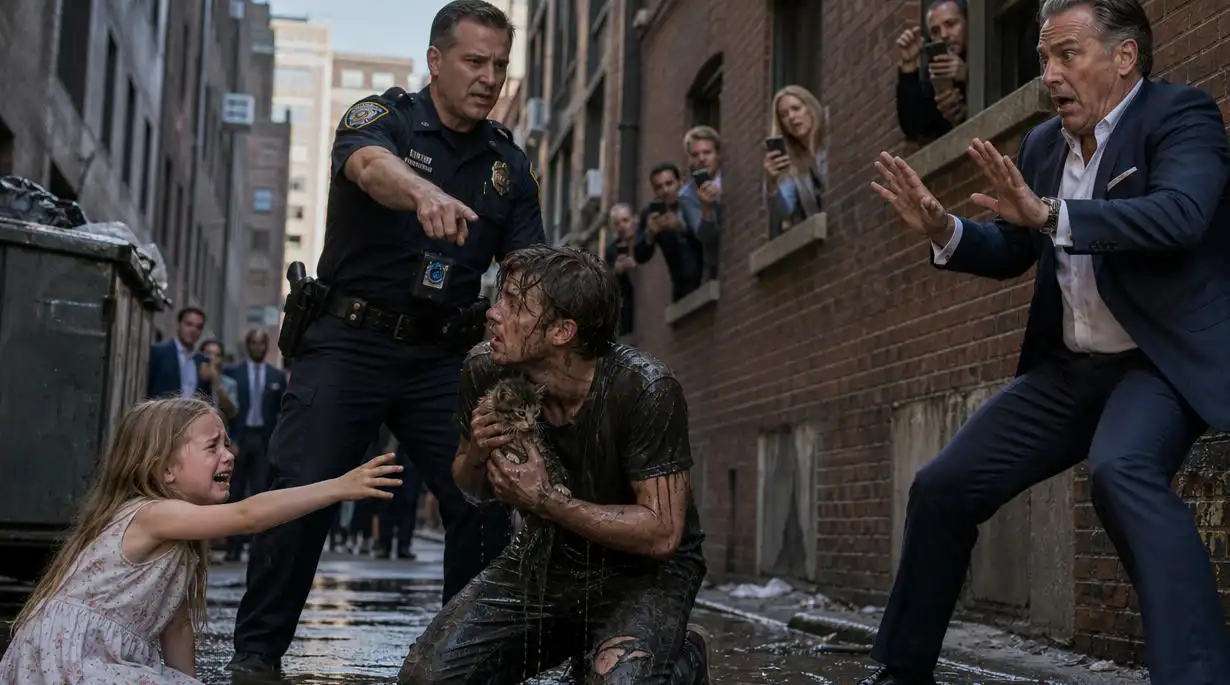
They Laughed While Security Beat the “Alley Thief”… Then One Video Made Everyone REGRET It
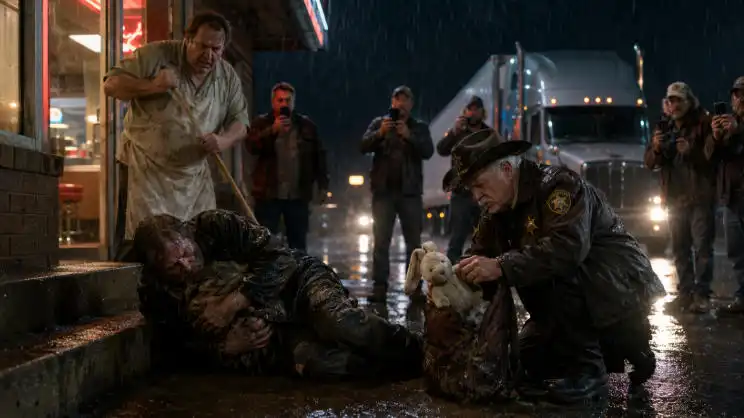
A Diner Owner Called Him a “VAMPIRE” and Kicked Him Into the Rain… Then KARMA Pulled Up in 18 Wheels
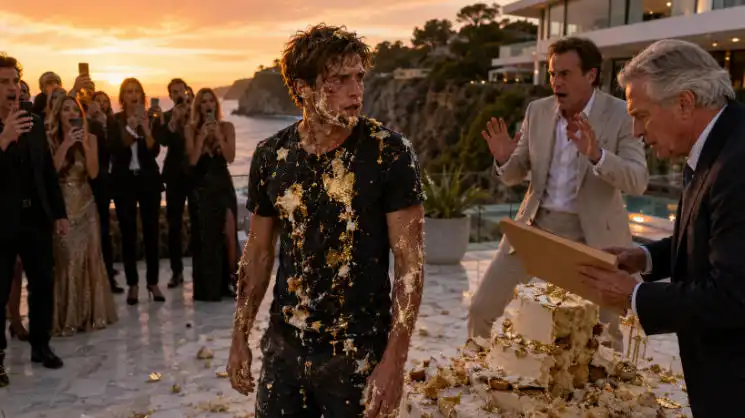
A Hollywood Producer Humiliated a Quiet Crew Worker on LIVE Video… Then KARMA Walked In Holding a Sealed Trust File