

The elevator doors opened at 6:42 a.m.
David stepped out first.
No security uniform.
No wet collar.
No cheap black tie.
Just a dark tailored suit, a clean white shirt, and a sealed black inspection folder tucked under his arm.
Behind him came five federal officers.
The trading floor went silent so fast you could hear the phones blinking.
Lawrence Vale was in his glass office with his feet on the desk.
Same gold cufflinks.
Same expensive watch.
Same smile that had ruined people’s lives for years.
He was telling two junior analysts, “Regulators are slow animals. By the time they find smoke, the fire is already offshore.”
Then he saw David.
For half a second, Lawrence looked confused.
Then annoyed.
Then afraid.
David walked straight to the glass door and said, “Mr. Vale, do not touch your computer.”
Lawrence laughed once.
Not because it was funny.
Because his body didn’t know what else to do.
“You,” he said. “The guard?”
David held up the folder.
“Federal preservation order. Immediate access. All devices, all communications, all trading records, all visitor logs.”
The woman from the night before stood near the coffee bar in a cream coat, holding a designer bag like a shield.
She had come upstairs with Lawrence again.
Still unregistered.
Still smiling until she saw the badges.
A young analyst whispered, “Is this about last night?”
David didn’t look away from Lawrence.
“No,” he said. “Last night simply made it easier.”
Lawrence stood slowly.
His face tightened.
“This is absurd. I know people at the Commission.”
David nodded.
“I’m sure you do.”
Then one of the officers stepped into the office and placed a hand over Lawrence’s keyboard.
Another sealed his phone in a clear evidence bag.
A third turned to the trading floor.
“Nobody deletes, moves, transfers, uploads, downloads, wipes, encrypts, or powers down anything.”
Nobody moved.
Not even the assistants.
Not even the senior vice presidents who usually acted like gravity reported to them.
David looked through the glass wall at every person who had watched Lawrence humiliate him six hours earlier.
The same lobby guard captain was there too.
He had been called upstairs to confirm the overnight access records.
His hands were shaking.
He couldn’t meet David’s eyes.
David did not embarrass him.
He did not shame him.
He simply said, “Captain Reynolds, please provide the original shift log.”
The man swallowed.
“Yes, sir.”
That one word hit the room harder than shouting.
Sir.
Last night, Lawrence had made the whole lobby treat David like dirt.
This morning, every powerful person in that building watched David give orders.
And the people with badges followed them.
Lawrence pointed at him.
“You set me up.”
David’s voice stayed quiet.
“No, Mr. Vale. You signed yourself in.”
Lawrence’s date stepped back.
“Lawrence,” she whispered, “what is happening?”
He snapped at her, “Be quiet.”
David turned to her.
“Your access attempt at 1:17 a.m. was recorded. You used no registered visitor badge. You were escorted toward a restricted trading floor during a blackout period before a public merger announcement.”
Her face drained.
“I didn’t know anything.”
Lawrence barked, “She has nothing to do with this.”
David opened the folder.
“That will be determined by the evidence.”
The first time I saw Lawrence Vale, I was not in a suit.
I was behind the security desk on a Tuesday night, watching men worth millions treat janitors, guards, drivers, and receptionists like stains on the floor.
I had taken the overnight security job three months earlier under a different last name.
To everyone in that building, I was David Hale, badge number 0472.
A quiet guy.
A young guy.
The kind of guy people forgot while standing right in front of him.
That was the point.
My father was the regional enforcement chief for the Securities and Exchange Commission.
But he did not send me in there to play hero.
He sent me in there because the official investigation had hit a wall.
People were tipping Lawrence off.
Documents disappeared before subpoenas arrived.
Private meetings became “calendar errors.”
Visitor logs were edited.
Cleaners reported shredded files in bags that were not supposed to leave the 51st floor.
Junior analysts were terrified.
And Lawrence Vale, the bank’s golden managing director, kept making impossible trades at impossible times.
Before pharmaceutical approvals.
Before defense contracts.
Before merger announcements.
Before market-moving layoffs.
Billions moved.
Shell accounts profited.
Retirement funds lost.
And every time the SEC got close, someone inside the bank warned him.
So I went where men like Lawrence never looked.
The lobby.
The freight elevator.
The midnight access desk.
The place where arrogance gets lazy.
For weeks, I watched.
I logged every after-hours badge swipe.
I copied every visitor exception.
I noted every “private guest” Lawrence brought near restricted floors.
I learned which assistant printed documents at 2 a.m.
I learned which analyst cried in the stairwell.
I learned which executive called compliance a “decorative department.”
But I still needed one thing.
A clean, undeniable chain of events.
Something that showed Lawrence knowingly violated restricted-floor protocol during a live blackout period.
Something he could not explain away as “market instinct.”
Then he handed it to me.
With coffee.
At 1:17 a.m., Lawrence arrived with a woman named Vanessa Cross.
She was not bank staff.
Not a client.
Not cleared counsel.
Not registered.
She was tied to a consulting firm that had bought options in three companies Lawrence’s team had confidential deal access to.
Her name was already in the file.
But until that night, she had never physically attempted to enter the restricted floor with him.
When I refused entry, Lawrence could have walked away.
He could have called legal.
He could have behaved like the man on magazine covers who gave speeches about integrity.
Instead, he chose humiliation.
He chose an audience.
He chose cruelty.
He looked at my uniform and decided I was safe to abuse.
That was his mistake.
The lobby that night was not empty.
Two cleaners were polishing the far marble wall.
A junior associate was waiting on a rideshare.
The security captain stood behind me, terrified of losing his job.
Three cameras covered the entrance.
One camera covered the badge reader.
One camera covered the visitor tablet.
And my body camera, approved for overnight security under building policy, was recording from the second Lawrence raised his voice.
Vanessa laughed first.
“He is adorable,” she said, looking at me like I was a dog blocking a doorway. “Do you practice saying no in the mirror?”
Lawrence smiled.
“David, right?”
“Yes, sir.”
He leaned closer.
“David, let me teach you something about buildings like this. The people who matter don’t ask permission from people who don’t.”
I said, “The confidential trading floor requires registered clearance.”
His smile vanished.
The captain whispered, “David, please.”
Lawrence heard that and loved it.
He turned toward the captain.
“Is he new?”
“Yes, Mr. Vale.”
“Then train him.”
The captain’s lips trembled.
“David, apologize to Mr. Vale.”
“For following access rules?”
The lobby froze.
Lawrence’s face turned red.
Vanessa covered her mouth, laughing.
“Oh my God. He thinks he’s important.”
Lawrence lifted one shoe.
Italian leather.
Mirror shine.
He placed it on the marble desk base.
“Clean it.”
I looked at the shoe.
Then at him.
“No.”
He nodded slowly, like he had been waiting for that.
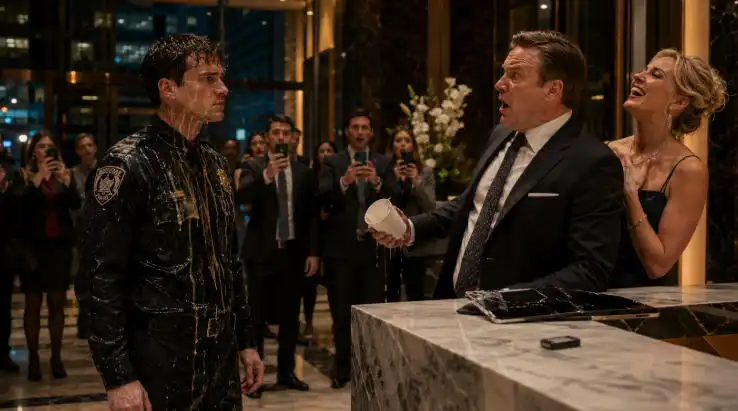
Then he picked up the coffee.
The cup was supposed to be iced, but the barista had remade it hot because Lawrence had screamed at him earlier.
Steam still rose from the lid.
Lawrence removed it.
The captain said, “Sir—”
Lawrence poured the coffee over my head.
It hit my hair first.
Then my forehead.
Then my cheek.
Hot enough to sting.
Not hot enough to scar.
Just hot enough to make the point.
The point was not pain.
The point was rank.
Vanessa whispered, “Now he looks awake.”
The junior associate near the door lowered his phone, stunned.
The cleaners stopped moving.
The captain looked like he might cry.
Lawrence stepped in close enough that I could smell his cologne.
“People like you exist so men like me don’t have to wait.”
I wiped coffee from my eyes.
I did not punch him.
I did not shout.
I did not tell him my father’s name.
I did not say the SEC already had enough to bury him.
Because angry men confess when they think they are winning.
So I looked up at the security camera and said, “Thank you, Mr. Vale.”
He frowned.
“For what?”
I picked up the visitor tablet he had knocked down earlier.
The casing had cracked.
The internal access log drive had popped loose just enough for me to remove it without altering the data.
I placed it into a clear evidence pouch.
That was when Lawrence’s smile slipped.
Only for a second.
But it was enough.
He knew records mattered.
Men like him always know.
He just didn’t think the guard did.
By 3:30 a.m., the building’s original visitor access file, lobby footage, badge denial report, bodycam audio, and Lawrence’s attempted restricted-floor entry were all preserved.
By 5:15 a.m., the emergency preservation order was signed.
By 6:10 a.m., federal officers were in the underground garage.
By 6:42 a.m., the elevator opened.
And Lawrence Vale’s little empire began to crack.
Inside his office, Lawrence tried one last time to perform power.
“This is harassment,” he said. “I demand counsel.”
“You may contact counsel,” David said. “After your devices are secured.”
“You can’t freeze my accounts.”
A federal officer looked up from a laptop.
“The court order already did.”
Lawrence’s mouth opened.
Nothing came out.
That was the first beautiful silence of the morning.
Then came the second.
One of the forensic analysts connected Lawrence’s phone to a secure evidence system.
Messages appeared.
Not on a giant screen.
Not for drama.
For custody.
For proof.
For the kind of paper trail powerful men fear more than fists.
There were coded texts to Vanessa.
“Bring the champagne. Floor 51 tonight.”
“Tomorrow’s announcement moves before open.”
“Tell your people to be ready.”
There were offshore transfer instructions.
There were calendar invites marked “family dinner” that matched restricted deal briefings.
There were voice memos.
There were photos of printed documents.
And then there was the worst one.
A message to the security captain from two weeks earlier.
“Any late-night exceptions from me do not get logged. Understood?”
The captain looked like he had been struck.
Lawrence turned on him instantly.
“You idiot.”
That told the room everything.
The captain’s eyes filled with tears.
“I have a mortgage,” he said softly. “He said I’d never work again.”
David looked at him.
“And last night?”
The captain stared at the floor.
“I was scared.”
David nodded.
“I know.”
The captain finally looked up.
“I’m sorry.”
David did not smile.
But his voice softened.
“Tell the truth now.”
So the captain did.
He gave them the deleted override requests.
The cash envelopes.
The off-book elevator entries.
The times Lawrence brought unauthorized visitors upstairs during deal blackout windows.
He gave them names.
Dates.
Amounts.
A man who had folded under fear finally stood under oath.
Lawrence lunged toward him.
“You spineless—”
Two officers stepped between them.
“Sit down, Mr. Vale.”
Lawrence sat.
Not because he wanted to.
Because power had changed hands.
Vanessa began crying near the coffee bar.
“I didn’t know he was using me.”
David turned one page in the folder.
“Your consulting firm purchased call options forty-three minutes after three late-night visits.”
She went quiet.
Lawrence looked at David again.
His eyes narrowed.
“Who are you?”
David finally answered.
“My name is David Mercer.”
The general counsel of the bank, who had just entered breathless and pale, stopped cold.
He knew the last name.
Lawrence didn’t.
Not yet.
David continued.
“For the last three months, I have worked undercover support for a federal securities investigation authorized through the regional enforcement office.”
Lawrence’s jaw tightened.
Then the general counsel whispered, “Mercer?”
David looked at him.
“Yes.”
The counsel closed his eyes.
As if the name alone had ruined his morning.
Lawrence turned.
“What?”
The counsel’s voice cracked.
“His father runs the regional enforcement division.”
The whole office seemed to tilt.
Lawrence stared at David.
The guard.
The boy.
The nobody.
The man he had ordered to clean his shoes.
“You’re his son?”
David did not flinch.
“I’m also the person you assaulted on camera while attempting to move an unregistered visitor into a restricted trading area during an active blackout period.”
Lawrence’s face went gray.
“You planned this.”
David shook his head.
“You planned the trades. You planned the access. You planned the intimidation. You planned the deleted logs. I planned to document it.”
An officer read the charges and enforcement actions aloud.
Securities fraud investigation.
Insider trading conspiracy.
Obstruction.
Evidence destruction.
Unauthorized access to restricted financial information.
Witness intimidation.
Emergency asset freeze across domestic and offshore accounts tied to the investigation.
Lawrence looked around for someone to save him.
The analysts stared at their desks.
The vice presidents stared at the floor.
The woman who had laughed at David’s salary would not look at him.
The security captain quietly handed over the last envelope Lawrence had given him.
It still had Lawrence’s initials on the flap.
By 8:05 a.m., Lawrence Vale was escorted out of the glass office he once treated like a throne.
He passed the trading floor.
No applause.
No shouting.
Just silence.
That was worse.
Because silence meant everyone understood.
His cufflinks flashed under the fluorescent lights.
For the first time, they looked cheap.
When they reached the lobby, the morning crowd had already gathered.
Employees.
Janitors.
Assistants.
Drivers.
Receptionists.
The same people Lawrence had ignored for years.
Some recognized him.
Some recognized David.
The young associate from the night before stood near the revolving doors.
So did the two cleaners.
So did the barista Lawrence had screamed at.
The security captain walked behind the officers, still pale, but no longer hiding.
Lawrence saw the marble desk.
The same place where he had lifted his shoe.
The same place where coffee had hit my uniform.
His eyes dropped to the floor.
David stopped beside the desk.
For one second, Lawrence had to stand exactly where he had made David stand.
Wet with shame, not coffee.
A reporter outside shouted, “Mr. Vale, did you profit from confidential merger information?”
Another shouted, “Are offshore accounts being frozen?”
Lawrence said nothing.
The man who loved an audience had finally found one he could not control.
A week later, the bank announced Lawrence’s termination.
Not resignation.
Termination.
His licenses were suspended pending proceedings.
His assets tied to the scheme were frozen.
His private funds were locked.
Several clients sued.
Two senior executives retired overnight.
Vanessa’s consulting firm collapsed under subpoenas.
The security captain cooperated fully and kept his job after the building’s new compliance team reviewed his testimony and the threats against him.
He never asked me to forgive him.
But one morning, he left a fresh coffee on the desk with a note.
Not hot.
Not iced.
Just coffee.
The note said:
“I should have stood beside you. I will next time.”
I kept it.
Not because I needed the apology.
Because people can be afraid and still choose better the next morning.
Lawrence did not get that chance.
Within months, federal prosecutors joined the case.
The evidence from the lobby became a small piece of a much larger pattern.
Trades.
Texts.
Transfers.
Destroyed files.
Threatened staff.
False certifications.
The kind of corruption that wears a custom suit and calls itself genius.
By the time the case was finished, Lawrence faced up to 25 years in federal prison exposure across the combined charges and plea negotiations.
His “Wall Street legend” became a compliance training slide.
His name disappeared from charity boards.
His penthouse was listed.
His friends stopped answering.
And that ridiculous gold cufflink?
One of the officers photographed it as part of his property inventory.
People online argued about me afterward.
Some said I should have revealed myself the moment he poured the coffee.
Some said I should have humiliated him back in the lobby.
Some said I was cruel for staying silent.
But here is the truth.
If I had shouted my father’s name, Lawrence would have apologized to power.
Not to me.
Not to the cleaners.
Not to the captain.
Not to the barista.
Not to every invisible person he had stepped on for years.
He would have learned nothing except how to recognize a dangerous last name.
So I let him show the world who he was when he thought nobody important was watching.
That was the real evidence.
My father asked me later if I was okay.
I told him the burn faded.
The coffee washed out.
The uniform was replaced.
But I still remembered the way the lobby went silent.
He said, “Silence can be useful.”
I said, “Only if someone records it.”
He smiled.
Three months after the case broke, I was promoted into the youngest supervisory role in our regional enforcement unit.
Not because I was his son.
Because I had the logs.
The footage.
The chain of custody.
The patience.
And the scars on my pride that reminded me why the work mattered.
On my first day, I walked past a new class of junior investigators.
One of them asked, “What’s the most important lesson in enforcement?”
I thought about Lawrence.
His shoe on the marble.
The coffee on my face.
The laugh from the woman beside him.
The captain’s fear.
The elevator doors opening at sunrise.
Then I said:
“Never assume the person with the least power in the room has the least evidence.”
That is the lesson Lawrence Vale paid for.
And he paid dearly. ⚖️
So choose a side:
Was David cold-blooded for letting Lawrence humiliate himself on camera…
Or was that exactly the justice Lawrence deserved?
Disclaimer: Mention of any brand or trademark is for identification only and does not imply partnership or endorsement
They Laughed While Security Beat the “Alley Thief”… Then One Video Made Everyone REGRET It
A Diner Owner Called Him a “VAMPIRE” and Kicked Him Into the Rain… Then KARMA Pulled Up in 18 Wheels

A Hollywood Producer Humiliated a Quiet Crew Worker on LIVE Video… Then KARMA Walked In Holding a Sealed Trust File