

The governor stepped out of the black SUV, and Derek smiled like he had just been handed the whole state.
He straightened his tie.
He lifted one hand as if he owned the plaza, the cameras, the police, and every person standing there.
But the governor did not smile back.
He looked past Derek.
Straight at Chloe.
Then his face changed.
Not political.
Not polished.
Personal.
“Chloe?” he said, barely loud enough for the crowd to hear.
Derek blinked.
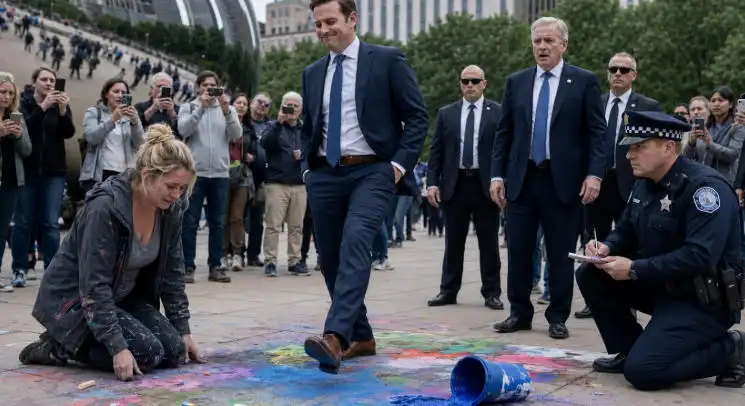
Chloe froze with blue paint soaking the edge of her sneakers.
Her chalk-covered hands were trembling.
The patrol officer still had the violation pad half-open in one hand.
The ruined painting bled into the pavement between all of them.
For one long second, nobody moved.
Then Derek laughed nervously.
“Governor, sir, I was just handling a public nuisance before your walkthrough. These street vendors get aggressive if you let them—”
“She is not a nuisance,” the governor said.
His voice cut through the plaza like a slammed door.
Derek stopped talking.
The tourists stopped whispering.
Even the officer lowered his pen.
Chloe swallowed hard.
She did not want this.
Not the cameras.
Not the pity.
Not the old memory being dragged into the sunlight.
She only wanted an apology.
Maybe enough money to replace the supplies Derek had kicked across the concrete.
Maybe one day where she did not have to prove she belonged in a public place.
But Derek had made sure the whole plaza was watching.
So now the whole plaza would hear it.
The governor stepped closer.
His security team moved with him, but he waved one hand to keep them back.
His eyes stayed on Chloe.
“I have looked for you for almost four years,” he said.
Chloe’s mouth tightened.
Derek’s smile disappeared.
Four years earlier, Chloe had not been drawing in Millennium Park.
She had been living three counties south in a rented duplex with water stains on the ceiling and a three-year-old son who still slept with a night-light.
A flood had hit faster than anyone expected.
Roads vanished.
Cars floated.
The news helicopters showed neighborhoods that looked like muddy lakes.
Chloe had been delivering groceries that week for extra money.
She was crossing a bridge when she saw a small white SUV half-submerged near the edge of the road.
A little girl was screaming inside.
No cameras were there.
No reporters.
No applause.
Just rain hard enough to sting and water rising against the windows.
Chloe had pulled over.
She had used the tire iron from her trunk to smash the back window.
She had cut her hand badly on the glass.
Then she climbed into brown water up to her waist and pulled the little girl out while the current tried to take them both.
The girl was six.
Shaking.
Sobbing.
Wearing one pink sneaker.
Chloe carried her to higher ground, wrapped her in her own jacket, and waited until emergency crews arrived.
When a paramedic asked for Chloe’s name, she gave only her first name.
She did not wait for the cameras.
She did not want trouble with work.
She did not want anyone asking why she was behind on rent, why she was driving with a cracked windshield, why her phone had been shut off three days before.
She left.
Later, she heard the girl had survived.
That was enough.
Or she thought it was.
Now the governor stood in front of her with tears gathering in his eyes.
“That child was my daughter,” he said.
The sound that moved through the crowd was not a cheer.
It was a deep, stunned breath.
Phones lifted higher.
The older tourist Derek had slapped with cash whispered, “Oh, my Lord.”
Derek turned toward the governor with both palms up.
“Sir, I didn’t know. Obviously, I didn’t know who she was.”
That sentence made Chloe finally look at him.
Not knowing who she was.
As if that was the problem.
As if a woman had to be connected to someone powerful before she deserved basic respect.
The governor looked at him too.
Slowly.
Coldly.
“No,” he said. “You knew exactly who she was.”
Derek’s face tightened.
“She was a woman on her knees, working in public. You thought that made her safe to abuse.”
Nobody spoke.
The patrol officer’s face flushed red.
Derek tried to recover.
“With respect, Governor, this is being taken out of context. I’m on a tight schedule. We are trying to keep this plaza clear for your appearance. Your office knows my candidate has been a loyal ally. I’m sure we can—”
“You kicked her property,” the governor said.
Derek swallowed.
“You threatened her permit access,” the governor continued.
“I was speaking generally.”
“You told witnesses to be quiet.”
“That was a joke.”
The older tourist stepped forward, still holding the crumpled bills.
“No, sir,” he said. “He hit me in the chest with money and told me to buy a conscience.”
A woman beside him raised her phone.
“I recorded that part.”
Another voice said, “I recorded the kick.”
A young father lifted his hand.
“I got the threat too.”
Chloe stared at the crowd.
Ten minutes earlier, most of them had been silent.
Not because they approved.
Because Derek looked expensive.
Because he spoke like a man who knew officials.
Because the officer was standing there with a ticket pad.
Because people are often brave only after someone powerful gives them permission.
The governor turned to the patrol officer.
“Did you check her permit before preparing that citation?”
The officer stiffened.
“I was about to, sir.”
“Were you?”
The officer looked down.
“No, sir.”
Chloe reached toward her canvas bag, but her hand shook too badly to open it.
A young woman from the crowd stepped forward gently.
“May I?”
Chloe nodded.
The woman opened the bag and pulled out a clear plastic folder.
Inside was Chloe’s permit.
Valid.
Stamped.
Paid.
The governor took one look and handed it back.
Then he looked at Derek.
“This woman had more right to be here than you did.”
Derek’s jaw worked like he was chewing glass.
“Governor, I work with Senator Hale’s campaign. We are expected at your donor meeting in twenty minutes.”
“I know exactly who you work with.”
That was when Derek’s confidence returned a little.
He thought the name would save him.
Senator Hale was powerful.
Derek had spent two years making sure everyone knew it.
He posted pictures from fundraisers.
He shook hands near podiums.
He called reporters by their first names.
He used the word “access” like a weapon.
And today, in the plaza, he had believed Chloe was the perfect target.
Poor enough to scare.
Public enough to humiliate.
Invisible enough to erase.
But the governor did not reach for Derek’s hand.
He reached for his phone.
“Get Senator Hale on speaker,” he told his chief of staff.
Derek’s eyes widened.
“Sir, I don’t think that’s necessary.”
“It is.”
The chief of staff made the call.
The plaza went silent again.
Even the street musicians across the walkway stopped playing.
After three rings, a man answered.
“Governor, we’re five minutes out. Derek should already be—”
“He is standing in Millennium Park after destroying a permitted artist’s work, threatening her access to public spaces, intimidating witnesses, and interfering with a patrol officer’s judgment.”
A pause.
Then Senator Hale said, “What?”
Derek stepped forward.
“Senator, it’s not like that. This woman—”
“Be quiet, Derek,” the senator snapped.
That was the first crack.
Not the legal one.
The social one.
The moment Derek realized his powerful friends did not love him.
They loved distance from scandal.
The governor looked at Chloe.
“Would you like to press charges for property damage?”
Derek made a disgusted little laugh.
“Charges? For chalk?”
Chloe looked down.
The little girl in her drawing was gone now.
The red umbrella had become a wet smear.
The skyline had dissolved into blue streaks.
Her donation jar had been knocked over too.
A few coins glittered near Derek’s shoes.
“It wasn’t just chalk,” Chloe said.
Her voice was quiet.
But this time, everyone leaned in.
“That was four hours of work.”
She picked up a broken piece of white chalk from the ground.
“That was my grocery money.”
She looked at Derek.
“And you did it because you could.”
The governor nodded once.
“Officer, begin a report.”
The patrol officer snapped out of his shame.
“Yes, sir.”
Derek’s face went red.
“You can’t be serious.”
The governor’s security director stepped closer.
Derek pointed at him.
“Don’t touch me. You have no idea what kind of calls I can make.”
The governor said, “Make them.”
Derek looked around.
For the first time, nobody looked afraid of him.
Not the tourists.
Not the officer.
Not Chloe.
Even his two aides had taken several steps back.
One of them was staring at the ground.
The other was deleting something from his phone.
The governor noticed.
“You,” he said to the aide. “Stop.”
The aide froze.
The security director walked over.
“Were you recording?”
The aide’s lips parted.
“I was just—”
“Preserve the phone,” the governor said. “If you delete evidence during an active police report, you will make this worse.”
The aide looked like he might faint.
Derek spun toward him.
“You idiot.”
The governor’s voice sharpened.
“Do not threaten him either.”
That was the second crack.
Derek’s world was built on people flinching.
Now everyone was watching him flinch.
The officer asked Chloe for her statement.
She gave it clearly.
Derek stepped on the artwork.
She asked him to stop.
He insulted her.
He told the officer to remove her.
He threw cash at a witness.
He kicked the paint bucket.
He threatened to make her disappear from public spaces across the state.
The officer wrote it down.
The tourist handed over the bills.
The young father shared the video.
The woman with the phone AirDropped her recording to the officer.
A street vendor nearby said Derek had shoved past his cart too.
Another witness said Derek’s aide had told people to “stop filming if they knew what was good for them.”
Every little abuse Derek thought would vanish in the noise of a busy plaza became a piece of evidence.
Then the senator’s voice came through the speaker again.
“Governor, I want to be very clear. Derek is no longer authorized to represent this campaign.”
Derek’s mouth fell open.
“Senator—”
“You are done,” the senator said. “Effective immediately.”
The governor’s chief of staff looked at Derek.
“Also, our office is withdrawing the coordinated event support scheduled for your candidate’s fundraiser tonight.”
Derek stared at him.
“What?”
“And the governor’s affiliated donors will be notified that your team created a public incident involving witness intimidation, destruction of property, and threats against a permitted citizen.”
Derek’s skin went pale.
That was not just a firing.
That was political death.
Not quiet death.
Public death.
The kind that donors remembered.
The kind reporters replayed.
The kind that turned every old enemy into a source.
Derek lunged toward the governor’s chief of staff.
“You can’t do that because of some sidewalk woman!”
The security director stepped between them.
The officer moved too.
“Sir, step back.”
Derek ignored him.
“I said step back,” the officer repeated.
Derek shoved the officer’s hand away.
That was the third crack.
And this time, it sounded like handcuffs.
The officer turned Derek around and cuffed him in front of everyone.
Derek shouted, “This is insane! This is political! She set me up!”
Chloe actually laughed once.
A small, tired sound.
“I was drawing a picture.”
The crowd reacted to that.
Not with wild cheering.
With the kind of murmuring that hurts worse.
Disgust.
Embarrassment.
Recognition.
Because everyone knew Derek had not been trapped by Chloe.
He had been exposed by himself.
The governor stepped beside Chloe, but he did not touch her without permission.
“May I speak about what you did for my family?” he asked.
Chloe looked at him.
The cameras were still up.
Her hands still shook.
Part of her wanted to say no.
Heroes are easier to admire when they do not need rent money.
People love a rescue story more than they love the person who still has bills afterward.
But then Chloe saw Derek standing in handcuffs, still glaring at her like she had stolen something from him.
And she thought of every person who had ever been told to move along.
Every worker called “in the way.”
Every mother treated like her struggle made her less worthy.
So Chloe nodded.
The governor faced the crowd.
“Four years ago, during the Black River flood, my daughter was trapped in a vehicle filling with water. Emergency crews were delayed. A woman nobody knew stopped, broke a window, and carried my child through floodwater to safety.”
He looked back at Chloe.
“She left before anyone could properly thank her.”
A few people in the crowd wiped their eyes.
The governor continued.
“My family searched for her. We had only one first name and a blurry image from a traffic camera. We never found her.”
Derek had stopped yelling now.
He looked smaller.
That was the strange thing about public humiliation.
Power can inflate a man.
Truth can shrink him.
The governor pointed gently toward the ruined chalk drawing.
“And today, I found her because a man with too much borrowed power decided she looked easy to crush.”
The words landed hard.
Derek looked at the phones.
At the officer.
At the tourists.
At the governor.
There was no door left.
The officer guided him toward the patrol car.
Derek twisted once more.
“Chloe, tell them this is a misunderstanding.”
Chloe looked at him.
For the first time all day, her voice did not shake.
“No.”
That one word got the loudest reaction.
Not applause at first.
Just silence.
Clean silence.
Then the older tourist started clapping.
The woman with the phone joined.
Then the young father.
Then half the plaza.
Derek was put into the back of the patrol car while people recorded the man who had tried to buy their silence.
The governor’s chief of staff took Chloe’s contact information.
Not from her scraped dignity.
Not as charity.
As a matter of record.
Within two hours, the videos were everywhere.
By evening, Derek’s name was no longer attached to “rising strategist.”
It was attached to “campaign manager arrested after threatening Chicago chalk artist.”
The senator’s campaign released a statement cutting ties.
The donor meeting was canceled.
Two major backers withdrew from the race.
The aide who tried to delete footage turned over his phone through an attorney.
The officer filed a supplemental note admitting he had moved toward enforcement before verifying Chloe’s permit.
That part mattered to Chloe.
Because Derek had not acted alone.
He had been helped by a system that almost believed him faster because his suit looked expensive.
Three days later, Chloe received a call from the Illinois Arts Council.
At first, she thought it was another reporter.
She almost did not answer.
But the woman on the other end spoke gently.
“We would like to commission a permanent recreation of your Millennium Park piece for the state collection.”
Chloe sat down at her kitchen table.
Her son, Miles, was eating cereal beside a stack of overdue notices.
“A permanent what?” she asked.
The woman explained.
A state-funded commission.
A gallery exhibition.
A public program for street artists.
A written statement recognizing permitted public art as labor worthy of protection.
And yes, real payment.
Not exposure.
Not “visibility.”
Money.
Enough to catch up on rent.
Enough to replace her supplies.
Enough to buy Miles the winter coat she had been putting off.
Chloe cried after she hung up.
Not pretty tears.
The kind that come when your body finally believes it can stop bracing.
Two months later, her first gallery show opened in Chicago.
The main piece was not the ruined skyline.
It was the little girl with the red umbrella.
But this time, Chloe added another figure beside her.
A woman holding the umbrella steady in the rain.
She did not make the woman’s face heroic.
She made it tired.
Determined.
Human.
The governor attended with his wife and daughter.
His daughter, now older, stood in front of the painting for a long time.
Then she turned to Chloe and whispered, “Thank you for not letting go.”
Chloe bent down and hugged her.
Cameras flashed, but this time Chloe did not feel like a spectacle.
She felt seen.
There is a difference.
As for Derek, his trial did not turn into the grand conspiracy he kept promising.
It was simple.
Property damage.
Disorderly conduct.
Witness intimidation allegations tied to his threats.
Resisting the officer when he shoved the officer’s hand away.
His attorney tried to argue stress.
Politics.
Miscommunication.
But the videos did not care about his excuses.
The videos showed his shoe grinding through the art.
His hand throwing money.
His foot kicking the bucket.
His mouth saying, “I have the kind of friends who can make you disappear.”
That sentence followed him everywhere.
The judge ordered restitution.
Community service.
Probation.
A public apology letter.
But no campaign would touch him again.
No serious donor returned his calls.
The man who bragged he could make Chloe disappear became the one people stopped inviting into rooms.
Chloe did not celebrate his downfall every day.
She had a child to raise.
Art to make.
Bills to pay.
Healing is not fireworks.
Sometimes healing is buying groceries without checking your bank app in the parking lot.
Sometimes it is watching your son point at your painting in a real gallery and say, “My mom made that.”
Sometimes it is walking through Millennium Park with a valid permit in your bag and not lowering your eyes when men in suits pass by.
One spring afternoon, Chloe returned to the plaza.
She brought chalk.
A folding chair.
A new donation jar.
But this time, a small brass plaque had been installed near the performance space.
It said the plaza welcomed public artists whose work reflected the city’s spirit.
No names.
No politics.
Just a rule made clearer because one bully broke it in front of everyone.
Chloe knelt down and began to draw.
A little boy stopped with his grandmother.
“Is that rain?” he asked.
Chloe smiled.
“At first.”
“Then what happens?”
She picked up a piece of yellow chalk.
“Then the sun comes out.”
The grandmother dropped a twenty into the jar.
Not as pity.
As payment.
A patrol officer walking by paused.
Not the same officer from that day.
He looked at her permit badge clipped to her bag and nodded respectfully.
“Beautiful work, ma’am.”
Chloe nodded back.
“Thank you.”
That was all.
No shouting.
No threats.
No handcuffs.
Just dignity restored in the same place where it had been attacked.
And maybe that was the real victory.
Derek wanted to prove that power meant stepping on people who had less.
Chloe proved power is what happens when the truth stands up in public and refuses to move.
So pick a side:
Was Chloe right to press charges and let Derek lose everything he built on intimidation?
Or should powerful people get endless second chances after humiliating someone who cannot fight back?
Because I know where I stand. ⚖️
Disclaimer: Mention of any brand or trademark is for identification only and does not imply partnership or endorsement
They Laughed While Security Beat the “Alley Thief”… Then One Video Made Everyone REGRET It
A Diner Owner Called Him a “VAMPIRE” and Kicked Him Into the Rain… Then KARMA Pulled Up in 18 Wheels
A Hollywood Producer Humiliated a Quiet Crew Worker on LIVE Video… Then KARMA Walked In Holding a Sealed Trust File