


The first sheet hit the table so softly you could hear the wind move through the press tent.
Thomas did not shout.
He did not point.
He did not beg anyone to believe him.
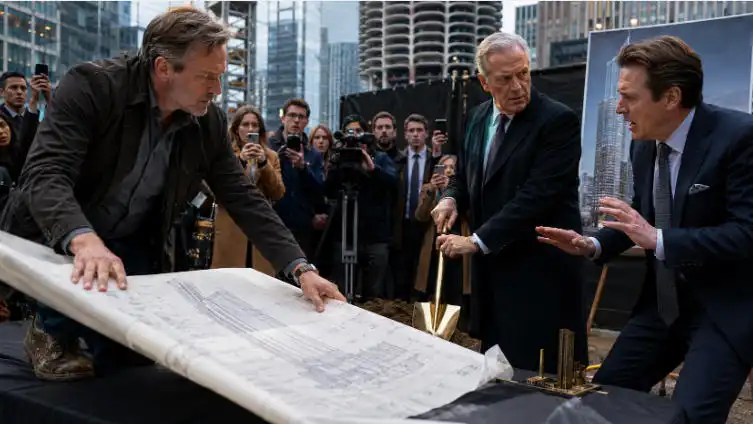
He simply unrolled a yellowed piece of translucent vellum across the polished ceremonial table and placed two muddy fingers on the corner where the first time stamp sat.
Victor’s face changed before anyone else understood why.
The billionaire client, Conrad Hale, lowered the gold shovel in his hand.
The cameras kept recording.
And the whole crowd at the downtown Chicago groundbreaking ceremony waited for one quiet architect to explain why the most celebrated tower design in the city suddenly looked like stolen property.
Two weeks earlier, Thomas Whitaker had still believed hard work mattered.
He was 45.
A senior architect.
Not flashy.
Not famous.
He wore the same brown leather satchel every day. He sharpened pencils by hand. He kept old structural notebooks going back fifteen years because he believed buildings were promises, not products.
Victor Lang believed buildings were magazine covers.
Victor was one of the firm’s partners.
Cold smile.
Tailored suits.
A handshake that made clients feel important and employees feel disposable.
The project was supposed to change everything.
A new corporate headquarters in downtown Chicago.
Forty-seven stories.
A public plaza.
A wind-responsive exterior skin.
A natural ventilation system that could reduce energy consumption dramatically.
Thomas had spent three years developing the core concept.
Not just the pretty parts.
The bones.
The load paths.
The lateral bracing.
The way the tower would flex safely in Chicago’s brutal wind instead of resisting it like a rigid box.
Junior architects called it “Thomas’s living tower.”
Not in front of Victor, of course.
Never in front of Victor.
Victor hated anything he had not invented.
One Friday night, Thomas stayed late with three junior architects: Emily, Grant, and Paul.
The office lights were half off. Pizza boxes sat open beside foam models. The skyline glowed through the glass wall.
Thomas pointed to the atrium section.
“This is where people will think the design is fragile,” he said. “But this diagonal transfer truss is the key. The atrium is not empty space. It’s doing work.”
Emily nodded, eyes tired but bright.
“That’s beautiful,” she said.
Thomas smiled.
“Beautiful only matters if it stands.”
Victor appeared behind them.
“Still playing professor?”
Everyone went quiet.
Thomas straightened.
“We’re finalizing the structural narrative for Hale’s review.”
Victor picked up one of the vellum sheets and barely looked at it.
“Clients don’t pay for narratives. They pay for confidence.”
Thomas reached for the sheet.
Victor held it away.
“Careful,” Thomas said. “That’s the original load path study.”
Victor smiled.
“Relax. Nobody steals homework in the big leagues.”
But the next Monday, Thomas’s files were missing from the shared drive.
His physical model had been moved.
His marked-up vellum set was gone from the flat file.
At 9:30 a.m., he was called into the glass conference room.
Victor sat at the head of the table.
Beside him was Lydia Marsh from HR.
Lydia had a folder in front of her and the expression of someone who had already decided where the body would be buried.
Thomas saw two security guards outside the door.
His stomach tightened.
Victor leaned back.
“Thomas, this is difficult.”
“No,” Thomas said. “It’s usually not difficult when someone starts with that sentence.”
Lydia cleared her throat.
“Thomas, serious concerns have been raised regarding your calculations on the Hale Headquarters proposal.”
Thomas blinked.
“My calculations?”
Victor slid a printed packet across the table.
Red circles.
Highlighted numbers.
A few altered diagrams.
Thomas knew instantly what had happened.
Someone had changed the assumptions.
They had removed the secondary bracing notation.
They had made the atrium look unsupported.
“This is wrong,” Thomas said.
Victor sighed loudly.
“That is exactly the problem.”
Thomas looked at Lydia.
“These are not my sheets.”
Lydia would not meet his eyes.
“The firm has determined that your continued involvement creates unacceptable liability.”
Thomas felt heat rise in his face.
“Victor, you removed the transfer truss schedule.”
Victor stood.
“Listen to yourself. This is why we are here. You are emotional. Defensive. Dangerous to the client.”
“Dangerous?”
Victor leaned closer.
“You nearly cost this firm a billion-dollar commission because you wanted to be special.”
Thomas stood too.
“That design works because of the principle you just deleted.”
Victor smiled.
“What principle?”
Thomas stared at him.
For a second, the room was silent.
Victor did not know.
He had stolen the design, but he had not understood it.
Thomas said quietly, “Lateral load redistribution through the atrium spine.”
Victor’s eyes flickered.
Then he laughed.
“You see, Lydia? He’s hiding behind jargon.”
Lydia closed her folder.
“Thomas, your access has been revoked. You’ll collect personal belongings under supervision.”
Thomas turned toward the glass wall.
Outside, junior architects watched from their desks.
Emily had one hand over her mouth.
Grant looked down.
Paul turned away.
They knew.
Thomas knew they knew.
Victor opened the door and raised his voice so the entire studio could hear.
“Let this be a lesson. Genius is not an excuse for incompetence.”
Nobody spoke.
Not one person.
Thomas walked to his desk with security behind him.
He packed his notebooks.
His framed photo of his late wife.
His old drafting compass.
When he reached for his black blueprint tube, Victor stepped in front of him.
“That belongs to the firm.”
Thomas looked at him.
“My personal archive tube?”
“Anything related to Hale belongs to the firm.”
Thomas’s voice stayed calm.
“Then you won’t mind if I take my blank sketch paper.”
Victor smirked.
“Take your crayons too.”
A few people laughed nervously.
That hurt more than Thomas expected.
On the way out, rain had turned the construction yard behind the office into thick mud. The firm was staging a site walk for Conrad Hale’s representatives that afternoon.
Victor followed Thomas outside.
So did Lydia.
So did half the office, pretending not to watch.
Thomas stopped at the edge of the temporary walkway.
Victor came close enough for only Thomas to hear.
“You were useful,” Victor said. “That’s all. Useful people should know when to disappear.”
Thomas turned.
“You don’t understand the building.”
Victor’s smile vanished.
Then, with both hands, he shoved Thomas in the chest.
Thomas stumbled backward.
His heel slipped.
He fell hard into the construction mud.
The splash hit his shirt, his satchel, his face.
Someone gasped.
Someone else whispered, “Oh my God.”
Victor stood over him.
“You are a washed-up draftsman with delusions of importance,” he shouted. “You couldn’t design a doghouse without someone checking your math.”
Phones came up.
Junior architects froze.
Lydia snapped, “No filming. Put those away.”
Victor pointed at Thomas.
“If any of you support him, follow him out.”
That did it.
Heads dropped.
Phones disappeared.
Thomas sat in the mud for one long second.
Then he slowly stood.
He wiped mud from his glasses.
He looked at Emily.
She was crying, silently.
Thomas did not blame her.
Fear is a powerful architect too.
It builds walls inside people.
He picked up his satchel and walked away.
But Victor had made one mistake.
He thought the originals were in the black tube.
They were not.
Thomas had stopped trusting Victor months earlier.
Not because he was paranoid.
Because buildings teach you to notice stress before collapse.
Victor had begun asking strange questions.
“Do we really need all these handwritten sheets?”
“Why keep physical drafts?”
“Could someone else present this if you got sick?”
Thomas had smiled and answered politely.
Then he had done what old-school architects do.
He made copies.
Better than copies.
He had the first concept sketches scanned by an independent archival service.
He had mailed sealed duplicate vellum sets to himself.
He had digital time stamps from the cloud server before Victor restricted access.
He had emails from junior staff discussing his original calculations.
He had the plotter logs.
He had photos of the model beside his marked-up wall sketches.
And most important, he had a thin notebook filled with the structural logic Victor could imitate but never explain.
Thomas went home that night, washed mud from his hair, and sat at his kitchen table until sunrise.
He did not post online.
He did not call Victor names.
He did not beg the junior staff to risk their jobs.
He built a timeline.
Date.
Draft.
Calculation.
Witness.
Storage path.
Revision history.
Then he called an attorney.
Not a loud one.
A precise one.
A woman named Patricia Bell, who had once represented engineers in a bridge-design dispute.
Patricia listened for forty minutes without interrupting.
Then she said, “You are not going to win this by saying he stole your idea.”
Thomas rubbed his eyes.
“I know.”
“You win by proving authorship, alteration, and reliance.”
“I can prove all three.”
“Good,” she said. “Then we do this cleanly.”
Patricia sent preservation letters to the firm.
To Victor.
To HR.
To the billionaire client’s legal department.
No threats.
No drama.
Just notice that evidence relating to authorship, calculations, electronic edits, and personnel actions must be preserved.
Victor ignored it.
Of course he did.
He was already preparing for the groundbreaking ceremony.
The city was watching.
Business journals called it “Chicago’s next architectural icon.”
Victor gave interviews.
He stood in front of renderings and used Thomas’s words.
“A building that breathes.”
“A tower that works with the wind.”
“A new civic landmark.”
Every time Thomas saw the phrase, he felt something twist in his chest.
But he stayed quiet.
That was the hardest part.
People think revenge is loud.
The strongest kind is usually paperwork.
The night before the ceremony, Emily called him from a blocked number.
Her voice shook.
“I can’t testify,” she said immediately. “I’m sorry. My dad’s medical bills… I can’t lose this job.”
Thomas sat by the window.
“I didn’t ask you to.”
“I know what he did.”
“I know.”
“Grant knows too. Paul too. But Victor said he’d ruin us.”
Thomas closed his eyes.
“Emily, listen to me. Don’t risk your job for me.”
“He pushed you.”
“I remember.”
“And nobody helped.”
Thomas looked at his old drafting compass on the table.
“You were afraid.”
She started crying.
“I hate myself for it.”
“Don’t,” he said. “Just tell the truth when the rules protect you.”
“What rules?”
Thomas looked at Patricia’s preservation letter lying beside him.
“The ones Victor thinks are for other people.”
The next morning, Chicago was bright and cold.
The ceremony site had been dressed like a movie set.
White tent.
Rows of chairs.
A press riser.
A table with a scale model under glass.
City officials in dark coats.
Developers.
Reporters.
Architectural critics.
Junior staff from the firm stood near the back, stiff and pale.
Victor stood at the front in a navy suit, laughing beside Conrad Hale.
Conrad was a billionaire who liked winners.
Everyone knew it.
He had built his fortune buying companies, cutting waste, and rewarding people who made him look brilliant.
He did not care who designed the tower.
He cared that it worked, that it made headlines, and that his name stood on the skyline.
At least, that was what Victor believed.
Victor stepped to the microphone.
“Today,” he said, “we break ground on more than a building. We break ground on the future.”
Applause.
Thomas stood across the street, watching.
Patricia stood beside him.
“You ready?” she asked.
“No,” Thomas said.
“Good. Ready people get careless.”
They crossed when Victor began describing the design.
Thomas heard his own language coming from Victor’s mouth.
“The atrium spine creates a living core…”
Thomas stopped walking for half a second.
Patricia touched his arm.
“Keep going.”
Victor continued.
“Our wind-responsive geometry allows the tower to adapt…”
Thomas entered the tent.
A reporter noticed him first.
Then Emily.
Her face went white.
Victor saw him next.
For one tiny second, panic flashed across Victor’s face.
Then he covered it with anger.
“Security,” Victor said into the microphone.
The crowd turned.
Thomas walked forward in his old gray overcoat.
His work boots were clean now, except for a dried line of mud he had left along one seam.
He wanted Victor to see it.
Lydia hurried toward him.
“Thomas, you are not authorized to be here.”
Patricia stepped in front of her.
“I’m his counsel.”
That stopped Lydia.
Victor laughed into the microphone.
“Ladies and gentlemen, forgive the interruption. This is a former employee who has been dealing with some personal disappointment.”
Thomas said, “I have a question about the design.”
Victor’s jaw tightened.
“This is not the forum.”
Conrad Hale looked annoyed.
“What question?”
Victor turned quickly.
“Mr. Hale, I apologize. He was removed from the project for serious calculation issues.”
Thomas lifted the black blueprint tube.
“That is exactly why I’m here.”
Victor snapped, “That tube belongs to the firm.”
Thomas walked to the ceremonial table and opened it.
“No,” he said. “This one belongs to me.”
The first vellum sheet unrolled.
Then the second.
Then the third.
Old-school translucent drawings.
Hand notations.
Revision dates.
Archival stamps.
A small barcode from the independent scan service.
Thomas placed metal weights on the corners.
The cameras leaned in.
Conrad’s expression shifted from irritation to interest.
Victor tried to laugh.
“Sketches. Sentimental nonsense.”
Thomas pointed to the first sheet.
“This is the original atrium spine load-path study. Dated eighteen months before your presentation.”
Victor said, “Anyone can date a sketch.”
Patricia placed a binder on the table.
“Certified scan logs. Mailing receipts. Server access records. Plotter history. Preservation notice copies.”
Lydia stepped back.
Conrad looked at Victor.
Victor’s smile became thinner.
Thomas kept his voice even.
“Mr. Hale, Victor told you I made catastrophic calculation errors.”
Conrad said, “That is what I was told.”
Thomas nodded.
“Then ask him one question.”
Victor’s face hardened.
Conrad looked between them.
“What question?”
Thomas turned to Victor.
“Why does the south atrium not collapse under torsional wind shear?”
The tent went quiet.
Victor scoffed.
“This is absurdly technical for—”
Thomas interrupted.
“No. It is the core principle of the building you just claimed to have designed.”
A reporter whispered, “Keep rolling.”
Thomas pointed to the rendering.
“The public sees empty glass space. But the atrium works because the diagonal transfer truss redirects lateral force into the spine columns here and here. Without that system, your altered version fails under the very wind conditions the tower was designed for.”
Conrad slowly turned toward Victor.
“Explain it.”
Victor blinked.
“Of course. The design uses, ah, adaptive bracing—”
Thomas said, “Where?”
Victor looked at the model.
“At the central core.”
Thomas shook his head.
“That would overload the service shaft.”
Victor’s mouth opened.
Nothing came out.
Thomas slid another sheet forward.
“This is the calculation Victor’s packet claimed was wrong. But the packet removed the secondary truss schedule.”
He placed the altered packet beside the original.
Same diagram.
One missing notation.
One missing schedule.
One missing truth.
Conrad picked up both documents.
His face darkened.
“Victor.”
Victor said, “This is a misunderstanding.”
Thomas looked at the junior architects.
Emily was trembling.
Grant’s eyes were wet.
Paul clenched his jaw.
Conrad followed Thomas’s gaze.
“Who else worked on these drawings?”
Nobody spoke.
Victor turned slowly.
“Careful,” he said.
That one word did more damage than any accusation Thomas could have made.
The microphone caught it.
Everyone heard it.
Conrad heard it.
Patricia heard it.
The reporters heard it.
Emily lifted her chin.
“I did.”
Victor spun toward her.
“Emily.”
She stepped forward, shaking.
“Thomas led the design. We all worked under him. Victor took the files after Thomas finished the structural narrative.”
Grant stepped beside her.
“He changed the packet.”
Paul followed.
“He told us we’d be fired if we said anything.”
Lydia whispered, “This is not appropriate.”
Patricia looked at her.
“Neither is retaliatory termination after evidence alteration.”
Conrad placed the papers down very carefully.
Then he looked at Victor with the kind of disgust wealthy men reserve for people who have cost them money in public.
“You told me he was incompetent.”
Victor’s voice cracked.
“He was unstable.”
Conrad pointed to the vellum.
“This man just explained my building in thirty seconds. You couldn’t explain your way out of a revolving door.”
A few people gasped.
Victor turned red.
“Mr. Hale, I built the client relationship.”
Conrad stepped closer.
“You stole the product.”
Victor lowered his voice.
“We can fix this privately.”
Conrad looked around at the cameras.
“Privately? You made me stand in front of the city beside a fraud.”
Then Conrad picked up the gold shovel.
For one unbelievable second, Victor thought Conrad was handing it to him for the photo.
Instead, Conrad turned away.
He held it out to Thomas.
The tent erupted in whispers.
Thomas did not take it immediately.
He looked at the shovel.
Then at Victor.
Then at Conrad.
“I don’t want a performance,” Thomas said. “I want the drawings corrected before anyone pours concrete.”
Conrad stared at him.
Then he smiled for the first time.
“That is the first intelligent thing anyone has said today.”
He pushed the shovel into Thomas’s hands.
“You are now project design lead, pending legal review. My office will contract with you directly.”
Victor lunged forward.
“You cannot do that.”
Conrad did not even look at him.
“I can do many things, Victor. My lawyers enjoy hobbies.”
The crowd laughed.
Not loudly.
But enough.
Victor heard it.
That was his first punishment.
Not the legal one.
The human one.
Being laughed at by the room he had tried to own.
The ceremony ended without the planned photo.
Instead, every news outlet in Chicago had a better story.
Architect confronts partner at groundbreaking.
Original drawings reveal authorship dispute.
Billionaire client removes firm partner on camera.
Within twenty-four hours, Conrad Hale’s company paused the contract with Victor’s firm.
Within forty-eight hours, Patricia filed formal claims for wrongful termination, intellectual property misappropriation, defamation, and evidence alteration.
The state licensing board opened a disciplinary review after receiving the altered structural packet.
The firm’s insurers demanded internal records.
The junior architects gave protected statements.
Lydia tried to say she had only followed procedure.
But the emails told a different story.
She had helped Victor build the false termination file.
She had scheduled security before Thomas even entered the HR meeting.
She had marked the junior staff as “potential loyalty risks.”
Victor’s world shrank quickly.
First, he was removed from the Hale project.
Then he was placed on leave.
Then his partnership was suspended.
Then the licensing board issued an emergency restriction while the investigation proceeded.
Months later, after hearings, records, expert review, and testimony, Victor’s license was revoked.
Not because Thomas hated him.
Because rules exist for a reason.
A dishonest architect does not just steal credit.
He puts people inside buildings he does not understand.
The commercial fraud investigation followed.
Victor had sold stolen authorship to secure a massive contract.
He had used altered documents to remove the real designer.
He had lied to the client.
He had lied to the firm.
He had lied to the city.
The newspapers were not kind.
The same magazines that once called him “visionary” now used words like “disgraced,” “misconduct,” and “structural deception.”
Thomas did not celebrate.
Not the way people expected.
He returned to work.
Real work.
Conrad gave him a temporary office overlooking the site.
Emily, Grant, and Paul joined him after leaving the old firm.
The first week, they were nervous.
Thomas could tell.
They were waiting for him to mention their silence.
He never did.
On Friday evening, Emily stayed late.
Just like before.
She stood beside the model and said, “I should have spoken up sooner.”
Thomas kept drawing.
“Yes.”
She swallowed.
“I’m sorry.”
Thomas put down his pencil.
“I was angry.”
“I know.”
“But I also know fear is expensive. Victor made sure all of you knew the price.”
Emily wiped her cheek.
“I hated watching you in the mud.”
Thomas looked at the skyline.
“So did I.”
Then he gave her a fresh sheet of tracing paper.
“Check the plaza canopy drainage.”
She blinked.
“That’s it?”
“No,” Thomas said. “Then check it again. Forgiveness does not mean sloppy work.”
She laughed through tears.
That was the first time the new office felt alive.
A year later, Thomas Whitaker opened his own firm.
Not huge.
Not flashy.
He named it Whitaker Civic Design.
The first rule was written on the wall near the entrance:
The person who understands the work gets heard.
No one laughed at it.
People who had been ignored at bigger firms came to work there.
Older designers.
Young interns.
Engineers with accents.
Single parents returning after career breaks.
Quiet people with brilliant hands.
Thomas did not build a firm around revenge.
He built one around the thing Victor never understood.
Respect.
The Hale Headquarters rose slowly from the Chicago ground.
Steel first.
Then glass.
Then the atrium spine.
The day the transfer truss was lifted into place, Thomas stood on site with a hard hat and safety vest.
Conrad Hale stood beside him.
“You know,” Conrad said, “the media still wants a documentary.”
Thomas smiled.
“They can film the building.”
“They want you.”
“They’ll be disappointed. I’m mostly coffee and redlines.”
Conrad laughed.
Below them, Emily directed a detail review with confidence Thomas had not seen in her before.
Grant argued with a contractor over weld tolerances.
Paul checked a column connection twice.
Thomas watched them and felt something inside him loosen.
His late wife had once told him, “You design like you’re apologizing to the future.”
He had never fully understood that until now.
Buildings outlive insults.
They outlive liars.
They even outlive the people who first imagined them.
But only if someone protects the truth long enough for steel to become skyline.
At the final topping-out ceremony, there was another crowd.
Another table.
Another set of cameras.
This time, Thomas was not muddy.
Victor was not there.
Lydia was not there.
The gold shovel had been placed in a glass case inside the project office, not as a trophy, but as a reminder.
Conrad asked Thomas to speak.
Thomas hated speeches.
But he stepped up anyway.
He looked at the workers.
The young architects.
The engineers.
The reporters.
Then he said:
“A building is not one person’s ego. It is thousands of decisions made honestly. If one person lies, everyone carries the risk. If one person tells the truth, everyone gets safer.”
He paused.
“I was pushed into mud for saying this design had a spine.”
People grew quiet.
Thomas smiled a little.
“It turns out the building did.”
Emily started clapping first.
Then Grant.
Then Paul.
Then the ironworkers.
Then the whole site.
Thomas looked up at the unfinished tower, its steel frame catching the Chicago light.
For the first time in a long time, he did not feel like a man trying to prove he belonged.
He felt like the man who had drawn the line and refused to let someone erase it.
And Victor?
The last Thomas heard, Victor had tried to open a consulting shop under another name.
Clients searched him.
They found the hearings.
The video.
The gold shovel moment.
The mud.
Reputation is a structure too.
Once the foundation cracks, expensive paint cannot save it.
So yes, Thomas exposed him publicly.
Not for revenge.
For safety.
For the junior architects Victor tried to silence.
For the client Victor tried to fool.
For every quiet professional who has watched a loud thief take credit and call it leadership.
Victor wanted applause for a building he did not understand.
Thomas gave him a lesson he could never redesign.
Choose a side: was Thomas right to expose Victor in front of the media, or should thieves in expensive suits be protected from public embarrassment? ⚖️
Disclaimer: Mention of any brand or trademark is for identification only and does not imply partnership or endorsement
They Laughed While Security Beat the “Alley Thief”… Then One Video Made Everyone REGRET It
A Diner Owner Called Him a “VAMPIRE” and Kicked Him Into the Rain… Then KARMA Pulled Up in 18 Wheels

A Hollywood Producer Humiliated a Quiet Crew Worker on LIVE Video… Then KARMA Walked In Holding a Sealed Trust File