



Karen was still smiling when the FBI knocked.
Not a polite knock.
Not the kind of knock that says, “Ma’am, may we speak with you?”
It was the kind that makes every curtain in the neighborhood move at the same time.
And for once, Karen Whitmore had no clipboard in her hand.
She had no pearl necklace.
No perfect blazer.
No HOA rulebook.
Just silk pajamas, bare feet, and the same terrified look she used to put on everyone else’s face.
Three days earlier, she had stood on my porch and told the whole neighborhood I was trash.
My name is Rachel Miller.
I was forty years old, recently divorced, and new to Brookhaven Estates.
I moved there because I wanted a quiet street for my twelve-year-old son, Eli.
Good schools.
Safe sidewalks.
A small backyard where we could breathe again.
I had no idea the most dangerous thing in that neighborhood wasn’t crime.
It was Karen.
Karen Whitmore was the HOA president.
She wore pearls to inspect mailboxes.
She carried a clipboard like a weapon.
She spoke softly, but every sentence came with a fine attached.
She had a perfect colonial house at the end of Wisteria Lane, trimmed hedges sharp enough to slice bread, and a front lawn so green it looked fake.
People waved at her.
But not because they liked her.
Because they feared her.
The first week I lived there, Karen left a warning on my door.
“Children’s bicycle visible from street. Violation.”
Eli had leaned his bike beside the porch for ten minutes while bringing groceries inside.
Fine: $75.
The second week, Karen sent me a notice because my welcome mat had “excessive seasonal color.”
It was blue.
The third week, she stopped her SUV in front of my house and stared while I carried moving boxes inside.
Then she said, “Brookhaven has standards, Rachel.”
She said my name like it was something she had scraped off her shoe.
I tried to keep my head down.
That’s what most neighbors did.
Mr. Hughes, an elderly widower three houses down, once paid $200 because his trash bin was visible from the curb after 8 a.m.
He had been at a cardiology appointment.
Mrs. Alvarez, a retired nurse, had to repaint her mailbox because Karen said the shade of white “clashed with neighborhood symmetry.”
Even Mr. Collins, our mailman, avoided eye contact when Karen was outside.
But one morning, while handing me a package, he whispered, “Don’t let her scare you too much.”
I gave him a tired smile.
“That obvious?”
He glanced down the street toward Karen’s house.
“Lady has been making people miserable for years.”
Then his voice dropped.
“Someday, people like that trip over their own mess.”
I didn’t know then how right he would be.
It started with the cat.
A tiny gray stray began showing up under my hydrangeas during a heat wave.
The poor thing was skinny, dirty, and scared of every sound.
Eli saw it first.
“Mom, can we help him?”
I said, “We can give him water.”
That was all.
A small ceramic bowl.
Plain white.
Placed in the corner of the porch, hidden behind a planter.
The cat would come out when the street got quiet and drink like it had crossed a desert.
Eli named him Button because of the round gray spot on his nose.
For three days, Button came and went.
I called a local rescue.
They told me they were overloaded, but if I could keep him nearby, they would send someone to scan him and maybe help trap him safely.
I thought that was responsible.
Karen thought it was an opportunity.
On Monday morning, I was watering the porch plants when Karen marched up my driveway with two HOA board members behind her.
Both women looked uncomfortable.
Karen did not.
She had on white slacks, beige heels, oversized sunglasses, and a smile that made my stomach tighten.
“Rachel,” she said. “We need to discuss the animal problem.”
I looked down.
Button was curled in the shade behind the planter.
“There’s no problem,” I said. “He’s just a stray. I called a rescue.”
Karen’s smile thinned.
“Feeding feral animals is prohibited.”
“I’m giving him water.”
“You’re attracting pests.”
“He’s thirsty.”
Karen turned around slowly, making sure the neighbors could hear.
By then, Mr. Hughes was standing near his mailbox.
Mrs. Alvarez had stopped pruning roses.
A teenage boy across the street had his phone lifted.
Karen loved an audience.
She pointed at Button.
“That animal makes this neighborhood look neglected.”
My hands tightened around the hose.
“With respect, Karen, he’s a living thing.”
She laughed.
Not loudly.
Worse.
Politely.
“Oh, honey. That kind of thinking is why communities decline.”
Then she stepped onto my porch.
I moved forward.
“Please don’t scare him.”
Karen looked straight at me.
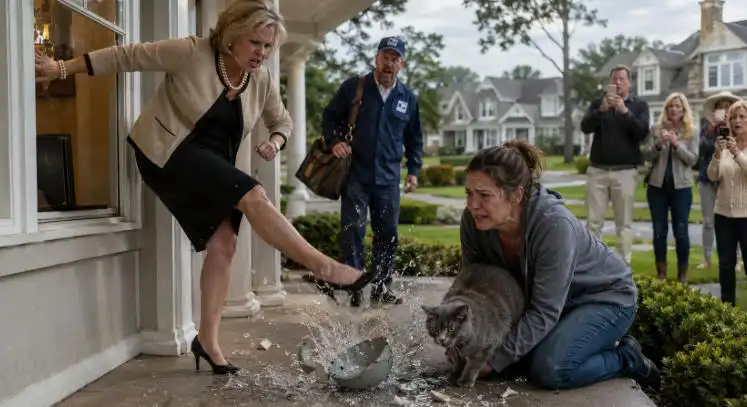
Then she raised her beige heel and kicked the water bowl.
It flew off the porch.
It shattered on the walkway.
Water splashed across the concrete.
Button shot into the bushes.
Eli had just opened the front door and saw everything.
“Mom?”
His voice cracked.
That was the moment something inside me shifted.
Karen turned to the neighbors.
“Let this be a reminder. Brookhaven Estates does not tolerate low-class behavior.”
My cheeks burned.
The board members stared at the ground.
Mr. Hughes looked away, angry but silent.
Mrs. Alvarez covered her mouth.
The teenage boy kept filming.
Karen pulled out her phone.
“I’m calling animal control.”
I stepped between her and the bushes.
“No.”
Her eyebrows lifted.
“Excuse me?”
“You’re not sending someone to drag a frightened cat out from under my shrubs because you need to feel powerful.”
One of the board women whispered, “Karen, maybe we should—”
Karen snapped, “Stay out of it, Linda.”
Then she leaned toward me.
“You’ve been here less than a month, and you already think rules don’t apply to you.”
I looked at the broken ceramic pieces on the ground.
Then at my son’s face.
Then back at her.
“No, Karen. I think rules should protect people. Not give bored bullies a crown.”
The neighborhood went silent.
Karen’s nostrils flared.
“You will regret that.”
I believed her.
By noon, there was a new violation notice on my door.
Unauthorized animal feeding.
Porch obstruction.
Unapproved ceramic exterior object.
Total fine: $350.
At the bottom, in Karen’s perfect handwriting, she had added:
“Further noncompliance may result in legal action.”
That night, Eli sat at the kitchen table with red eyes.
“Are we going to get kicked out?”
“No,” I said.
But I wasn’t sure.
I had used almost everything from the divorce settlement on the down payment.
My ex-husband was behind on support.
My freelance bookkeeping work paid the bills, but barely.
I could not afford a war with an HOA.
That was what Karen counted on.
People like her don’t just bully.
They calculate who can’t fight back.
So I didn’t yell.
I didn’t post online.
I didn’t storm over to her house.
I did what I knew how to do.
I documented.
I took photos of the broken bowl.
I saved the fine notices.
I wrote down the names of every witness.
I asked the teenager’s mother if he would please save the video.
Then I called the rescue again.
They sent a volunteer named Denise, who crawled halfway under my hydrangeas with tuna and patience.
Button came out after twenty minutes.
He wasn’t feral.
He was terrified, dehydrated, and covered in fleas.
Denise scanned him.
No chip.
“He’s adoptable,” she said. “Sweet little guy.”
Eli looked at me with hope so bright it hurt.
I sighed.
Button stayed.
For the next few days, Karen drove past my house slower than necessary.
She sent two more warnings.
One for “visible pet activity.”
One for “noncompliant porch tone.”
I didn’t even know porches had tones.
Neighbors started quietly checking on me.
Mrs. Alvarez brought lemon bars.
Mr. Hughes offered to testify if Karen tried anything.
Mr. Collins, the mailman, shook his head every time he saw another HOA envelope in my box.
“She’s pushing too hard,” he said one afternoon.
I watched Karen standing in her driveway, shouting into her phone.
“She always pushes hard.”
Mr. Collins lowered his voice.
“You know, she just approved a special assessment last year. Said the community needed new security cameras and drainage repairs.”
I remembered reading the paperwork after moving in.
Every homeowner had paid $900.
“That work was done, right?”
He snorted.
“You see new cameras?”
I looked around.
The entrance camera still had a cracked cover.
The drainage ditch near the cul-de-sac still flooded when sprinklers ran too long.
Mr. Collins adjusted his mailbag.
“Folks asked questions. Karen told them the money was allocated.”
That word stuck with me.
Allocated.
Bookkeepers hear words differently.
Allocated could mean assigned.
Or hidden.
That evening, after Eli went to bed, I pulled every HOA document I had.
Budgets.
Assessment letters.
Meeting minutes.
Vendor names.
A few things didn’t line up.
The security company listed on the invoice had no working website.
The landscaping repair charge was strangely rounded.
The drainage contractor had the same mailing address as a private mailbox store.
It wasn’t proof.
But it smelled wrong.
I emailed the HOA treasurer, a quiet man named George Kline, asking for copies of expense reports.
He replied fifteen minutes later.
“Please direct all records requests to President Whitmore.”
That was odd.
The treasurer should have had records.
The next morning, Karen posted a notice on the community board.
“REMINDER: Unauthorized inquiries into HOA financial management create legal exposure for the community.”
She didn’t use my name.
She didn’t have to.
By then, people were watching.
But Karen forgot one thing.
Bullies are careful in public.
Careless in private.
And Button, the cat she tried to destroy, had no respect for property lines.
Karen liked to leave her home office window cracked in the early mornings.
Her office faced the side yard, where a row of hedges separated her house from the walking path.
Button had started exploring.
He would sit on my porch, then trot through yards like a tiny gray inspector.
On Thursday morning, around 6:40, I heard a shriek.
Not a scream.
A shriek.
I ran outside in slippers.
So did half the street.
Karen’s front door burst open.
She came running out in a silk robe, hair half-wrapped in a towel, yelling, “Get it out! Get that filthy animal out!”
Button shot out behind her, across the lawn, and under Mr. Hughes’s truck.
Karen’s left cheek had a scratch.
Her robe belt was crooked.
Behind her, through the open front door, I could see stuffing from a shredded couch cushion scattered across the living room floor.
Karen saw us watching.
Her face changed.
The fear vanished.
The performance returned.
“This is Rachel’s fault!” she shouted. “Her diseased cat broke into my home!”
I crossed my arms.
“Button climbed through your open window?”
Karen pointed at me.
“You will pay for my sofa.”
Then Mr. Collins stepped forward.
He had been delivering mail at the corner.
His eyes were fixed on Karen’s doorway.
“Karen,” he said slowly, “why is there cash all over your living room?”
The whole street went quiet.
Karen turned pale.
I looked again.
He was right.
Not just stuffing.
Cash.
Stacks of bills had spilled from the torn couch cushion.
A black binder lay open on the floor near the coffee table.
Loose papers were scattered everywhere.
Karen rushed back inside and tried to slam the door, but her robe caught.
For one second, everyone saw it.
The binder.
The columns.
Names of residents.
Amounts collected.
Amounts “reassigned.”
My stomach dropped.
Mr. Collins whispered, “I knew it.”
Karen slammed the door.
But it was too late.
The teenager across the street had filmed again.
So had Mrs. Alvarez.
So had three other neighbors.
I went home, hands shaking, and called a lawyer I used to do contract work for.
I told him everything.
The fines.
The assessment.
The fake-looking invoices.
The cash.
The ledger.
The witnesses.
He listened without interrupting.
Then he said, “Rachel, do not confront her. Preserve everything. Send me copies.”
By noon, he had helped me file a formal records demand under our state’s HOA transparency laws.
By evening, three neighbors had added sworn statements.
By Friday, George Kline, the HOA treasurer, called me.
His voice trembled.
“I didn’t know where the money was going,” he said. “Karen locked me out of the accounts six months ago. She said the board had approved an executive procedure.”
“George,” I said carefully, “did the board approve that?”
“No.”
“Do you have emails?”
A long pause.
“Yes.”
That was the first real crack.
George sent the emails to the attorney.
Karen had pressured him.
Threatened him.
Told him that if he questioned her, she would accuse him of mismanaging funds.
She had moved HOA money into an “emergency reserve vendor account” controlled by a shell company.
That company’s address matched the fake drainage contractor.
The name attached to it?
Karen’s adult nephew.
By Saturday, the story had spread through the neighborhood without a single public post.
People compared fines.
Invoices.
Meeting minutes.
One couple discovered they had paid for tree removal that never happened.
Another family found a “legal processing fee” added after they questioned Karen’s parking rules.
Mrs. Alvarez had been charged twice for the mailbox repaint approval.
Mr. Hughes had paid a “late compliance penalty” that did not exist in the bylaws.
Karen had not just been cruel.
She had been using cruelty as cover.
The more scared people were, the less likely they were to ask where the money went.
On Sunday morning, Karen tried to regain control.
She called an emergency HOA meeting on the clubhouse lawn.
Everyone came.
Not because we respected her.
Because we wanted to watch.
Karen stood at the front in a navy dress, pearls back in place, hair perfect.
“Recently,” she began, “certain disgruntled residents have spread defamatory rumors.”
Her eyes landed on me.
I stood in the back with Eli beside me.
Button was safe at home, asleep in a laundry basket.
Karen lifted her chin.
“Let me be clear. Brookhaven Estates will not be hijacked by emotional people who do not understand governance.”
Mr. Hughes muttered, “Here we go.”
Karen continued.
“Effective immediately, Rachel Miller is under review for repeated violations, harassment of board leadership, and maintaining a nuisance animal.”
Eli grabbed my hand.
I squeezed it once.
Then George Kline stepped forward.
He held a folder.
His hands shook, but his voice didn’t.
“Karen, before you continue, I need to state for the record that the board did not authorize several financial transfers you claimed were approved.”
Karen’s face hardened.
“George, sit down.”
“No.”
One word.
The whole neighborhood felt it.
George opened the folder.
“I have emails. Bank notices. Vendor records. And the formal demand letter from counsel.”
Karen laughed.
“You have no authority.”
Then a black SUV turned into the clubhouse parking lot.
Then another.
The laughter died.
Two federal agents stepped out.
Then two more.
Karen’s mouth opened, but nothing came out.
One agent approached her.
“Karen Whitmore?”
She looked around at us, as if someone might save her.
No one moved.
The agent said, “We have questions regarding financial transactions connected to Brookhaven Estates Homeowners Association and related vendor accounts.”
Karen tried to recover.
“This is a private community matter.”
The agent did not blink.
“Not anymore.”
That line traveled through the crowd like electricity.
Karen’s perfect face cracked.
For years, she had weaponized rules against people who were tired, elderly, grieving, divorced, broke, or simply too polite to fight.
Now the rules had found her.
The agents did not arrest her on the lawn that day.
They asked questions.
They collected statements.
They took copies.
Karen stood there, trembling with rage, while neighbors she had bullied for years watched in silence.
But the real fall came two mornings later.
At 6:15 a.m., Brookhaven Estates woke to flashing lights.
Not sirens.
Just lights.
FBI vehicles parked outside Karen’s house.
Agents walked up her perfect front path with a warrant.
Curtains opened one by one.
Doors cracked.
People stepped onto porches with coffee cups in hand.
Karen answered in silk pajamas.
No makeup.
No pearls.
No clipboard.
An agent handed her paperwork.
Another entered the house.
A third went around to the side office window — the same window Button had climbed through.
Mrs. Alvarez stood beside me on the sidewalk.
Mr. Hughes came out in a bathrobe.
Mr. Collins had stopped his mail truck at the curb.
Nobody cheered.
That would have made us like her.
But nobody looked away either.
Karen saw us.
Her face twisted.
“You’re enjoying this?” she shouted.
Mr. Hughes answered first.
“No, Karen. We’re witnessing compliance.”
That nearly broke me.
The agents carried out boxes.
Computers.
Binders.
A small safe.
And from the living room, sealed in evidence bags, came stacks of cash that had been hidden inside the custom sofa.
The same sofa Button shredded.
Karen tried to claim the money was personal savings.
The ledger said otherwise.
Line by line, it tied cash amounts to fake fines, inflated assessments, and payments redirected through sham vendors.
The total was more than anyone expected.
Over $180,000.
Some of it had gone to home renovations.
Some to luxury shopping.
Some to a vacation rental Karen had listed under her sister’s name.
The community had paid for her “standards.”
The investigation took weeks, but Karen’s power ended that morning.
The board voted to suspend her authority.
Then remove her.
Then cooperate fully with investigators.
George resigned as treasurer, not because people blamed him most, but because he said he should have fought sooner.
The fake vendor accounts were frozen.
Residents received notices that restitution would be pursued.
Karen’s nephew turned over documents almost immediately.
People like that rarely stay loyal when prison becomes part of the conversation.
Karen was later charged with fraud-related offenses connected to the HOA funds.
Her attorney told local reporters it was “a misunderstanding.”
But the video of her kicking a water bowl had already made its quiet rounds among residents, attorneys, and investigators.
It showed exactly who she was when she thought no one important was watching.
At the next official HOA meeting, the clubhouse was packed.
For the first time since I moved in, people spoke freely.
Mrs. Alvarez stood up and said, “I want every rule reviewed.”
Mr. Hughes said, “I want fines audited for the last five years.”
A young father said, “I want a board that remembers this is a neighborhood, not a prison.”
Then someone nominated me for HOA president.
I actually laughed.
“No. Absolutely not.”
Mrs. Alvarez smiled.
“Rachel, you stood up first.”
“I stood up for a cat.”
Mr. Hughes nodded.
“Exactly.”
I looked at Eli.
He was sitting in the back row, grinning.
So I agreed to serve temporarily.
Then the temporary vote became official.
I won by a landslide.
My first motion was simple.
All fines issued under Karen’s unauthorized policies would be reviewed.
My second motion removed the ridiculous cosmetic rules that had nothing to do with safety or property value.
No more mailbox shade inspections.
No more porch tone violations.
No more fines for children’s bikes left outside during dinner.
We created a hardship review committee for elderly residents and single parents.
We opened monthly financial reports to all homeowners.
We replaced the fake security camera at the entrance with a real one, properly invoiced and publicly approved.
And yes, we passed a humane animal policy.
No feeding colonies irresponsibly.
No cruelty.
No using “community standards” as an excuse to hurt something helpless.
The first community event under the new board was a Saturday picnic.
Nothing fancy.
Folding tables.
Lemonade.
Hot dogs.
Kids riding bikes in the street without fear of a $75 fine.
Mrs. Alvarez brought lemon bars.
Mr. Hughes brought a radio and played old Motown.
Mr. Collins stopped by after his route and was treated like a celebrity.
Eli sat on the grass with Button in his lap.
Button had gained weight.
His fur was clean.
The gray spot on his nose still looked like a little button.
People came over to pet him.
Someone joked that he should be named honorary treasurer.
I said absolutely not.
He already had a history with hidden cash.
Everyone laughed.
It was the first time Brookhaven Estates felt like a neighborhood instead of a showroom.
A few months later, I saw Karen one last time.
She was leaving the courthouse with sunglasses on and no pearls.
A reporter asked if she had anything to say to the residents of Brookhaven.
Karen kept walking.
But as she passed me, she stopped.
For a second, I saw the old Karen fighting to come out.
The insult.
The sneer.
The need to make me feel small.
Instead, she looked down.
Because the rules she worshipped had finally applied to her.
I didn’t say anything cruel.
I didn’t need to.
I went home to my son, my neighbors, and the little gray cat who had accidentally done what all of us had been too afraid to do.
He clawed open the truth.
People still ask me if I regret standing up to Karen that day.
I don’t.
Not for one second.
Because some bullies hide behind clean lawns, nice clothes, polished manners, and words like “standards.”
But character is not measured by hedges.
It’s measured by what you do when something small and helpless is thirsty.
So choose a side:
Rachel protecting the stray cat was RIGHT.
Karen finally got exactly what she deserved.
Disclaimer: Mention of any brand or trademark is for identification only and does not imply partnership or endorsement

They Laughed While Security Beat the “Alley Thief”… Then One Video Made Everyone REGRET It
A Diner Owner Called Him a “VAMPIRE” and Kicked Him Into the Rain… Then KARMA Pulled Up in 18 Wheels

A Hollywood Producer Humiliated a Quiet Crew Worker on LIVE Video… Then KARMA Walked In Holding a Sealed Trust File