
The announcer didn’t say Duke’s name right away.
He didn’t have to.
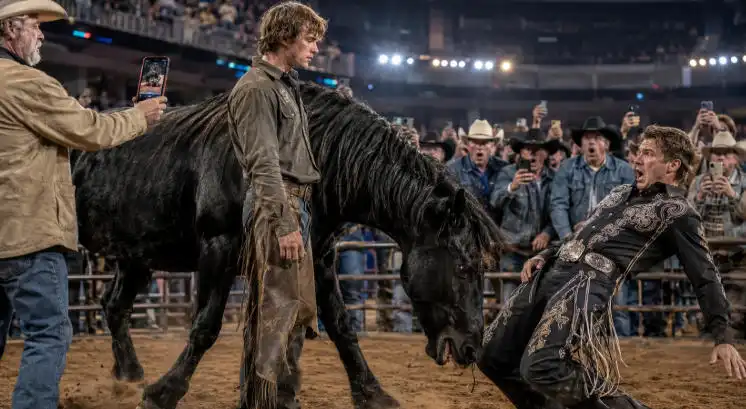
The giant screen above the Houston rodeo arena froze on one ugly frame: a black mustang trapped in a private barn, bleeding, shaking, while a man in polished champion boots raised a whip.
Forty thousand people stopped cheering.
Duke Callahan stopped smiling.
And I stood in the dirt with my hat in my hand, listening to the horse breathe.
His name was Widowmaker.
That was what Duke called him.
I never did.
To me, he was just Midnight.
Because the first time I saw him, he was standing alone under a Montana sky, black as a storm cloud, scared enough to kill any man who came close.
Most folks said I was too quiet to be useful.
Duke said I was too poor to matter.
The sheriff back home said I was lucky Duke’s family even let me sleep in the bunkhouse.
So I learned early.
Don’t argue with men who buy their own applause.
Don’t beg proud people to have mercy.
And never show your strongest card until the whole table is watching.
Duke Callahan was rodeo royalty in our part of Montana.
His father owned the biggest ranch in three counties.
His posters hung in feed stores.
His belt buckles shined under television lights.
Local news called him “the future of American rodeo.”
But behind the barns, where cameras didn’t usually reach, Duke was something else.
He didn’t train horses.
He broke them.
There is a difference.
Training asks for trust.
Breaking demands fear.
Duke liked fear.
He liked the way young ranch hands jumped when he shouted.
He liked the way judges smiled when his father shook their hands.
He liked the way the sheriff looked the other way every time a horse came out of Duke’s trailer limping.
And he loved reminding me where I stood.
“Wyatt,” he’d say, tossing a shovel at my boots. “The manure’s getting lonely.”
The other cowboys laughed because Duke laughed.
That was how power worked in our town.
Men didn’t laugh because something was funny.
They laughed because the rich man’s son had started it.
I was 25 years old, but most of them still called me “boy.”
I slept over the tack room.
I ate last.
I patched fences before sunrise and cleaned stalls long after the others had gone drinking.
When Duke needed a punching bag, he used words.
“Your daddy leave you that hat?”
“Your mama teach you to talk to horses because people got tired of hearing you?”
“You ever think about quitting, Wyatt? Or is shoveling manure the family business?”
I never answered.
Not because I was weak.
Because horses listen better when your anger isn’t louder than your hands.
The only person in that town who treated me like a man was Dr. Ellen Hayes, the old country vet.
She had silver hair, sharp eyes, and a truck older than me.
She’d come out at night when Duke’s injured horses needed help.
No invoice.
No questions.
Just her medical bag, her flashlight, and the same tired sentence.
“Again?”
I’d nod.
She’d kneel beside whatever poor animal Duke had pushed too far.
Then she’d glance at me and say, “Document everything.”
So I did.
Not for revenge at first.
For the horses.
Photos of swollen legs.
Videos of illegal spurs.
Vet reports.
Dates.
Trailer numbers.
Witness notes.
The kind of paper trail powerful men hate because it doesn’t care how much money they have.
Dr. Hayes kept copies.
I kept copies.
And the horses kept scars.
Midnight had the worst of them.
Duke bought him cheap from a rescue auction because he wanted a dramatic story for the national rodeo season.
“Untamable mustang conquered by champion Duke Callahan.”
That was the headline he wanted.
But Midnight wouldn’t kneel for him.
He bit through a lead rope.
Kicked a gate off its hinges.
Threw Duke twice.
The second time, Duke landed hard in front of half the ranch crew.
Everyone saw it.
Nobody laughed.
That made Duke angrier than pain ever could.
Three nights later, I found Midnight tied short in the private training barn.
No water.
Sweat dried white on his neck.
Fresh welts under the saddle line.
Duke stood there with two men from his crew.
One was filming.
Not because he had a conscience.
Because Duke liked making examples.
“See this?” Duke said on the video. “This is what happens when an animal thinks it has choices.”
I didn’t step in swinging.
That would have gotten me arrested by the same sheriff eating steak with Duke’s father.
So I did the only thing a poor man could do against rich cruelty.
I recorded.
From the side door.
From behind stacked hay.
From my phone with a cracked screen and a dying battery.
Then I waited until Duke left.
I went inside.
Midnight was shaking so hard the chains rang against the boards.
I didn’t touch him.
I sat ten feet away in the straw and hummed the same old church tune my mother used to hum when storms rolled over our trailer.
For an hour, nothing changed.
Then his breathing slowed.
By dawn, he let me loosen the rope.
By the next week, he let me clean his wounds.
By the end of the month, he followed my voice.
Duke noticed.
He always noticed anything that made him feel small.
“You been babying my horse?” he asked one afternoon.
“He’s not ready for Houston,” I said.
Duke smiled.
Houston was the biggest rodeo stage in America.
Television crews.
Sponsors.
Judges.
Money.
A roaring arena full of people who believed a shiny buckle meant a clean soul.
“He’ll be ready,” Duke said. “Or he’ll be dog food.”
Dr. Hayes filed another report.
The sheriff buried it.
Animal control “lost” the complaint.
Duke’s father hosted a fundraiser two days later.
The sheriff stood at his side, smiling under a banner about “community values.”
That was the moment I stopped hoping the town would do the right thing.
Some towns don’t change in private.
They have to be embarrassed in public.
Houston came hot, loud, and golden.
The arena was huge enough to swallow our whole county.
Thousands of cowboy hats moved like waves.
Vendors shouted.
Kids sat on their fathers’ shoulders.
Cameras swept across the chutes.
Duke walked in like a king.
White hat.
Pressed shirt.
Custom boots.
His father beside him.
The sheriff in the VIP section, laughing with donors like he belonged there.
I came in through the livestock gate.
Dust on my jeans.
Old hat in my hand.
A stable pass clipped to my shirt.
Nobody looked twice.
That suited me fine.
Midnight stood in chute seven.
They had renamed him Widowmaker for television.
The name made Duke sound brave.
It made the horse sound guilty.
Duke’s crew had him boxed tight.
Too tight.
His eyes rolled.
Foam flecked his lips.
He slammed his body against steel and the crowd gasped.
Duke waved at the cameras.
“Ladies and gentlemen,” the announcer boomed, “Duke Callahan is about to attempt the impossible!”
Attempt.
That word did a lot of work.
Duke had already arranged the story.
If he rode the horse, he was a legend.
If the horse exploded, he was a brave man facing a monster.
If the horse got hurt, well, monsters get put down.
I saw the rifle case near the back gate.
My stomach went cold.
Duke saw me looking.
He walked over, smiling.
“Don’t worry, manure boy,” he said. “You can sweep him up after.”
His crew laughed.
Then he shoved me.
Hard.
I hit the dirt in front of the chute.
The crowd saw it.
A camera caught it.
My hat rolled under the fence.
Duke leaned down close enough for me to smell the mint on his breath.
“You’re not a cowboy,” he said. “You’re barn trash.”
The other cowboys laughed louder now.
A few fans booed, but most didn’t know what they were seeing.
Public cruelty often looks like entertainment until someone names it.
I got to my knees.
Duke turned to mount.
Midnight kicked the gate so violently the steel screamed.
Duke froze.
The horse lunged against the chute again.
One handler backed away.
Another crossed himself.
Duke’s face changed.
Not much.
Just enough.
Fear.
Real fear.
He looked toward the man by the rifle case.
“Shoot it,” Duke snapped. “That animal’s dangerous.”
That was the moment every quiet day of my life had been building toward.
I stood.
“Don’t touch him.”
My voice wasn’t loud.
But it carried.
Maybe because the arena had gone still.
Maybe because truth sounds different when nobody expects it from the poor man.
Duke laughed.
“You think that horse knows you?”
I walked to the chute.
Midnight’s eye found mine.
I didn’t reach for the reins.
I didn’t grab.
I just laid my palm against the post and breathed out.
“Easy, boy,” I whispered. “I’m here.”
The horse stopped.
Not slowly.
Not after a fight.
He stopped like a church bell had gone silent.
His head lowered.
His ears flicked toward me.
A murmur moved through the crowd.
Duke’s smile cracked.
Behind me, Dr. Hayes stepped to the rail.
She held up her phone.
Her hand shook, but her voice did not.
“Play it,” she said to the arena production manager.
Duke turned.
“What the hell is that?”
The manager hesitated.
Then one of the national rodeo officials, a hard-faced woman in a black blazer, gave a single nod.
The giant screen flickered.
The first video appeared.
Midnight tied short in Duke’s private barn.
Duke’s voice came through the arena speakers.
Clear.
Ugly.
Proud.
“This is what happens when an animal thinks it has choices.”
The crowd erupted.
Not cheering.
Not booing.
Something worse.
Disgust.
Duke lunged toward Dr. Hayes, but security stepped in.
“Turn it off!” he yelled. “That’s edited!”
Dr. Hayes didn’t flinch.
“There are six files,” she said. “Original timestamps. Vet reports. Chain-of-custody copies. Sent to the rodeo commission, the state board, and federal investigators this morning.”
Duke’s father stood in the VIP box.
The sheriff rose beside him.
For once, neither man looked powerful.
They looked exposed.
The second video played.
Illegal equipment.
Blood under a saddle pad.
Duke laughing.
The third showed the sheriff’s deputy leaving the ranch after a complaint had been filed and marked “unfounded.”
The fourth showed Midnight after midnight, shaking in the barn while I cut the rope loose with my pocketknife.
The crowd saw my face on the screen.
Younger.
Scared.
Angry.
Silent.
Duke pointed at me.
“He stole my horse!”
The rodeo official turned to him.
“No,” she said. “Your entry is suspended pending investigation.”
Then she looked at me.
“Mr. Wyatt Miller, Dr. Hayes submitted emergency transfer paperwork under animal welfare provisions this morning. You are listed as the temporary handler of record.”
Duke’s mouth opened.
No words came out.
That was new for him.
The announcer, who had been frozen beside his microphone, finally spoke.
“Ladies and gentlemen… due to official review, Duke Callahan is disqualified from competition.”
The boos came like thunder.
Duke tried to shove past security.
One guard caught him.
Another took his arm.
His father shouted from the box, “Do you know who we are?”
A little boy near the front yelled back, “Everybody does now!”
That broke the arena.
People stood.
Phones raised.
The sheriff tried to leave through the VIP aisle.
Two state investigators met him at the stairs.
Not with drama.
Not with shouting.
Just badges.
Paper.
Rules.
That was the legal hammer.
No fistfight.
No curse.
No revenge speech.
Just evidence moving through the system rich men thought they owned.
Duke was escorted out first.
Limping pride before he ever got hurt.
But his real fall came three minutes later.
Because the rodeo commission allowed me one choice.
Withdraw Midnight from the event for his safety…
or ride only if the horse showed readiness and the vet cleared him.
Dr. Hayes checked him right there.
Eyes.
Legs.
Breathing.
Old scars.
Fresh stress.
Then she looked at me for a long time.
“He decides,” she said.
So I stepped toward Midnight again.
“Want to show them who you are?” I whispered.
The horse pushed his forehead into my chest.
The whole front row saw it.
I didn’t spur him.
I didn’t yank him.
I mounted like I was asking permission.
The chute opened.
For one heartbeat, we stood under the lights.
Then Midnight moved.
Not wild.
Not broken.
Powerful.
He surged into the arena like a storm that finally knew where to go.
The crowd forgot how to breathe.
Every turn was clean.
Every leap was controlled.
Not because I conquered him.
Because he trusted me enough not to throw me away.
Eight seconds passed.
Then ten.
Then twelve.
By the time the buzzer sounded, nobody was sitting.
The judges huddled.
The announcer’s voice cracked.
“Ladies and gentlemen… that is the highest scored ride in the history of this event.”
I slid down and put my forehead against Midnight’s neck.
He was trembling.
So was I.
The screen showed the score.
Then it showed Duke in the security corridor, red-faced, shouting that his father would “buy the whole damn rodeo.”
But there are some things money can’t buy back once the whole country has seen them.
By morning, Duke Callahan was banned for life from every sanctioned rodeo event tied to the national circuit.
Sponsors dropped him before breakfast.
His channel disappeared two days later after platforms reviewed the animal abuse footage.
Federal investigators opened a case connected to interstate transport, falsified welfare records, and cruelty allegations.
The sheriff was suspended first.
Then removed.
Then investigated for burying complaints after taking political money from Duke’s father.
Men who used to laugh when Duke laughed suddenly remembered they had “always been uncomfortable.”
That’s how cowards clean their boots after the mud hits someone powerful.
Dr. Hayes testified.
So did I.
So did two young ranch hands who finally admitted they had helped hide injuries because they feared losing their jobs.
I didn’t hate them.
Fear makes people small.
But truth gives them one chance to stand back up.
Months later, I returned to Montana not as Duke’s stable boy, but as the highest-paid young horseman in American rodeo.
Offers came from Texas, Wyoming, Colorado.
Training contracts.
Clinics.
Brand deals.
A documentary crew.
I took only the work that let me build what I really wanted.
Land.
Grass.
Water.
Shelter.
A ranch where no animal had to earn kindness.
I bought 1,200 acres outside Bozeman with a creek running through it and cottonwoods along the fence line.
The first sign at the gate didn’t have my name.
It said:
Second Chance Western Rescue.
No fancy slogan.
No statue.
Just stalls with clean straw, a vet room for Dr. Hayes, and enough open pasture for the frightened ones to remember they had legs.
Midnight was the first horse through the gate.
He stepped out of the trailer, lifted his head, and looked at the mountains like he recognized freedom.
I stood beside him for a long time.
Dr. Hayes wiped her eyes and pretended dust was bothering her.
“You did good, Wyatt,” she said.
I shook my head.
“He did.”
She smiled.
“That’s how I know you’re the right man for this.”
A year after Houston, I was invited back to the rodeo.
Not as a stable hand.
As a headline trainer.
They wanted me to give a speech.
I almost said no.
Talking still never felt natural.
But then I thought about every quiet kid in every barn who had been told he was nothing because his jeans were dirty.
So I stood in that same arena.
Same lights.
Same dust.
Different man.
I looked out at thousands of faces and said the only thing that mattered.
“A horse doesn’t become great because you break his spirit. A person doesn’t become small because you make him clean stalls. And a bully doesn’t become a champion because people are too scared to tell the truth.”
The arena rose.
Not for me alone.
For Midnight.
For Dr. Hayes.
For every animal that survived a cruel hand.
For every poor kid who kept working while rich men laughed.
Duke never rode professionally again.
His father sold pieces of the ranch to cover legal bills.
The sheriff lost his badge.
And the town that once called me manure boy now sends injured horses to my gate with handwritten notes that say, “Please help.”
I do.
Every time I can.
Because justice isn’t only watching a bully fall.
Justice is building something kinder where his shadow used to be.
So pick a side.
Share this if you believe Wyatt was right to wait until the whole world could see the truth.
Comment if you believe Duke should have been stopped the first time he hurt a horse. 🐎
Disclaimer: Mention of any brand or trademark is for identification only and does not imply partnership or endorsement
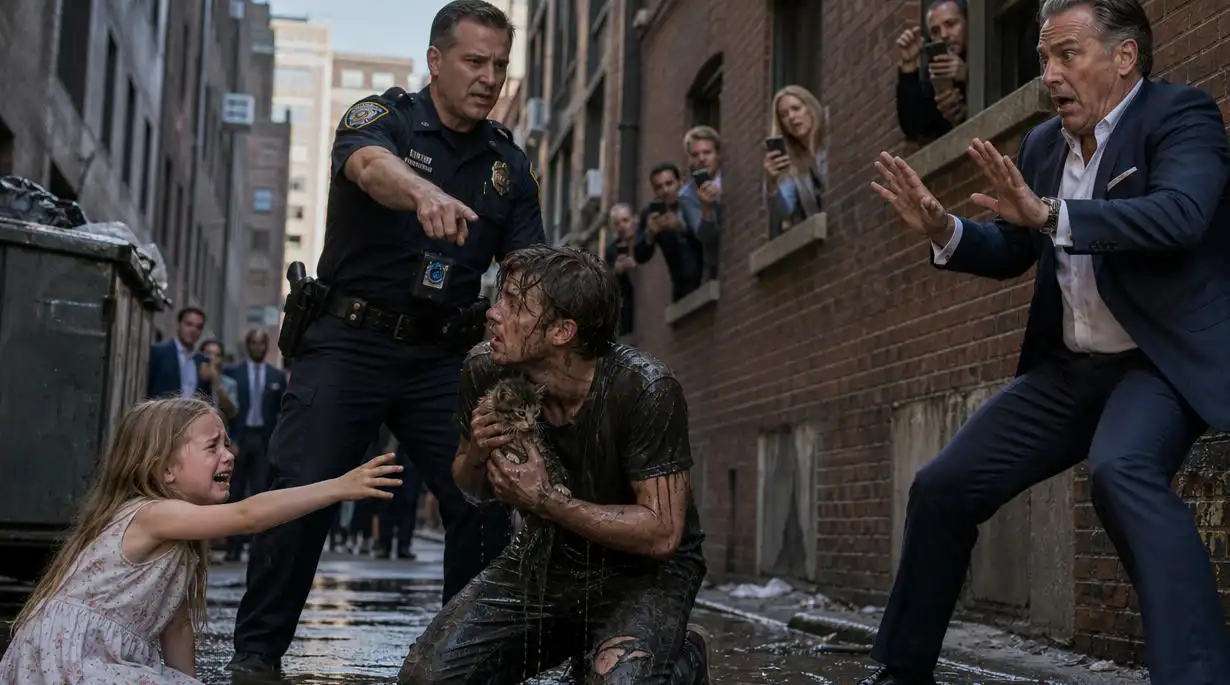
They Laughed While Security Beat the “Alley Thief”… Then One Video Made Everyone REGRET It
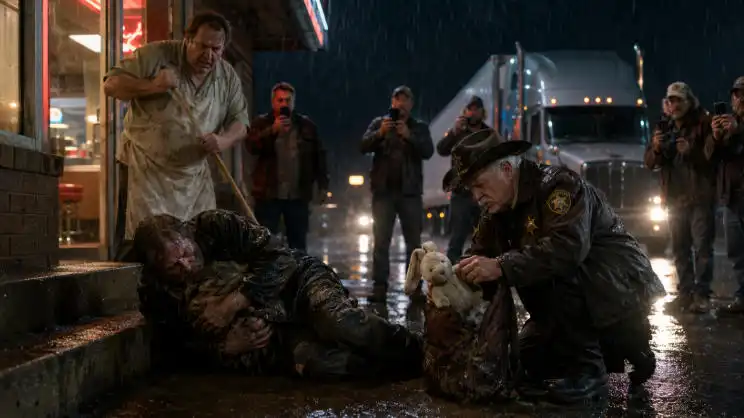
A Diner Owner Called Him a “VAMPIRE” and Kicked Him Into the Rain… Then KARMA Pulled Up in 18 Wheels
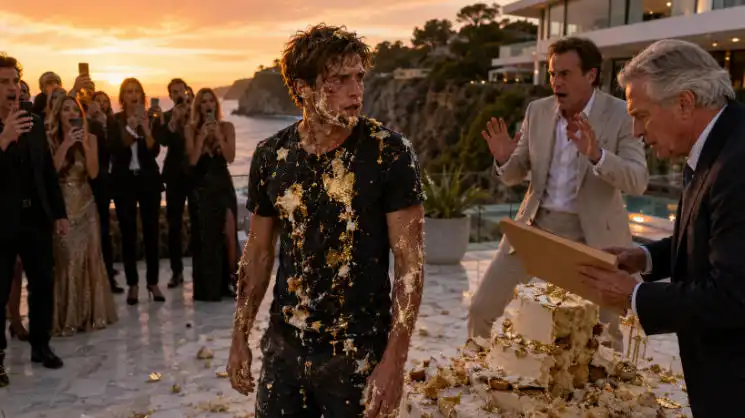
A Hollywood Producer Humiliated a Quiet Crew Worker on LIVE Video… Then KARMA Walked In Holding a Sealed Trust File