



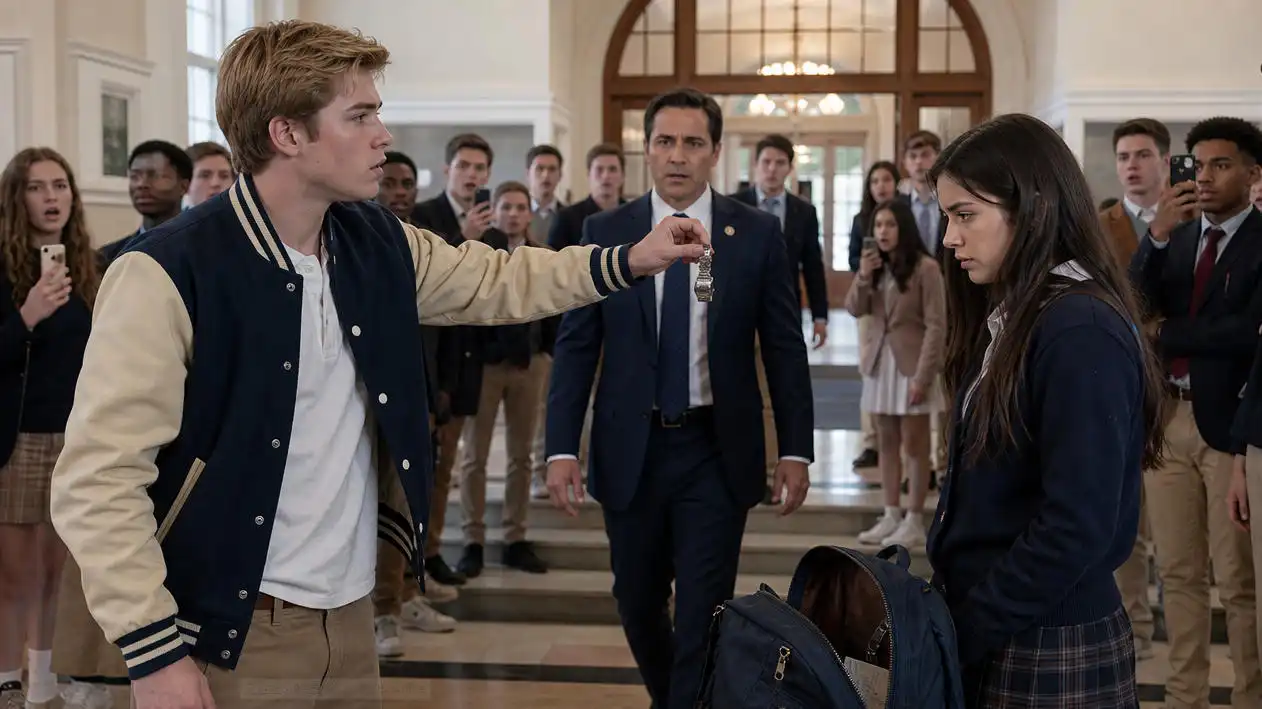
The screen froze before anyone could see the hand clearly.
For one second, the entire first-floor lobby went silent.
Even the phones stopped moving.
Logan stared at the monitor like he could scare the footage into disappearing.
My father stood beside me with one hand on my shoulder.
He didn’t raise his voice.
He didn’t threaten anyone.
That was what made the adults nervous.
He simply looked at the principal and said, “From the beginning.”
The principal swallowed.
“Mr. Hart, I think we should discuss this privately.”
My father smiled.
Not kindly.
“No. My daughter was accused publicly. The evidence can be reviewed publicly.”
A ripple moved through the crowd.
Students pressed closer.
Teachers stood at the edges of the lobby pretending they were there for crowd control, but every one of them was watching.
Logan’s friends suddenly stopped laughing.
That should have been the first warning.
People like Logan were loud when they thought the room belonged to them.
They got quiet when they realized someone else had the keys.
My name is Avery Hart.
At St. Bartholomew Academy, that name was supposed to mean nothing.
I was the scholarship girl.
I wore the same navy cardigan three days a week because I only had two good ones.
I packed my lunch in the same faded canvas bag.
I worked weekends at a bookstore two towns over.
At that school, people could smell financial weakness like smoke.
And Logan Whitmore had made a sport of reminding me.
His family donated to the school.
His mother chaired the gala committee.
His father played golf with the principal and half the board.
Their name was carved into the science wing in gold letters so big you could see it from the parking lot.
Logan didn’t walk through school.
He moved through it like an heir inspecting property.
He would snap his fingers at freshmen blocking the stairs.
He called the cafeteria staff “the help.”
He once told a teacher, “My father pays for this building,” when she gave him detention.
And nothing happened.
Nothing ever happened to Logan.
So when he chose me, everyone understood the message.
I was safe to hurt.
It started small.
My notes disappeared.
My locker combination got posted in a group chat.
Someone poured coffee into my backpack during lunch and wrote “try washing poverty out” on a napkin.
I reported it once.
The assistant principal sighed and said, “Avery, sometimes high-achieving students experience social friction.”
Social friction.
That was what they called cruelty when the cruel person’s parents wrote checks.
I learned to keep my head down.
I learned not to react.
I learned that in places like St. Bartholomew, truth mattered less than who had the louder last name.
At least, that was what Logan believed.
What he didn’t know was that my father had spent twenty-five years in Washington, D.C., making powerful people regret underestimating quiet rooms.
His name was Charles Hart.
At home, he was the dad who burned pancakes and clipped grocery coupons.
At school events, he wore old sweaters and sat in the back.
No one at St. Bartholomew knew that senators returned his calls before breakfast.
No one knew that governors hated seeing his number pop up on their phones.
No one knew he was one of the top political lobbyists in Washington.
Not because he hid it dramatically.
Because he believed a child should be judged by her character, not her father’s Rolodex.
And I agreed.
Until Logan put the principal’s watch in my backpack.
The setup happened on a Thursday.
The lobby was packed because rain had canceled outdoor lunch.
Students clustered near the trophy cases, the front office, the lockers, the stairwell.
It was the perfect stage.
That was not an accident.
I was at my locker switching books when Logan’s friends appeared.
Chase and Dylan.
They were always around him, like backup vocals for a bad song.
Chase leaned against the locker beside mine and said, too loudly, “Hey, isn’t this Avery’s bag?”
I turned.
My backpack was sitting on the bench where I had placed it ten seconds earlier.
Dylan picked it up.
“Why is it so heavy?”
“Put it down,” I said.
My voice was calm, but my stomach tightened.
Logan stood behind them with his arms crossed, enjoying himself.
Chase unzipped the front pocket.
I stepped forward.
Dylan blocked me with his shoulder.
“Relax,” he said. “Unless you’ve got something to hide.”
That was when Chase pulled out the silver watch.
The principal’s watch.
Everyone recognized it.
Principal Mercer wore it every single day, flashing it around like it was a medal for being important.
The lobby gasped.
Logan’s face transformed into fake shock.
He had rehearsed it beautifully.
“Avery,” he said, loud enough for the stairwell to hear, “tell me you didn’t.”
Phones came up.
A girl near the trophy case whispered, “Is she serious?”
Someone laughed.
Someone else said, “I always thought she was weird.”
My cheeks burned so hot I felt dizzy.
“I didn’t steal that,” I said.
Logan tilted his head.
“Then why was it in your bag?”
“I don’t know.”
“That’s convenient.”
Principal Mercer arrived almost immediately.
Not from down the hall.
From around the corner.
He looked at the watch in Chase’s hand.
Then at me.
Then at Logan.
It lasted less than two seconds, but I saw it.
A look passed between them.
Small.
Quick.
Familiar.
That was when I understood.
This wasn’t just Logan.
The principal had been waiting.
Mercer straightened his tie and said, “Avery, come to my office.”
“I didn’t do anything.”
“Avery.”
His voice hardened.
“Do not make this worse.”
Logan leaned in as I passed him.
His breath smelled like mint gum.
“You should’ve transferred when you had the chance,” he whispered.
I looked at him.
I didn’t cry.
That disappointed him.
Then I saw my father enter through the glass doors.
For a moment, the lobby blurred around him.
He wore his navy suit.
The serious one.
The one he wore when clients flew in from Texas or when networks called at midnight.
A gold congressional access pin sat on his lapel.
Not flashy.
Not decorative.
Just a tiny signal to the people who understood what doors it opened.
Principal Mercer understood.
His face changed.
“Mr. Hart,” he said, suddenly polite. “This is a school matter.”
My father walked to me first.
Not to the principal.
Not to Logan.
To me.
He placed his hand on my shoulder and said softly, “Are you hurt?”
I shook my head.
“Did anyone touch you?”
“Dylan pushed me back from my bag.”
My father’s eyes moved to Dylan.
Dylan looked away.
Then Dad turned to Mercer.
“I want campus security footage from the lobby and the east hallway.”
Mercer gave a tight smile.
“That may not be necessary.”
“It is necessary.”
“I’m sure we can handle this internally.”
My father nodded once.
“Then handle it correctly.”
Mercer’s jaw flexed.
“Mr. Hart, the watch was found in Avery’s backpack.”
“By whom?”
Mercer blinked.
“Excuse me?”
“My daughter’s property was searched. By whom?”
Chase lifted the watch slightly, suddenly realizing he was still holding it.
My father looked at him.
“You?”
Chase’s confidence cracked.
“I mean, we found it.”
“You searched a student’s bag without staff supervision?”
No one answered.
My father turned to Mercer.
“And you allowed evidence in an alleged theft to be handled by students before any formal report?”
Mercer’s face flushed.
“This is not a courtroom.”
“No,” my father said. “That’s why I’m being patient.”
The lobby went dead quiet.
Then Dad took out his phone.
“I’ve already contacted the school board’s legal counsel, the parent liaison, and a juvenile defense attorney who is listening now. I also notified the congressional office that recommended this academy for a civic leadership grant last year, since one of its administrators may be mishandling a disciplinary matter involving a scholarship student.”
Mercer’s mouth opened.
Closed.
Logan’s eyes narrowed.
He still didn’t understand.
People like Logan thought power meant shouting first.
My father knew power meant documenting everything before anyone realized the game had started.
Dad pointed to the security monitor behind the front desk.
“Play the footage.”
Mercer hesitated.
That was the moment the crowd sensed blood in the water.
A teacher named Mrs. Greene stepped forward.
“Principal Mercer, the cameras were working this morning. I checked them during arrival.”
Mercer shot her a look.
She didn’t step back.
My father glanced at her and gave the smallest nod.
She had been one of the few teachers who was kind to me.
That day, she became the first adult in the building to choose the truth out loud.
Mercer went behind the desk and clicked through the security system.
The monitor flickered.
A timestamp appeared.
11:42 a.m.
East hallway.
There was the principal’s office door.
There was Logan.
Alone.
The lobby inhaled.
Logan said, “That’s not—”
My father lifted one hand.
“Let it play.”
On the screen, Logan looked left.
Then right.
He opened the door to the principal’s office with a keycard.
A keycard.
Someone behind me whispered, “How does he have that?”
Logan disappeared inside.
Twenty seconds later, he came out holding something wrapped in a napkin.
He tucked it into the pocket of his varsity jacket.
The lobby erupted.
“That’s him!”
“Oh my God.”
“He stole it?”
Logan’s face went red.
“That doesn’t prove anything.”
My father stayed still.
“Continue.”
The footage changed.
11:51 a.m.
First-floor hallway outside the lockers.
There I was, walking toward the bathroom with my math binder.
My backpack sat on the bench.
Logan entered the frame.
He moved quickly.
Too quickly to be casual.
He took the wrapped object from his pocket.
Unzipped the front pocket of my backpack.
Slid the object inside.
Zipped it back up.
Then he stepped away and texted someone.
Seven seconds later, Chase and Dylan appeared.
Perfect timing.
The lobby exploded.
Students shouted.
Teachers moved in front of the younger kids.
Chase dropped the watch like it had burned him.
Dylan backed into the lockers.
Logan stared at the screen with his mouth open.
For the first time since I had known him, he had no clever line ready.
My father finally looked at him.
“Now,” he said, “we are in the courtroom part.”
Logan shook his head.
“No. No, this is being taken out of context.”
A boy in the crowd laughed.
“What context makes that okay?”
Logan snapped, “Shut up.”
That was when Principal Mercer made his fatal mistake.
He tried to save Logan.
“Students,” Mercer barked, “disperse immediately. This is a confidential disciplinary matter.”
My father turned slowly.
“Confidential?”
Mercer straightened.
“Yes. And I will not have this school turned into a circus.”
“You allowed my daughter to be accused in front of this entire lobby.”
“That was unfortunate.”
“You allowed students to search her bag.”
“I arrived after—”
“You arrived before any staff member called you.”
Mercer froze.
My father tapped his phone.
“I have the lobby audio.”
Another wave moved through the crowd.
Mercer’s skin went gray.
Dad continued, calm as winter.
“A parent near the front desk was recording the choir fundraiser display. Your voice is on that recording at 11:47, telling Logan, and I quote, ‘Make sure it is found where people can see.’”
For a second, nobody breathed.
Then Mrs. Greene covered her mouth.
Chase whispered, “Principal Mercer…”
Logan turned on him.
“Don’t say anything.”
But panic is contagious.
Dylan cracked first.
“He told us it was just a prank.”
Logan lunged toward him.
My father stepped between them before anyone else moved.
He didn’t touch Logan.
He didn’t have to.
“Careful,” Dad said quietly. “There are more cameras.”
Logan stopped.
Mercer tried to speak.
My father cut him off.
“Mr. Mercer, I am formally requesting preservation of all video, audio, keycard logs, email records, and text communications connected to this incident. I am also asking the board to suspend any disciplinary action against my daughter pending an independent review.”
Mercer forced a laugh.
“You can request whatever you like.”
Dad looked at the gold pin on his lapel, then back at Mercer.
“I’m not requesting as a frightened parent.”
He opened a folder from his briefcase.
Inside were printed pages.
Emails.
Board policies.
Scholarship protection clauses.
A copy of the student handbook.
A legal notice.
“I’m requesting as the legal representative for a parent whose child was falsely accused, physically blocked from her property, publicly humiliated, and targeted with evidence tampering on school grounds.”
Mercer stared at the folder.
Logan’s mother arrived during that sentence.
Of course she did.
Tall.
Perfect hair.
Cream-colored coat.
The kind of woman who looked offended by fingerprints on glass.
“What is going on here?” she demanded.
Logan rushed toward her.
“Mom, they’re trying to twist this.”
She placed a manicured hand on his shoulder and looked at me like I was gum under her shoe.
“This is ridiculous,” she said. “Avery has always seemed unstable.”
My father’s expression didn’t change.
Mrs. Whitmore continued, louder.
“My son would never risk his future over some girl desperate for attention.”
That did it.
A few students booed.
One girl yelled, “We saw the video!”
Mrs. Whitmore snapped, “Children do not understand context.”
My father said, “Then explain it.”
She blinked.
“Excuse me?”
“Explain the context in which your son enters the principal’s office, removes the watch, plants it in my daughter’s backpack, coordinates a public discovery, and allows her to be accused of theft.”
Mrs. Whitmore lifted her chin.
“I will not be interrogated by you.”
“No,” Dad said. “You’ll be interviewed by the board’s investigator, and possibly by law enforcement if Mr. Mercer files the original theft report he was so eager to assign to Avery.”
Mercer flinched.
Because filing that report now meant reporting Logan.
Mrs. Whitmore looked at Mercer.
“Arthur?”
That one word told the whole room enough.
Arthur.
Not Principal Mercer.
Arthur.
Family friend.
Political ally.
Dinner guest.
My father caught it too.
“Thank you,” he said softly.
“For what?” she snapped.
“For confirming the relationship.”
The next hour changed everything.
The board chair arrived.
Then the school attorney.
Then two security officers.
Students were sent to class, but by then the lobby video had already traveled through half the school.
Someone had filmed the monitor.
Someone had filmed Logan’s face.
Someone had filmed my father saying, “No. My daughter was accused publicly.”
By 3 p.m., St. Bartholomew Academy was no longer managing a theft.
It was managing a scandal.
And scandals are very different when the wrong people notice.
My father did not scream.
He did not curse.
He did not demand special treatment.
He demanded process.
That was worse for them.
Because process left records.
He asked for the keycard logs.
They showed Mercer’s administrative override had been used to grant Logan access to the principal’s office at 11:39 a.m.
Mercer claimed he had not done that.
Then the IT director produced a login record.
Mercer’s password.
Mercer’s terminal.
Mercer’s office computer.
At 11:36 a.m.
Then came the texts.
Dylan handed over his phone first.
Chase followed ten minutes later.
Logan had written:
“She won’t fight back.”
Then:
“Mercer said make it public so scholarship committee sees it.”
That text was the blade.
Because the real motive finally came out.
I had beaten Logan for the Harrington Civic Leadership Scholarship.
Full tuition.
Internship placement.
A summer program in Washington.
Logan’s family thought it was supposed to be his.
They had donated.
They had hosted dinners.
They had smiled at the right people.
But the committee had chosen me because of my essays, my volunteer work, and my grades.
Logan could not stand it.
His mother could not stand it.
And Mercer had apparently promised them there would be “room to reconsider” if I became “disciplinarily ineligible.”
So they built a story.
Poor girl.
Stolen watch.
Public discovery.
Scholarship revoked.
Logan restored.
Clean.
Simple.
Cruel.
Except they forgot one thing.
I had a father who taught me, from the time I was little, that when powerful people behave badly, you don’t just get mad.
You get receipts.
Two weeks earlier, after my locker combination was posted online, Dad had asked me to write down every incident.
Dates.
Times.
Names.
Witnesses.
Screenshots.
He said, “Most bullies don’t fall because of one big mistake. They fall because every little mistake has a timestamp.”
I thought he was just trying to make me feel less helpless.
He was building the file.
The school board met that night in emergency session.
My father did not let them hide behind “student privacy” to bury what had been done to me.
He kept my name out of the press.
But he made sure the facts could not disappear.
A student had been framed.
A principal had enabled it.
A donor family had pressured school leadership over a scholarship decision.
A public accusation had been staged to create grounds for removal.
By morning, Principal Arthur Mercer was placed on administrative leave.
By Friday, he resigned.
Not “to spend more time with family.”
Not “to pursue other opportunities.”
Resigned after an independent investigator confirmed misconduct and policy violations.
His office was emptied before lunch.
I watched from the second-floor window as he carried a cardboard box to his car.
For two years, I had walked past that office feeling small.
Now the man who had tried to ruin my future couldn’t even meet my eyes through a pane of glass.
Logan’s punishment came in waves.
First, suspension.
Then expulsion.
Then the academy notified the scholarship committee that my award would remain intact and that Logan’s application had been permanently withdrawn.
Chase and Dylan were expelled too.
They tried to say they were pressured.
Maybe they were.
But they still laughed when they opened my bag.
They still blocked me when I reached for my property.
They still let a crowd believe I was a thief.
Choices have weight.
For the Whitmore family, the consequences spread beyond school.
My father never made a public speech.
He didn’t have to.
In Washington, reputation moves faster than paperwork.
The gala committee quietly removed Mrs. Whitmore’s name.
Two political nonprofits returned pledged donations.
A consulting contract tied to Mr. Whitmore’s firm evaporated after board members learned about the attempted scholarship interference.
Their family had built their power on being welcomed into every room.
Now doors closed before they reached them.
People stopped returning calls.
Invitations vanished.
A newspaper ran a careful, legally reviewed story about donor influence at elite private schools.
No minors were named.
No gossip.
Just facts.
But people knew.
They always know.
Three months later, the Whitmore foundation announced it was “restructuring.”
By winter, their company filed for bankruptcy protection after losing two major clients.
I did not cheer when I heard.
That surprised people.
They expected me to celebrate.
But revenge, real revenge, is not screaming when someone falls.
It is standing upright after they tried to make you crawl.
On my first day back after the investigation, the lobby felt different.
Students watched me, but not with pity.
With caution.
With respect.
Some apologized.
Most didn’t.
Mrs. Greene met me near the lockers and handed me a new blue notebook.
“For Washington,” she said.
I smiled.
“Thank you.”
She squeezed my shoulder.
“You earned your place, Avery. Don’t ever let anyone make you feel like you snuck in.”
That was the first time I almost cried.
Not when they called me a thief.
Not when Logan smirked.
Not when the watch came out of my bag.
But when someone finally said out loud that I belonged.
My father waited outside that afternoon.
Same old car.
Same grocery-store sunglasses.
Same man everyone had mistaken for ordinary.
I got in and sat quietly for a moment.
Then I said, “Did you know Logan would do something like that?”
Dad sighed.
“I hoped he wouldn’t.”
“But you were ready.”
“I’ve spent my whole life around people who think rules are obstacles for other people,” he said. “They usually make the same mistake.”
“What mistake?”
He looked toward the school.
“They confuse kindness with weakness.”
I watched students spill out through the front doors.
The same doors I had wanted to disappear through just days before.
“What happens now?” I asked.
Dad smiled.
“Now you go build a life so good that this becomes the smallest story people tell about you.”
That summer, I went to Washington.
Not because of my father.
Because of the scholarship Logan tried to steal.
I walked through marble halls.
I sat in committee rooms.
I learned how policy was written, how influence worked, and how easily systems could be bent when nobody was watching.
And every time I saw someone in power speak down to an intern, an assistant, a janitor, or a student, I remembered Logan in that lobby.
I remembered the watch.
I remembered the crowd.
I remembered my father’s hand on my shoulder.
Don’t say a word.
Not because silence meant surrender.
Because sometimes the strongest move is letting the evidence speak first.
Years later, people at St. Bartholomew still tell the story.
They say Avery Hart became untouchable after that day.
Maybe that is true.
But not because my father was powerful.
Not because Logan lost everything.
Not because the principal carried his career out in a cardboard box.
I became untouchable because I finally understood something no bully wants you to know:
Your dignity does not come from whether the crowd believes you.
It comes from refusing to become what they accuse you of being.
Logan wanted me frantic.
He wanted me crying.
He wanted me begging people to believe me.
Instead, I stood still.
And the truth walked in wearing a navy suit.
So yes, Logan lost his school.
His friends lost their places.
Mercer lost his office.
The Whitmore family lost the protection they thought money could buy.
But I gained something bigger than revenge.
I gained my voice.
I gained my future.
And I gained the certainty that quiet people are not easy targets.
Sometimes they are just waiting for the camera to finish recording. ⚖️
Pick a side: Avery’s father handled it perfectly… or he went too far by making the reckoning public. Share this if you believe public humiliation deserves public truth.
Disclaimer: Mention of any brand or trademark is for identification only and does not imply partnership or endorsement

The Store Manager Splashed Hot Coffee On A Poor-Looking Electrician’s Face… But She Had NO IDEA He Owned The Power Behind Her Throne
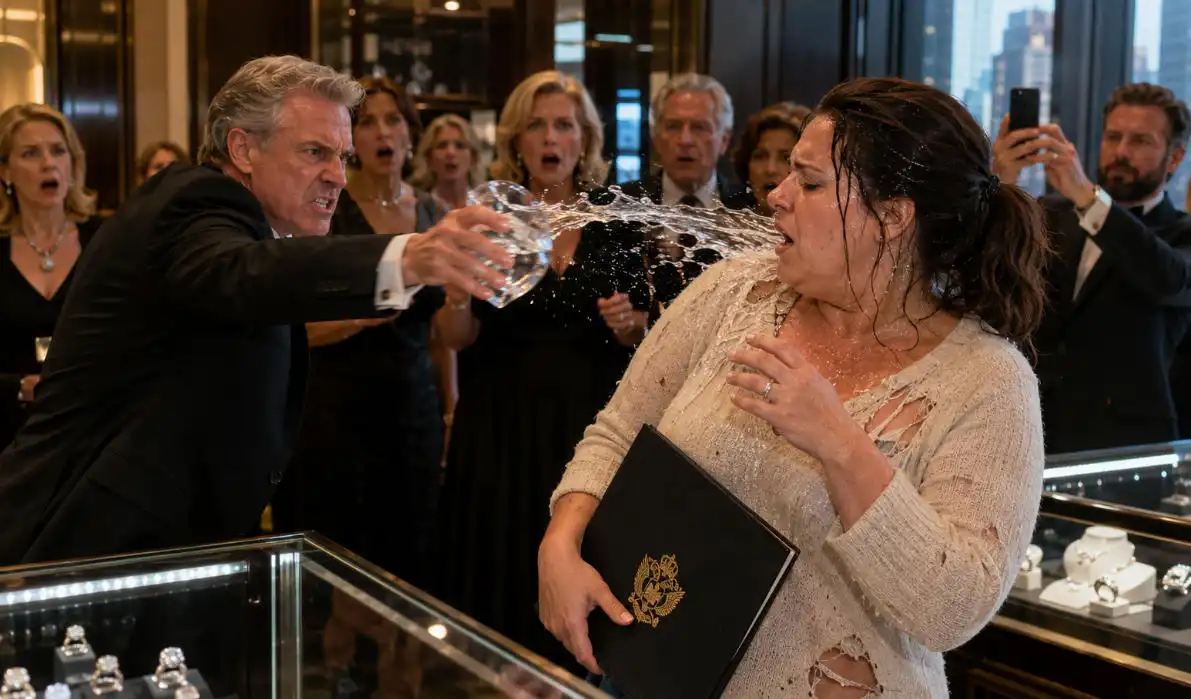
A Plump HOUSEWIFE Was Humiliated At A Cartier VIP Event… But The Snobby Appraiser Had NO IDEA Who She Really Was 💎
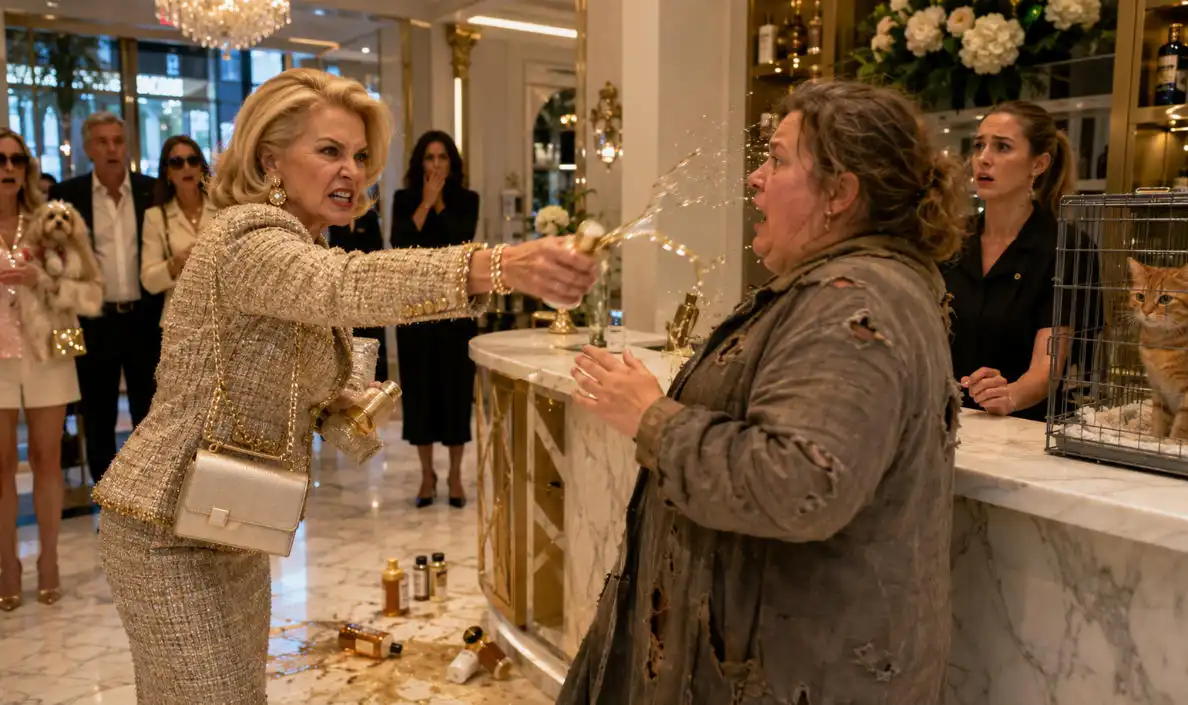
A Chubby Shelter Volunteer Was HUMILIATED In A Luxury Beverly Hills Pet Spa By A Rich Woman… But They Had NO IDEA Who She Really Was 😳