
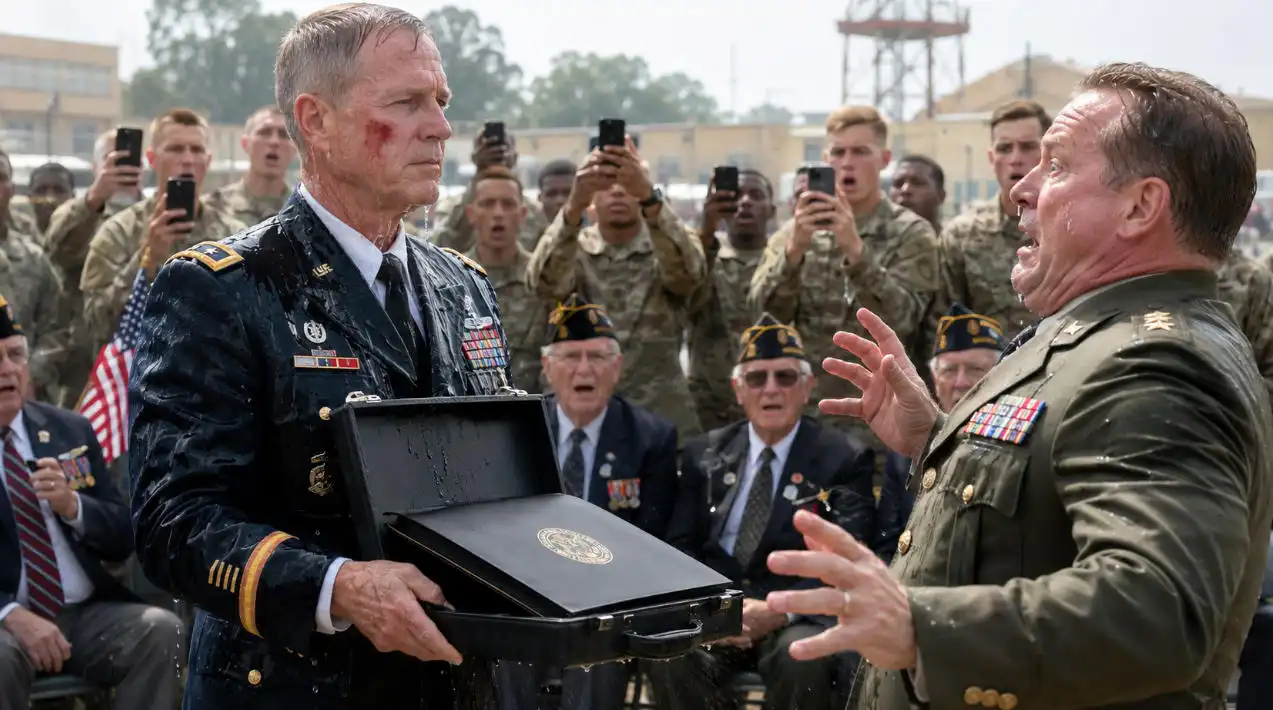
The slap was still ringing across the parade field when Justin opened the black briefcase.
Nobody moved.
Not the recruits.
Not the officers.
Not even Deputy Commander Dick, whose hand was still hanging in the air like he had forgotten it belonged to him.
Justin stood there soaked from collar to belt, water dripping from his jaw onto the concrete, and looked at the man who had just hit him.
“Deputy Commander,” Justin said quietly, “you just made this official.”
Dick blinked.
The whole battalion watched.
Four elderly veterans stood under the brutal sun beside the stage, their dress jackets too heavy for the heat, their faces red from waiting.
They had been invited there for honor.
Instead, they had been treated like a problem.
And the man who did it had a rank on his chest, a smug smile on his face, and the kind of confidence that comes from believing consequences are for other people.
His name was Deputy Battalion Commander Dick.
Everyone on base knew the story.
Dick did not rise because he was respected.
He rose because his family owned a defense-supply company that had been feeding contracts into military training programs for years.
Field tents.
Cooling stations.
Ceremonial staging.
Uniform accessories.
Cheap equipment with expensive invoices.
His uncle played golf with people who signed procurement paperwork.
His father hosted fundraisers.
His wife posted photos from “patriotic charity galas” where she smiled beside men who outranked almost everyone at the camp.
Dick carried himself like the base was not a command.
It was a family business.
That morning, he had decided four old veterans were bad for optics.
“They’re dusty,” he said before the formation began.
A young lieutenant looked uncomfortable.
“Sir, they’re decorated combat veterans.”
Dick adjusted his sunglasses.
“They were decorated a long time ago. Today is about readiness, cameras, and donors. I don’t need four ancient ghosts making the camp look like a retirement home.”
The lieutenant said nothing.
Because everyone knew what happened when you corrected Dick.
Bad assignments.
Frozen recommendations.
Missing paperwork.
Sudden fitness complaints.
One recruit had been sent to clean vehicle bays for three weeks after asking why a shipment of cooling fans arrived broken.
Another had watched his transfer request disappear after refusing to carry Dick’s personal golf bags to a staff vehicle.
Dick did not just punish people.
He made examples out of them.
So when the veterans arrived before noon, nobody dared tell them the truth.
They were led to the side of the parade platform.
No shade.
No chairs.
No water station.
One of them, a thin man named Sergeant Major Ellis, leaned on a cane and asked a corporal, “Son, are we in the right place?”
The corporal swallowed hard.
“Yes, sir.”
Another veteran, Mr. Caldwell, smiled faintly.
“Been a long time since anyone called me sir.”
The corporal looked like he might cry.
The recruits noticed.
They were young, sunburned, and exhausted from morning drills, but they noticed everything.
They saw the old men standing.
They saw the empty chairs under the canopy reserved for donors.
They saw Dick walk past the veterans without saluting, without speaking, without even looking them in the eye.
Then they saw Justin.
At first, nobody paid much attention to him.
He looked like a records-office employee.
Older white man.
Plain tan shirt.
Gray hair cut short.
Thin black tie.
Polished shoes that had seen better days.
A black briefcase in his left hand.
He did not enter with security.
He did not announce himself.
He simply walked to the side table, signed in as “Justin — Records Office,” and watched.
He watched the veterans.
He watched the recruits.
He watched Dick tell the band to stand down.
He watched the ceremony program get folded and shoved beneath a clipboard.
Then he walked up to Dick.
“Deputy Commander,” Justin said, “the official decoration ceremony has not begun.”
Dick turned like someone had touched the sleeve of a king.
“Who are you?”
“Justin.”
“I can read a cheap name tag.”
“I’m here regarding the honors list.”
Dick laughed.
The sound carried because the microphones on the stage were already live.
“The honors list?”
“Yes, sir.”
Dick stepped closer.
“Listen carefully, Justin from Records. This ceremony is canceled.”
A murmur passed through the recruits.
One of the veterans looked up.
Justin did not flinch.
“On whose authority?”
That question changed the air.
Officers near the stage looked away.
The lieutenant who had spoken earlier stared at the ground.
Dick’s jaw tightened.
“My authority.”
Justin nodded once.
“Then I’ll need you to state that on record.”
Dick smiled.
“Oh, will you?”
He took the bottle of water from his aide’s hand.
The aide froze.
Dick twisted off the cap.
“Here’s my statement.”
He lifted the bottle and poured it over Justin’s head.
Cold water ran down Justin’s forehead, over his glasses, into his shirt.
A few recruits gasped.
A phone came up.
Then another.
Then five more.
Dick leaned in.
“You clerks get confused when you spend too much time around paper. You start thinking ink outranks command.”
Justin wiped water from his chin.
“Deputy Commander, I advise you to stop.”
Dick’s face darkened.
“You advise me?”
Then he slapped him.
Hard.
Justin’s head turned slightly from the blow.
The sound cracked against the parade platform.
A woman in the donor section covered her mouth.
One of the elderly veterans took a step forward.
Justin raised one hand.
“Please stay where you are, Sergeant Major.”
The veteran stopped.
Not because Justin sounded afraid.
Because he sounded like a man giving a lawful instruction.
Dick noticed that tone too.
For the first time all morning, his confidence twitched.
“Who did you say you were?”
Justin slowly removed his glasses.
His cheek was red.
His shirt was drenched.
His voice stayed calm.
“I told you my first name.”
Then he turned to the recruits.
“Keep recording.”
That was when the parade field went completely silent.
Justin set the black briefcase on the table.
He clicked the first lock.
Then the second.
The snaps sounded small.
But somehow they carried farther than the slap.
Inside was a leather folder sealed in clear protective wrap.
Gold border.
Raised eagle.
Red ribbon.
A document control number printed in black.
The lieutenant nearest Dick went pale.
Dick saw his face.
“What?” Dick snapped. “What are you looking at?”
The lieutenant did not answer.
Justin removed the folder and placed it flat on the table.
He did not open it yet.
He let everyone see the seal.
Then he pulled out a small identification case and set it beside the folder.
A Pentagon badge.
Not a visitor badge.
Not a contractor badge.
A command-level credential.
The donor section began whispering.
Dick stared at it.
His mouth opened.
Nothing came out.
Justin spoke into the live microphone.
“My name is Justin Hale. Senior Historical Decorations Officer, Pentagon Honors and Political Review Division.”
The parade field went still.
Even the recruits who had been filming seemed to forget they were holding phones.
Justin continued.
“I oversee delayed military honors, post-service valor verification, political clearance review, and ceremonial compliance for presidentially authorized decorations.”
Dick’s face drained.
“Turn off the microphone,” he hissed.
Nobody moved.
Justin looked at the sound technician.
“Leave it on.”
The technician nodded like his life depended on it.
Justin finally opened the folder.
Page one carried a signature.
Not printed.
Not stamped.
Hand-signed.
The President’s authorization for delayed formal recognition of four veterans whose actions had been buried in classified records for decades.
Sergeant Major Ellis.
Corporal Bennett.
Specialist Caldwell.
Staff Sergeant Monroe.
Four names.
Four lives.
Four men who had been invited to stand in the heat while a career climber decided they were inconvenient.
Justin turned to the first page.
“These veterans were part of a classified extraction operation thirty-two years ago,” he said. “Their citations were delayed under national security restrictions. Those restrictions were lifted eight months ago.”
One recruit whispered, “Oh my God.”
Justin went on.
“The Office of Military Honors instructed this command to provide ceremonial presentation, medical accommodation, seating, hydration, and full formation recognition.”
He looked at Dick.
“You received that instruction nineteen days ago.”
Dick swallowed.
“I receive a lot of paperwork.”
Justin nodded.
“Yes. And you marked this one as ‘nonessential optics.’”
The lieutenant’s head snapped up.
Dick turned on him.
“Who gave him that?”
Justin pulled out another page.
“You did. In your internal memo.”
A low noise moved through the crowd.
Not a shout.
Not applause.
Something heavier.
Recognition.
The sound people make when a bully’s mask starts slipping in public.
Dick tried to recover.
“This is being taken out of context.”
Justin turned another page.
“Then let’s add context.”
He lifted a printed email chain.
“Your staff requested that the ceremony canopy be reserved for private donors from Dickson Defense Supply.”
Dick’s wife, seated under that canopy, stiffened.
Justin continued.
“The veterans’ chairs were removed from the official seating chart at 7:42 this morning.”
He turned another page.
“The cooling station funded for this event was invoiced by your family company.”
He paused.
“But never installed.”
The recruits started murmuring louder.
One of the old veterans closed his eyes.
He had stood two hours in the sun while money meant for their care had turned into someone else’s invoice.
Dick’s voice rose.
“That is a procurement issue. You have no authority over contracts.”
Justin looked at him for a long moment.
“You’re right.”
Dick almost smiled.
Then Justin said, “That is why the Defense Contracting Integrity Office is waiting at the main gate.”
The smile died before it fully formed.
Two black SUVs rolled slowly onto the far edge of the parade ground.
Military police stepped out first.
Then two civilian federal auditors in dark suits.
Then a regional general with a sealed command folder under one arm.
The recruits turned their phones toward the vehicles.
Dick whispered, “No.”
Justin’s voice remained steady.
“This inspection was scheduled before I arrived. Your behavior today simply made the command decision easier.”
The general crossed the field without hurry.
He was silver-haired, broad-shouldered, and furious in the quiet way only powerful men can be furious.
He stopped beside Justin.
“Officer Hale.”
Justin nodded.
“General Maddox.”
The general looked at Justin’s wet shirt.
Then at the red mark on his cheek.
Then at Dick.
“You struck a Pentagon officer during an active honors compliance review.”
Dick tried to speak.
“Sir, I didn’t know—”
The general cut him off.
“That is not a defense. That is the confession.”
The line hit the field like thunder.
A few recruits could not help themselves.
They reacted.
Not with laughter.
With that sharp breath people make when truth finally lands where it belongs.
Dick looked around and saw every phone pointed at him.
The veterans.
The recruits.
The donors.
The officers who had feared him for months.
Everyone saw him now.
Not as a commander.
As a man who had poured water on honor and slapped the person sent to protect it.
Justin picked up the presidential honors list.
“Deputy Commander Dick, you are hereby removed from the active promotion slate pending political suitability review.”
Dick’s knees bent slightly.
“No. You can’t do that.”
Justin turned to the general.
General Maddox opened his sealed folder.
“I can.”
The general removed one page and read aloud.
“Effective immediately, Deputy Commander Richard ‘Dick’ Harmon is relieved of ceremonial command authority, suspended from eligibility for advancement, and referred for conduct unbecoming, obstruction of honors compliance, misuse of military event resources, and improper influence related to vendor access.”
Dick’s wife stood under the canopy.
“Richard?”
He did not look at her.
Justin turned another page.
“Additionally, Dickson Defense Supply and all associated entities are suspended from new military procurement consideration pending full review.”
That was when Dick’s father, seated in the donor section, stood up so fast his chair fell backward.
“You can’t suspend a company because of a misunderstanding!”
One of the federal auditors stepped forward.
“It isn’t a misunderstanding, Mr. Harmon. Your company billed the government for veteran accommodations that were not provided.”
The father’s face turned gray.
The recruits heard it.
The officers heard it.
The veterans heard it.
The whole family machine was being exposed on the very stage Dick had tried to use for vanity.
Dick turned on Justin.
“You set me up.”
Justin shook his head.
“No. I gave you every chance to follow the order.”
“You came dressed like a clerk.”
“I came dressed like the kind of person you ignore.”
That sentence moved through the formation like fire.
The lieutenant who had been afraid all morning finally lifted his head.
Sergeant Major Ellis gripped his cane tighter.
Justin looked at the old veterans.
His expression changed.
Not softer exactly.
But human.
“Gentlemen,” he said, “I apologize for the delay. You were owed better.”
Sergeant Major Ellis nodded once.
His voice was rough.
“We’ve waited thirty-two years, son. Another morning didn’t kill us.”
Justin’s jaw tightened.
“It should not have happened.”
Dick suddenly stepped backward.
The military police moved in.
“Deputy Commander Harmon,” one of them said, “you need to come with us.”
Dick raised both hands.
“Hold on. This is insane. I am still an officer.”
General Maddox looked at him.
“Not on this field.”
Dick’s face twisted.
Then, in a panic, he did the worst possible thing.
He pointed at the veterans.
“This whole circus is for them? They’re old men! Nobody even remembers what they did!”
The field froze.
That line stripped away the last thin layer of professionalism.
Even some senior officers looked disgusted.
Justin closed the folder.
Then he stepped close enough that only the front rows could hear clearly, though the microphone still caught every word.
“You’re wrong.”
He turned toward the recruits.
“These men went into a hostile valley under blackout conditions to pull out twenty-six trapped American and allied personnel. Their unit took fire for seven hours. They held their position after communication failed. Two of them carried wounded soldiers on broken legs. One of them refused evacuation until every younger man was out first.”
The veterans looked down.
Not proud.
Not dramatic.
Just quiet.
Because men who survive things like that do not always know what to do with applause.
Justin continued.
“Their after-action reports were sealed. Their witnesses were scattered. Their recognition was delayed, then misplaced, then buried under administrative excuses.”
He looked at Dick.
“And today you tried to bury them one more time.”
Dick’s mouth trembled.
The general gave a short order.
“Remove his insignia.”
An officer stepped forward.
Dick jerked away.
“You’re not doing this in front of them.”
General Maddox’s voice hardened.
“You humiliated them in front of everyone. You will answer in front of everyone.”
The officer removed Dick’s command badge.
Then the shoulder insignia.
Then the ceremonial aiguillette he had been wearing for the donor cameras.
Piece by piece, the image Dick had built came apart.
The recruits watched in silence.
His father sat back down like his legs had stopped working.
His wife covered her face.
And the veterans stood with the dignity Dick had tried to steal.
Then General Maddox pointed toward the four elderly men.
“Apologize.”
Dick stared at him.
“Sir?”
“On your knees.”
The field held its breath.
Dick looked at the phones.
The recruits.
The donors.
The auditors.
The general.
There was no private exit.
No friendly hallway.
No uncle to call.
No office door to close.
Slowly, shaking with rage and shame, Dick lowered himself to the concrete in front of the veterans.
His voice came out cracked.
“I apologize.”
Justin said nothing.
General Maddox did.
“For what?”
Dick’s eyes filled with hatred.
“For disrespecting your service.”
The general waited.
Dick swallowed.
“For canceling your ceremony.”
The silence deepened.
“And for using my position to put my interests above your honor.”
Sergeant Major Ellis looked at him for a long time.
Then he said, “Don’t apologize because you got caught. Remember why you knelt.”
Dick had no answer.
The military police lifted him by the arms and escorted him off the field.
Nobody cheered.
Not yet.
It was too heavy for cheering.
Justice sometimes arrives not like fireworks, but like a door finally closing on a man who thought he owned the building.
When Dick disappeared behind the SUVs, Justin turned back to the stage.
His shirt was still wet.
His cheek was still red.
But his hands were steady.
“General,” he said, “permission to continue the ceremony.”
General Maddox nodded.
“Granted.”
The band leader, who had been frozen near the platform, lifted his baton.
The first notes of the anthem rose over the parade ground.
This time, every recruit stood taller.
The canopy seats were cleared.
The veterans were brought forward.
Chairs were placed under shade.
Cold water was handed to each of them first.
Not donors.
Not officers.
Them.
A medic quietly checked their blood pressure.
Sergeant Major Ellis tried to wave him off.
Justin leaned in.
“Please let him do his job, Sergeant Major. I have become very strict about accommodations today.”
The old man gave a tired smile.
“Fair enough.”
Then Justin walked to the microphone.
“Today,” he said, “we correct a debt.”
His voice carried across the field.
“These decorations were delayed by secrecy, mishandled by bureaucracy, and nearly obstructed by arrogance. But valor does not expire.”
A few recruits wiped their eyes before the medals even appeared.
Justin opened the case.
Four medals rested inside.
Heavy.
Bright.
Long overdue.
He called the first name.
“Sergeant Major Thomas Ellis.”
The old man rose slowly.
His cane clicked once on the stage.
Justin stepped forward and pinned the medal to his jacket.
“For extraordinary courage under hostile fire, for refusing evacuation, and for preserving the lives of those placed in your care.”
Ellis stared straight ahead.
His lips trembled once.
Then steadied.
The recruits applauded.
At first respectfully.
Then louder.
By the time the second veteran stepped forward, the applause had become thunder.
Corporal Bennett cried openly when his medal was pinned.
Specialist Caldwell laughed through tears and said, “My wife always told me I should’ve kept better paperwork.”
The whole field laughed with him.
Staff Sergeant Monroe, the quietest of them all, saluted Justin with a hand that shook.
Justin returned the salute.
Two men from different parts of the military world.
One who had carried a rifle.
One who had carried records.
Both understanding the same thing.
Honor means nothing if nobody is willing to defend it when it becomes inconvenient.
After the ceremony, the recruits broke formation only when ordered.
But once released, many approached the veterans carefully.
Not crowding.
Not performing.
Just saying thank you.
One young recruit stood before Sergeant Major Ellis and said, “Sir, I’m sorry we didn’t do anything sooner.”
Ellis put a hand on his shoulder.
“You saw it. You remembered it. Next time, act sooner.”
The recruit nodded.
“I will.”
Justin heard that.
It mattered.
Later that afternoon, the official consequences began.
Dick was removed from the command structure before sunset.
His promotion board file was frozen.
His conduct review expanded when three junior officers submitted statements about prior retaliation.
The procurement audit found inflated invoices, missing equipment, and repeated event charges tied to Dickson Defense Supply.
Within a week, the company’s military access was suspended.
Within a month, two contracts were terminated.
Within three months, Dick’s father resigned from the company board after emails revealed attempts to pressure base staff into approving incomplete deliveries.
Dick’s wife deleted every gala photo from her public page.
The family name that had opened doors now made people check paperwork twice.
As for Dick, he was discharged after formal proceedings.
Not because Justin hated him.
Not because the veterans demanded revenge.
Because rules mean nothing if powerful people can break them in public and call it leadership.
The video spread everywhere.
Millions saw the water hit Justin’s face.
Millions heard the slap.
Millions watched Dick’s expression change when the black briefcase opened.
But the part that people shared most was not the punishment.
It was the medal ceremony.
Four elderly veterans standing under the flag.
Four long-delayed honors finally placed where they belonged.
Justin later received a handwritten letter from Sergeant Major Ellis.
It said:
“Officer Hale, I thought the country had forgotten us. Turns out it was just waiting for the right man to open the right folder.”
Justin kept that letter in his desk.
Not in a display case.
Not on a wall.
In the top drawer, beside blank citation forms and a spare pair of glasses.
Because he knew there would always be another file.
Another delay.
Another person who thought old service could be ignored because the witnesses had gray hair.
And if needed, he would walk in quietly again.
With a plain shirt.
A black briefcase.
And the patience to let arrogance reveal itself.
The final ceremony photo showed Justin standing beside the four veterans.
His shirt had dried by then.
The slap mark had faded.
But everyone who had been there remembered it.
They remembered the heat.
The silence.
The insult.
The folder.
The moment a man who treated honor like paperwork learned that paperwork can become a hammer.
And most of all, they remembered Sergeant Major Ellis raising his medal gently in one hand while the recruits applauded so hard the stage shook.
That was the real ending.
Not Dick losing his rank.
Not his family losing its contracts.
Not the public apology.
The real ending was four forgotten men finally hearing an entire battalion say:
“We see you.”
And maybe that is the lesson.
Never mistake quiet for weak.
Never mistake age for useless.
And never, ever humiliate the people who carried your country before you were even strong enough to stand.
Pick a side and share it: Dick deserved to lose everything tied to that uniform — or Justin went too far by taking down the family business too. ⚖️
Disclaimer: Mention of any brand or trademark is for identification only and does not imply partnership or endorsement
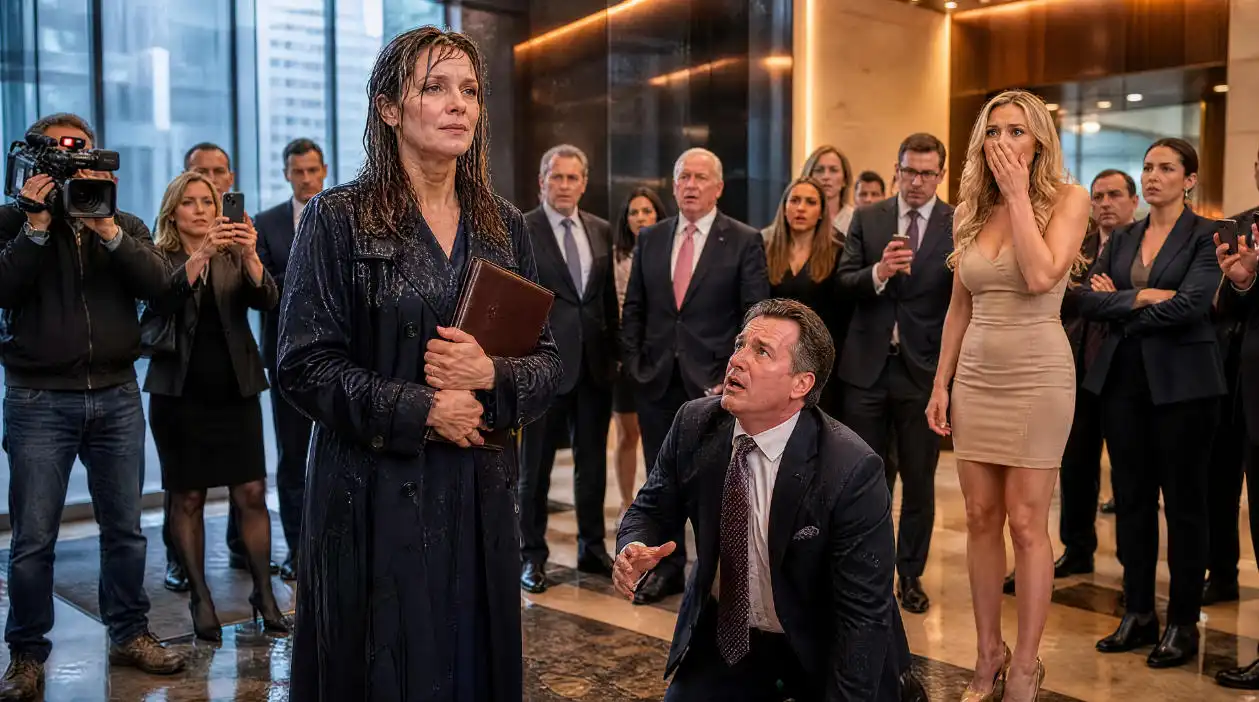
Thrift Store Customer Harper Was SLAPPED and Soaked in Coffee by Her Millionaire Ex… But He Had NO IDEA Who Really Controlled His Mansion 😳

His Fiancée Slapped His Penniless Ex-Wife in Public — Then KARMA Walked Into His Charity Gala Wearing Diamonds
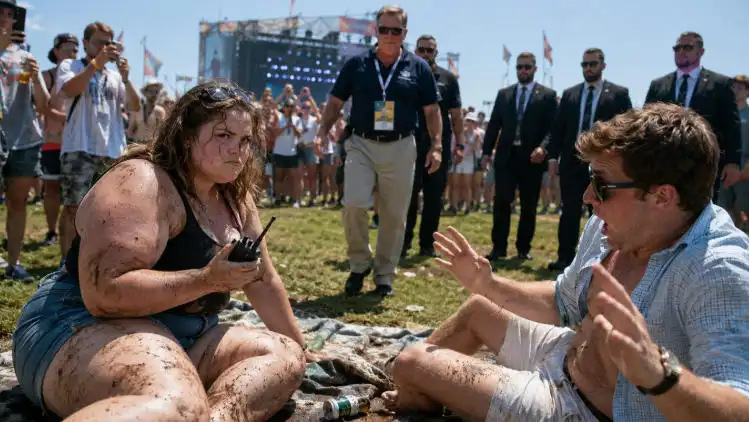
Frat Boys Stole Her Spot, Dumped Beer on Her Head, and Called Her “Nobody”… Their REGRET Came Fast