



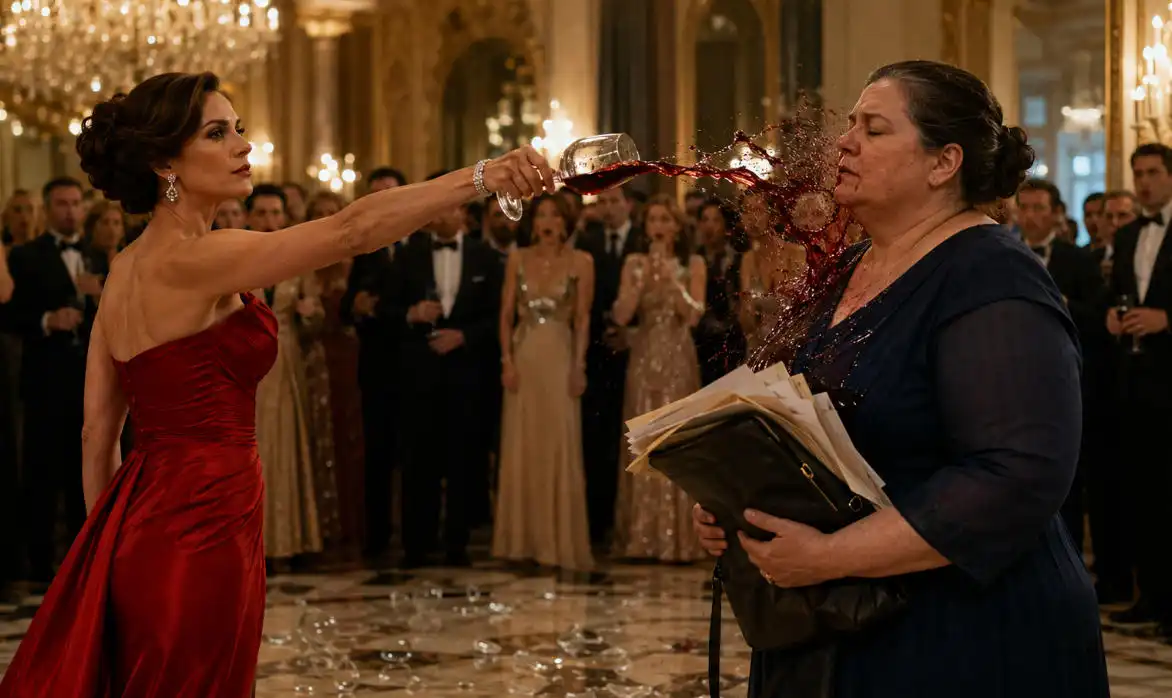
The president’s words stopped halfway through the ballroom.
Not because he forgot the sentence.
Because Tiffany had finally seen the seal on the folder.
Her family seal.
The same gold crest printed on the alumni trust invitations, the donor wall, and the scholarship brochures she had bragged about all night.
Susan was still on the marble floor.
Wine dripped from her chin.
Her dress was torn.
Her cheek was red from the slap.
And Tiffany stood over her like she had just won.
“Go ahead,” Tiffany said, forcing a laugh. “Tell them whatever little story you brought in that bargain-bin folder.”
The ballroom stayed quiet.
That was the thing about rich rooms.
People laughed when the powerful laughed.
They looked away when the powerful were cruel.
And when the powerful suddenly looked scared…
Everyone noticed.
I had not been back to my old university in twenty-seven years.
Back then, I was Susan Miller.
The quiet girl in the library.
The one who worked two jobs.
The one who could not afford the pearl earrings, the spring-break trips, or the sorority house dues.
Tiffany Caldwell had been everything I was not.
Beautiful.
Connected.
Feared.
She was the kind of woman professors greeted by name before she even opened her mouth.
I was the kind of woman they asked to carry boxes.
So when the alumni association invited me to the annual Beverly Hills Legacy Dinner, I almost threw the envelope away.
The invitation called me a “distinguished alumna.”
That made me laugh.
I was a county librarian.
I drove a twelve-year-old car.
I still used coupons.
But I went because the invitation had come with a private note from the university president.
Susan, We need you in the room this year. There are matters involving the Caldwell Fund that require your presence.
The Caldwell Fund.
That name had followed Tiffany her entire life.
Her grandfather’s money had built the alumni trust.
Her father had chaired the donor committee.
Tiffany had spent decades telling people that fund was “basically family property.”
At the dinner, she made sure everyone heard it.
“My father saved this school,” she told the women at her table. “Without the Caldwells, half these girls would be studying in a strip mall.”
People laughed.
They always laughed.
Then I walked in.
I was wearing a navy dress I bought on clearance.
My shoes were sensible.
My hair was pinned back with a drugstore clip.
And the second Tiffany saw me, her mouth curled.
“Well,” she said. “Look what the archive dragged in.”
I tried to walk past her.
She blocked me.
“Do you work here now?” she asked.
“No,” I said quietly. “I was invited.”
That made her table laugh.
One woman pretended to check my name tag.
Another whispered, “Isn’t she the library girl?”
Tiffany leaned closer.
“You always did have a talent for standing near important people.”
I said nothing.
That bothered her more than any insult could have.
I found my seat near the back.
Not at the donor tables.
Not with the legacy families.
Near the service door, beside two retired professors who did not recognize me until they squinted at my name card.
Across the room, Tiffany held court.
She talked about her daughter’s equestrian team.
Her husband’s investment firm.
Her family’s “generational duty” to guide the university.
Then the president announced that later in the evening, there would be “a major correction regarding the governance of several alumni funds.”
Tiffany’s smile tightened.
Just a little.
But I saw it.
So did the attorney sitting beside the president.
His name was Mr. Ellison.
He had called me three weeks earlier.
“Ms. Miller,” he said, “are you aware that your late aunt was the last independent fiduciary appointed to the Caldwell Women’s Education Trust?”
I had nearly dropped the phone.
My aunt Ruth had worked for the university for forty years.
Not as faculty.
Not as a donor.
As a records administrator.
She was the woman everyone ignored until they needed the one document nobody else could find.
When the original Caldwell patriarch created the trust, Aunt Ruth had been appointed as a neutral records officer after a nasty family dispute.
That appointment came with a strange clause.
If the Caldwell family ever misused restricted education funds, voting control transferred to the neutral fiduciary’s legal successor.
Aunt Ruth had no children.
She left that responsibility to me.
For years, Tiffany’s family treated the alumni fund like a private ATM.
Consulting fees.
Luxury travel billed as “donor development.”
Scholarship money delayed while Caldwell-owned vendors got paid first.
The university suspected it.
The auditors proved it.
But they needed the legal controller in the room.
Me.
That was why I carried the folder.
Not because I wanted revenge.
Because rules matter.
Especially when the people breaking them smile for cameras while poor girls lose scholarships.
Still, I had planned to handle it quietly.
I had planned to sign the transfer papers.
Let the trustees make their announcement.
Go home.
Feed my cat.
Return to work Monday.
Then Tiffany decided my silence was permission.
When dessert was served, I stood to bring my folder to Mr. Ellison.
That was when one of Tiffany’s friends stuck out her heel.
I hit the marble hard.
My folder opened.
Papers slid across the floor.
A few people gasped.
Most stared into their wine glasses like the ceiling had suddenly become interesting.
Tiffany picked up one paper.
She didn’t read it.
She just waved it.
“Look,” she said. “Susan brought homework.”
Her table laughed.
I reached for the paper.
She lifted it higher.
“Say please.”
I stood slowly.
“Tiffany,” I said, “give me the document.”
Her face changed.
Not fear.
Not yet.
Offense.
Because women like Tiffany can insult you all night, but the moment you speak to them like an equal, they call it disrespect.
She stepped closer.
“Do you know what this room costs?” she asked. “Do you know what my family has given this school?”
I looked around.
At the chandeliers.
The gold chairs.
The donor plaques.
The women who once signed yearbooks with hearts and now looked through me like glass.
“Yes,” I said. “I know exactly what your family has taken.”
The slap came so fast the room cracked silent.
My cheek burned.
Someone whispered, “Oh my God.”
Tiffany’s breathing grew heavy.
“You bitter little nobody,” she said.
Then she poured the wine.
Cold red down my face.
My neck.
My dress.
The room smelled like alcohol and roses.
I heard a phone camera click.
Then another.
Tiffany grabbed my hair when I bent for the folder.
“Still crawling after papers,” she hissed. “Some things never change.”
She shoved me.
My shoulder hit the floor.
A glass broke beside me.
My dress tore.
For one second, I wanted to scream.
Not because of the pain.
Because I was fifty-eight years old, lying on a marble floor at a university dinner, and a room full of educated adults was watching a bully relive high school.
But Aunt Ruth used to say:
“Never interrupt people while they are building the case against themselves.”
So I stayed down.
I gathered the papers.
One by one.
Then I looked at Tiffany and said:
“You really should have read the foundation bylaws.”
She laughed.
The president did not.
Mr. Ellison stepped forward.
The security director moved quietly to the side of the room.
And the president tapped the microphone.
“Ladies and gentlemen,” he said, “before we honor tonight’s legacy donors, we need to recognize the woman who legally controls the Caldwell Women’s Education Trust.”
Tiffany rolled her eyes.
“Daddy controls that trust,” she said.
Her father, seated at the front table, turned pale.
The president looked directly at me.
“Ms. Susan Miller.”
Nobody clapped.
Not at first.
They were too busy understanding the sentence.
Tiffany blinked.
“No,” she said. “That’s impossible.”
Mr. Ellison opened the folder and removed the original bylaws, the audit summary, and the signed succession order.
“It is not impossible,” he said. “It is binding.”
Tiffany’s father stood.
“Ellison,” he warned.
The attorney did not flinch.
“Mr. Caldwell, the audit found unauthorized transfers, improper reimbursements, and restricted scholarship funds redirected through Caldwell-affiliated vendors. Under Section 12-B of the trust bylaws, control transfers immediately to the independent fiduciary successor.”
He turned one page.
“That successor is Ms. Miller.”
Tiffany laughed again, but this time it broke in the middle.
“This is absurd. She’s a librarian.”
I stood up.
My knees hurt.
My hair was loose.
My cheek was swelling.
Wine had stained the front of my dress like a wound.
“Yes,” I said. “I am.”
Then I picked up the pen Mr. Ellison offered me.
The ballroom watched.
Tiffany watched.
Her father watched.
And I signed.
One signature.
That was all it took.
Not a scream.
Not a slap back.
Not a dramatic speech.
Just ink on a legal document her family had ignored for decades.
Mr. Ellison spoke into the microphone.
“Effective immediately, the Caldwell family’s administrative access to all trust accounts is revoked.”
Tiffany’s mother covered her mouth.
Her father gripped the table.
Tiffany whispered, “No.”
The attorney continued.
“All pending disbursements to Caldwell Holdings, Caldwell Events Group, and associated consulting entities are frozen pending civil review.”
Tiffany’s husband stood up and walked out.
Not quickly.
Quietly.
Like a man who had just realized the cameras were still recording.
Then the president said the sentence Tiffany would never forget.
“The university will also remove the Caldwell name from all scholarship communications until the review is complete.”
That was when Tiffany stepped backward.
Her heel hit the broken wine glass.
She stumbled.
Then she dropped to her knees on the glass-strewn marble, not from injury, but because her legs seemed to forget how to hold up a legacy.
“Please,” she said.
Not to me at first.
To the president.
To her father.
To anyone who still mattered.
Nobody moved.
Then she turned to me.
“Susan,” she said, her voice shaking. “You don’t understand. My daughter’s trust is tied to those accounts. My house. My club membership. Our company credit line. You’ll ruin us.”
I looked at her.
For a moment, I saw the girl from college.
The one who laughed when I served coffee at faculty events.
The one who told a professor I had stolen a bracelet, only for it to be found later in her own purse.
The one who taught an entire room how to pretend not to know me.
“You did that yourself,” I said.
She reached toward my dress.
I stepped back.
Security helped me move away from the glass.
The president took off his jacket and placed it over my shoulders.
That small kindness nearly broke me.
Not the slap.
Not the wine.
Kindness.
Because cruelty can make you numb.
Kindness reminds you what you survived.
The fallout began before the dessert plates were cleared.
Videos of Tiffany pouring wine on me spread through alumni group chats.
Then Facebook.
Then local news.
By morning, Caldwell Holdings announced a “temporary restructuring.”
By Wednesday, three lenders froze their lines of credit.
By Friday, the family company filed for emergency protection after the trust freeze exposed how badly they had been using nonprofit-connected money to stay afloat.
Tiffany was removed from the women’s leadership council.
Then the museum board.
Then the country club charity committee she loved more than some people love their children.
Invitations stopped coming.
Calls stopped being returned.
The same social circle that once laughed at her cruelty now acted shocked to discover it.
That part did not surprise me.
Cowards love morals after the danger is gone.
But the best part was not Tiffany losing her status.
It was the Monday after.
I stood in the university library, in the old reading room where I had once shelved books for minimum wage.
The president held a press conference.
No chandeliers.
No wine.
No designer gowns.
Just rows of young women, many of them first-generation students, sitting with their parents and trying not to cry.
He thanked me publicly.
I hated that part.
Then I made the only announcement I had wanted to make from the beginning.
“The Caldwell Women’s Education Trust will be renamed the Ruth Miller Opportunity Fund,” I said. “Every dollar will go where it was always supposed to go: tuition, books, housing, emergency grants, and childcare support for low-income women earning their degrees.”
A girl in the front row started crying into her mother’s shoulder.
Another covered her mouth.
A father in a work uniform wiped his eyes.
That was the sound of money finally reaching the people it had been stolen from.
Not applause.
Relief.
Later, Mr. Ellison told me Tiffany had tried to challenge the transfer.
She failed.
The documents were too clean.
The videos were too public.
The audit was too detailed.
Her father resigned from every university committee.
Her family sold their Beverly Hills house within six months.
Tiffany moved to a gated rental two towns away and stopped posting photos with champagne glasses and charity banners.
I never heard an apology.
Not a real one.
There was a statement from her attorney about “an emotional misunderstanding.”
There was a private message that said, “I hope you can find grace.”
I did find grace.
Just not the kind she wanted.
Grace was not pretending the slap didn’t happen.
Grace was not handing power back to people who used it to humiliate others.
Grace was making sure the next Susan did not have to crawl for papers while rich women laughed.
One year later, I attended the first Ruth Miller Opportunity Fund dinner.
Not in Beverly Hills.
In the student union.
The food was simple.
The flowers were donated.
The dresses came from everywhere: thrift stores, department stores, borrowed closets.
And every woman in that room belonged.
A scholarship recipient named Marisol stood up and said, “Because of this fund, I don’t have to drop out.”
That was my revenge.
Not Tiffany kneeling.
Not the social collapse.
Not the headlines.
That moment.
A young woman staying in school because rules finally protected the right person.
So here is the choice:
If you believe Susan was right to stay silent, use the law, and let Tiffany destroy herself in public — share this.
If you think Susan should have shown mercy after what Tiffany did in front of everyone — say that with your whole chest.
Disclaimer: Mention of any brand or trademark is for identification only and does not imply partnership or endorsement

Thrift Store Customer Harper Was SLAPPED and Soaked in Coffee by Her Millionaire Ex… But He Had NO IDEA Who Really Controlled His Mansion 😳

His Fiancée Slapped His Penniless Ex-Wife in Public — Then KARMA Walked Into His Charity Gala Wearing Diamonds

Frat Boys Stole Her Spot, Dumped Beer on Her Head, and Called Her “Nobody”… Their REGRET Came Fast