
The folder hit the counter so softly you could hear the ice melting on my shirt.
Nobody laughed now.
Not the woman with the phone.
Not the men at the bar.
Not even Chad, who still had his hand raised like he was deciding whether to slap me a third time.
The dockmaster swallowed hard.
“Mr. Whitmore,” he said, looking at Chad, “I really think you should step inside.”
Chad’s face tightened.
“Why?” he snapped. “Because this man found a coupon for a bait shop?”
A few members gave nervous little laughs.
But they were not laughing at me anymore.
They were laughing because they did not know what else to do.
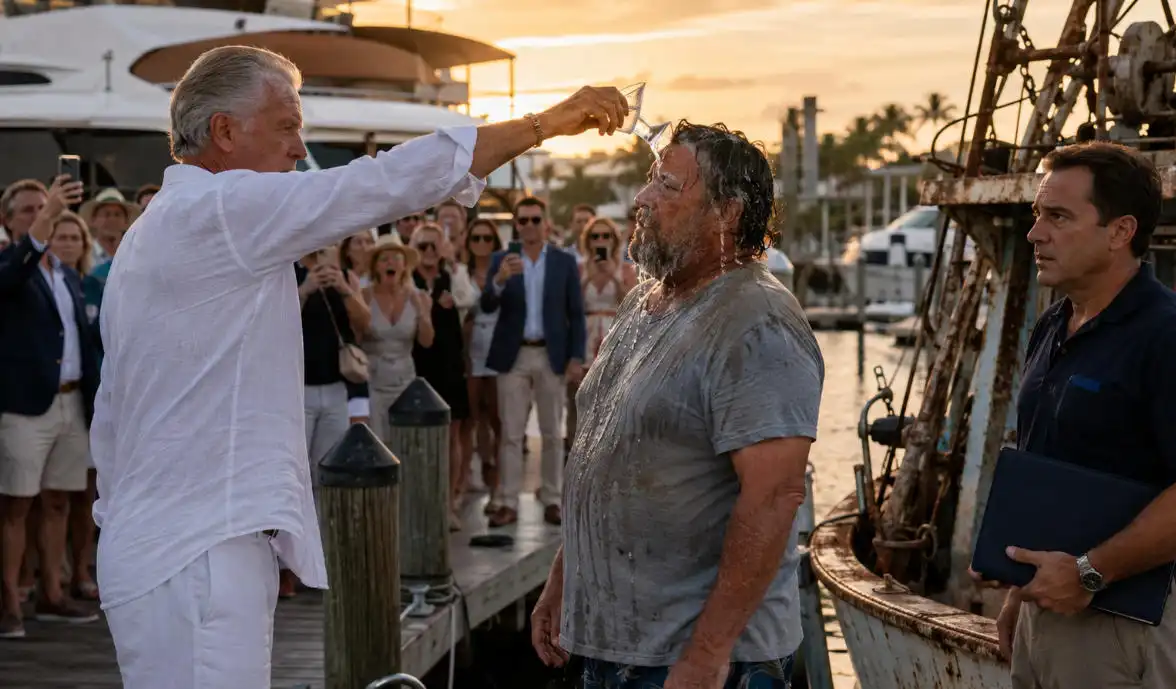
I stood there with martini dripping from my eyebrows, my torn beach shorts clutched at the side, and my old fishing boat rocking behind me like a mutt nobody wanted to pet.
That boat was my late brother’s.
He and I used to take her out before sunrise, back when Miami still felt like a place where working men could breathe.
She was ugly.
She was loud.
She smelled like salt, bait, and old memories.
But she was mine.
And I had every legal right to dock her there.
Chad Whitmore did not see a man.
He saw a belly.
A cheap hat.
A sunburn.
A boat that did not match his wine list.
That was all he needed.
Chad was the president of the Pelican Crown Yacht Club, a private marina where men measured success by the length of their yachts and women whispered the price of handbags like church prayers.
He had a 92-foot luxury yacht named Legacy.
He had a reserved premium slip.
He had a voice that made waiters apologize for existing.
And that afternoon, he decided I was the perfect person to punish in public.
“Look at him,” Chad said, turning to the dock. “This is why standards matter.”
I said nothing.
That made him angrier.
“Answer me when I’m speaking to you.”
I looked at him and said, “I heard you.”
“You heard me?” he said. “Good. Then hear this. Your boat is not welcome here.”
The dockmaster, Paul, shifted behind the counter.
“Chad,” he said carefully, “we need to verify—”
Chad cut him off.
“You work for this club.”
Paul went quiet.
That was Chad’s favorite trick.
He did not need to be right.
He only needed people scared enough to act like he was.
Then came the martini.
The slap.
The second slap.
The hair grab.
The shove.
The rip of my shorts.
The sound of my hip hitting the dock.
I remember looking up and seeing twenty faces.
Some shocked.
Some pleased.
Some filming.
Nobody helped.
That part hurt more than the fall.
Because public humiliation has a sound.
It is not always laughter.
Sometimes it is silence.
Sometimes it is the tiny click of a phone camera while your dignity is lying beside you on wet wood.
Chad stepped over me and said, “This club is not a charity dock.”
I finally spoke.
“Are you done?”
He smiled.
“Not even close.”
I nodded.
Then I asked him the question he should have feared.
“Are you absolutely sure you want this recorded?”
He spread his arms like a preacher.
“I want everyone to record it.”
So they did.
Every second.
Every insult.
Every hand he put on me.
Every member who laughed.
I did not fight back.
Not because I was weak.
Because I had already spent three months fighting in the only place that mattered.
Paper.
Contracts.
County filings.
Marina lease maps.
Mooring rights.
And one clause Chad had never bothered to read.
See, the Pelican Crown Yacht Club loved to act like it owned the water.
It did not.
It owned the clubhouse.
It owned the bar.
It owned the pool.
But the basin, the premium slips, the transient moorings, and the access rights for that section of the private marina were leased through a separate holding company.
That holding company had been bleeding money for years.
The club members never knew.
Chad knew, though.
He knew because he had been using his position to delay payments, pressure smaller slip holders, and quietly shift fees onto fishermen, service boats, and retirees who could not fight back.
My brother was one of them.
Before he passed, Chad had forced him out of a slip he had used for sixteen years.
Called his boat an embarrassment.
Raised his fees without notice.
Then gave the space to one of his buddies.
My brother had kept everything.
Letters.
Receipts.
Photos.
Emails.
And after his funeral, I found the folder in a tackle box.
That is when I started digging.
I am not a lawyer.
I am not a billionaire.
I am just stubborn.
And I had sold my plumbing company two years earlier.
Not for yacht-club money, maybe.
But for enough.
Enough to buy the defaulted marina rights when the holding company quietly put them up for sale.
Enough to hire a marine attorney.
Enough to purchase the exclusive docking and mooring rights Chad thought were beneath his attention.
So when I came to the dock that day, I was not asking permission.
I was confirming enforcement.
My old boat was not trespassing.
Chad’s yacht was.
The dockmaster opened the navy folder and pulled out a stamped agreement.
Chad’s smile flickered.
“What is that?” he demanded.
Paul looked miserable.
“It’s the executed transfer of mooring rights for Basin C, North Channel, and slips 1 through 38.”
The woman with the phone whispered, “What does that mean?”
Paul looked at me.
I gave him a small nod.
He continued.
“As of 9:00 a.m. this morning, all docking privileges in this basin are controlled by Mr. Gary Dawson.”
The whole dock froze.
Chad blinked.
Then he laughed once, sharp and fake.
“That’s absurd.”
My attorney, Mr. Alvarez, stepped out from beside the marina office.
He had been waiting there the whole time.
Gray suit.
Calm face.
No drama.
Just a leather folder and the kind of silence expensive lawyers carry.
“It’s not absurd,” he said. “It’s recorded.”
Chad looked at him.
Then at me.
Then at his yacht.
Legacy sat in the best slip in the marina, white and polished and illegal.
Mr. Alvarez handed Paul a second document.
“This is formal notice. Mr. Whitmore’s vessel has been occupying a mooring space without authorization since 9:01 a.m.”
Chad’s mouth opened.
Nothing came out.
I said, “You were notified yesterday that all premium slip assignments would need reauthorization.”
Chad pointed at me.
“You sent that?”
“My office did.”
“You’re not an office,” he said.
I looked down at my wet shirt.
“Today, apparently, I’m also not a charity dock.”
A few people gasped.
One man at the bar muttered, “Oh, Lord.”
Paul read the next page.
“Due to repeated unpaid assessments, false slip declarations, and unauthorized vessel placement, the vessel named Legacy is subject to immediate lockout pending review.”
Chad turned red.
“You can’t touch my yacht.”
Mr. Alvarez said, “No one is touching it. We are denying unauthorized docking access under the lease terms your club signed and renewed twice.”
Chad grabbed the paper.
“You people set me up.”
I finally stepped closer.
“No, Chad. You set yourself up.”
Then I pointed to the phones.
“You just did it on camera.”
His eyes shifted.
For the first time, he understood the trap.
The assault.
The slurs about my boat.
The public humiliation.
The claim that he was “protecting the club.”
All of it was recorded.
Not by me.
By his own crowd.
The same people who laughed were now holding evidence.
That is when the harbor compliance officer arrived.
Then two security guards.
Then a tow captain in a navy polo who looked like he had seen rich men cry before.
Chad backed toward his yacht.
“No. No, no, no. This is private property.”
Mr. Alvarez said, “The water access is leased. Your authority ended when the transfer executed.”
Chad pointed at Paul.
“Tell them who I am.”
Paul looked exhausted.
“You’re suspended pending board review.”
Chad stared at him.
“I made you dockmaster.”
Paul’s jaw tightened.
“And you made me watch you hurt people.”
That line hit the dock harder than the slap had hit me.
For years, everyone had acted like Chad was untouchable.
In ten seconds, he became a man standing barefoot in loafers, surrounded by phones, begging employees to protect him from the rules he used against everybody else.
The tow crew placed a notice on Legacy.
Bright orange.
Impossible to miss.
UNAUTHORIZED BERTHING — SUBJECT TO REMOVAL
Chad lunged toward it.
Security blocked him.
He shoved one guard.
Bad move.
The guard did not shove back.
He simply said, “Sir, that’s enough.”
Chad’s wife appeared from the clubhouse.
Elegant dress.
Tennis bracelet.
Face pale.
“Chad,” she whispered, “what did you do?”
He spun toward her.
“Don’t start.”
But she was watching the video on someone’s phone.
The martini.
The slap.
The hair grab.
The shove.
Me on the dock.
My torn shorts.
His voice saying, “People like you don’t belong where people like me keep their yachts.”
She covered her mouth.
The board members arrived one by one.
Men who had laughed at his jokes for years.
Men who owed him favors.
Men who suddenly remembered they had reputations.
One of them, a retired judge, looked at the video and said, “We need to remove him immediately.”
Chad heard that.
His knees bent a little.
“You’re not serious.”
The judge looked at me, then at the crowd.
“Dead serious.”
By sunset, Chad Whitmore was permanently expelled from the Pelican Crown Yacht Club.
Not quietly.
Not with a handshake.
Publicly.
His access card was disabled at the gate.
His reserved parking spot was painted over within a week.
His name was removed from the brass president’s plaque in the clubhouse lobby.
And Legacy?
That beautiful 92-foot trophy he worshipped?
It was towed from the premium slip while half the marina watched.
Chad stood on the dock crying so hard his sunglasses shook in his hand.
Not because he was sorry.
Because everyone could see him losing.
That was the only pain he understood.
The financial review came next.
It turned out Chad had approved unauthorized slip swaps, hidden late fees, and used club influence to push out smaller boat owners who made the place look “less exclusive.”
My brother’s case was not the only one.
There were nine.
Nine people.
Retirees.
A charter captain.
Two widows.
A disabled veteran.
Men and women Chad had treated like stains on his view.
The club settled with every one of them.
Paul kept his job.
The board changed its rules.
And every member now had to sign a conduct policy that said, very clearly, no person could be harassed, removed, or denied marina access based on appearance, vessel age, income, or “perceived social status.”
That last phrase was Mr. Alvarez’s idea.
I loved it.
As for Chad, his yacht was held for violations, unpaid fees, and unauthorized berthing penalties.
When he could not clear the debt, Legacy went to auction.
I did not bid.
I did not need his yacht.
I had already bought something better.
Six months later, I hosted the first annual Dawson Memorial Fishing Day at the marina, named after my brother.
No dress code.
No velvet rope.
No one checking watches.
Just coffee, breakfast sandwiches, kids with fishing poles, old captains telling lies, and working boats tied beside million-dollar yachts like they belonged to the same ocean.
Because they did.
At the end of the day, Paul walked me to the farthest dock.
“You ready to see her?” he asked.
There she was.
My new superyacht.
Sleek.
Quiet.
Ridiculous.
The kind of vessel Chad would have killed to be invited aboard.
Its propulsion system was advanced enough that one magazine called it “the future of private cruising.”
I named her Second Chance.
But my brother’s old fishing boat stayed tied right beside her.
Fresh paint.
Same cooler.
Same patched seat.
Same soul.
A reporter once asked me why I kept that old thing after everything changed.
I told her the truth.
“Because that boat tells me who I am before money tries to.”
And yes, I saw Chad one more time.
Outside the auction house.
Wrinkled shirt.
No yacht.
No club.
No crowd laughing behind him.
He looked at me and said, very quietly, “You ruined my life.”
I shook my head.
“No, Chad. I bought the dock. You brought the cruelty.”
He had no answer.
I walked away.
Not angry.
Not shaking.
Just free.
Because the best revenge is not screaming.
It is letting the rules speak loudly enough for everyone to hear. ⚓
So pick a side and say it plainly:
Was Gary ruthless for letting Chad fall in public — or did Chad finally get exactly what he earned?
Share this if you believe dignity should never depend on the size of someone’s boat.
Disclaimer: Mention of any brand or trademark is for identification only and does not imply partnership or endorsement