
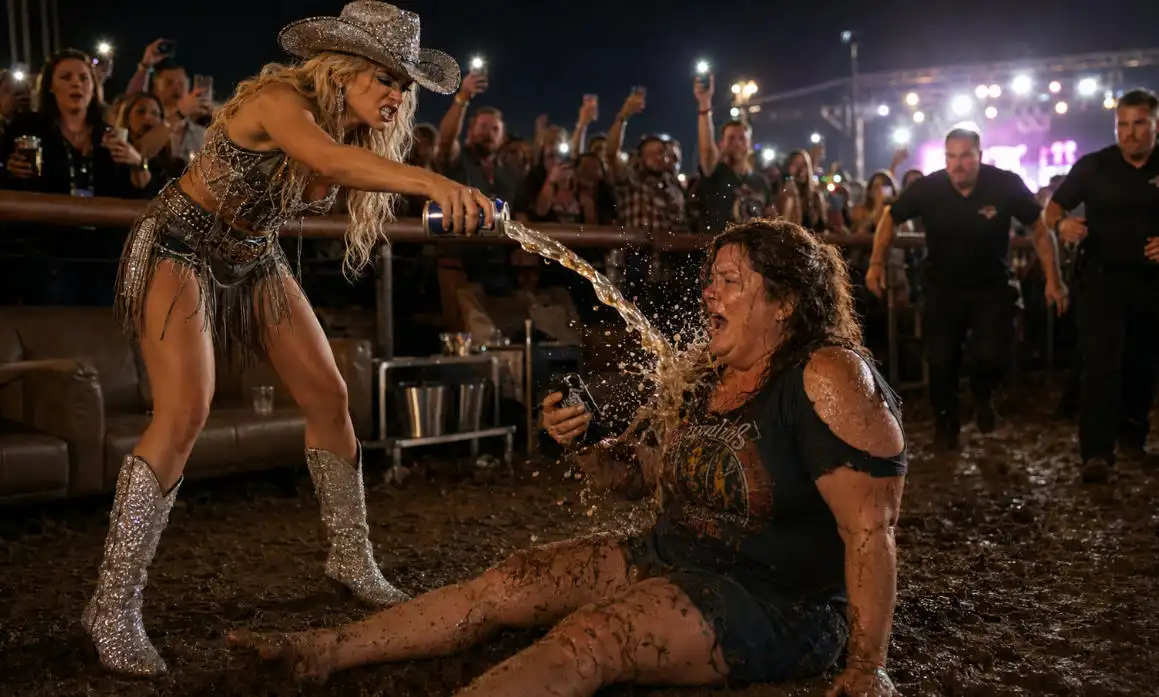
“Miss Lexi, before you sing one more note… there’s someone you need to answer to.”
That sentence cut through the VIP section louder than the sound check from the main stage.
Lexi froze with one hand still on her microphone pack.
Her boots were clean.
My shirt was torn.
And every phone in that muddy VIP pit was pointed at us.
The festival director, a gray-haired man named Howard Pike, climbed onto the small platform beside the security rail.
He wasn’t smiling.
Behind him stood two stage managers, one legal coordinator, and the head of artist relations.
Lexi blinked at them like she was watching a joke go wrong.
“What is this?” she snapped. “I’m on in twenty minutes.”
Howard looked at me first.
Not at Lexi.
At me.
“Ma’am,” he said quietly, “are you injured?”
The whole crowd went silent.
That silence felt heavier than the beer in my hair.
I was Loretta Mae Whitfield.
Fifty-two years old.
A lifelong country music fan.
A woman with bad knees, a soft middle, and a closet full of old tour shirts I loved more than most people love jewelry.
That night, to Lexi, I was just an easy target.
A heavy woman in a faded shirt.
Someone she could embarrass in front of strangers.
Someone she thought had no power.
Lexi laughed, but it came out thin.
“Are we seriously stopping my set because a fan got dramatic?”
I looked down at my shirt.
The torn collar hung open where her hand had ripped it.
It was a 1987 shirt from my late husband’s favorite country tour.
He bought it before I ever met him.
I used to joke that he loved that shirt before he loved me.
When he passed, I kept it folded in cedar for three years before I could wear it again.
That night was the first time.
And Lexi had ripped it while people cheered.
Howard turned toward Lexi.
“This woman had every right to stand where she was standing.”
Lexi rolled her eyes.
“Fine. Give her a refund and a towel.”
A few of her fans laughed nervously.
She took one step toward the backstage gate.
Security did not move for her.
That was when her face changed.
Not fear yet.
Confusion.
The kind entitled people feel when the world does not obey quickly enough.
“Move,” she ordered them.
No one moved.
Howard opened the clipboard.
“Lexi, your artist agreement includes a conduct clause, a violence clause, and a sponsor morality clause.”
Lexi scoffed.
“Oh my God. She fell.”
A young woman near the rail shouted, “No, she didn’t!”
Another voice said, “You slapped her!”
Then another.
“You pulled her hair!”
“I got it on video!”
“She tore the lady’s shirt!”
Phones lifted higher.
For once, the crowd wasn’t laughing.
They were watching.
Lexi spun toward them.
“Put your phones down!”
That only made more people record.
I still hadn’t said much.
That surprised everyone.
Maybe it surprised me too.
When you grow up in a small Tennessee town, you learn there are moments when yelling only gives cruel people more of what they want.
So I didn’t yell.
I didn’t call her names.
I didn’t swing back.
I did what my father taught me.
Stand still.
Let a fool finish building her own fence.
Then close the gate.
Howard stepped closer.
“Loretta, do you want medical assistance?”
Lexi’s eyes shot back to me.
“Wait,” she said. “You know her?”
Howard didn’t answer.
I reached into my wet crossbody bag and pulled out my wallet.
The little black badge was clipped inside.
Not flashy.
Not gold.
Just matte black with silver letters.
Lexi stared at it.
Her lips parted.
She read the words once.
Then again.
WHITFIELD MEDIA GROUP CHAIRWOMAN
For the first time all night, Lexi had nothing to say.
Whitfield Media Group owned the festival.
Not sponsored.
Not partnered.
Owned.
We owned the production company that built the stage.
We owned the media rights.
We owned the livestream contract.
We owned the booking company that arranged Lexi’s slot.
And because my late husband and I had spent thirty years building that company from one local radio station into a national media group, I also chaired the board that approved every major artist contract.
Including hers.
Lexi’s voice dropped.
“You’re… Loretta Whitfield?”
I wiped beer from my eyebrow with the back of my hand.
“Yes.”
A murmur moved through the VIP section like wind through dry leaves.
People who had been laughing ten minutes earlier suddenly looked down at their shoes.
One man actually hid his phone behind his back, as if that could erase what he had filmed.
Lexi swallowed.
“I didn’t know.”
That was the sentence that told everyone who she really was.
Not “I’m sorry.”
Not “Are you okay?”
Not “I shouldn’t have done that.”
Just:
“I didn’t know.”
As if cruelty would have been fine if I had been nobody.
Howard looked at the legal coordinator.
“Document everything.”
The coordinator nodded and spoke into her headset.
That was when the legal hammer came down.
Not with screaming.
Not with revenge.
With paperwork.
Howard read from the contract.
“Artist shall not engage in conduct that creates physical risk, reputational damage, sponsor liability, public disorder, or documented harassment toward guests, staff, vendors, or executives.”
Lexi shook her head fast.
“This is ridiculous. She baited me.”
I almost laughed.
But I didn’t.
Instead, I looked at the phones around us.
“Did I?”
No one answered for Lexi.
Because everyone had the truth in their hands.
Video from six angles.
Audio of her insulting me.
Clear footage of the beer.
The slap.
The hair pull.
The shove.
The torn shirt.
And the words she whispered when she thought only I could hear:
“Learn your place.”
Except one phone caught that too.
A teenage girl near the barrier raised her hand.
“My video has the whisper.”
Lexi turned pale.
Her manager came running from backstage, out of breath and red-faced.
“What happened?”
Lexi grabbed his arm.
“Fix this.”
He looked at me.
Then at Howard.
Then at the badge in my hand.
All the color left his face.
“Lexi,” he whispered, “please tell me you did not touch Mrs. Whitfield.”
She snapped, “She was blocking the camera line!”
The manager closed his eyes.
That was his answer.
Howard spoke into his radio.
“Hold main stage. Remove Lexi’s equipment from the evening lineup.”
Lexi’s head whipped around.
“You can’t do that.”
Howard looked at the contract again.
“We can.”
Her manager stepped in fast.
“Let’s all calm down. We can issue a private apology, maybe a donation—”
“No,” I said.
It was the first word I said loudly enough for the whole VIP section to hear.
Everyone looked at me.
I stood there in the mud, beer drying sticky on my neck, the torn fabric pressed against my chest.
I was embarrassed.
I was angry.
But mostly, I was tired.
Tired of people thinking money gives them permission to be cruel.
Tired of public humiliation being treated like entertainment.
Tired of good people being told to laugh it off because the bully is famous.
I looked at Lexi.
“You don’t owe me a private apology. You owe every person here the truth.”
Lexi’s eyes filled, but not with remorse.
With panic.
“My tour launches next month,” she said.
Howard turned another page.
“Yes. About that.”
Her manager whispered, “Howard, please.”
Howard didn’t stop.
“Whitfield Media Group controls the broadcast package, sponsor placements, regional promotions, and venue media buys for the first twelve dates.”
Lexi’s mouth opened.
No sound came out.
Howard continued.
“Given the documented assault, breach of conduct, and sponsor exposure, we are suspending all promotional support pending full legal review.”
The manager put both hands on his head.
“That triggers the insurance review,” he muttered.
The legal coordinator nodded.
“And the venue compliance review.”
Another staffer added, “And the sponsor withdrawal clause.”
Lexi looked from face to face.
She still didn’t fully understand.
So Howard made it plain.
“Your global tour may be canceled before it begins.”
The crowd gasped.
Lexi whispered, “No.”
That was when the arrogance finally cracked.
She stepped toward me.
Security blocked her.
“Loretta,” she said, suddenly sweet, suddenly soft, suddenly human for the cameras. “Mrs. Whitfield. I am so sorry. I was under pressure. I didn’t mean—”
“You meant every word,” I said.
Her face twisted.
Rain had started to fall lightly, turning the dirt darker around our boots.
The same mud she had pushed me into now splashed up the sides of her glitter heels.
And then she did something I will never forget.
She dropped to her knees.
Right there in the mud.
In front of her fans.
In front of the crew.
In front of every phone she had begged people to put away.
“Please,” she cried. “Please don’t ruin me.”
I looked at her kneeling there.
A younger me might have felt satisfied.
A crueler me might have enjoyed it.
But I didn’t.
I felt sad.
Not for her career.
For the fact that this was the first time she had spoken to me like I was a person.
Only after she realized I had power.
I stepped back.
“You ruined yourself when you thought I had none.”
Nobody cheered.
That mattered.
It wasn’t a circus anymore.
It was a lesson.
Howard gave the final instruction.
“Escort Lexi and her team off festival grounds. Preserve all footage. Notify sponsors. Notify counsel.”
Lexi’s manager tried one last time.
“Can we at least keep tonight quiet?”
I looked around at hundreds of glowing screens.
“That choice was made when she turned the crowd into witnesses.”
Within an hour, the festival released a short official statement.
No drama.
No insults.
Just facts.
An artist had violated guest safety policies.
Her performance was canceled.
The matter was under legal and contractual review.
By morning, three sponsors had paused their involvement with her tour.
By noon, two venues pulled promotional support.
By the end of the week, her agency announced she would be taking “time away from public performances.”
That was the polite version.
The real version was harsher.
The industry had seen the videos.
Promoters had seen the risk.
Insurance companies had seen the liability.
And nobody wanted to build a tour around an artist who might assault a paying guest in front of cameras.
The lawsuits came later.
Contract disputes.
Sponsor claims.
Venue penalties.
Millions on paper.
Maybe more.
I didn’t celebrate any of it.
I didn’t need to.
The rules did what rules are supposed to do when powerful people forget they apply to them.
They held.
But the part that stayed with me wasn’t Lexi kneeling.
It was what happened twenty minutes after she was escorted out.
Howard asked if I wanted to go home.
I said no.
I had been pushed down in front of that stage.
I wanted to stand on it.
So he walked me backstage.
Someone found me a clean denim jacket.
Someone else brought me a towel.
A young staffer carefully folded what was left of my husband’s old shirt and promised to have it professionally preserved.
Then Howard handed me a microphone.
The main stage lights were blinding.
Thousands of people waited, confused and restless.
I walked out slowly.
My knees hurt.
My hair was still damp.
My hands shook.
But I stood center stage anyway.
The crowd went quiet.
I looked out over all those faces and said:
“Tonight, one performer lost her time slot because she forgot country music was built by ordinary people with extraordinary hearts.”
A roar went through the field.
I lifted one hand.
“So we’re giving her entire set to independent artists who still remember what respect sounds like.”
That roar became thunder.
Three local singers got the call.
A father-daughter bluegrass duo.
A waitress from Kentucky with a voice like church bells.
A retired Marine who wrote songs in his garage after his wife died.
None of them had Lexi’s glitter.
None of them had her entourage.
But every one of them walked on that stage with gratitude in their eyes.
And they sang like the night mattered.
The crowd sang with them.
People cried.
People danced.
Strangers hugged.
One woman from the VIP section found me later and said, “I laughed at first. I’m ashamed.”
I told her, “Then don’t waste the shame. Let it teach you.”
A week later, the teenage girl who captured Lexi whispering “Learn your place” sent me a message.
She said her grandmother watched the video and told her:
“Baby, never laugh when the crowd picks a target. That’s when you find out who you are.”
I printed that message.
It’s on my desk now.
As for the shirt, it couldn’t be repaired.
Not really.
The fabric was too old.
The tear was too deep.
So I had it framed.
Mud stain and all.
Beer mark and all.
Ripped collar and all.
Under it, I put a small brass plate:
THE NIGHT RESPECT TOOK THE STAGE
I still go to festivals.
I still stand near the rail when my knees let me.
And yes, I still wear old country shirts.
Because dignity doesn’t come from youth.
It doesn’t come from beauty.
It doesn’t come from fame.
It comes from how you treat people when you think they can do nothing for you.
Lexi learned that in the mud.
I learned something too.
Silence is not always weakness.
Sometimes silence is the sound of the trap closing.
So choose a side:
Was I right to let Lexi expose herself in front of everyone before I used the contract against her — or should I have stopped her the moment she started humiliating me?
Share this if you believe public cruelty deserves public consequences. ⚖️
Disclaimer: Mention of any brand or trademark is for identification only and does not imply partnership or endorsement
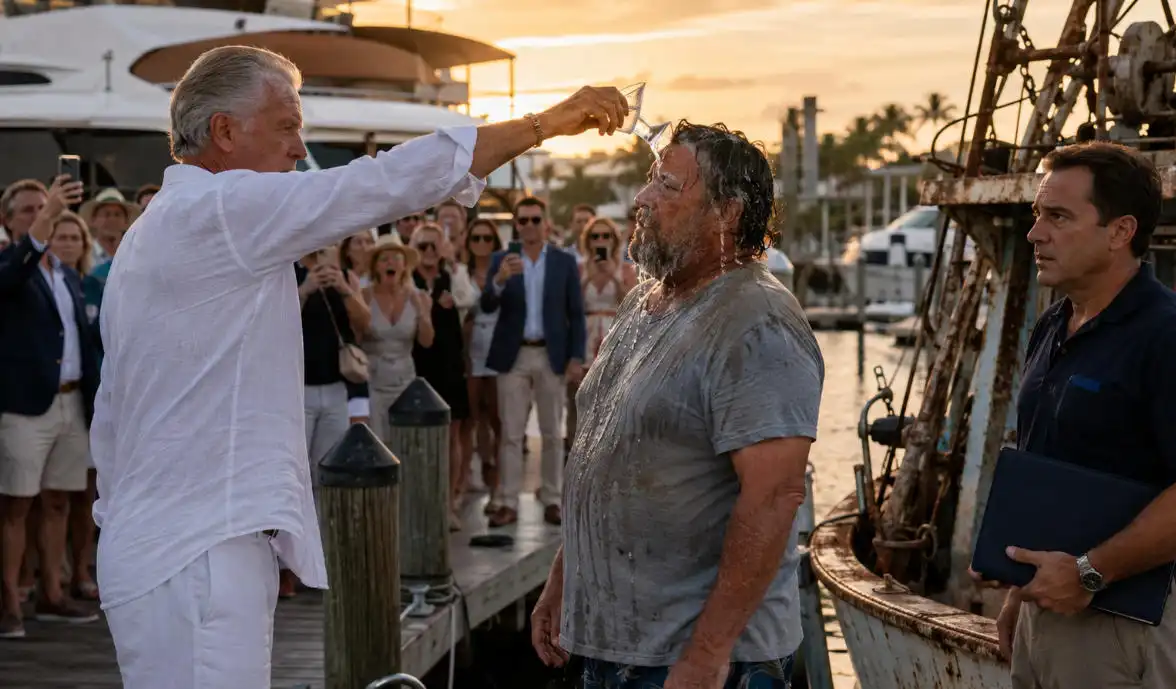
A Big-Bellied Fisherman Was Laughed Off A Miami Yacht Dock By A Snobby Club President… But Chad Had NO IDEA What Gary Had Signed That Morning 😳
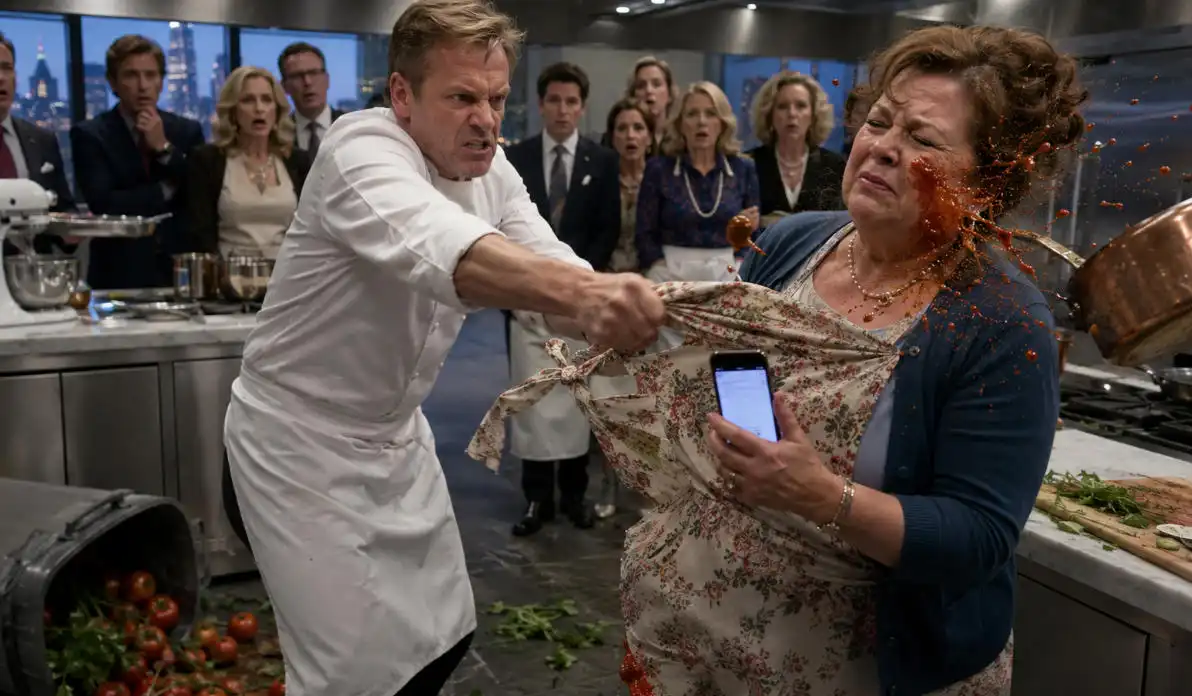
He Slapped A Quiet Housewife In Front Of Food Critics… Minutes Later, KARMA Walked Into His Own Kitchen ⚖️
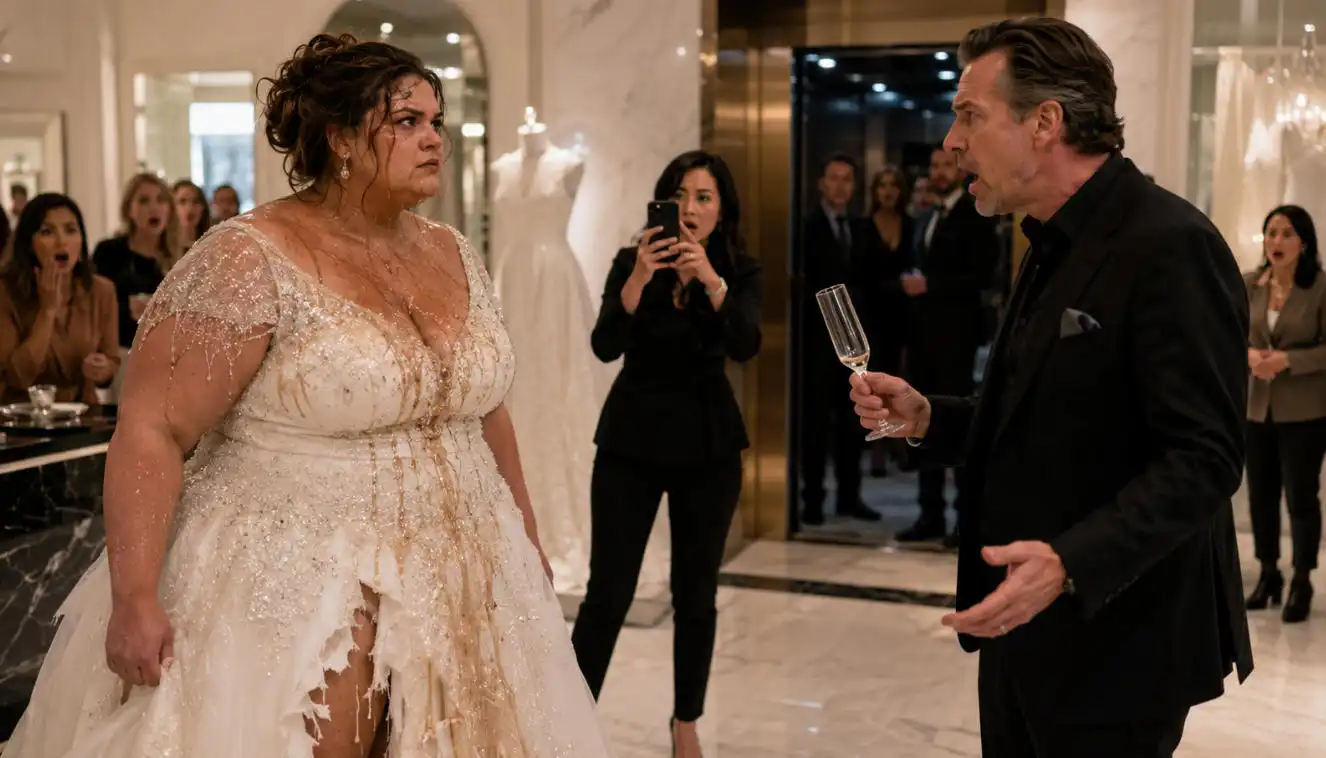
The Famous Designer Laughed at a Bride’s Body, Let His Staff Film Her, and Then Poured Champagne on Her… It Became the BIGGEST Mistake of His Life