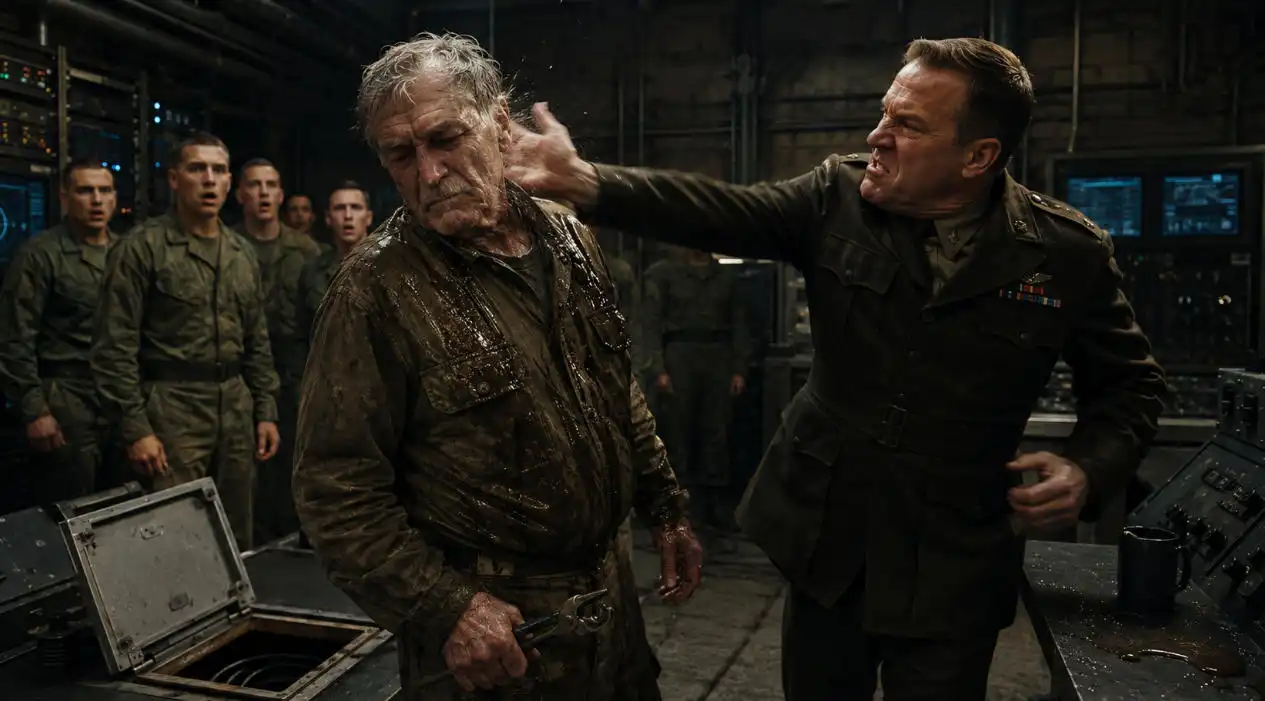
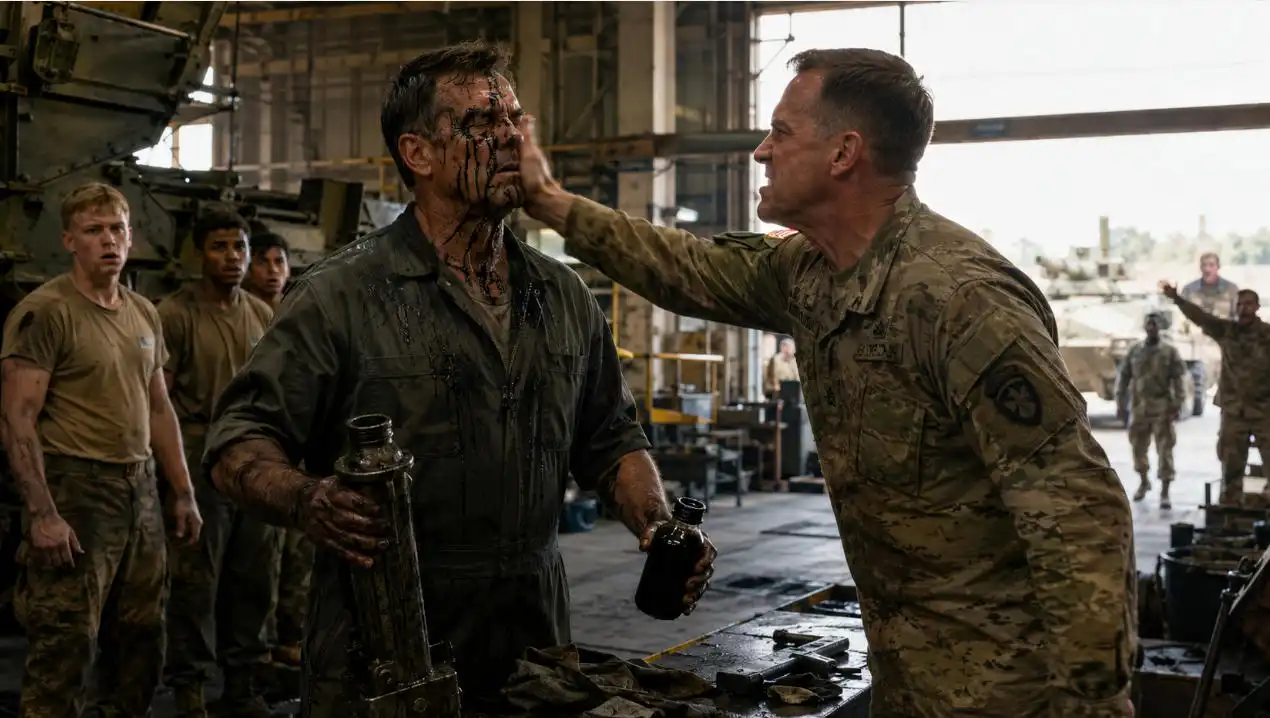

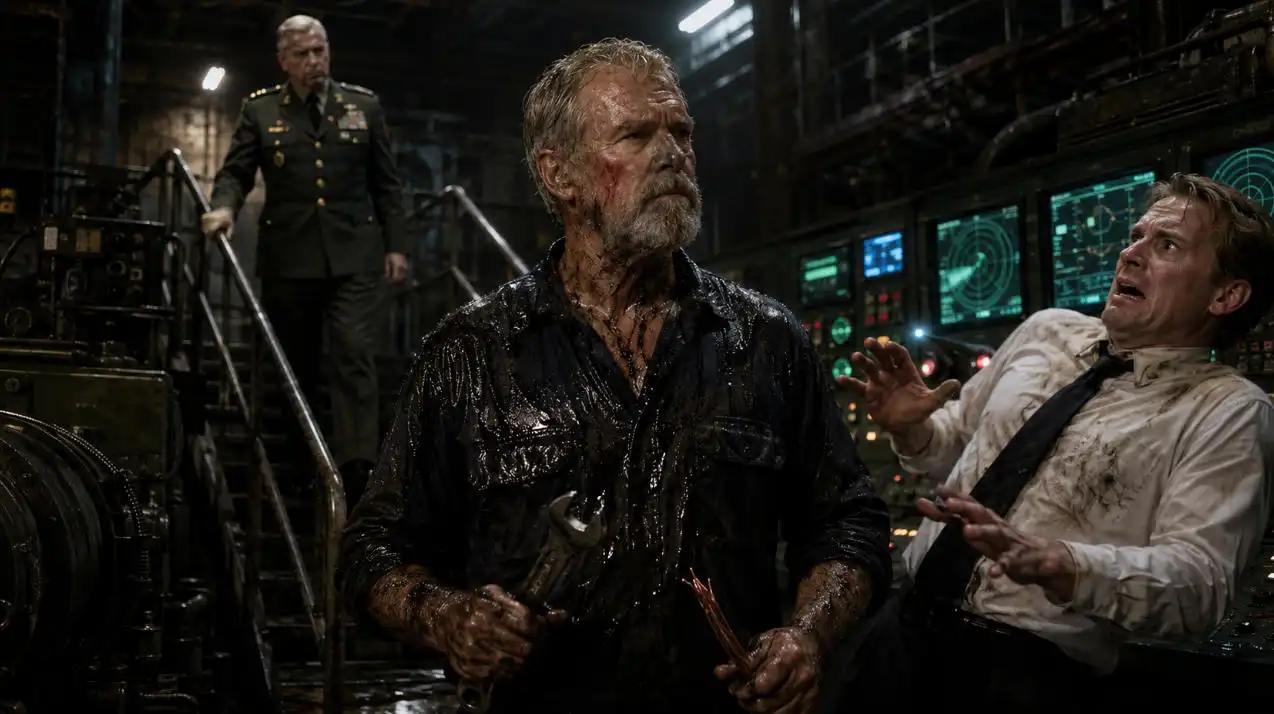
Then the major picked up Chester’s oil-stained wrench and asked Dean one question.
“Did you strike this man before or after he restored power to my camp?”
Nobody breathed.
The generator room was still shaking from the heavy-fuel unit coming back to life. The smell of diesel hung in the air. Red emergency lights faded into full white overhead lamps.
Dean’s hand was still half-raised.
Chester stood there with fuel dripping off his chin.
And every young technician in that underground room knew the truth.
Dean swallowed.
“General, this man failed his post.”
The major general looked at Chester.
Chester did not speak.
That silence made Dean bolder.
“He caused a complete systems blackout,” Dean said. “Radar, searchlights, training grid, all of it. I came down here to take command.”
One of the technicians, a twenty-two-year-old private named Lewis, shifted near the control board.
Dean saw him move.
“Don’t even think about opening your mouth,” Dean snapped.
The major general’s eyes moved from Dean to Lewis.
“What is your name, son?”
“Private Lewis, sir.”
“Were you here when the blackout happened?”
“Yes, sir.”
Dean cut in fast.
“Private Lewis is new. He doesn’t understand the system.”
Lewis stared at the floor.
Chester wiped diesel from his eyebrow with the sleeve of his uniform.
He still said nothing.
That was Chester.
For thirty-one years, he had kept military bases alive without speeches. He was not the kind of man who needed a clean office or a shiny title.
He knew generators.
Heavy-fuel systems.
Cold-start loops.
Ancient switchgear.
Emergency transfer relays that younger officers treated like museum junk until the night went black and everybody started praying.
The camp called him “Mr. Chester.”
Not because he asked for respect.
Because he had earned it in storms, freezes, sand, heat, and four different deployments where the lights staying on meant men came home alive.
Dean did not know any of that.
Dean had arrived three weeks earlier with polished shoes and a clipboard full of new rules.
He was not a bad officer because he was young.
He was bad because he confused authority with knowledge.
On his second day, he told the mechanics, “From now on, everything goes through me.”
Chester had looked at him and said, “Sir, emergency power can’t wait for paperwork.”
Dean smiled.
“That’s what people say when they don’t want supervision.”
By the end of that week, Dean had locked up the copper jumpers, sealed the bypass cabinet, moved two fuel techs to inventory duty, and required written permission for any adjustment on the generator bank.
Chester warned him.
Quietly.
Twice.
“Sir, those old units need manual override access. If the automatic fuel sync fails, we have two minutes before cascading shutdown.”
Dean tapped his pen against Chester’s report.
“You people always exaggerate so you can feel important.”
“You people?” Chester asked.
“Technicians,” Dean said. “Men who think grease under their nails makes them irreplaceable.”
Chester looked at him for a long second.
Then he filed the warning through the proper channel.
He copied Maintenance Command.
He copied Camp Operations.
He copied Energy Security.
And because Chester was not stupid, he kept a printed copy in the inside pocket of his work jacket.
That morning, the storm rolled in from the west.
Training searchlights were running.
Radar calibration was underway.
A visiting team from Air Defense Command was due before sundown.
Dean wanted everything to look perfect.
So when a junior tech reported a pressure fluctuation in Fuel Line Three, Chester told the team to open the manual bypass cabinet.
The cabinet was locked.
The red tag hanging from it read:
ACCESS RESTRICTED — LOGISTICS DIRECTOR AUTHORIZATION ONLY
Chester called Dean.
No answer.
He radioed the duty desk.
No response.
He checked the fuel feed.
The automatic sync was hunting between two pressure bands. The old heavy-fuel generator did not like that. It coughed once. Then again.
Chester’s jaw tightened.
“Lewis, open the auxiliary panel.”
“Sir, we need Dean’s key.”
“We need the bypass.”
“Sir, he took the key ring upstairs.”
The first radar screen went black.
Then a searchlight tower died.
Then the training-grid alarms started screaming.
By the time Dean came charging down the stairs, the whole camp was in darkness.
And Dean was not afraid of the blackout.
He was afraid of blame.
That was why he came in shouting.
That was why he needed a villain.
And Chester, soaked from working under a leaking hatch, old enough to have gray in his beard, and calm enough to irritate arrogant men, was the easiest target.
Dean pointed at him.
“You did this.”
Chester turned from the panel.
“Sir, your lockout order delayed the manual bypass.”
The room heard it.
That was Dean’s breaking point.
His face went hard.
He grabbed the waste-diesel bucket used for contaminated fuel samples.
Private Lewis said, “Sir—”
Dean threw the bucket.
It hit Chester across the chest and face.
The smell was instant.
Heavy.
Sour.
Humiliating.
Someone gasped.
Then Dean stepped forward and slapped Chester across the mouth.
It was not a battlefield strike.
It was not panic.
It was the slap of a man who wanted witnesses.
Dean wanted the room to see Chester as small.
He wanted the techs to see what happened when someone embarrassed him.
“You old grease rat,” Dean said.
Chester touched his cheek.
His eyes watered from the diesel, but his voice stayed steady.
“Sir, move away from the panel.”
Dean laughed.
“You’re giving me orders?”
“No, sir.”
Chester reached down.
He picked up a battered wrench.
Then a short length of copper wire.
“I’m preventing the second failure.”
Dean snorted.
The young technicians stood frozen.
They wanted to help.
They also knew Dean had the power to ruin evaluations, assignments, promotions, housing approvals, weekend passes, everything.
So Chester did what he had done his whole life.
He carried the weight alone.
He slid under the side panel.
The generator was still warm.
Too warm.
He could hear the fuel pump stutter.
He could feel the vibration through the concrete.
He did not need light to understand the machine.
He knew it by sound.
By smell.
By the rhythm of old metal trying not to die.
“Lewis,” Chester said.
“Yes, sir?”
“When I say now, reset breaker four.”
Dean barked, “Nobody touches anything unless I say so.”
Chester ignored him.
He stripped the copper wire with his teeth.
Dean stepped closer.
“I swear, Chester, if you damage government equipment—”
Chester’s wrench cracked against the jammed manual linkage.
Once.
Twice.
A young corporal whispered, “He’s bypassing the lockout.”
“No,” another said. “He’s rebuilding the circuit around it.”
Chester wound the copper wire across the emergency contact, tightened it, and slapped the panel with the flat of his hand.
“Now.”
Lewis looked at Dean.
Then at Chester.
Then he hit breaker four.
For one terrible second, nothing happened.
Dean smiled.
“Perfect. You just proved—”
The generator coughed.
The floor trembled.
A belt shrieked.
Then the massive heavy-fuel unit roared like a beast waking under the earth.
Lights snapped on section by section.
The radar room upstairs shouted over the intercom.
“Radar One rebooting!”
“Radar Two online!”
“Searchlight tower east restored!”
“Training grid returning!”
Dean’s smile disappeared.
Chester slowly stood.
Diesel dripped from his sleeve to the concrete.
That was the moment the iron door opened at the top of the stairs.
Major General Harlan Voss descended into the generator room with two staff officers behind him.
He had come for an inspection.
Instead, he found a courtroom made of concrete, oil, and witnesses.
The major general saw everything that mattered.
The slapped cheek.
The diesel-soaked uniform.
The waste bucket on its side.
The young technicians standing like men who had just seen something they would never forget.
Dean straightened so fast his boots scraped.
“General Voss, sir. We had a minor technical disturbance, but I have the situation under control.”
The major general looked past him.
At Chester.
“What’s your name?”
“Chester Hale, sir.”
The general blinked once.
“Hale?”
“Yes, sir.”
“Chester Hale from Forward Power Group Nine?”
Dean’s eyebrows twitched.
Chester nodded.
“Yes, sir.”
The general turned fully toward him.
“I read your after-action report from Kandahar.”
The room changed.
Even the generator seemed quieter.
Dean looked confused.
The general continued.
“You kept a field hospital powered through a fuel-contamination event for eighteen hours with two cracked injectors and a hand-built relay.”
Chester lowered his eyes.
“Men needed surgery, sir.”
“You received a theater commendation.”
“Yes, sir.”
“And later rewrote the emergency heavy-fuel recovery protocol for three commands.”
Dean’s face lost color.
Private Lewis stared at Chester like he was seeing him for the first time.
The major general lifted Chester’s wrench.
Then he asked Dean that question.
“Did you strike this man before or after he restored power to my camp?”
Dean’s mouth opened.
No answer came.
The general’s voice dropped.
“That is not a difficult question.”
Dean tried to recover.
“Sir, emotions were high. The blackout endangered readiness. I had to impose discipline.”
“By throwing contaminated fuel on a senior technical specialist?”
Dean’s throat moved.
“Sir, I believed he was negligent.”
The general looked around the room.
“Who witnessed the fuel being thrown?”
For one second, fear held the room hostage.
Then Lewis raised his hand.
A corporal raised his.
Then another tech.
Then another.
Soon, nearly every hand in the generator room was up.
Dean turned slowly.
Betrayal hit his face.
But it was not betrayal.
It was gravity.
The major general nodded to his aide.
“Take statements.”
Dean stepped forward.
“Sir, these enlisted men are emotionally compromised.”
The general’s eyes hardened.
“You are one sentence away from making this worse.”
Chester finally spoke.
“Sir.”
Everyone turned.
Chester reached into the inside pocket of his soaked work jacket.
The paper came out stained at the edges, but readable.
“I submitted a written warning forty-six hours ago regarding the manual bypass cabinet, the fuel-sync instability, and the operational risk of restricting emergency override access.”
Dean stared at the paper.
The major general took it.
He read the top line.
Then the copied recipients.
Then Dean’s signature at the bottom.
The silence was brutal.
The general looked up.
“Director Dean, this is your authorization?”
Dean’s lips barely moved.
“Yes, sir, but—”
“You locked the bypass.”
“For accountability.”
“You removed the key from the generator room.”
“To prevent unauthorized tampering.”
“You ignored the emergency call.”
“I was coordinating—”
“You blamed the man who warned you.”
Dean said nothing.
The general stepped closer.
“And then you assaulted him in front of his team.”
Dean’s face went red.
“Sir, with respect, he is a civilian technical contractor attached to—”
Chester’s eyes lifted.
The general cut Dean off.
“Mr. Hale is not merely attached to this camp.”
Dean froze.
“He is the command-certified heavy-fuel recovery authority for this training theater. His access level exceeds yours on emergency energy restoration.”
The words landed harder than the generator roar.
Dean looked at Chester.
For the first time, he understood he had not slapped a powerless old mechanic.
He had slapped the man the entire camp depended on when officers ran out of answers.
General Voss handed the warning report to his aide.
“Secure the lockout order. Pull the radio logs. Preserve security footage from the generator-room stairwell and main corridor.”
Dean’s eyes widened.
“Security footage?”
Lewis spoke before he could stop himself.
“Sir, the hallway camera faces the entrance. It would have caught the bucket.”
The general nodded.
“Good.”
Dean turned on him.
“Private, I’ll remember this.”
The major general’s voice cracked like a rifle shot.
“No. You will not.”
Dean went still.
“You are relieved of duty effective immediately.”
“Sir—”
“Your access badges will be collected. You will remain under administrative hold pending investigation for operational negligence, abuse of authority, and physical misconduct toward protected technical personnel during an active readiness incident.”
Dean looked around, searching for one friendly face.
There were none.
The young technicians who had feared him minutes earlier now stood taller.
Not loud.
Not smiling.
Just watching.
And being watched by them was worse than being yelled at.
The general nodded toward the military police officer who had followed him in.
“Escort him upstairs.”
Dean’s voice cracked.
“General, my career—”
“Should have mattered to you before your pride outranked the mission.”
The MP took Dean’s badge.
Then his radio.
Then the key ring from his belt.
That key ring made a small metallic sound when it landed in the evidence bag.
It was the sound of a man losing the power he had abused.
Dean looked at Chester one last time.
His expression was no longer arrogant.
It was pleading.
Chester did not return hatred.
He simply said, “The men need access to the bypass cabinet, sir.”
The general turned to the aide.
“Unlock it.”
The aide did.
Lewis opened the cabinet.
Inside were the tools Dean had seized.
Copper jumpers.
Manual relay clamps.
Emergency schematics.
The things Chester had said they needed.
The things Dean had called excuses.
General Voss faced the room.
“Let the record show that Mr. Hale restored base power under public humiliation, physical misconduct, and emergency conditions created by unauthorized administrative interference.”
No one cheered.
It was still the military.
But every man in that generator room felt the same thing.
The truth had finally been given a uniform.
Later that night, the investigation moved faster than Dean expected.
The radio logs showed three missed emergency calls.
The lockout order showed Dean’s signature.
Security footage showed him entering the stairwell with the waste bucket.
Witness statements matched.
The system logs showed Chester had attempted manual bypass access before the full blackout.
The generator data proved the failure sequence exactly as Chester had warned.
Dean had not just been rude.
He had endangered readiness.
By morning, the base knew.
Not through gossip.
Through orders.
Director Dean was removed from logistics command.
His personnel authority was suspended.
His pending promotion packet was pulled.
He was reassigned to the dirtiest disciplinary support detail in the regional fuel-and-coal handling yard until his formal review.
Not as a dramatic punishment.
As a message.
A man who thought fuel workers were beneath him was now ordered to work where every mistake left evidence on his own hands.
When Dean arrived at the coal-prep facility, there were no polished floors.
No air-conditioned office.
No young technicians to bully.
Just black dust, hard hats, chain belts, and supervisors who cared only whether the job was done safely.
The first time he complained about the smell, an old yard foreman looked at him and said, “Funny. I heard you liked throwing dirty fuel on better men.”
Dean said nothing after that.
Back at the training camp, Chester returned to the generator room the next morning.
His cheek was still bruised.
His uniform had been replaced.
His old wrench sat on the workbench, cleaned by Private Lewis.
Lewis stood beside it, nervous.
“Mr. Chester?”
“Yeah?”
“I should’ve spoken faster.”
Chester looked at the young man.
“You spoke when it counted.”
Lewis swallowed.
“I was scared.”
Chester nodded.
“Courage isn’t never being scared. Courage is telling the truth while your voice shakes.”
Lewis looked down.
“Are you leaving, sir?”
Chester almost smiled.
“Why would I leave?”
“After what happened.”
Chester ran his hand over the generator casing.
“Machines don’t care who embarrassed you. They care whether you show up.”
That afternoon, General Voss called an all-hands formation in the training hangar.
The whole camp came.
Technicians.
Security.
Radar operators.
Drivers.
Cooks.
Clerks.
People who had spent the blackout in darkness now stood under steady lights.
Dean was not there.
Chester stood near the side wall because men like him never walked to the center unless ordered.
General Voss ordered him.
“Mr. Hale, front and center.”
Chester stepped forward slowly.
The hangar quieted.
The general spoke into the microphone.
“Last night, this camp lost radar, searchlights, and generator stability during an active readiness window. The failure was not caused by a lack of technical skill. It was caused by arrogance interfering with expertise.”
A few heads turned.
Everyone understood.
The general continued.
“Mr. Chester Hale restored power in under two minutes using field-expedient methods that prevented a larger cascade.”
He looked at Chester.
“He did it after being publicly humiliated by an officer who mistook a quiet man for a weak one.”
Nobody moved.
Then the general opened a sealed folder.
“Effective immediately, Chester Hale is appointed Theater Chief of Electrical Energy Assurance for this command region.”
A sound passed through the hangar.
Not quite a cheer.
Not yet.
The general kept reading.
“He will have direct emergency authority over power continuity, generator operations, heavy-fuel recovery, and base-level energy readiness during operational events.”
Chester blinked.
The general looked at the officers in the front row.
“To be clear, in an energy emergency, Mr. Hale’s technical authority outranks ordinary administrative preference.”
That was when the hangar erupted.
Technicians clapped first.
Then radar crews.
Then drivers.
Then the whole room.
Chester stood there with his hands at his sides, uncomfortable with applause, but unable to stop the look in his eyes.
It was not pride.
It was relief.
Not for himself.
For every quiet worker who had ever been treated like furniture by someone who needed them only after disaster hit.
Lewis clapped until his palms hurt.
The general handed Chester a new badge.
Not shiny for decoration.
Functional.
Access.
Authority.
Protection.
The kind of badge that meant no future Dean could lock the cabinet and blame the man holding the wrench.
Chester accepted it.
“Thank you, sir.”
The general leaned close enough that only Chester heard the next words.
“My father was a boiler mechanic. Men like Dean never understood men like him either.”
Chester nodded once.
“Then your father taught you well.”
That evening, Chester walked back down into the generator room.
The machines hummed steadily.
The bypass cabinet was open.
The copper jumpers were back where they belonged.
A new laminated order hung beside the control board:
EMERGENCY TECHNICAL ACCESS SHALL NOT BE RESTRICTED BY ADMINISTRATIVE STAFF DURING READINESS EVENTS.
Lewis read it out loud and grinned.
“Looks official.”
Chester looked at the generator.
“It should’ve always been common sense.”
For the first time in a long while, the young technicians laughed without fear.
Weeks later, Dean’s review concluded.
The findings were blunt.
Operational negligence.
Abuse of authority.
Retaliatory conduct.
Failure to follow technical-risk warnings.
His career track collapsed.
The officers who had once praised his “decisive leadership style” quietly removed their names from his recommendation file.
His family heard the story before he could soften it.
Not the exaggerated version.
The documented one.
The one with signatures, footage, logs, and witnesses.
Dean had built his reputation on looking powerful in rooms where others were afraid to speak.
But once the room spoke together, his power had nowhere to hide.
Chester never celebrated Dean’s downfall.
When Lewis asked why, Chester tightened a valve and said, “A man losing his job isn’t the victory.”
“What is?”
Chester pointed at the lights overhead.
“That those boys upstairs won’t lose radar because someone’s ego wanted a locked cabinet.”
That was Chester’s justice.
Not revenge.
Readiness.
Safety.
Respect.
And the next time a young officer visited the generator room, he did not call the technicians grease rats.
He removed his cap, looked around at the huge heavy-fuel units, and said, “Gentlemen, teach me what I need to know.”
Chester looked at Lewis.
Lewis hid a smile.
Then Chester picked up his wrench.
“Good place to start.”
The camp stayed bright that night.
Radar swept the sky.
Searchlights cut clean lines through the dark.
And deep underground, the old generator kept roaring like it knew exactly who had saved it.
So choose a side:
Was Chester’s silence strength—or should every workplace bully be exposed the second they cross the line? Share this if you believe quiet workers deserve loud respect. ⚡
Disclaimer: Mention of any brand or trademark is for identification only and does not imply partnership or endorsement
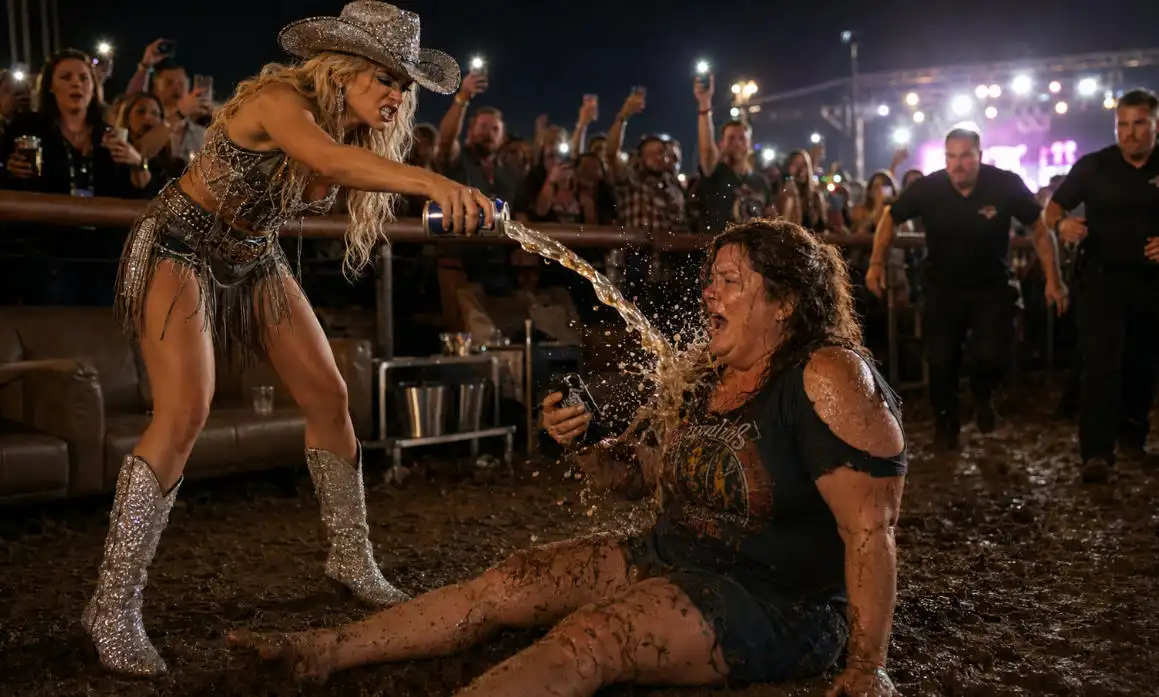
A Pop Star Slapped A Quiet Woman In The VIP Section While Fans Filmed… Her REGRET Started Before The First Song Ended
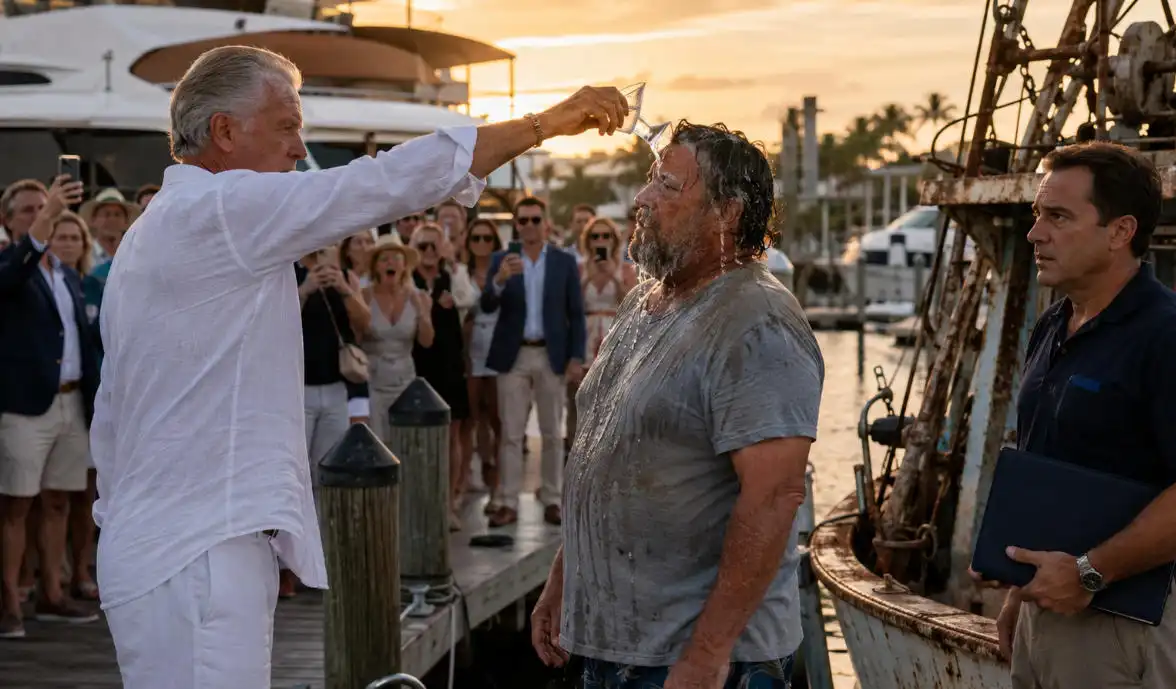
A Big-Bellied Fisherman Was Laughed Off A Miami Yacht Dock By A Snobby Club President… But Chad Had NO IDEA What Gary Had Signed That Morning 😳
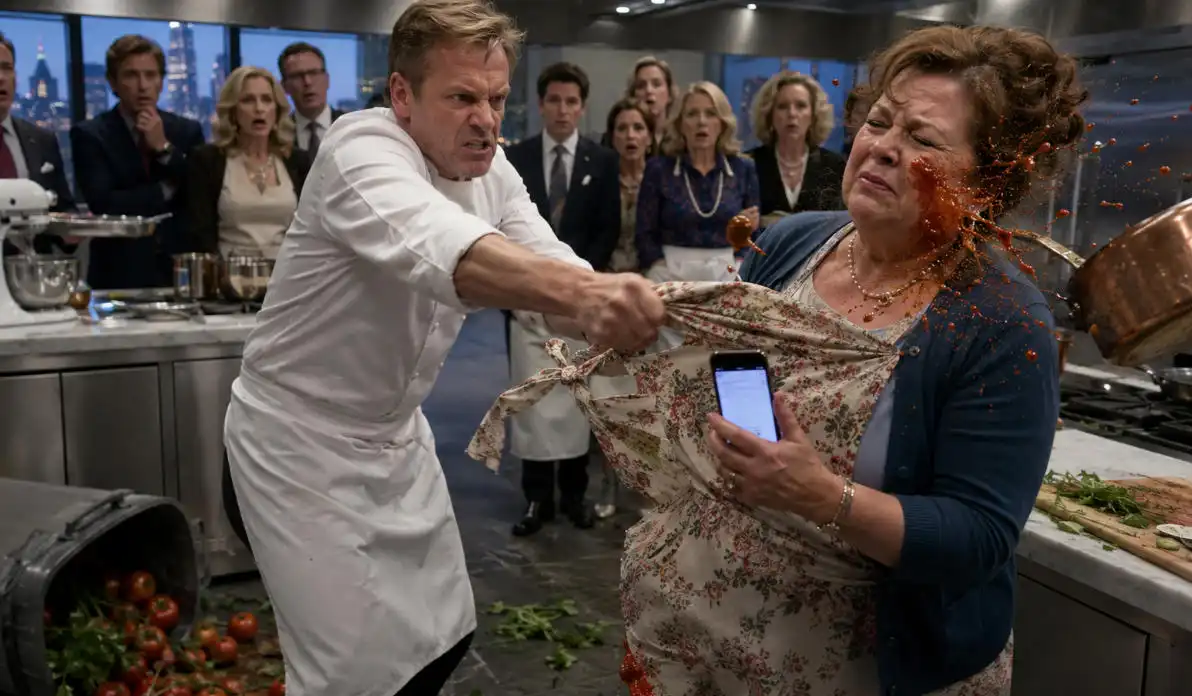
He Slapped A Quiet Housewife In Front Of Food Critics… Minutes Later, KARMA Walked Into His Own Kitchen ⚖️