
“Start the timer.”
That was all I said.
I didn’t wipe the oil off my face.
I didn’t look at Major Swift.
I just slid my old armored-vehicle jack under the first dead machine and listened to the engine tick itself cold.
The whole repair bay held its breath.
Twenty minutes earlier, that same room had been full of shouting, orders, and humiliation.
The heavy repair depot at Fort Calhoun Training Camp was never quiet. Steel clanged. Compressors screamed. Engines coughed smoke into the ceiling fans.
But that morning felt different.
The armored brigade had been called into an emergency readiness pull.
Every vehicle had to roll.
Every crew had to move.
Every mechanic had to work fast.
I was standing near Bay Four with grease on my sleeves and a jack handle in my hand when I heard it.
A knock.
Not loud.
Not dramatic.
Just a dry, ugly little rattle under the engine note.
The kind of sound most men miss.
The kind of sound that tells you metal is eating itself alive.
I stepped toward the armored vehicle and raised my hand.
“Shut it down.”
A young mechanic named Ellis looked at me like he had been praying someone would say it.
“Mr. Raymond, I thought I heard it too.”
I leaned close to the engine housing.
Three seconds.
That was enough.
“That oil is wrong,” I said.
The repair bay froze.
Because everybody knew what that meant.
For months, the depot had been receiving oil that didn’t behave right. Too thin when hot. Too dirty out of the drum. Too cheap for machines that carried soldiers into live-fire training.
But the paperwork always said the same thing.
Approved.
Certified.
Signed.
Major Victor Swift’s signature sat on every order.
Swift was the logistics officer in charge of procurement.
Clean uniform.
Polished boots.
Perfect haircut.
The kind of man who could walk through a room full of mechanics and make everyone feel dirty for doing the work that kept him looking important.
He came out of his office with a coffee cup in one hand and a clipboard in the other.
“What did you say?”
I kept my voice low.
“I said the oil is wrong.”
Swift smiled.
Not because he thought I was funny.
Because he thought I was beneath him.
“Raymond, you are here to lift vehicles and turn bolts. You are not here to audit supply contracts.”
A few soldiers outside the bay were already yelling.
“We roll in twenty!”
Another engine coughed.
Then another.
I pointed toward the drums stacked against the back wall.
“Those drums need to be quarantined. Pull samples from every vehicle serviced this week.”
Swift stepped closer.
The young mechanics backed away.
Not because they disagreed with me.
Because Swift had power over their schedules, promotions, evaluations, and punishments.
“You listen to me,” Swift said. “You will not create panic because your old ears heard a noise.”
I looked at him.
“My old ears have saved more engines than your clipboard ever will.”
That did it.
His face hardened.
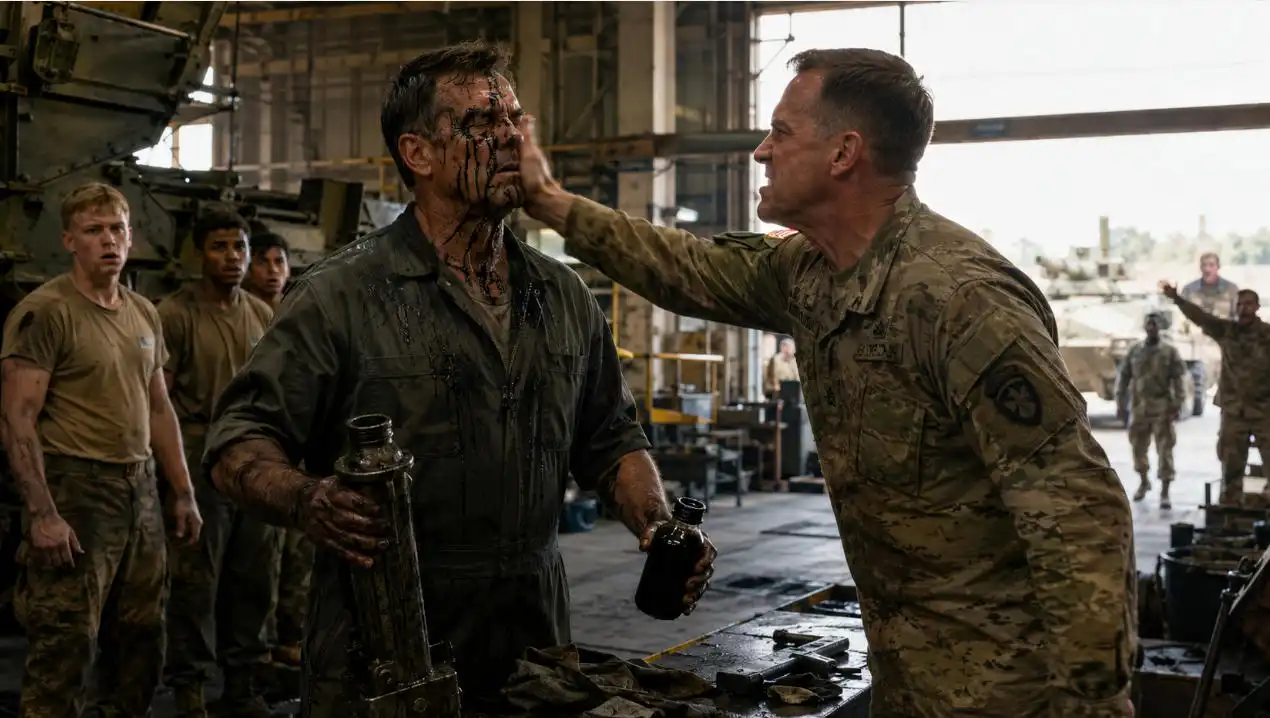
There was a shallow drain pan on the floor beside us, full of waste oil pulled from a failing engine.
Swift picked it up.
Ellis whispered, “Major, don’t—”
Swift threw it.
Black oil hit my face, my shirt, my chest.
It ran into my eyes.
It filled my mouth with a bitter burned-metal taste.
For one second, nobody moved.
Then Swift slapped me.
Hard enough to turn my head.
Hard enough that the sound bounced off the steel walls.
“You will not embarrass me in my depot,” he said.
His voice was low now.
Mean.
Personal.
“You are a mechanic. A dirty one. Remember your place.”
Somebody outside laughed nervously.
Somebody else muttered, “That ain’t right.”
But nobody stepped in.
That’s how public humiliation works.
It doesn’t need everyone to agree.
It just needs everyone to stay quiet.
I could have hit him back.
I wanted to.
I’m not going to pretend I didn’t.
But a man like Swift survives by dragging better men into mud and then pointing at their dirty hands.
So I did nothing.
I wiped one eye clear.
I reached into my pocket.
The sealed sample bottle was still there.
Swift saw it.
For the first time that morning, his smile flickered.
I had collected that sample before he came out of his office.
Not from a used pan.
Not from a contaminated floor.
Straight from a sealed drum with the lot number still stamped on the side.
I put it back in my pocket.
Then I picked up my armored-vehicle jack.
“Start them all,” I said.
Swift laughed.
“You heard him,” he shouted. “Start every vehicle. Brigade rolls now.”
The engines fired.
The bay shook.
The armored vehicles pulled out in a line, one by one, rumbling toward the outer road.
Swift looked at me with oil still dripping from my chin.
“That is what leadership looks like.”
I said nothing.
Because I could already hear it.
Engine three was dragging.
Engine seven was starving.
Engine nine was chewing itself apart.
They made it less than fifteen minutes.
The first call came over the radio.
“Vehicle Three stalled at west access.”
Then another.
“Vehicle Seven overheating.”
Then another.
“Vehicle Twelve lost pressure.”
Then the whole channel became noise.
Half the armored brigade was dead before reaching the outer road.
That was when the district inspection team arrived.
Not because of luck.
Because I had called them the night before.
I had spent six weeks documenting everything.
Delivery logs.
Lot numbers.
Failed filters.
Photos of sludge inside clean-service engines.
Statements from young mechanics who were too scared to sign their names but brave enough to tell the truth.
And one audio recording.
Swift’s own voice.
Telling a supplier, “Keep the price low and the difference quiet.”
I had not wanted a scene.
I had wanted the chain of command to handle it quietly.
But Swift was greedy.
And greed gets careless when it thinks nobody important is listening.
The lead inspector was Colonel Martin Hale.
Gray hair.
Hard eyes.
The kind of officer who didn’t raise his voice because he didn’t need to.
He walked into the repair bay with two investigators and a maintenance evaluator beside him.
He looked at me first.
Oil on my face.
Red mark on my cheek.
Jack in my hand.
Then he looked at Swift.
“Major Swift,” Colonel Hale said, “why is this mechanic injured?”
Swift recovered fast.
“Discipline issue, sir. He interfered with readiness operations and contaminated himself during unauthorized work.”
Ellis opened his mouth.
Swift shot him a look.
The boy closed it.
I didn’t blame him.
Fear is heavy when you’re young.
Colonel Hale turned to me.
“Mr. Raymond, can you proceed?”
I nodded.
Swift let out a small laugh.
“Sir, with respect, this man is not qualified to lead an inspection.”
That was the last mistake he made in uniform.
Colonel Hale looked at him.
“You mean Chief Master Technician Raymond Cole?”
The room changed.
Not loudly.
Not with gasps like in movies.
It changed in the way men straighten when they realize they have been standing next to a loaded cannon.
Ellis blinked.
One of the armored crewmen whispered, “Chief Master?”
Swift’s face tightened.
Colonel Hale continued.
“The same Raymond Cole who wrote the diagnostic standard for armored powertrain failure by acoustic signature?”
Nobody spoke.
He looked at Swift again.
“The same Raymond Cole I requested for this readiness audit.”
Swift’s mouth opened.
No words came out.
I set my jack into position.
“Start the timer,” I said.
Ellis pulled out his phone.
Not to post.
To time me.
Ten minutes.
That was all I needed.
I raised the vehicle enough to clear the access point.
Pulled the panel.
Dropped the filter housing.
Cracked the oil line.
The smell came first.
Burned additives.
Suspended grit.
Cheap base stock breaking down under heat.
I held up the filter.
Dark flakes glittered in the folds.
Not normal wear.
Not after a recent service.
Contamination.
The maintenance evaluator stepped closer.
I cut the filter open and spread the material across a clean inspection tray.
“Metal particulate,” I said. “Abrasive grit. Additive separation.”
Swift barked, “That could come from anything!”
I pulled the sealed sample bottle from my pocket.
“Then test the drum too.”
Colonel Hale nodded.
An investigator took the bottle.
Another investigator walked to the stacked drums and matched the lot number.
Same supplier.
Same procurement batch.
Same signature on the paperwork.
Swift’s signature.
His voice got too loud.
“This is theater. He is setting me up.”
I looked at him for the first time since the slap.
“No, Major. I listened.”
That line hit harder than I expected.
Because every mechanic in that room understood it.
Machines talk.
Good mechanics listen.
Bad leaders only hear themselves.
The inspector ran a field viscosity test.
The maintenance evaluator checked the sample against required specifications.
Then they opened the procurement file.
Swift kept shaking his head.
But his hands were trembling.
Colonel Hale placed one page on the workbench.
“Major Swift, did you authorize a vendor substitution three months ago?”
Swift swallowed.
“It was within cost-saving discretion.”
“Was the substitute oil certified for these engines?”
“It was represented as equivalent.”
“By whom?”
Swift said nothing.
The investigator pressed play on a small recorder.
Swift’s own voice filled the repair bay.
“Keep the price low and the difference quiet.”
No one moved.
Then came the supplier’s voice.
“And your percentage?”
Swift closed his eyes.
The young mechanics stared at the floor.
The armored soldiers outside stopped shouting.
Even the engines seemed silent.
Colonel Hale turned to Swift.
“You ordered substandard oil into combat vehicles. You concealed failures. You retaliated against a technician reporting safety issues. And you physically assaulted him in front of witnesses.”
Swift tried one last time.
“Sir, this is being exaggerated.”
Ellis finally stepped forward.
“No, sir.”
His voice shook.
But he kept going.
“Major Swift told us to drain the clean drums into marked containers and make the labels match. He said anyone who complained would be reassigned to night recovery duty.”
Another mechanic stepped forward.
Then another.
Then another.
One of them had photos.
One had copied delivery slips.
One had a voicemail.
Fear broke all at once.
Not because they suddenly became brave.
Because one man had finally shown them they were not alone.
Swift looked smaller by the second.
His polished boots were standing in the oil he had thrown at me.
Colonel Hale ordered him relieved on the spot.
No shouting.
No drama.
Just a sentence that ended a career.
“Major Swift, surrender your access credentials.”
Swift didn’t move.
A military police officer stepped forward.
That got him moving.
His badge came off.
His keys came off.
His clipboard stayed on the table.
For the first time all morning, he had nothing in his hands.
The investigation moved fast after that.
The failed vehicles were recovered.
The oil drums were seized.
The supplier’s invoices exposed the kickback trail.
The money had not gone through one clean account.
It had gone through consulting fees, fake maintenance reviews, and a property trust under a relative’s name.
Swift had thought dirty money looked clean if you spread it out.
He was wrong.
At the military hearing, the young mechanics testified.
So did the armored crews who almost rolled out with engines ready to fail.
So did I.
Swift sat straight at first.
Then lower.
Then lower.
By the end, he looked like a man trying to disappear inside his own uniform.
The court found him guilty of corruption, falsifying procurement records, endangering readiness, retaliation, and assault.
His rank was stripped.
His pension was forfeited.
The illegal proceeds were seized through military and federal recovery actions.
The house bought with supplier kickbacks was taken.
The vehicles he bragged about were gone.
His name became a warning in every logistics classroom that followed.
Not because people hated him.
Because they understood what he had risked.
Not machines.
People.
A bad engine can kill a crew.
A corrupt signature can bury sons and daughters.
That was the part I could not forgive.
Not the oil in my face.
Not the slap.
Not the insult.
Those things heal.
But sending soldiers out in vehicles you know are unsafe?
That is not arrogance.
That is betrayal.
Three months later, I walked back into that same repair depot.
The floor had been repainted.
The bad drums were gone.
The young mechanics had new testing kits, new reporting rules, and protection from retaliation.
Ellis was the first one to see me.
He grinned.
“Chief?”
I looked around.
Every bay was moving clean.
Every checklist was signed by two people.
Every engine sounded right.
Colonel Hale stood by the center aisle.
He handed me a folder.
“Effective immediately, Raymond Cole will oversee armored maintenance standards for the entire theater.”
For a second, I didn’t answer.
Not because I was surprised.
Because I was listening.
No bad knocks.
No dry rattle.
No hidden damage.
Just machines breathing the way they should.
Ellis stepped forward with my old jack.
They had cleaned it.
Polished it.
Put a small brass plate on the handle.
LISTEN FIRST.
I laughed then.
Couldn’t help it.
The same jack Swift mocked was now hanging on the wall beside the inspection office.
Not as a trophy.
As a reminder.
The dirtiest hands in the room might belong to the only man keeping everyone alive.
I never needed revenge.
I needed the truth to have witnesses.
And that day, it finally did. ⚙️
So pick a side:
Raymond was right to stay silent and let the evidence destroy Swift. Or Swift deserved to be exposed even sooner, before one more vehicle rolled out.
Share this if you believe no uniform, title, or polished office should ever outrank the truth.
Disclaimer: Mention of any brand or trademark is for identification only and does not imply partnership or endorsement
The Tavern Owner Set A Trap To Make Paul Drink Again… But He Had NO IDEA The Entire Town Was Watching 👀
They Laughed When Mark Announced He Was Running for Office… Then One Sealed Envelope Made the Whole Room Go Silent 😳
My Stepdaughter Thought Her Real Father Paid for Her Golf Club Wedding… Then I Showed the Guests the Letter He Sent Me