

The room went quiet after I raised my hand.
Not respectful quiet.
The kind of quiet that comes after someone finally realizes they may have gone too far.
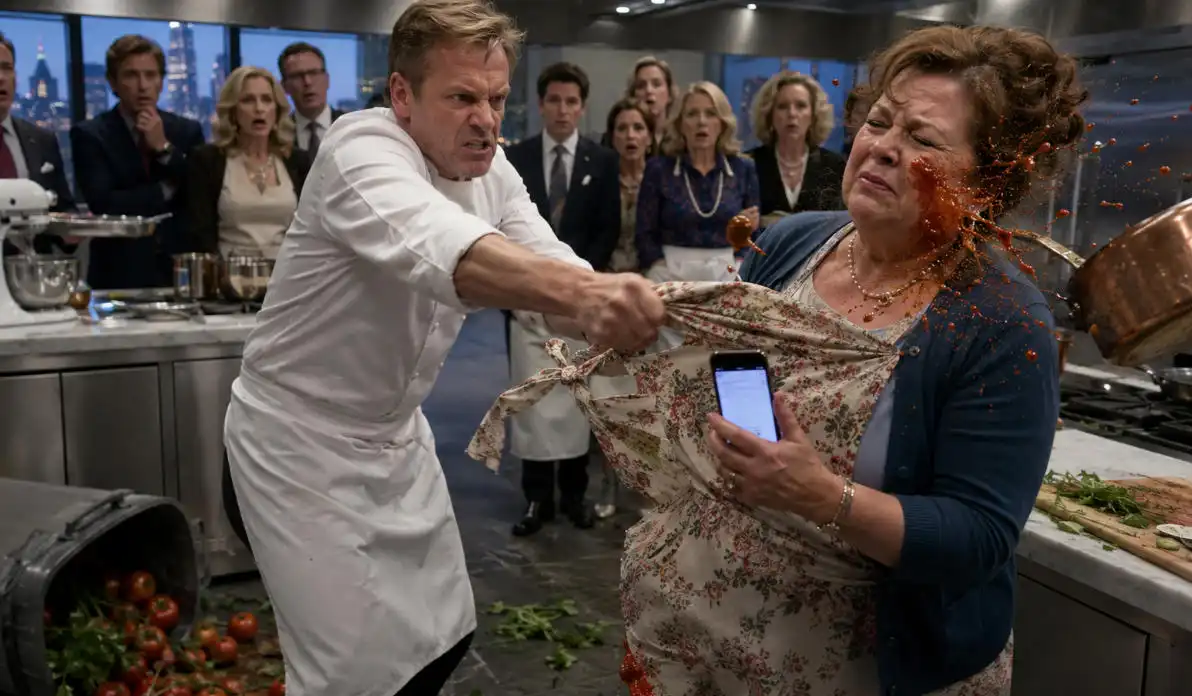
Chef Gordon still had one hand gripping the torn piece of my apron.
His jaw was tight.
His face was red.
The food critics in the front row had stopped taking notes.
One woman lowered her fork slowly and stared at the sauce running down the side of my face.
Gordon laughed once, sharp and ugly.
“What now, Mrs. Potluck?” he said. “You want to complain to management?”
I dabbed my cheek with a clean towel.
“I already did.”
That made the students laugh again.
A tall man in a navy blazer said, “This is embarrassing. She should just leave.”
Another student pointed at the trash bin where my ingredients were buried under paper towels.
“Honestly, Chef, she was slowing us down.”
I looked at every one of them.
I remembered their faces.
Not because I wanted revenge.
Because people show you who they are when they think you have no power.
And they thought I had none.
I was a round, quiet woman in a floral apron.
A widow.
A grandmother.
The kind of woman people assume will apologize just to make a room comfortable again.
Chef Gordon was the star.
The genius.
The man whose name was painted in gold on restaurants from New York to Miami.
He had magazine covers on the classroom wall.
He had a knife line.
A TV deal in negotiations.
A room full of rich students desperate to impress him.
And he had forgotten one very important thing.
Every empire has paperwork.
And paperwork has owners.
Two weeks before that class, my attorney had asked if I wanted to attend the opening session of Gordon’s newest “elite culinary experience.”
I almost said no.
I had no interest in being recognized.
For twelve years, I had stayed invisible.
My late husband, Thomas, had invested early in Gordon’s restaurant group before anyone knew the chef’s name.
When Thomas got sick, we moved our shares into a private holding company.
After he passed, those shares became mine.
Not a little piece.
Not a symbolic piece.
The controlling piece.
I never appeared in the glossy interviews.
I never stood at ribbon cuttings.
I let the chefs cook, the managers manage, and the guests enjoy their meals.
That was the point.
Thomas used to say, “The best owners don’t need applause. They just make sure the doors stay open.”
But lately, the doors had been opening for the wrong kind of people.
There had been complaints.
Quiet ones at first.
Line cooks crying in walk-in freezers.
Dishwashers fired for “attitude.”
Hostesses mocked for their accents.
Junior chefs forced to work off the clock.
A prep cook burned during service and told not to file a report because it would “hurt the brand.”
Every time the board asked Gordon about it, he called the workers soft.
Every time HR raised concerns, he called them replaceable.
So I came to the class.
No jewelry.
No designer handbag.
No announcement.
Just an apron, a canvas grocery bag, and the family tomato sauce I had made every Sunday for forty years.
I wanted to see the man when he thought nobody important was watching.
And he gave me the whole truth in less than twenty minutes.
When I entered, he smirked.
When I introduced myself as Beatrice, he didn’t shake my hand.
When I set my ingredients down, he lifted one tomato between two fingers like it was garbage.
“Farmers market?” he said. “How quaint.”
Then the students joined in.
They wanted his approval so badly they turned cruel for entertainment.
One woman grabbed my herbs.
A man took my butter.
Someone snatched the little jar of sauce from my bag and said, “Maybe her grandson packed lunch.”
They tossed everything into the trash.
Gordon watched like a king watching peasants fight.
Then he said, “Good. Now the workspace is clean.”
That was the first moment I almost broke.
Not because of the ingredients.
Because my granddaughter had tied the ribbon around that sauce jar that morning.
She said, “Grandma, make them taste the one Grandpa loved.”
But I swallowed it.
I clicked the voice memo app in my pocket.
I let the classroom cameras keep recording.
I let the food critics keep watching.
And I waited.
Then came the sauce.
The slap of heat against my cheek.
The shove.
The torn apron.
The gasp from the room.
That was the line.
Not for my pride.
For the contract.
Gordon’s ownership agreement included a morality clause, a workplace conduct clause, and a personal liability clause for violent behavior during company-sponsored events.
He had signed all of them.
Twice.
The luxury cooking classroom was not his personal playground.
It was owned by the restaurant group.
The staff were company employees.
The students had signed attendance waivers.
The cameras were official marketing cameras.
And three independent food critics had witnessed everything.
So when Gordon asked if I wanted to complain to management, I almost smiled.
I didn’t need management.
I had the board.
I held up my phone.
“Gordon,” I said calmly, “before you touch me again, you should know this class is being streamed to the emergency board meeting.”
The room froze.
His eyes flicked to the ceiling camera.
Then to my phone.
Then back to me.
“What did you say?”
I tapped the screen and turned it toward him.
There were eight faces on the video call.
The board chair.
The legal counsel.
The CFO.
Two operations directors.
HR.
Security.
And my attorney.
Nobody spoke at first.
Then the board chair cleared his throat.
“Chef Gordon Voss,” he said, “step away from Mrs. Beatrice Whitmore.”
The students stopped breathing.
A critic whispered, “Whitmore?”
Gordon’s face changed.
Not all at once.
First confusion.
Then recognition.
Then fear.
He looked at me like I had transformed in front of him.
“Beatrice Whitmore?” he said.
I nodded.
“The majority shareholder.”
A metal spoon clattered onto the floor.
The woman who had thrown my herbs away covered her mouth.
The man in the navy blazer took one step back like cruelty might be contagious.
Gordon tried to laugh.
It came out thin.
“This is absurd,” he said. “This is a misunderstanding.”
The legal counsel’s voice came through the phone.
“It is not. We have live video, audio, witness statements, and prior complaints under review.”
Gordon pointed at me.
“She provoked this. She came here to trap me.”
I looked at him.
“No, Gordon. I came here to see whether the stories were true.”
He had no answer.
The board chair continued.
“Effective immediately, you are suspended from all operational authority. Your access to company properties, accounts, kitchens, media channels, and private offices is revoked pending formal removal.”
Gordon went pale.
“You can’t do that.”
“We can,” the attorney said. “You agreed to those terms in your equity and conduct documents.”
He looked around the room, searching for allies.
The students stared at the floor.
The critics stared at him.
The cameras stared at everyone.
That is the thing about public humiliation.
Cruel people enjoy it until the direction changes.
Security entered through the double doors.
Two calm men in black suits.
Not dramatic.
Not loud.
Just final.
“Chef,” one said, “please come with us.”
Gordon stepped backward and hit the prep table.
A stack of small white tasting plates tipped over.
They shattered near his feet.
The sound made the whole room flinch.
And then the proudest man in Manhattan lowered himself onto the floor.
Right there.
In front of the critics.
In front of the students.
In front of the board on video.
His knees landed near the broken porcelain.
He didn’t care anymore.
“Beatrice,” he said, voice cracking. “Please. I built this.”
I looked at him for a long moment.
“No, Gordon. People built this. You branded it.”
His eyes filled.
“I’ll apologize. Publicly. Privately. Whatever you want. Don’t take the restaurants.”
I thought about Thomas.
I thought about the prep cook who had been told to hide his injury.
I thought about the hostess who quit after Gordon called her “decorative.”
I thought about the dishwasher who had sent a two-sentence email saying, “I don’t want money. I just want him to stop.”
Then I looked at the torn apron in Gordon’s hand.
“You had many chances to be decent,” I said. “You used every one of them to be cruel.”
The board voted that afternoon.
Unanimous.
Gordon was stripped of his remaining shares under the misconduct clause.
His name was removed from future locations.
His office was sealed.
His accounts were frozen for audit.
The video was turned over to the authorities, along with the medical report from the burn on my cheek and the witness statements from everyone in the room.
Because he had put his hands on me during a company event, in front of witnesses, the matter did not end with an apology.
It became a criminal case.
Assault.
Workplace violence.
Civil liability.
The TV network dropped negotiations within forty-eight hours.
Two sponsors paused contracts.
Three former employees came forward with sworn statements.
The empire he thought belonged to him had rules.
And for the first time, those rules protected the people he liked to step on.
But here is the part people never expect.
I did not leave that classroom.
After security escorted him out, everyone stood around in shock.
The students looked like children caught breaking something expensive.
The critics waited to see what I would do.
One of the assistants brought me a fresh towel.
Another offered to call a doctor.
I said yes to the doctor.
Then I asked for a clean pan.
The board chair, still on the phone, blinked.
“Mrs. Whitmore, you don’t have to continue.”
“I know,” I said.
Then I looked at the trash bin.
“My ingredients are gone. But the kitchen still has onions, butter, pasta, eggs, and tomatoes.”
A young assistant whispered, “Yes, ma’am.”
I washed my hands.
I tied what was left of my apron behind my back.
The room stayed silent as I chopped onions.
Not fast.
Not fancy.
Just steady.
I melted butter.
Added tomatoes.
Salt.
Pepper.
A little garlic.
I made the kind of food that doesn’t scream for attention.
The kind that waits for you to come home.
One of the critics leaned forward.
The students watched like they were seeing cooking for the first time.
No yelling.
No ego.
No fear.
Just heat, patience, and care.
When the pasta was ready, I plated it in small bowls.
My hands shook a little, but I finished.
The first critic tasted it.
She closed her eyes.
The second took a bite and put his pen down.
The third smiled sadly and said, “This tastes like somebody loved you.”
That is when I finally cried.
Not loud.
Just one hand over my mouth.
Because Thomas would have loved that.
Then something happened I will never forget.
The critics stood.
One by one.
Then the assistants.
Then even the students.
A standing ovation in the same room where they had laughed at me less than an hour earlier.
I did not need it.
But I accepted it.
Not for myself.
For every quiet person who has ever been mistaken for weak.
For every worker who has ever swallowed disrespect because they needed the paycheck.
For every older woman who has been treated like she stopped mattering the moment she stopped trying to impress the room.
A week later, we renamed the culinary program.
No chef’s name.
No ego on the wall.
Just this:
The Whitmore Table — Cook With Dignity.
Every employee received back pay after the audit.
The injured prep cook got his medical bills covered.
The dishwasher was rehired with a raise.
The hostess became guest relations manager.
And every new chef in the company now signs one sentence before stepping into a kitchen:
Talent does not excuse cruelty.
As for Gordon, he lost the restaurants, the shares, the show, and the room that once clapped for him.
The last time I saw him was in court.
He would not look at me.
That was fine.
I did not need his apology to heal.
I went home that evening and made Sunday sauce with my granddaughter.
She tied a new ribbon around the jar.
Then she asked, “Grandma, were you scared?”
I told her the truth.
“Yes.”
She looked worried.
So I added, “But being scared is not the same as being powerless.”
That night, we ate at the kitchen table.
No cameras.
No critics.
No applause.
Just family.
And that was the best meal of all. ❤️
So choose a side:
Was Beatrice right to take everything from Gordon after what he did publicly…
Or should she have accepted his apology and let him keep his empire?
Disclaimer: Mention of any brand or trademark is for identification only and does not imply partnership or endorsement

A Pop Star Slapped A Quiet Woman In The VIP Section While Fans Filmed… Her REGRET Started Before The First Song Ended

A Big-Bellied Fisherman Was Laughed Off A Miami Yacht Dock By A Snobby Club President… But Chad Had NO IDEA What Gary Had Signed That Morning 😳
The Famous Designer Laughed at a Bride’s Body, Let His Staff Film Her, and Then Poured Champagne on Her… It Became the BIGGEST Mistake of His Life