



“Broke women don’t belong in silk.”
That was what my future mother-in-law said to my Aunt Margaret in the middle of the grand dining room of a Caribbean cruise ship.
Not whispered.
Not hidden behind a napkin.
Said clearly.
Sweetly.
Cruelly.
She wanted everyone to hear it.
And they did.
Three tables turned.
A waiter stopped pouring wine.
A little girl at the next table stared at the cheap glittery gown lying across my aunt’s lap like someone had dropped a rag on a queen.
My aunt was seventy-two years old.
A widow.
Thin hands.
Silver hair pinned neatly at the back of her neck.
Pearls that were real, but old.
Shoes polished even though the soles had been repaired twice.
She had once belonged to a family people whispered about in Charleston drawing rooms. Not flashy wealth. Old wealth. Quiet wealth. Libraries, portraits, foundation plaques, family silver, and manners sharp enough to cut glass.
But money can vanish.
Bad investments.
Medical bills.
A dishonest accountant.
And finally, grief.
After my Uncle Edmund died, Aunt Margaret sold the house, the horses, the paintings, and almost everything that had ever made people treat her like she mattered.
What she kept was her posture.
Her manners.
Her wedding ring.
And a kind of dignity that made rude people feel small.
Which was probably why Denise hated her so much.
Denise Hargrove was my fiancé’s mother.
She had married into money, divorced into more money, and spent the last twenty years acting like the world owed her applause for it.
She wore diamonds before breakfast.
She sent food back at restaurants just to remind servers who was in charge.
She called people “sweetheart” only when she was about to humiliate them.
And this cruise was her kingdom.
A seven-day Caribbean luxury cruise for my wedding weekend.
She paid for the upgraded suites.
She paid for the private reception.
She paid for the champagne.
She paid for the photographer.
And she reminded everyone of it every fifteen minutes.
“Family should be grateful,” she kept saying.
What she meant was: obey me.
My fiancé, Tyler, had grown up under her thumb.
Good man.
Soft spine.
That week, I saw both more clearly than ever.
When I invited Aunt Margaret, Denise frowned like I had dragged a stray dog into church.
“Is she still… comfortable?” Denise asked me one month before the cruise.
“She’s my aunt,” I said.
“That’s not what I asked.”
I should have known then.
But Aunt Margaret was happy to come.
She told me, “A family wedding on the sea? Your Uncle Edmund would have loved that.”
The moment she stepped onto the ship, something changed in her face.
She paused at the gangway.
Her fingers tightened around the handle of her small suitcase.
I thought she was tired.
“Are you all right?” I asked.
She looked up at the ship’s white balconies, the brass rails, the sweeping decks.
For one second, her eyes filled with something I couldn’t name.
Memory, maybe.
Or pain.
Then she smiled.
“Perfectly, darling.”
That was Aunt Margaret.
Even when her heart cracked, she made it sound like music.
The trouble began at dinner on the second night.
Denise had arranged a “family elegance dinner,” which meant she wanted photos of everyone looking expensive around her.
She placed Aunt Margaret at the far end of the table, beside a cousin nobody liked and across from an empty chair.
Then she made a show of arriving late.
The dining room was glowing with chandeliers.
The Caribbean was dark blue through the windows.
A string quartet played near the staircase.
Denise swept in wearing emerald satin and enough diamonds to light a lighthouse.
Behind her came one of her assistants carrying a white garment bag.
“Oh, Margaret,” Denise sang.
Aunt Margaret looked up from her menu.
“Yes?”
“I brought you something.”
My stomach tightened.
Denise never gave gifts without poison inside.
She took the garment bag and unzipped it slowly.
Out came a cheap, glittery, pale pink gown.
The kind sold under fluorescent lights in discount stores.
Thin fabric.
Plastic stones.
Loose threads hanging from the sleeves.
Denise held it up with two fingers.
“I noticed your dress looked a little… historical,” she said.
Aunt Margaret was wearing navy crepe. Simple. Beautifully tailored. Probably twenty years old and still more elegant than Denise’s emerald satin.
Denise smiled wider.
“So I found this for you in one of those little port shops. Very affordable. Very current for your situation.”
Tyler whispered, “Mom.”
Denise ignored him.
She walked to Aunt Margaret and dropped the gown into her lap.
Not handed.
Dropped.
The table went silent.
Aunt Margaret looked down at the gown.
Then up at Denise.
“Thank you,” she said quietly. “That was thoughtful.”
Denise laughed.
“Oh, please don’t do that.”
“Do what?” my aunt asked.
“That fake noble act.” Denise leaned one jeweled hand on the table. “You know, the soft voice, the straight back, the old manners. It doesn’t work anymore, Margaret. Your family lost the money. The show is over.”
My face went hot.
“Denise,” I said, “stop.”
She turned to me with a smile.
“Sweetheart, I’m helping her. Someone has to be honest. A bankrupt woman shouldn’t sit here pretending she’s still first class.”
A waiter froze beside the table.
My cousin Emily pushed back her chair.
“Say one more word,” Emily snapped.
Denise lifted her champagne glass.
“Careful. I paid for your cabin too.”
There it was.
The chain around everyone’s neck.
Money.
Her money.
Her favorite weapon.
Aunt Margaret placed one hand gently on Emily’s wrist.
“No,” she said. “Let her finish.”
Denise’s eyes glittered.
“Oh, I’m finished. I just think people should know their place.”
Then she looked at Aunt Margaret’s pearls.
“And maybe stop wearing heirlooms they can’t afford to insure.”
A man at the next table muttered, “Good Lord.”
Someone else was filming.
I saw the red recording light on a phone.
Tyler still said nothing.
He stared at his plate like it might save him.
I wanted to scream.
But Aunt Margaret didn’t.
She folded the cheap gown neatly.
She set it beside her plate.
Then she lifted her water glass with a hand that did not shake.
“Denise,” she said, “wealth can buy many things. Volume, for instance.”
A few people gasped.
Denise blinked.
Aunt Margaret continued.
“But it cannot buy breeding.”
The whole table inhaled.
Denise’s face hardened.
“What did you say to me?”
“I said,” Aunt Margaret replied, “you are very loud.”
For half a second, I thought Denise might slap her.
Instead, she grabbed the cheap gown and shoved it toward Aunt Margaret’s chest.
The glassware rattled.
Wine spilled across the white tablecloth.
My chair scraped back.
“Enough!” I said.
Denise turned on me.
“Sit down. This entire trip exists because I paid for it.”
And that was when I noticed the officer.
He stood near the dining room entrance in a crisp white uniform.
Senior staff, I guessed.
He had been watching our table.
But not like a man watching drama.
Like a man who had just recognized a ghost.
His face had gone pale.
He looked at Aunt Margaret.
Then he looked toward the folded cheap dress.
Then he whispered into his radio.
Aunt Margaret saw him too.
Something changed in her expression.
Not surprise.
Not fear.
Recognition.
The officer approached carefully.
“Madam,” he said to my aunt, his voice low, “may I ask your full name?”
Denise barked a laugh.
“Oh, for heaven’s sake, are we checking credit scores now?”
The officer did not look at her.
Aunt Margaret dabbed the spilled wine with her napkin.
“Margaret Ashford Vale,” she said.
The officer swallowed.
“Mrs. Edmund Vale?”
The dining room seemed to go quieter.
Aunt Margaret’s eyes softened.
“Yes.”
The officer stepped back at once.
“Please excuse me.”
He turned and walked quickly away.
Denise rolled her eyes.
“Wonderful. Now you’ve frightened the help with your tragic little title.”
My aunt looked at her.
For the first time all night, she smiled.
Not kindly.
Not cruelly.
Just knowingly.
“Denise,” she said, “you should sit down.”
Denise laughed.
“I beg your pardon?”
“You should sit down,” Aunt Margaret repeated. “And stop talking.”
Denise’s mouth opened.
Then the dining room doors swung wide.
The captain entered.
Not a manager.
Not a waiter.
The captain.
White uniform.
Gold stripes.
Polished shoes.
A serious face.
Behind him came four senior officers.
One by one, they lined up near the entrance.
Conversations died across the room.
Forks lowered.
Phones rose.
Denise straightened, assuming naturally that authority had arrived for her.
She smiled like a woman greeting a servant.
“Captain, thank goodness. I need to report a disturbance at my table.”
The captain walked past her.
Straight past her.
He came to Aunt Margaret’s chair.
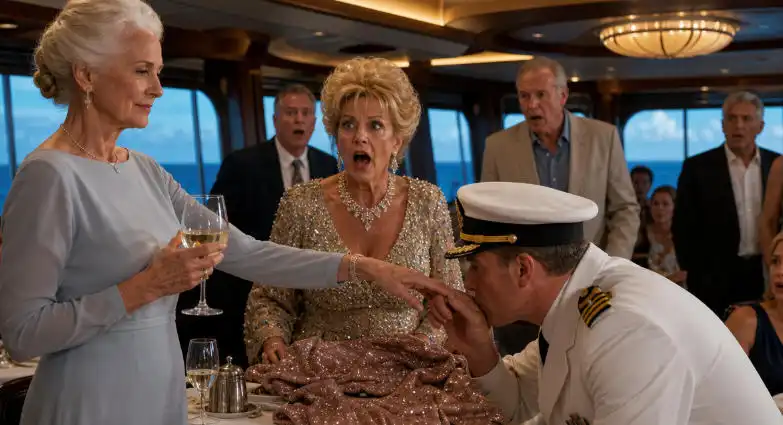
Then, in front of everyone, he lowered himself to one knee.
Denise’s smile disappeared.
My aunt closed her eyes for just a second.
The captain took her hand with old-world care.
He bowed his head and kissed the back of it.
“Mrs. Vale,” he said, “welcome home.”
A sound moved through the dining room.
Shock.
Confusion.
A few whispers.
Denise stared as if the laws of nature had betrayed her.
“I’m sorry,” she said sharply. “What is this?”
The captain rose.
His voice carried clearly.
“This vessel was designed by Edmund Vale.”
Aunt Margaret’s fingers tightened around her napkin.
“My late husband,” she said softly.
The captain nodded.
“Not only designed, ma’am. Saved.”
He turned toward the room.
“When this ship was still on paper, the company was collapsing under delays, engineering failures, and lawsuits. Mr. Vale redesigned the hull stabilization system, corrected the safety flaws, and personally guaranteed the completion financing when lenders pulled back.”
Denise’s face changed.
Just a little.
Not guilt.
Calculation.
The captain continued.
“In gratitude, and by binding agreement with the cruise line, Mr. Vale reserved a permanent privilege for his wife, Mrs. Margaret Ashford Vale.”
My heart started pounding.
Aunt Margaret looked down.
Not proud.
Not triumphant.
Almost embarrassed.
The captain said, “Mrs. Vale holds lifetime highest guest status aboard this vessel and any successor vessel in this class. Private dining access. Officer escort. Bridge reception rights. Priority suite privileges. And, when necessary, the right to request removal from shared spaces of any passenger who harasses, threatens, or endangers her comfort while aboard.”
Denise laughed once.
A brittle sound.
“That is absurd.”
The captain turned to her.
“No, Mrs. Hargrove. It is contractual.”
Denise’s lips parted.
“I paid for this wedding group.”
“Yes,” the captain said. “You purchased cabins.”
He paused.
“She helped create the ship you’re standing on.”
Someone at the next table whispered, “Oh my God.”
Emily covered her mouth.
Tyler finally looked up.
His face was white.
Denise pointed at Aunt Margaret.
“She is a bankrupt widow.”
The captain’s expression hardened.
“She is Mrs. Vale.”
Denise snapped, “I want to speak to corporate.”
“You may do so when we reach port.”
“Now.”
“No.”
The word cracked across the table.
Denise recoiled.
The captain looked to the senior officer beside him.
“Mr. Alvarez, please confirm what you witnessed.”
The officer stepped forward.
“I witnessed Mrs. Hargrove publicly insult Mrs. Vale, shove an article of clothing into her person, cause wine to spill across the table, and ignore repeated requests from family members to stop.”
Denise’s face flushed.
“That is not what happened.”
At least six people spoke at once.
“Yes, it is.”
“I recorded it.”
“She shoved it.”
“We all saw it.”
The public pressure Denise had created turned around and swallowed her whole.
Phones were still up.
Guests were staring.
The same room she wanted as her stage became her courtroom.
The captain said, “Mrs. Hargrove, under passenger conduct policy and at Mrs. Vale’s discretion, you are being removed from public areas for the remainder of the voyage until disembarkation.”
Denise gripped the back of her chair.
“You cannot lock me up.”
“You will be escorted to your suite,” he said. “Security will remain outside your corridor. You may order meals. You may contact your attorney. You may communicate with family by phone. But you will not enter dining rooms, theaters, lounges, pool decks, or wedding events.”
“My son’s wedding is tomorrow!”
The room went even quieter.
Tyler stood at last.
For one terrible second, I thought he would defend her.
Instead, he looked at his mother and said, “Mom, you did this.”
Denise stared at him.
“You ungrateful little coward.”
That was when I knew.
Not just about Denise.
About Tyler too.
Because he flinched.
A grown man, almost forty, still flinching from his mother’s voice.
Aunt Margaret saw it.
She always saw the wound under the behavior.
She rose slowly.
The captain offered his arm, but she didn’t take it yet.
She looked at Denise.
“Your money has made everyone afraid of inconveniencing you,” she said. “That is not the same as respect.”
Denise’s eyes were wet now, but not from sorrow.
From rage.
“You think this makes you important?”
“No,” Aunt Margaret said. “I was important to the people who loved me long before this ship existed.”
Then she turned to Tyler.
“Son, love should not require silence.”
Tyler swallowed hard.
Denise screamed, “Do not lecture my child!”
Two security officers stepped forward.
The captain gave one small nod.
Denise grabbed her purse from the table.
“You’ll all regret this. Every one of you. I paid for everything.”
Aunt Margaret finally took the captain’s arm.
“No, Denise,” she said. “Tonight you paid for a lesson.”
Security escorted Denise out.
Not dragged.
Not manhandled.
Simply surrounded.
Her heels struck the floor too sharply.
Guests watched her pass in absolute silence.
No applause.
That would have been too cheap.
The silence was worse.
It said: we saw you.
When she reached the doors, Denise turned back.
The cheap pink gown still lay on the table.
Aunt Margaret picked it up.
For a wild second, I thought she might throw it.
She didn’t.
She handed it to the waiter.
“Would you please see that this is donated at the next port, if it can be of use to someone?”
The waiter nodded with visible relief.
“Of course, ma’am.”
Then the captain guided Aunt Margaret to the center of the dining room.
The senior officers formed a line.
One by one, they approached her.
The hotel director.
The chief engineer.
The staff captain.
The safety officer.
Each bowed or shook her hand.
The chief engineer, a broad man with gray hair, had tears in his eyes.
“I trained on your husband’s drawings,” he told her. “We still use his notes.”
Aunt Margaret pressed her hand to her chest.
“He would have been so pleased.”
Then the captain lifted a glass.
“To Edmund Vale,” he said. “And to Mrs. Vale, whose name is part of this ship’s bones.”
The room rose.
Not because anyone ordered them to.
Because sometimes people know when dignity has entered the room.
Glasses lifted.
Aunt Margaret stood under the chandelier in her old navy dress, with repaired shoes and pearls she could no longer insure.
And she looked richer than every diamond in the room.
🥂
The next morning, the wedding was supposed to happen.
But I did not sleep.
I sat on the balcony of my cabin watching black water turn silver under the moon.
Tyler came out just before sunrise.
He looked wrecked.
“I’m sorry,” he said.
I didn’t answer right away.
He sat beside me.
“I should have stopped her.”
“Yes,” I said.
“I’ve spent my whole life trying not to set her off.”
“I know.”
He rubbed his face.
“That doesn’t excuse it.”
“No,” I said. “It explains it.”
That hurt him.
I could see it.
But I was done softening truth so men could keep pretending helplessness was kindness.
He looked at me.
“Are you still marrying me today?”
The ocean moved quietly below us.
I thought of Aunt Margaret sitting alone after Uncle Edmund died.
I thought of her selling furniture while still writing thank-you notes.
I thought of Denise using money like a whip.
I thought of Tyler staring at his plate while the woman who raised him tried to crush the woman who had helped raise me.
“I love you,” I said.
His eyes filled.
“But I won’t marry into silence.”
He bowed his head.
For a long time, neither of us spoke.
Then he said, “What do I have to do?”
“Not for me,” I said. “For yourself.”
He nodded slowly.
At ten o’clock, Denise called from her suite.
Tyler put her on speaker.
Her voice was sharp enough to slice fruit.
“Fix this. I want that woman removed from the wedding, and I want the captain disciplined.”
Tyler closed his eyes.
Then he opened them.
“No.”
Silence.
“What did you say?”
“I said no.”
“You pathetic—”
He cut her off.
“If you insult my fiancée, her aunt, or anyone else today, I will end the call. If you threaten money, I will hang up. If you punish me financially, that’s your choice.”
Denise laughed coldly.
“You will lose everything.”
Tyler looked at me.
Then at Aunt Margaret, who had stepped quietly into the room.
“No,” he said. “I’ll lose your leash.”
He hung up.
His hands were shaking.
Aunt Margaret walked over and took them.
“Courage often trembles,” she said. “Do it anyway.”
We did not hold the wedding that day.
Not because Denise ruined it.
Because truth saved it.
Tyler and I stood before our families in the small chapel on Deck 6 and told them the ceremony would be postponed.
There were whispers.
There were shocked faces.
There were relatives who had flown in and cruised in and packed formal clothes.
But I said, “A marriage deserves two people who can stand up in public before they make promises in public.”
Tyler took the microphone.
“My mother’s behavior last night was cruel,” he said. “My silence was cowardly. I’m sorry to Aunt Margaret. I’m sorry to my fiancée. I’m sorry to everyone who watched me fail to act.”
Aunt Margaret cried then.
Just a little.
Not from humiliation.
From relief.
Denise watched from her suite through whatever angry phone calls she was making, but she never appeared again in public.
The cruise line documented the incident.
Witness statements.
Video evidence.
Security reports.
Contract clauses.
Everything proper.
Everything within the rules.
No revenge outside the law.
No screaming in hallways.
No petty tricks.
Just policy.
Conduct.
Consequences.
The legal hammer came down clean.
At the next port, Denise was escorted off the ship by security and met by a company representative. Her remaining cruise privileges were revoked. Her private reception booking was canceled under the passenger misconduct clause. The unused portion was not refunded because she had violated the conduct agreement she signed when booking the group.
She threatened lawsuits.
The cruise line sent her the video.
She stopped threatening.
A month later, Tyler moved his accounts away from hers.
He found a therapist.
He wrote Aunt Margaret a letter by hand.
Not a text.
A letter.
She framed it.
Six months later, Tyler and I married in a small church garden with fifty people, folding chairs, lemonade, and no diamonds trying to blind the guests.
Aunt Margaret wore the navy dress.
The same one Denise mocked.
The captain could not attend, but he sent a handwritten note and a small brass plaque from the shipyard archives.
It read:
EDMUND VALE BUILDER OF SAFE PASSAGE
Aunt Margaret held it against her heart.
“He always said ships were promises,” she whispered.
At the reception, Tyler raised his glass.
“To Aunt Margaret,” he said. “Who taught me that dignity is not something you buy. It is something you protect.”
Everyone stood.
This time, people did applaud.
And Aunt Margaret, elegant as ever, lifted her champagne glass and smiled.
Not because she had beaten Denise.
But because for one night on that cruise ship, the world remembered what Denise had forgotten.
Money is loud.
Class is quiet.
And real power does not need to announce itself before it enters the room.
It only needs the truth.
So choose a side and say it plainly:
TEAM AUNT MARGARET — dignity wins.
Or TEAM DENISE — money excuses cruelty.
Share this if you believe nobody should be humiliated just because life knocked them down. ⚓
Disclaimer: Mention of any brand or trademark is for identification only and does not imply partnership or endorsement

The Tavern Owner Set A Trap To Make Paul Drink Again… But He Had NO IDEA The Entire Town Was Watching 👀

They Laughed When Mark Announced He Was Running for Office… Then One Sealed Envelope Made the Whole Room Go Silent 😳

My Stepdaughter Thought Her Real Father Paid for Her Golf Club Wedding… Then I Showed the Guests the Letter He Sent Me