
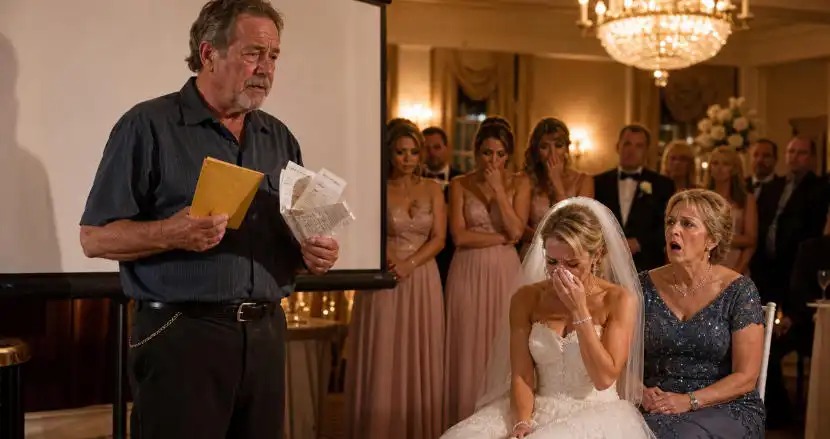
Then I clicked the remote, and the first bank receipt filled the projector screen.
The room went so quiet I could hear the ice shifting in champagne glasses.
At the top of the screen was my name.
HAROLD J. WILKES.
Under it was the transfer date.
Then the amount.
$18,750.
Paid to Oak Ridge Golf Club.
The same golf club where I had just been told I did not belong in the front row.
The same ballroom where women in pearls had stared at my old shoes like I had tracked mud across their family name.
The same wedding where my stepdaughter let strangers laugh at me because I was not “real family.”
A low murmur rolled through the room.
One of the bridesmaids, the redhead who had joked that I looked like the air-conditioning repairman, lowered her wine glass.
The groom’s mother, Elaine Whitmore, stood near the head table with her mouth half-open.
She had spent the whole day walking around like she owned the oxygen in the building.
Now she looked like someone had taken her script away.
Madison, my stepdaughter, stood beside her new husband, Parker. Her veil was still pinned perfectly into her hair. Her makeup was flawless. Her diamond earrings caught the light.
But her face had gone pale.
“Harold,” she said, barely above a whisper.
I looked at her.
For a second, I saw the little girl she used to be.
Seven years old.
Knees scraped from falling off her bike.
Hair tangled from swimming in the neighbor’s pool.
Standing in my garage doorway with a broken doll in her hands, asking, “Can you fix her too?”
I fixed that doll.
Then I fixed her bike.
Then I fixed her science project.
Then I fixed the leaky roof over the bedroom she cried in when her father missed another birthday.
For twenty-two years, I showed up.
But at her wedding, I was the man with the embarrassing shoes.
I pressed the remote again.
A second receipt appeared.
$9,400.
Florist deposit.
A third.
$12,200.
Catering balance.
Then another.
$6,100.
Live band.
Then another.
$4,850.
Photography package.
Then the final one.
$31,600.
Remaining reception balance.
The room changed.
It was not loud anymore.
It was heavy.
People started turning away from Elaine and toward me.
Aunt Diane covered her mouth.
Parker’s father leaned forward slowly, reading every line.
My wife, Linda, sat frozen at table fourteen, because Elaine had “accidentally” placed her there too.
Not beside her daughter.
Not beside me.
Table fourteen.
Next to the coatroom.
That was how they had arranged the mother who raised the bride.
Elaine tried to laugh.
It came out thin.
“Well,” she said, lifting her chin, “this is very inappropriate.”
I nodded once.
“You’re right.”
That surprised her.
I set the remote down on the lectern and looked over the guests.
“It was inappropriate when you took my chair from the front row.”
A few people shifted.
“It was inappropriate when your friends laughed at my shoes.”
The redheaded bridesmaid looked at the floor.
“It was inappropriate when your son’s best man thanked a man who never came, never called, and never paid one dime for this wedding.”
Parker turned to his best man.
The best man’s face turned red.
“I was told—” he started.
Elaine snapped, “Don’t.”
That one word told the whole room plenty.
Madison’s lips parted.
“What do you mean, never paid?”
I picked up the envelope.
The old paper had been folded and unfolded so many times that the crease was soft.
I had carried it for three months.
Not because I wanted revenge.
Because I knew the truth had a way of becoming necessary when lies got comfortable.
I pulled out the letter.
“Three months ago,” I said, “your mother asked me not to make a scene when your father said he might not contribute.”
Linda looked down.
She hated conflict.
She had spent half her life smoothing over men who disappeared and women who judged.
I continued.
“I called your father myself. I told him you deserved help with your wedding. I told him, no matter what happened between adults, you were still his daughter.”
Madison stared at the letter like it might bite her.
“He sent this.”
Elaine took one step toward me.
“Harold, don’t.”
I turned to her.
For thirty-four years, I worked in factories and machine shops. I had bosses scream in my face. I had customers accuse me of things I did not do. I had foremen talk down to me because I did not wear a tie.
Elaine Whitmore did not scare me.
“Why not?” I asked.
Her cheeks tightened.
“This is a wedding.”
“No,” I said. “This became a performance the minute you humiliated my wife and me in front of everyone.”
Parker stepped back from his mother.
That was the first good thing he did all day.
I unfolded the letter.
I did not read all of it.
Only enough.
“Harold,” I read, “Madison is grown. She chose the life she wanted. I will not be guilted into paying for a country club wedding so she can impress people I don’t care about.”
Madison flinched.
I kept reading.
“If you want to play father, you pay for it. She made her choice. Stop asking me for money.”
A woman near the back whispered, “Oh my God.”
Madison shook her head.
“No. No, he told me he helped.”
I looked at her mother.
Linda’s eyes were wet.
I hated that she was being dragged through this.
But she was not the liar.
She was the woman who begged me, three times, to let the day pass without ruining Madison’s happiness.
And I had tried.
God help me, I had tried.
I would have stood in the back.
I would have eaten cold chicken near the kitchen doors.
I would have let them think whatever they wanted about my shoes.
But then Elaine put my wife at table fourteen.
Then the bridesmaids laughed.
Then Madison looked away.
And then they thanked the absent man.
That was the last insult.
Madison turned to Elaine.
“You told me Dad paid for the reception.”
Elaine’s face hardened.
“I told you your father wanted you to have a beautiful day.”
“That’s not the same thing.”
Elaine took a breath and switched into her favorite voice.
The wealthy-woman voice.
Soft.
Controlled.
Deadly.
“Madison, sweetheart, today is not the time to be emotional.”
I almost laughed.
Not because it was funny.
Because some people mistake cruelty for manners if they say it quietly enough.
Parker spoke next.
“Mom, did you know Harold paid for everything?”
Elaine looked at him like he had betrayed the family crest.
“Parker, this is not your concern.”
“It’s my wedding.”
“It is our family’s reputation.”
There it was.
The real bride at the wedding.
Reputation.
Not Madison.
Not Parker.
Not love.
Reputation.
Parker’s father, Richard, slowly stood from the head table.
He was a tall man with silver hair and a country club tan. He had said maybe twenty words to me all day.
He looked at his wife.
“Elaine.”
She turned sharply.
“Sit down, Richard.”
He did not sit.
“Did you remove Harold from the front row?”
Elaine smiled tightly.
“There was a seating concern.”
“No,” Parker said. “There were empty seats.”
People began whispering again.
Phones were out now.
Not one or two.
Dozens.
The public pressure Elaine loved using against people had turned around and found her.
She looked toward the photographer.
“Stop filming.”
The photographer did not lower his camera.
The videographer kept rolling too.
I did not ask them to.
I did not need to.
Truth does not need a director.
Madison stepped down from the small platform near the sweetheart table. Her dress brushed the floor as she walked toward me.
For a second, I thought she was going to ask me to stop.
Maybe tell me I was embarrassing her.
Maybe say what she had said once during the planning dinner, when Elaine suggested the “real family photo” should be small.
“Harold understands.”
I had understood too much for too long.
But Madison stopped in front of the screen and looked up at the receipts.
Her voice cracked.
“You paid all of this?”
“Yes.”
“Why didn’t you tell me?”
I swallowed.
“Because you were happy thinking your father finally showed up for you.”
Her eyes filled.
That landed harder than any receipt.
The whole room seemed to breathe in at once.
I continued, softer now.
“I thought maybe you needed that more than I needed credit.”
Linda started crying at table fourteen.
Madison looked toward her mother.
“Mom knew?”
Linda wiped her face.
“I knew your father refused,” she said. “I knew Harold paid. I did not know Elaine had told people your father paid for everything.”
Madison looked back at Elaine.
“You lied to me.”
Elaine lifted both hands like she was calming a child.
“I protected you.”
“No,” Madison said. “You protected your image.”
A small sound came from the guests.
Not applause.
Not yet.
Just recognition.
Everyone knows that kind of person.
The one who wounds you and calls it protection.
The one who lies and calls it class.
The one who excludes people and calls it tradition.
Elaine’s mask cracked.
“Do you have any idea how this looked?” she hissed. “A bride’s stepfather in scuffed shoes sitting in the front row at Oak Ridge? People talk, Madison. They notice things.”
I looked down at my shoes.
Old black leather.
Creased across the toes.
Polished by my own hands that morning.
I had bought them for my wedding to Linda seventeen years earlier. I wore them to my mother’s funeral. I wore them to Madison’s high school graduation. I wore them to the courthouse when I helped Madison fight a parking ticket she was too scared to handle alone.
Those shoes had walked into every important day I was allowed to attend.
And one day I was not.
Madison stared at Elaine.
“You moved him because of his shoes?”
Elaine did not answer.
She did not need to.
The silence confessed for her.
Then Parker did something I did not expect.
He walked to the front row, picked up the empty chair, and carried it down the aisle himself.
Nobody moved.
Nobody spoke.
He placed it beside Madison’s mother’s chair at table fourteen.
Then he turned to his wife.
“I’m sorry,” he said. “I should have noticed.”
Madison wiped her tears.
“You should have.”
He nodded.
“I know.”
That mattered.
Not because it fixed everything.
Because some men defend their mothers so long they forget to defend what is right.
Parker looked at me.
“Mr. Wilkes, I owe you an apology.”
I said nothing.
He kept going.
“I let my family treat you like a guest we were ashamed of. You paid for the day I just got married on. But even if you hadn’t paid a cent, you deserved respect.”
The room watched him closely.
Parker turned to the guests.
“And for the record, I don’t care who hears this. Harold Wilkes is family.”
Madison covered her mouth.
That was when I saw it.
Not the bride who wanted approval.
Not the young woman trying to look rich enough for Elaine.
My Madison.
The one who once fell asleep in the passenger seat of my pickup after I drove three hours to pick her up from a bad college party.
The one who called me when her first apartment flooded.
The one who asked me, quietly, if I thought she was “too much trouble.”
I had told her, “Kiddo, trouble is what family shows up for.”
She walked toward me again.
This time, she did not stop.
She threw her arms around my neck.
“I’m sorry,” she whispered.
I stood stiff for half a second.
Old habits.
A working man learns not to break in public.
Then I hugged her back.
Her veil brushed my cheek.
“I thought he finally cared,” she cried.
“I know.”
“I wanted it to be true.”
“I know.”
“I let them treat you like you didn’t matter.”
That one hurt.
Because it was honest.
I pulled back and looked at her.
“You hurt me today, Madison.”
Her face crumpled.
“I know.”
“But you are not the first person to confuse a loud lie with love.”
She nodded through tears.
Behind her, Elaine was speaking quickly to Richard.
“This is humiliating. We need to shut this down.”
Richard looked tired.
Not angry.
Tired.
“Elaine,” he said, “you humiliated yourself.”
She recoiled like he had slapped her.
He continued.
“I asked you this morning why Harold and Linda weren’t seated with family. You told me Madison requested it.”
Madison turned.
“What?”
Richard looked at her.
“That’s what she said.”
Madison’s tears stopped for one second.
Then came the anger.
Clean.
Sharp.
Deserved.
“I never said that.”
Elaine looked around.
Too many witnesses.
Too many phones.
Too many rich friends pretending they were not recording while absolutely recording.
She tried one more angle.
“Well, I was trying to avoid awkwardness. Everyone knows stepfamilies can be complicated.”
I laughed once.
That was the only rude sound I made all night.
“Complicated?” I said. “I paid for braces when her father disappeared. I taught her to drive in a church parking lot. I sat outside emergency care at 2 a.m. when she had pneumonia. I helped her move four times. I walked her mother through cancer treatments. I have been many things, Elaine. Tired. Underpaid. Invisible. But I have never been complicated.”
The room went still again.
Then Aunt Diane stood.
“She’s right,” she said, pointing at Madison. “Harold was there.”
Another voice came from table six.
“He came to every school concert.”
Then Parker’s aunt said quietly, “Elaine, you owe that man an apology.”
Elaine’s face turned red.
She looked trapped.
And for the first time all day, the woman who loved hierarchy discovered she was at the bottom of one.
She looked at me.
“I’m sorry you felt disrespected.”
A few people groaned.
Madison stepped back.
“No.”
Elaine blinked.
Madison’s voice was shaking, but she did not look away.
“You don’t get to apologize for his feelings. You apologize for what you did.”
Parker stood beside her.
Richard stood beside Parker.
Linda rose slowly from table fourteen and stood beside me.
That was the image I will remember forever.
Not the receipts.
Not Elaine’s face.
Not the shocked guests.
My wife, my stepdaughter, and my new son-in-law standing together in a room that had tried to sort us by blood, money, and shoes.
Elaine’s shoulders dropped.
“I’m sorry,” she said, the words stiff as wire. “I removed your seat. I judged you. I allowed people to mock you. I should not have done that.”
I nodded.
I did not forgive her right there.
People love demanding instant forgiveness from the person they hurt because it makes the room comfortable again.
But I was not responsible for making Elaine comfortable.
“Thank you for saying it,” I replied.
That was all.
Madison turned to the DJ.
“Cut the music.”
He had not played anything in ten minutes, but he nodded like a man grateful for instructions.
Then Madison picked up the microphone.
Her hands trembled.
She looked at the crowd.
“I need to correct something.”
Nobody interrupted.
“My biological father did not pay for this wedding. He did not attend this wedding. He did not walk me down the aisle because he chose not to be here.”
Her voice broke.
“The man who paid for this wedding is the man I let stand in the back today.”
She looked at me.
“The man who packed my lunches when Mom worked doubles. The man who never missed a pickup. The man who showed up when it was inconvenient.”
She took a breath.
“And I am ashamed that I let anyone treat him like less than my father.”
Linda pressed her hand to her mouth.
Madison turned toward me.
“Harold, would you please walk me to my seat?”
I could not speak at first.
The first row was still up front, near the head table.
But Parker shook his head.
“No,” he said. “We’re moving the family table.”
He turned to the event staff.
“Can we put Harold and Linda at the head table with us?”
The young banquet manager looked at Elaine, then at Parker, then at Madison.
“It’s your wedding,” he said.
A few guests laughed softly.
The staff moved fast.
Chairs shifted.
Plates lifted.
Name cards changed.
Elaine’s friends watched in silence as Linda and I were brought from table fourteen to the head table.
Not hidden.
Not tolerated.
Placed.
There is a difference.
When I sat down beside Madison, she reached under the table and squeezed my hand.
Her hand was cold.
Mine was rough.
She did not let go.
The reception resumed, but it was not the same party.
It was better.
Not perfect.
Better.
The best man apologized to me in front of Parker. He admitted Elaine had given him the line about thanking Madison’s father. He said he thought it meant me, until Elaine corrected him before the toast and told him to say “her father,” not “Harold.”
Parker told him, “Next time, ask the bride.”
That was the right answer.
The bridesmaid with the red hair came over later, eyes wet and mascara smudged.
“I was cruel,” she said. “I’m sorry.”
I looked at her expensive dress, her shaking hands, her embarrassed face.
“You were,” I said.
She nodded.
“I know.”
“Then be different next time.”
She nodded again and left.
That was enough.
Not everyone needs a speech.
Some people need a mirror.
Elaine left before the cake cutting.
Richard stayed.
That told everyone what they needed to know.
Two days later, the video made its way through the family.
By Monday morning, Oak Ridge had calls from members asking why a paying family had been treated that way by another guest. Elaine’s charity committee asked her to “step back” from chairing the fall gala. Her friends did not abandon her, exactly.
They did something worse for a woman like Elaine.
They became polite.
Distant.
Careful.
No gossip is louder than a room full of people suddenly watching what they say around you.
Madison called me the following Wednesday.
Not texted.
Called.
“Can I come over?” she asked.
“Always.”
She came alone.
No makeup.
Hair in a ponytail.
A sweatshirt from the state college she almost quit twice.
She brought a shoe box.
I looked at it and raised an eyebrow.
“I don’t need new shoes,” I said.
She smiled through tears.
“I know.”
Inside was not a new pair.
It was my old black dress shoes.
Cleaned.
Re-soled.
Re-stitched.
The leather had been conditioned until it looked deep and soft again.
A handwritten note sat inside.
Dad,
I used to think family was the person who gave me a last name.
Now I know family is the person who keeps showing up when no one claps for him.
I am sorry I forgot.
Love,
Madison
I read it twice.
Then I had to sit down.
She knelt in front of me, like she was seven again, holding that broken doll.
“Can we fix us too?” she asked.
That one got me.
I pulled her into my arms.
“Yeah, kiddo,” I said. “We can fix us.”
It was not instant.
Real healing rarely is.
We had dinners.
Hard conversations.
Quiet apologies.
She admitted she had been chasing a fantasy of her biological father for years. Every ignored call made her want his approval more. Every lie about him caring felt easier than admitting he chose absence.
I told her I understood.
But I also told her understanding pain does not excuse passing it to someone else.
She listened.
That mattered.
Parker came over too. He helped me replace a cracked section of fence in the backyard. He was terrible with tools, but he tried. By the end, he had three blisters and a better understanding of why working hands look the way they do.
Linda forgave Madison before I did.
Mothers are built with strange rooms in their hearts.
But one night, months later, Madison invited us to dinner.
Nothing fancy.
Pot roast.
Mashed potatoes.
Green beans.
At the table, she raised her glass.
“To my parents,” she said.
Not “my mom and Harold.”
Not “my stepdad.”
My parents.
I looked down at my plate because I did not trust my face.
Linda cried openly.
Parker smiled.
And Madison reached under the table and tapped my shoe with hers.
The old black shoes.
I still wear them.
Not because I cannot buy new ones.
Because they remind me that dignity does not come from leather, money, blood, or a country club chair.
Dignity comes from what you do when people give you every reason to become bitter, and you choose truth instead.
As for Madison’s biological father, he called two weeks after the wedding video spread.
He said he wanted to “clear things up.”
Madison listened for less than a minute.
Then she said, “You already cleared things up in your letter.”
And she hung up.
That was the last time she waited for him to become someone he was not.
Elaine sent one more apology letter. A real one this time. No excuses. No “sorry you felt.” No polished poison.
I accepted it.
I still keep my distance.
Forgiveness does not require front-row access back into your life.
The funny thing is, people remember that wedding now for the wrong reason and the right one.
Some remember the receipts.
Some remember Elaine’s face.
Some remember the old shoes.
But Madison says she remembers the moment the room went silent and she finally understood the difference between being loved loudly and being loved faithfully.
One makes speeches.
The other pays the bill and stands in the back until the truth needs him.
So choose a side:
Share this if you believe the man who shows up is the real father.
Keep scrolling if you think blood matters more than loyalty.
Disclaimer: Mention of any brand or trademark is for identification only and does not imply partnership or endorsement
The Tavern Owner Set A Trap To Make Paul Drink Again… But He Had NO IDEA The Entire Town Was Watching 👀
They Laughed When Mark Announced He Was Running for Office… Then One Sealed Envelope Made the Whole Room Go Silent 😳
She Called My Aunt “A Bankrupt Fake” In Front Of The Whole Table… Then The Ship’s Captain Got Down On One Knee ⚓