He called my truck “trash” before he even looked me in the eye.
Not quietly.
Not as a joke.
He said it loud enough for every customer at Miller’s Country Auto to hear.
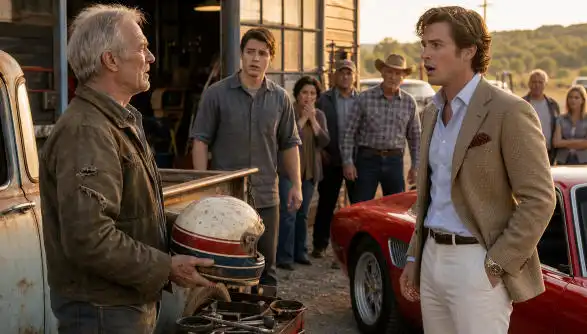
“This place smells like poverty,” the young man said, stepping out of his red sports car like the gravel itself was beneath him. “And that thing needs to be hauled off before it infects my tires.”
He pointed at my pickup.
My old pickup.
Rust on the bed.
Primer on one door.
A dented bumper I had straightened twice with a chain and an oak tree.
It wasn’t pretty.
But it had carried more honest work than that boy had ever done in his life.
I was standing beside it with a wrench in one hand and a box of sockets at my feet.
My jacket was torn at the cuff.
My boots were dusty.
My hands were black with grease.
To him, that was enough.
To him, I was just some broke old man taking up space.
His name was Brandon Vale.
Everybody in that county knew the Vale name.
Vale Automotive Group owned three dealerships, a towing company, a parts warehouse, and half the billboards on the interstate.
Brandon was the owner’s son.
The kind of boy who had never had to ask the price of anything.
He wore sunglasses indoors.
He had a watch that cost more than Danny Miller’s entire repair bay.
And he had the soft, smug face of someone who had mistaken inheritance for achievement.
Danny, the clerk, came out from behind the counter as soon as Brandon walked in.
Poor Danny looked like he had seen a state inspector and a banker walk in at the same time.
“Mr. Vale,” Danny said. “We’ll get you handled right away.”
There were six people in the waiting area.
A retired schoolteacher named Mrs. Collins.
Two truckers.
A young mother with a sleeping baby.
A farmer in overalls.
And a teenager filming something for his phone before anything had even happened.
Brandon looked around at them like they were furniture.
Then he looked back at me.
“Is he staff?” Brandon asked.
Danny swallowed. “He’s just helping with—”
“With what?” Brandon cut in. “Making the place look abandoned?”
A couple of people shifted in their chairs.
Nobody laughed.
That made Brandon worse.
Entitled people hate silence almost as much as they hate being told no.
He walked closer to me.
“You deaf, grandpa?”
I kept sorting my sockets.
He bent down, picked up one of my old wrenches with two fingers, and dropped it like it was dirty.
“Tell me something,” he said. “Do you sleep in that truck, or is the truck ashamed of you too?”
Mrs. Collins whispered, “Oh, dear.”
Danny’s face turned red.
“Mr. Vale, please…”
Brandon snapped his fingers at him.
“Don’t start. My father sends more business through this dump than anyone in this county.”
Then he turned back to me and pointed toward the far side of the lot.
“Move it.”
I looked up.
“Move what?”
“That rolling disease.”
“My truck?”
“If that’s what you call it.”
I wiped my hands on a rag.
“It runs.”
Brandon laughed.
“It leaks.”
“So do most things that still work hard.”
That got one quiet chuckle from one of the truckers.
Brandon heard it.
His neck tightened.
He stepped toward my toolbox and kicked it.
Hard.
The lid flipped open.
Sockets scattered across the gravel.
One bounced under the front tire of his sports car.
The young mother covered her baby’s ears like the sound itself had been cruel.
For a second, nobody moved.
Danny looked like he wanted to disappear.
The farmer took one step forward, then stopped.
Because that was the thing about the Vale family.
They were too connected.
Too rich.
Too useful.
People didn’t like them, but they needed them.
A tow here.
A loaner car there.
A sponsorship for the church raffle.
A job for a nephew.
That was how power worked in a small town.
Not with a crown.
With favors.
Brandon smiled down at me.
“Pick it up,” he said.
So I did.
One socket at a time.
I kneeled in the gravel and picked up every piece.
Not because he told me to.
Because my tools had never disrespected me.
When I stood again, I looked at his car.
A beautiful machine.
Low stance.
Wide tires.
Carbon fiber trim.
Too much horsepower for a boy with too little character.
I nodded toward it.
“You ever drive that thing anywhere besides a valet lane?”
The whole shop went quiet.
Brandon blinked.
“What did you say?”
“I asked if you drive it,” I said, “or if you just bought it to hide behind.”
A trucker coughed into his fist.
The teenager’s phone lifted higher.
Brandon took off his sunglasses slowly.
There it was.
The first crack.
Rich boys can survive being disliked.
They cannot survive being doubted.
“You want to talk driving?” he said.
“I didn’t say I wanted to.”
“No, no.” He smiled, but his jaw was tight now. “Let’s talk driving.”
He pulled his keys from his pocket and dangled them in front of my face.
“See these? This is what real success sounds like.”
The keys jingled.
Nobody spoke.
“My family owns the private test track three miles down the road,” he said. “We use it for promotional shoots. Dealer events. Real cars. Not farm junk.”
I let him talk.
That is the thing about arrogant people.
If you give them silence, they will build the trap themselves.
Brandon pointed at my pickup.
“If that rust bucket can make one clean lap without coughing up its own engine, I’ll give you my keys.”
Danny stepped forward.
“Mr. Vale, that’s not necessary.”
Brandon ignored him.
“And if it can’t,” he said, “you apologize to me on camera for wasting space in my town.”
My town.
That was how he said it.
Like county lines were property lines.
Like every road, shop, and working man belonged under the Vale family name.
I looked down at the keys.
Then at the crowd.
Then at Danny.
“Still got that old helmet in the office?”
Danny froze.
That was when the air changed.
Not much.
Just enough.
Mrs. Collins looked from him to me.
One of the truckers lowered his coffee.
Danny’s mouth opened, but nothing came out.
Brandon frowned.
“What helmet?”
I walked past him into the small office behind the counter.
It smelled like coffee, old invoices, and rubber floor mats.
On the top shelf, behind a stack of registration forms, sat a dusty white racing helmet with faded black stripes.
I had left it there years earlier.
Not as a trophy.
Not as a secret.
Just because some pieces of a man’s life are too heavy to keep at home and too important to throw away.
I took it down.
Dust fell across my sleeve.
The teenager at the door zoomed in with his phone.
On the left side of the helmet was a signature.
Faded, but readable.
Caleb “Cal” Mercer.
Brandon stared at it.
Then he laughed too quickly.
“Cute. You bought a fake helmet.”
Danny whispered, “It’s not fake.”
Brandon turned on him.
“What?”
Danny’s voice shook. “That’s Cal Mercer.”
Brandon rolled his eyes. “I know who Cal Mercer is.”
“No,” Danny said. “That is Cal Mercer.”
The shop went silent again.
But this time, it didn’t belong to Brandon.
It belonged to me.
I buckled the helmet under my arm and walked toward the lot.
“Call your track manager,” I said.
Brandon’s face lost color for half a second.
Then pride shoved it back in place.
“Fine,” he said. “Let’s go.”
By the time we reached the Vale private test track, half the repair shop had followed.
So had two pickup trucks from the gas station.
So had a sheriff’s deputy who said he was “just making sure nobody got stupid.”
The test track sat behind a chain-link fence on land Brandon’s father had bought years before.
It wasn’t fancy like the tracks I remembered.
But it had a long straightaway, two sweeping corners, and one tight left bend that punished overconfidence.
Brandon parked his red sports car near the gate and started performing for the phones.
“Everybody get this,” he called out. “The old man wants to race history.”
I climbed into my pickup.
Danny leaned into the window.
“Mr. Mercer,” he whispered, “you don’t have to prove anything.”
“I’m not proving anything,” I said.
“Then what are you doing?”
I looked at Brandon, who was still laughing with his hands in the air.
“I’m letting a boy meet the bill.”
Danny swallowed.
The truck started on the second turn.
Not pretty.
Not smooth.
But deep.
Brandon laughed when the engine coughed.
“That thing sounds like it needs last rites!”
I rolled down the window.
“Son,” I said, “cars don’t need to sound expensive. They need to listen.”
That shut him up for three seconds.
The track manager arrived in a golf cart, confused and irritated.
His name was Owen.
He was older than Brandon and smart enough to fear Brandon’s father more than Brandon himself.
“What is this?” Owen demanded.
Brandon slapped a hand on the hood of his sports car.
“A friendly demonstration.”
Owen looked at me.
Then at the helmet.
His eyes widened.
“Mr. Mercer?”
I nodded once.
Brandon snapped, “Why does everybody keep saying his name like he’s the president?”
Owen looked at him like he had just insulted church in front of his grandmother.
“Because your father has a signed photo of this man in his office.”
Brandon’s mouth closed.
The crowd murmured.
Someone said, “Wait… F1 Mercer?”
Someone else said, “No way.”
Yes way.
Years before, back when my knees didn’t ache in the rain and my hands didn’t shake before coffee, I had driven Formula One.
Not for long.
Long enough to win.
Long enough to crash.
Long enough to learn that speed reveals a man’s soul faster than money ever can.
I left racing after my wife got sick.
Reporters called it mysterious.
Fans called it tragic.
I called it marriage.
She needed me more than the podium did.
After she passed, I came home to the county where I was born.
I fixed engines.
I drank gas station coffee.
I helped Danny’s father keep Miller’s Auto open when the banks circled like buzzards.
I was not hiding.
I was living.
There is a difference.
Brandon didn’t know any of that.
To him, value had to be polished, loud, and expensive.
So he looked at my truck and saw junk.
He looked at me and saw nothing.
Owen, the track manager, cleared his throat.
“Mr. Vale, I don’t think this is a good idea.”
Brandon snapped back.
“Open the gate.”
“Your father—”
“I said open it.”
Owen hesitated.
I leaned out of my window.
“Make it official.”
Brandon frowned. “What?”
I nodded toward the phones.
“You made a public bet. Keys for one clean lap.”
The farmer called out, “We all heard it.”
Mrs. Collins raised her hand. “I certainly did.”
One of the truckers said, “I’ve got it on video.”
Brandon’s eyes jumped from face to face.
That was when he realized the mistake.
He thought the crowd was his stage.
But it had become his witness stand.
I pulled a folded paper from my glove box and handed it to Danny.
He unfolded it.
His eyebrows shot up.
“What’s that?” Brandon demanded.
Danny looked at me.
“Track liability release?”
I nodded.
“Signed last month. Owen and I tested the pickup here after hours when we rebuilt the rear end.”
Brandon’s face tightened.
“You’ve driven here before?”
“Many times.”
“In that?”
“In this.”
The crowd stirred again.
The first 30% of the truth was out.
But not all of it.
Not yet.
Brandon tried to laugh.
“Fine. So you know the track. Big deal. That truck still can’t touch my car.”
“I never said it could.”
“Then what are we doing?”
I looked through the windshield at the curve ahead.
“Teaching.”
The gate opened.
Owen stepped aside.
Brandon walked to his sports car, but I raised a hand.
“No.”
He turned.
“What?”
“You said if my truck makes one clean lap, I get your keys.”
“That’s right.”
“You didn’t say race.”
His lips parted.
The truckers laughed.
Brandon pointed at me.
“That’s not fair.”
“Neither was kicking a man’s tools.”
That line traveled through the crowd like wind through dry grass.
Phones lifted higher.
Brandon’s ears turned red.
He had built his own trap, and every person there had watched him do it.
Owen gave the signal.
I rolled onto the track.
For a moment, everything went quiet inside the cab.
The crowd faded.
Brandon faded.
The years faded.
My hands settled on the wheel.
My foot felt the pedal.
The old truck vibrated under me like a tired dog ready to hunt one more time.
I remembered my wife, Ellen, sitting in the bleachers at Monaco with a paper cup of coffee in her hand, pretending she wasn’t scared.
I remembered her saying, “Cal, speed is only beautiful when it serves something better than ego.”
She was right.
She usually was.
The flag dropped.
I launched.
The pickup roared down the straightaway.
Not like Brandon’s car.
No screaming luxury engine.
No perfect shifting computer.
Just raw American steel, rebuilt by hands that still knew what they were doing.
At the first corner, I lifted just enough.
The rear end stepped out.
The crowd gasped.
Then I caught it.
Smooth.
Clean.
A controlled drift through the bend, tires smoking, truck angled like it was dancing with the edge of disaster but never letting disaster lead.
The second corner came fast.
I pushed harder.
The old pickup slid wide, then tucked back in.
The crowd erupted.
I heard them even through the helmet.
By the time I hit the tight left, Brandon’s face was visible behind the fence.
His mouth was open.
Not smiling now.
The truck snapped sideways.
For one heartbeat, it looked impossible.
Then it straightened like a rifle shot and tore down the final stretch.
I crossed the line.
One clean lap.
No cones touched.
No engine failure.
No apology.
Just silence for half a second.
Then the whole place exploded.
People cheered.
The truckers yelled.
The teenager screamed, “BRO, THAT OLD MAN JUST COOKED HIM!”
Mrs. Collins covered her mouth and cried.
Danny was laughing and wiping his eyes at the same time.
I rolled back to the gate and shut off the engine.
Brandon stood by his sports car, pale and furious.
I stepped out.
The helmet came off slowly.
“Keys,” I said.
His hand closed around them.
“No.”
The crowd quieted.
I walked toward him.
“You made the bet.”
“I was joking.”
“You weren’t joking when you kicked my tools.”
He looked at the crowd.
Nobody came to rescue him.
That is the loneliest moment for a bully.
The moment the audience stops fearing him.
Brandon’s voice cracked.
“You can’t take my car.”
“I don’t want your car.”
That confused him.
I held out my hand.
“I want your keys.”
“Why?”
“Because a man who uses horsepower to humiliate people should spend some time walking.”
The sheriff’s deputy stepped closer.
“Public verbal wager. Plenty of witnesses. Best thing to do is hand them over and settle it later like adults.”
Brandon stared at him.
“You’re taking his side?”
The deputy shrugged.
“I’m taking the side of the part where everybody recorded you.”
That was the legal hammer.
Not revenge in a dark alley.
Not threats.
Not fists.
Witnesses.
Video.
A public wager.
A liability release.
Rules.
The very things Brandon thought only protected people like him.
His hand trembled.
Then he dropped the keys into my palm.
The sound was small.
But it hit him like thunder.
The crowd cheered again.
Brandon’s face twisted.
For the first time all day, he looked his age.
Young.
Spoiled.
Terrified.
And completely out of control.
“You ruined me,” he whispered.
“No,” I said. “You finally met yourself.”
That should have been the end.
But pride always begs for a second punishment.
Brandon lunged toward the keys.
Not a punch.
Not a real attack.
Just a desperate grab from a boy who had never lost anything he couldn’t buy back.
The sheriff caught his arm.
Brandon jerked away, stumbled backward, and tripped over the low trailer hitch near the track cart.
He hit the ground hard.
There was a sharp cry.
Owen knelt beside him.
“Don’t move.”
Brandon grabbed his lower leg, sobbing now.
“My dad is going to kill me.”
No one laughed.
Not then.
Pain has a way of making even fools human again.
An ambulance came.
So did Brandon’s father.
Richard Vale arrived in a black SUV with two company men behind him.
He was broad, silver-haired, and dressed like a man used to walking into rooms that automatically made space for him.
He took one look at his son on the stretcher.
Then at the crowd.
Then at me.
Recognition hit him immediately.
“Cal Mercer,” he said.
“Richard.”
His face tightened.
He looked at Brandon.
“What did you do?”
Brandon started babbling.
“He tricked me. He stole my keys. They all ganged up on me.”
The teenager stepped forward.
“I got the whole thing.”
Then another phone lifted.
Then another.
Mrs. Collins said, “So did I.”
The farmer said, “Me too.”
Richard Vale’s face slowly changed.
Not anger at us.
Something worse for Brandon.
Disappointment.
Public disappointment.
He watched the video right there on the track.
He watched his son mock the shop.
He watched him kick my toolbox.
He watched him call my truck garbage.
He watched him make the bet.
He watched him lose.
When the video ended, Richard closed his eyes.
For a moment, he looked older than me.
Then he turned to Brandon.
“You did this wearing our company jacket?”
Brandon looked down.
He was.
A black Vale Automotive jacket with the logo stitched over his heart.
Richard’s voice dropped.
“You humiliated an old man, a local shop, and every customer standing there… while representing my business.”
Brandon tried to sit up.
“Dad, I broke my leg!”
Richard snapped, “You broke more than that.”
The crowd went quiet again.
Richard looked at me.
“Cal, I’m sorry.”
I nodded once.
He looked at Danny.
“Mr. Miller, I’m sorry to your shop.”
Danny didn’t know what to say.
Richard turned to the crowd.
“Vale Automotive will cover every customer’s service bill today. And we will be making a public statement.”
Brandon started crying harder.
Not from his leg anymore.
From the sound of consequences.
Over the next week, the video spread everywhere.
First through town.
Then across the state.
Then onto every Facebook page where people still understand that money without manners is just noise.
The headline wrote itself:
“Vale Automotive Heir Humiliates Old Mechanic, Loses Car Keys After Bet.”
The damage was instant.
Vale Automotive’s reviews collapsed.
Local sponsors pulled back.
A church fundraiser returned their donation.
One dealership manager resigned after saying, “We sell trucks to people Brandon mocked.”
Richard Vale moved fast.
He suspended Brandon from all company roles.
Cut off his access to the company car fleet.
Issued a public apology.
Paid for new equipment at Miller’s Country Auto.
And, most importantly, he signed a written agreement that no Vale-owned tow or parts service would ever pressure or punish Miller’s shop for what happened.
Rules again.
Paper again.
The legal hammer does not have to be loud.
It just has to be real.
As for the red sports car keys?
I kept them for three days.
Then I mailed them to Richard Vale with a note.
Your son lost these. Maybe make him earn them back one mile at a time.
Richard called me that afternoon.
“You could have kept the car longer,” he said.
“I know.”
“Why didn’t you?”
“Because the lesson wasn’t the car.”
He was quiet.
Then he said, “What was it?”
I looked out my kitchen window at my rusty pickup.
“The lesson was that humiliation has interest. Sooner or later, the bill comes due.”
A month passed.
Brandon disappeared from town while his leg healed.
Some said his father sent him to work in the parts warehouse with no title.
Some said he had to take customer service calls.
Some said he wasn’t allowed near the dealership floor until he could go thirty days without insulting someone.
I don’t know which parts were true.
I only know this.
One Thursday morning, Danny called me.
“Mr. Mercer,” he said. “Can you come by the shop?”
“Something broken?”
“Yeah,” he said softly. “Mine.”
When I got there, Danny was standing beside an old blue sedan behind the shop.
His own car.
The one he always parked where customers couldn’t see it.
It had a cracked fender, bad brakes, a tired starter, and an engine that coughed like it had secrets.
Danny looked embarrassed.
“I was going to junk it,” he said. “Can’t afford to fix it right now.”
I walked around it once.
“Your dad drove this, didn’t he?”
Danny nodded.
“Before he passed.”
I knew what that meant.
Some cars are not transportation.
They are memory with tires.
I opened the hood.
“Bring me coffee.”
His eyes widened.
“Mr. Mercer, I can’t pay—”
“I didn’t ask.”
For the next five evenings, I worked on Danny’s sedan.
New brake lines.
Starter rebuild.
Fresh plugs.
A cleaned carburetor.
Two used tires from a friend who owed me a favor.
I even buffed the hood until the blue paint remembered itself.
On Saturday morning, I handed Danny the keys.
He stared at the car.
Then at me.
“You fixed it?”
“No,” I said. “I reminded it.”
He ran one hand over the fender.
His eyes filled.
“My dad taught me to drive in this car.”
“I know.”
He tried to speak, but couldn’t.
So I saved him the trouble.
“Consider it payment.”
“For what?”
“For being scared and still telling the truth.”
Danny shook his head.
“I almost made you move your truck.”
“But you didn’t lie when it mattered.”
That is worth something.
More than people think.
A few minutes later, Mrs. Collins arrived with a pie.
The truckers came by with coffee.
The farmer brought a box of peaches.
And for the first time in a long while, Miller’s Country Auto didn’t feel like a shop trying to survive.
It felt like a town remembering who it was.
Two weeks after that, a letter came to the shop.
No return address.
Inside was a cashier’s check made out to Miller’s Country Auto for the exact amount of Danny’s overdue equipment loan.
There was also a note.
No signature.
Just one sentence.
Tell Mr. Mercer I’m walking.
Danny showed it to me.
“Do you think it was Brandon?”
I read the note twice.
Maybe it was.
Maybe Richard made him do it.
Maybe both things were true.
Growth often starts as punishment before it becomes character.
I folded the note and handed it back.
“Put it in the office.”
“Next to the helmet?”
I smiled.
“No. Next to the coffee maker. People learn better when they’re awake.”
The rusty pickup still sits outside Miller’s Country Auto some mornings.
People still stop and take pictures.
Kids ask if it is “the drift truck.”
Old men ask what cam I’m running.
Teenagers point their phones at it and tell the story wrong, but close enough.
And every once in a while, someone in a shiny car pulls in and looks at me like they are trying to decide what I’m worth.
I let them wonder.
That’s the blessing of getting older.
You stop needing strangers to recognize you.
But you never stop recognizing character.
Brandon thought the world was divided into winners and nobodies.
He learned, in front of everyone, that the man you mock might be the man your father admired.
The truck you laugh at might be built better than your pride.
And the quiet old mechanic picking up his tools might still know how to take a corner at full speed.
So choose a side:
Stand with the old man who taught the lesson, or stand with the rich kid who had to learn it the hard way.
Share this if you still believe respect should come before money. 🛠️🏁
Disclaimer: Mention of any brand or trademark is for identification only and does not imply partnership or endorsement
Maggie Was Covered In Shampoo, Slapped, And Laughed At In Front Of Rich Parents… Until One Quiet Phone Call Changed EVERYTHING
A Blue-Collar Dad Was DRAGGED Out Of A D.C. Private School Auction By A Snobby Auctioneer… But They Had NO IDEA Who He Really Was 😳
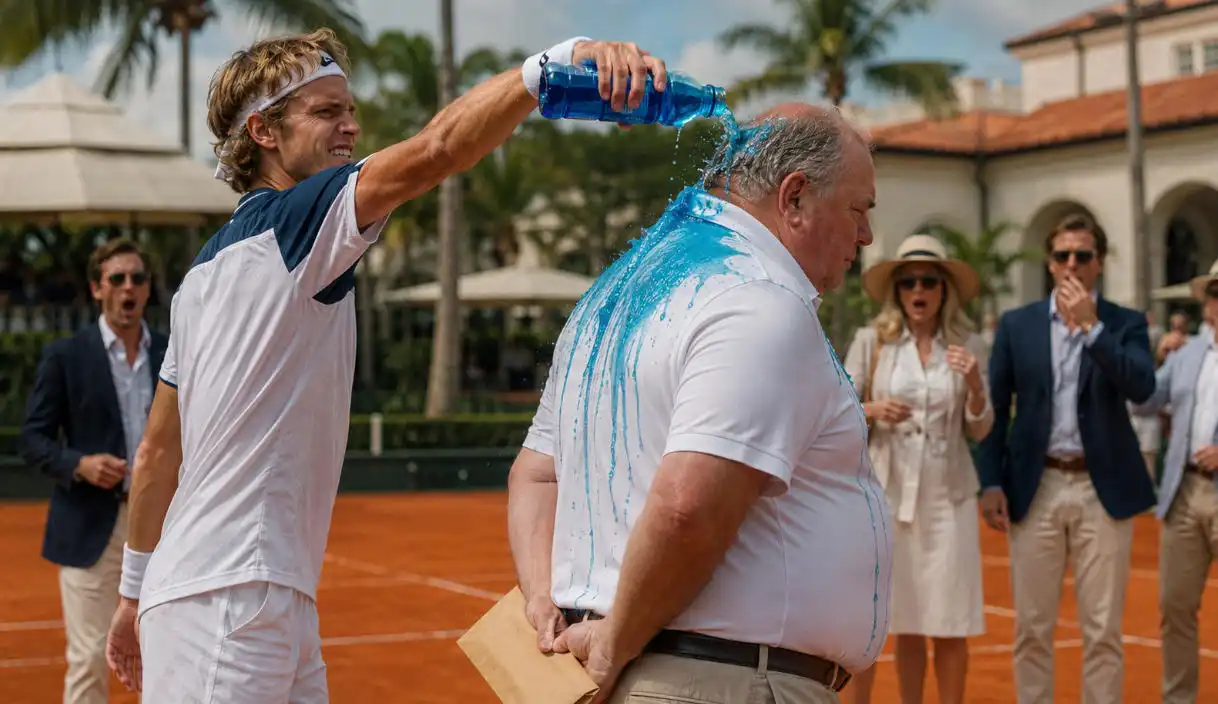
A Palm Beach Tennis Star HUMILIATED a Quiet Older Man in Front of the Whole Club… Then He Saw What Norman’s Attorney Filed That Morning