



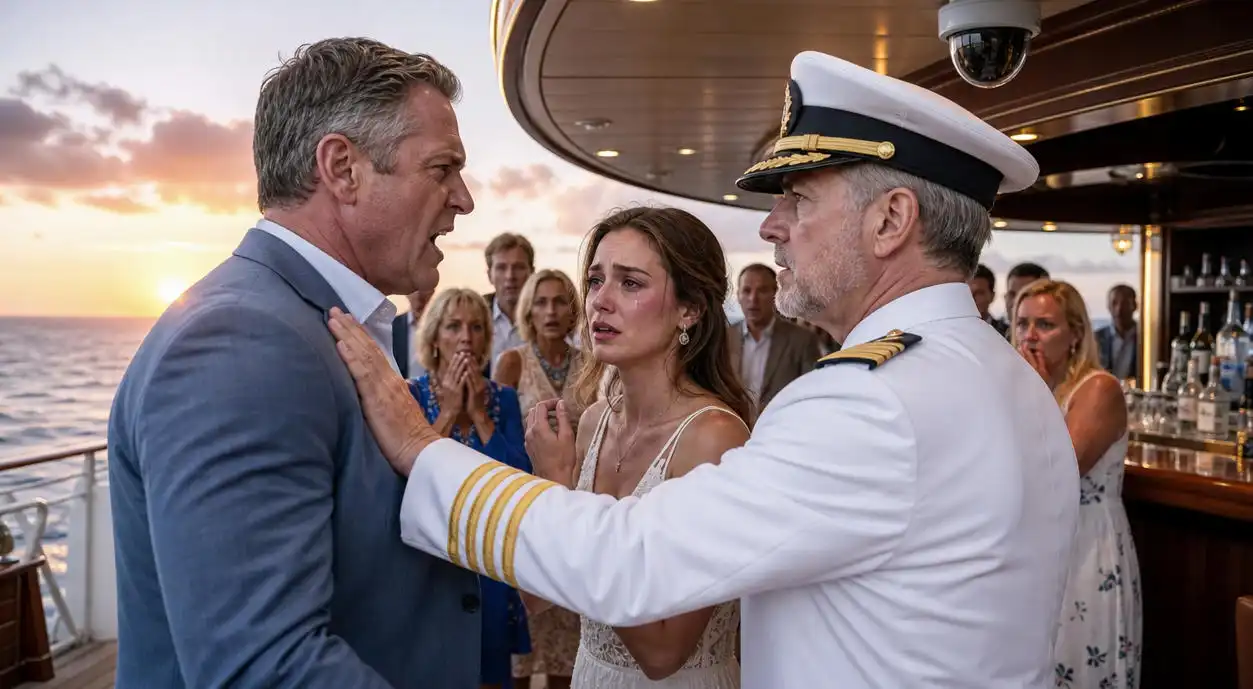
The steel door marked CREW ONLY swung open, and Grant Whitmore finally stopped laughing.
For the first time since boarding the ship, his money did not make the room bend around him.
For the first time, no waiter rushed to apologize.
No manager bowed.
No nervous employee said, “Of course, sir.”
The captain simply stood beside the open door and said, “Step inside, Mr. Whitmore.”
Grant looked at him like he had misheard.
“You’re joking.”
Captain Daniel Rourke did not blink.
“I am not.”
The Caribbean sun was still burning gold across the deck. The pool water glittered. The string quartet near the upper lounge had gone quiet. Dozens of passengers stood frozen with cocktails in their hands, watching a rich man learn that a cruise ship was not his private kingdom.
And I stood by the railing with my cheek stinging.
My name is Claire Whitmore.
I was twenty-nine years old.
I had been married to Grant for eleven months.
On land, he was the kind of man people apologized to before he even complained. His father owned hotels. His mother sat on charity boards. Grant had never waited in a line longer than five minutes in his life.
To strangers, he looked polished.
Handmade linen shirt.
Gold watch.
Perfect smile.
The kind of man older couples would call “successful.”
But behind closed doors, Grant treated marriage like ownership.
My phone had location sharing he controlled.
My credit card had alerts he monitored.
My closet had dresses he approved.
He once told me, “A wife is a reflection of her husband. If you look cheap, I look cheap. If you talk too much, I look weak.”
That cruise was supposed to be our “fresh start.”
That was what he called it after I packed a suitcase and went to my sister’s house three weeks earlier.
He sent roses.
He apologized.
He cried in my parents’ kitchen.
He said stress had changed him.
He said the cruise would save us.
Seven nights in the Caribbean.
Private balcony suite.
Fine dining.
No work calls.
No family pressure.
Just us.
What he really meant was: no witnesses who knew me.
No sister nearby.
No neighbor hearing through the walls.
No easy way to leave.
By the second day, I understood.
Grant had chosen the ocean because he thought the ocean meant isolation.
He thought water meant silence.
He thought a ship meant I was trapped.
He was wrong.
The moment that changed everything happened at sunset on Deck Seven.
I had been standing near the pool bar, dizzy from the heat. The bartender, a young man named Luis, noticed me gripping the counter and quietly slid over a glass of ice water.
“You okay, ma’am?” he asked.
I nodded.
“Thank you.”
That was all.
Two words.
Grant saw it from ten feet away.
His face shifted instantly.
Not embarrassment.
Not confusion.
Possession.
He crossed the deck fast enough that people turned.
“What was that?” he demanded.
I held the glass.
“What was what?”
“Don’t play dumb.”
“Grant, he gave me water.”
Luis raised both hands slightly. “Sir, she looked faint. That’s all.”
Grant turned on him.
“I didn’t ask you.”
Then he looked back at me.
“You enjoy humiliating me?”
My stomach dropped.
Not because I was surprised.
Because I knew that tone.
It was the tone that meant he wanted an audience.
Grant liked witnesses when he believed they would be too uncomfortable to stop him. He liked making me small in front of people. It made him feel powerful.
“Please lower your voice,” I said.
That made him smile.
A cruel little smile.
“Oh, now you care about appearances?”
The deck had gone still.
A woman in a sunhat lowered her book.
Two men near the railing stopped talking.
A child asked his father, “What’s wrong?”
Grant stepped closer.
“I brought you on a five-star cruise,” he said loudly, “and you’re batting your eyes at the help?”
Luis stiffened.
“I wasn’t—”
Grant snapped, “Shut up.”
I felt heat rise in my face.
“Grant. Stop.”
He leaned in.
“You don’t tell me what to do.”
Then he slapped me.
Not hard enough to knock me down.
Hard enough to make the deck gasp.
Hard enough to turn my head.
Hard enough to make everyone see.
The sound cracked through the air like a plate breaking.
My glass hit the deck and shattered.
For a second, I heard nothing but the sea.
Then whispers.
“Oh my God.”
“Did he just—”
“Someone call security.”
Grant grabbed my wrist.
“You embarrassed me,” he hissed.
I looked at his hand around my wrist.
Then at the security camera above the bar.
That camera had been there since we boarded. Small black dome. Angled toward the bar and the pool walkway.
I had noticed it the first day.
I had noticed many things.
The emergency phones.
The crew doors.
The officers’ stations.
The printed safety card in our cabin that said all onboard misconduct could be documented and handled by the ship’s master.
Grant thought I spent the first day crying in the bathroom.
I had actually spent it reading.
Because when a woman is trapped with a man who believes money outranks decency, she learns to study exits.
Grant squeezed my wrist tighter.
“Smile,” he said under his breath. “You’re making a scene.”
I did not smile.
I looked behind him.
Captain Daniel Rourke had stepped onto the deck.
He was older, maybe late fifties, with silver hair and a face that looked carved by storms and long years of responsibility. He wore a white uniform with gold stripes on the sleeves.
He did not run.
He did not shout.
He walked slowly through the silence.
That somehow made it more serious.
“Is there a problem here?” he asked.
Grant turned, irritated.
“Yes. Your bartender was flirting with my wife.”
Luis looked horrified. “Captain, I only gave her water.”
The captain glanced at the broken glass.
Then at my wrist.
Then at my cheek.
“Ma’am,” he said, “did this passenger strike you?”
Grant laughed.
“This passenger? I’m in the owner’s suite.”
The captain kept looking at me.
My voice came out thin.
“Yes.”
The word seemed to travel across the deck.
Grant’s head snapped toward me.
“Claire.”
One word.
A warning.
I swallowed.
Then I said it again.
“Yes. He hit me.”
The captain nodded once.
“Do you want this documented?”
That question mattered.
It was not pity.
It was procedure.
It gave me something Grant had spent months taking away.
A choice.
Grant stepped in front of me.
“My wife is emotional. We had a private disagreement.”
Captain Rourke’s eyes hardened.
“Nothing that happens on my deck in front of forty witnesses is private.”
A few passengers murmured.
Grant’s face flushed.
“You don’t know who I am.”
“No,” the captain said. “But I know where you are.”
Grant scoffed.
“I’ll have your job.”
“Possibly,” Captain Rourke said calmly. “After I finish doing it.”
That was when he lifted his radio.
“Security to Deck Seven. Medical to Deck Seven. Pull camera feed from Pool Bar Two. Notify the bridge we have an assault complaint involving a passenger.”
The word assault made Grant flinch.
Only for a second.
Then he recovered.
“Assault? Are you insane? She’s my wife.”
The captain stepped closer.
“Not a possession.”
The deck went dead silent.
Grant looked around and realized people were filming.
He pointed at them.
“Put your phones down.”
Nobody moved.
A woman near the hot tub said, “No.”
Just one word.
But it landed.
Grant’s mask cracked.
“You people have no idea what she’s like,” he shouted. “She provokes me. She humiliates me. She acts innocent, then plays victim.”
I stared at the ocean and said nothing.
That was my habit.
Silence had kept me safe for months.
But on that deck, silence was no longer protection.
Documentation was.
The security officers arrived first. Two men in navy uniforms moved between Grant and me. A ship medic followed with a small bag.
“Ma’am,” the medic said softly, “come with me, please.”
Grant lunged half a step.
“She’s not going anywhere.”
Both security officers moved.
The captain’s voice cut through the air.
“Mr. Whitmore.”
Grant froze.
“You will not approach her again.”
He laughed, but it sounded forced.
“You can’t order me around.”
The captain took one step closer.
“Under maritime law and ship security policy, I can confine a passenger who poses a safety risk to others until we reach port.”
Grant stared.
The words did not fit into his world.
Confine.
Passenger.
Safety risk.
He was used to being called “sir.”
He was not used to being treated like a threat.
“You’re bluffing,” he said.
The captain looked toward the security officers.
“Escort Mr. Whitmore to the secure holding cabin on Deck Two pending review.”
Grant’s mouth opened.
Nothing came out.
Then rage returned.
“You touch me and I’ll sue every person on this ship.”
Captain Rourke did not raise his voice.
“Noted.”
One security officer reached for Grant’s arm.
Grant jerked back.
“Get your hands off me.”
The second officer stepped behind him.
Passengers backed away.
Luis stood near the bar, pale but steady.
The retired man who had gasped earlier said, “We saw everything.”
His wife added, “Every bit of it.”
Grant looked at them like they had betrayed him personally.
“You don’t know our marriage.”
The older woman’s face tightened.
“I know what a slap sounds like.”
That sentence broke something in me.
Not because it was dramatic.
Because it was simple.
Because it was true.
For months, Grant had buried everything under excuses.
Stress.
Alcohol.
Misunderstanding.
Private argument.
My sensitivity.
My tone.
My failure to be grateful.
But a stranger on a ship had just reduced it to the truth.
A slap sounded like a slap.
The captain gestured to the crew door.
That was the door Grant now stared into.
The hallway beyond it was narrow and bright, nothing like the marble guest areas. No champagne. No sea view. No gold trim. Just steel walls, crew signs, and a security officer waiting with a tablet.
On the screen was the camera footage.
Frozen on the moment Grant’s hand struck my face.
Grant saw it.
His shoulders dropped.
Only slightly.
But I saw.
So did the captain.
Captain Rourke said, “You may make a statement after you are secured.”
Grant turned to me.
The anger left his voice and something more dangerous replaced it.
Sweetness.
“Claire. Tell them this is a misunderstanding.”
I looked at him.
There it was.
The switch.
The performance.
The same soft voice he used after every slammed door, every grabbed wrist, every apology bouquet.
“Baby,” he said, “don’t do this.”
The deck watched.
Cameras watched.
The ocean watched.
I took a breath.
Then I said, “I want it documented.”
Grant’s eyes went flat.
“You’ll regret this.”
Captain Rourke moved immediately.
“That is a threat.”
Grant snapped, “It’s a fact.”
The captain turned to security.
“Add intimidation of complainant.”
One officer typed on the tablet.
Grant stared at the screen like it had insulted him.
“You’re writing this down?”
“Yes,” the captain said.
“All of it?”
“All of it.”
That was the first real punishment.
Not the holding cabin.
Not the security officers.
The record.
Men like Grant survive by making sure their worst moments evaporate. They count on fear, wealth, family name, and shame to erase the truth before it hardens into evidence.
But on that ship, the truth was being written down in real time.
Witness names.
Camera angles.
Medical observation.
Threatening statements.
Location.
Time stamp.
Everything.
Security escorted him through the crew door.
He fought with words, not fists.
“My attorney will destroy you.”
“Do you know who my father is?”
“This is illegal.”
“She’s unstable.”
“She needs medication.”
“She’s lying.”
Each sentence made the officer type more.
When the steel door closed behind him, the deck exhaled.
I did not feel victorious.
Not yet.
I felt cold.
The medic guided me to a chair behind a privacy screen. She checked my cheek, my wrist, my blood pressure.
“You’re shaking,” she said.
“I’m fine.”
She gave me the look women give other women when they know “I’m fine” means “I’m trying not to fall apart.”
“You’re safe right now,” she said.
Right now.
Those two words mattered.
A cruise director offered to move me to a different cabin. The captain approved it personally. Within an hour, I was relocated to a smaller but secure cabin near the medical center. A female guest services officer named Maren stayed with me while I packed essentials from the suite.
Grant’s things were everywhere.
His cologne.
His cufflinks.
His leather shoes lined up like soldiers.
On the vanity, my passport sat inside the drawer where he had hidden it.
I stared at it.
Maren saw my face.
“Is that yours?”
“Yes.”
“Was it in your possession before?”
“No. I couldn’t find it yesterday.”
She photographed where it was found.
Another line in the report.
Another piece of the truth becoming solid.
That night, I did not sleep much.
The ship moved gently through the dark water. Outside my window, the Caribbean was black and endless. For the first time, the distance from land scared me less than the idea of going back home with him.
At 7:10 the next morning, Captain Rourke requested a formal meeting.
Not in a ballroom.
Not in public.
In a conference room near the bridge, with two security officers, the ship’s medical lead, a guest services manager, and a satellite call link to the cruise company’s legal department.
I sat at one end of the table.
Grant sat at the other.
Two officers stood between us.
He looked terrible.
His linen shirt was wrinkled. His hair was messy. His face carried the stunned exhaustion of a man who had spent one night without control.
But when he saw me, he smiled.
Not warmly.
Strategically.
“Claire,” he said, “I’m sorry you got scared.”
Not sorry I hit you.
Sorry you got scared.
The captain folded his hands.
“Mr. Whitmore, you are here to review the incident summary and passenger restrictions.”
Grant leaned back.
“I want her removed from this meeting.”
The legal representative on the screen said, “Mrs. Whitmore is the complainant.”
“She’s my wife.”
The captain said, “That has been established. It does not give you authority over her participation.”
Grant’s jaw tightened.
The captain read from the report.
“On Deck Seven, at approximately 6:42 p.m., multiple witnesses observed you strike Mrs. Whitmore across the face after she accepted water from a crew member. Security footage supports the witness accounts. Medical staff documented visible redness on her cheek and pressure marks on her wrist.”
Grant shook his head.
“This is being exaggerated.”
The captain continued.
“You then attempted to prevent her from leaving the area, referred to her as your wife in a manner implying control, threatened financial retaliation, and later stated, ‘You’ll regret this,’ after she requested documentation.”
Grant looked at me.
I looked down at my hands.
Not because I was weak.
Because I refused to give him a performance.
Captain Rourke slid a printed statement across the table.
“Effective immediately, you are restricted from all guest areas except under escort. You will remain in a secured passenger holding cabin until our next port of call. You will have meals delivered. You may communicate with legal counsel through monitored channels. You may not contact Mrs. Whitmore directly or indirectly.”
Grant slammed his palm on the table.
“You can’t imprison me for a marital argument.”
The captain’s voice remained even.
“I can restrict a passenger for safety and security reasons. I have done so.”
Grant turned to the screen.
“This company wants a lawsuit?”
The legal representative said, “The company wants its passengers safe.”
That sentence was so ordinary.
So corporate.
So devastating.
Grant had expected fear.
Instead, he got policy.
He expected negotiation.
Instead, he got procedure.
He expected status.
Instead, he got rules.
And rules, when properly applied, are terrifying to people who believe they are above them.
For the next three days, Grant stayed in the secure cabin on Deck Two.
The ship did not throw him into some medieval cell. It was not dramatic like a movie.
That made it better.
It was clean.
Small.
Windowless.
A bolted bed.
A bathroom.
A camera outside the door.
Meals on trays.
Security logs.
No bar.
No balcony.
No room service menu.
No wife to intimidate.
No audience to charm.
Just time.
And paperwork.
Meanwhile, the captain made sure I was protected without making me feel like a prisoner. I was assigned a new keycard. My old cabin access was disabled. Guest services helped me contact my sister by satellite email. The ship’s counselor checked on me twice.
And then something unexpected happened.
I stayed on the cruise.
At first, I thought I should hide in the cabin until port.
But on the second morning, the retired woman from the deck knocked gently on my door. Her name was Evelyn. Her husband, Frank, stood behind her holding two coffees.
“We’re going to breakfast,” she said. “You don’t have to join us. But if you want to sit with someone who won’t ask stupid questions, we saved a chair.”
I almost cried.
I went.
People were kinder than I expected.
Luis, the bartender, left a bottle of sparkling water at my table with a napkin folded around it.
No note.
Just kindness without demanding gratitude.
A grandmother from Ohio squeezed my hand and said, “My daughter left one like him. Best thing she ever did.”
A man near the elevator stepped aside and said, “Glad you’re okay, ma’am.”
The ship that Grant thought would trap me became the first place where strangers openly believed me.
That was the part he could not have predicted.
Public shame had been his weapon.
Public witness became mine.
On the fourth morning, we reached port in St. Thomas.
The captain had already coordinated with local authorities, customs, and the cruise company’s security division. The incident report, medical documentation, security footage, witness list, and passport discovery notes were all prepared.
Grant was escorted off the ship before regular disembarkation.
He wore sunglasses even though the sky was cloudy.
Two officers walked beside him.
A port authority official waited at the gangway.
So did police.
Grant tried one last time.
He stopped, turned toward Captain Rourke, and said, “You’re making a huge mistake.”
The captain answered, “No, Mr. Whitmore. I’m completing a report.”
Police took him from there.
Not dragged.
Not beaten.
Not humiliated with shouting.
Just escorted, processed, and removed with the quiet dignity of consequences.
That is the kind of justice people like Grant hate most.
The kind that does not need to scream.
The kind that can be filed.
I watched from an upper deck with Evelyn beside me.
My hands trembled.
She asked, “Are you afraid?”
“Yes,” I said.
“Good,” she replied gently. “That means you understand it was real. But don’t let fear convince you to go back.”
I didn’t.
The remaining days of the cruise were strange and beautiful.
I ate dinner by the window.
I watched a sunset without being told I was standing wrong.
I danced badly at an island night party with Evelyn and Frank laughing beside me.
I wore a blue dress Grant had once called “too simple.”
A crew photographer offered to take my picture near the railing.
For a moment, I almost said no.
Then I stood straight.
Wind in my hair.
Ocean behind me.
My cheek no longer red.
My wrist no longer marked.
My smile uncertain, but real.
When the ship returned to Florida, my sister was waiting at the terminal.
She ran to me before I made it through the doors.
I broke down in her arms.
Not cute crying.
Not graceful tears.
The kind of crying that empties a locked room inside your chest.
“I thought I was so stupid,” I whispered.
She held me tighter.
“You were isolated. That is not the same thing.”
Grant’s arrest did not magically fix everything.
Real life is messier than Facebook endings.
His family tried damage control.
His mother called it “an unfortunate misunderstanding.”
His father’s attorney sent a letter suggesting that I had “mischaracterized a private marital dispute.”
But the cruise report changed everything.
There was video.
There were witnesses.
There was medical documentation.
There was the recovered passport.
There were logs of his threats.
There was proof he had attempted to control my movement and identity documents while at sea.
My divorce attorney called it “the cleanest pattern evidence I’ve seen in years.”
Grant’s criminal case moved forward through the proper channels. The port incident triggered local charges related to assault and unlawful interference, and the cruise company permanently banned him from its fleet. His family could not buy that away.
The charity board removed him from a public fundraiser.
His father’s hotel group quietly placed him on “leave.”
The society friends who once laughed at his jokes stopped inviting him to dinner.
Not because they suddenly became saints.
Because evidence makes cowardice expensive.
During the divorce, Grant fought everything.
The apartment.
The accounts.
The narrative.
He claimed I had embarrassed him publicly.
My lawyer slid the cruise documentation across the conference table and said, “Your client did that himself.”
That became the sentence I carried with me.
Your client did that himself.
Not me.
Not the bartender.
Not the captain.
Not the witnesses.
Grant did not fall because I ruined him.
He fell because, for once, the world kept a record.
The divorce was finalized eight months later.
I kept my name.
My savings were restored.
The court granted protective restrictions.
Grant was ordered to complete intervention programs and pay legal fees connected to his misconduct. His criminal case ended with penalties that followed him far longer than the cruise did.
As for the captain, I wrote him a letter.
Not dramatic.
Just honest.
I told him that when he asked, “Do you want this documented?” he gave me back the one thing I had lost before I even realized it was gone.
Agency.
A month later, I received a short reply on cruise company letterhead.
Mrs. Whitmore,
You were entitled to safety. You were entitled to be heard. I simply followed the rules.
Respectfully, Captain Daniel Rourke
I framed it.
Not because he was a hero in a fairy tale.
Because sometimes healing begins when one person in authority refuses to look away.
One year after that cruise, I took another trip.
Not with a husband.
Not with fear.
With my sister.
We went to the coast of Maine, rented a small cottage, and ate lobster rolls on a windy pier. No luxury suite. No gold watch. No perfect image.
Just peace.
On the last morning, I stood by the water and thought about that Caribbean deck.
The slap.
The silence.
The steel door.
The captain’s voice.
“You have badly misunderstood how power works.”
Grant had believed power meant money.
Control.
Volume.
Fear.
But real power was a bartender telling the truth.
A stranger refusing to put her phone down.
A captain using his authority correctly.
A woman with a shaking voice saying, “I want it documented.”
So here is my final answer to anyone who thinks cruelty becomes legal when no land is in sight:
The ocean does not erase the rules.
Money does not erase witnesses.
Marriage does not erase consent.
And silence does not erase truth once someone is brave enough to record it. ⚖️
Grant spent three days in that secure cabin and much longer living with the consequences.
I spent the rest of that cruise learning what freedom tasted like.
It tasted like salt air.
Sparkling water.
A blue dress.
And breakfast with strangers who saved me a chair.
So choose a side:
Was Captain Rourke absolutely right to lock Grant away until port — or should a rich first-class passenger have been given “special treatment” after striking his wife in public?
Share this if you believe dignity should never depend on someone’s bank account. 🚢
Disclaimer: Mention of any brand or trademark is for identification only and does not imply partnership or endorsement

Thrift Store Customer Harper Was SLAPPED and Soaked in Coffee by Her Millionaire Ex… But He Had NO IDEA Who Really Controlled His Mansion 😳

His Fiancée Slapped His Penniless Ex-Wife in Public — Then KARMA Walked Into His Charity Gala Wearing Diamonds

Frat Boys Stole Her Spot, Dumped Beer on Her Head, and Called Her “Nobody”… Their REGRET Came Fast