

The garden director did not read the paper out loud at first.
He just stared at the seal.
Then he stared at Evelyn.
Then he looked at Grant Vale, the billionaire developer standing with dirt on his shoes and arrogance still hanging on his face like cheap cologne.
Grant snapped, “What is this little performance?”
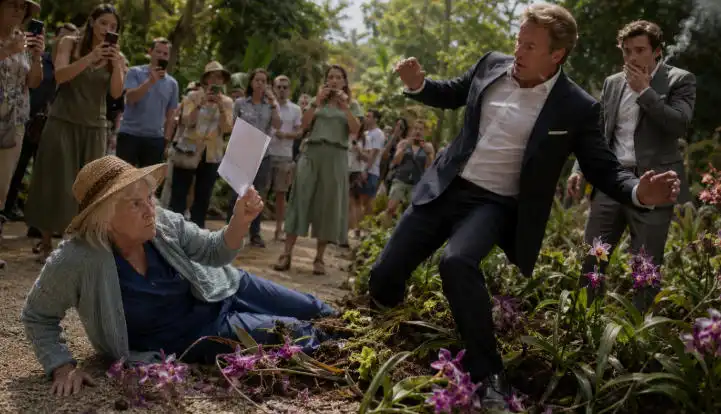
Evelyn sat on the gravel with soil on her palms, her straw hat beside her, and the crushed orchids trembling in the dirt.
She didn’t cry.
That bothered him most.
Because men like Grant Vale loved tears.
Tears made them feel powerful.
Silence made them nervous.
The director, Mr. Walsh, swallowed hard and lifted his radio.
“Call the city attorney,” he said. “Now.”
Grant laughed once.
A sharp, ugly laugh.
“You people are insane,” he said. “I donate more money to this city in a month than this place earns in a year.”
His assistant, Cole, tried to keep smiling, but the cigarette in his fingers was shaking.
A woman holding a camera whispered, “Did he just shove that old lady?”
A father pulled his two kids behind him.
A young man in a botanical society T-shirt kept recording with both hands.
Grant pointed at him.
“Turn that off.”
The young man answered, “No.”
Grant blinked.
He was not used to hearing that word.
Evelyn slowly pushed herself up with the help of a retired couple. Her knees were dusty. Her elbow had a red scrape. Her gardening glove was torn.
Still, she brushed soil from the paper like it was more important than her own skin.
Grant sneered.
“You better hope you have a good lawyer, sweetheart.”
Evelyn looked at him.
“I had thirty-eight years of patients call me sweetheart,” she said. “They earned it.”
A few people murmured.
Grant’s face tightened.
He hated losing the room.
He turned toward Mr. Walsh.
“I want her removed. I’m here for the site inspection next door. Your little plant museum is already delaying my project.”
Evelyn said softly, “No, Mr. Vale.”
Grant spun back.
“You know my name?”
“I know your permits.”
That was the first crack.
Tiny.
But everyone heard it.
Grant’s assistant Cole stepped closer and whispered, “Boss, maybe we should—”
“Shut up,” Grant snapped.
Then he looked at Evelyn’s old canvas bag, the dirt on her clothes, the straw hat, the worn sneakers.
He decided what men like him always decided.
That she was nobody.
That old women in garden gloves did not have power.
That people who volunteered at public places were there because life had passed them by.
He smiled again.
“You people are emotional,” he said. “I understand. You like your flowers. But progress doesn’t stop for nostalgia.”
Evelyn’s eyes moved to the crushed orchid bed.
“These were not nostalgia.”
Grant rolled his eyes.
“They’re plants.”
“They were part of a conservation covenant.”
That phrase landed differently.
The plant lovers stopped whispering.
Mr. Walsh lowered the paper just enough for Grant to see the top line.
Grant’s smile thinned.
“What covenant?”
Evelyn did not answer him directly.
She turned to the crowd.
“Would someone please keep recording? I want the smoking by the conservatory sign included.”
Cole dropped the cigarette and stepped on it.
Too late.
Three phones were already pointed at him.
Grant’s jaw flexed.
“You are making a very serious mistake.”
“No,” Evelyn said. “I made my serious mistakes years ago. Today I’m just correcting one.”
The city botanical garden had been Evelyn Harper’s quiet place for almost four decades.
Before she was “the old lady in the straw hat,” she had been Nurse Harper at Mercy General.
Night shift.
Emergency ward.
Pediatric oncology.
Burn unit.
Whatever room had the worst screaming, Evelyn usually ended up there.
She had held hands with dying husbands.
She had sung hymns to frightened children.
She had cleaned blood off wedding rings before giving them back to widows.
She had once worked twenty-one hours straight during a highway pileup and still came back the next morning because three of her patients asked for her by name.
But people like Grant never saw any of that.
They only saw the soft body.
The gray hair.
The slow walk.
The discount canvas bag.
After retirement, Evelyn volunteered at the botanical garden three mornings a week.
Not because she needed something to do.
Because her late husband, Paul, had planted the first orchid bed with his own hands.
Paul Harper had been a city planner before the city became greedy.
He believed every neighborhood deserved one beautiful place that no rich man could buy.
When the original landowner died, Paul helped create a trust to protect the garden and the strip of land beside it.
The paperwork was boring.
Old.
Dry.
The kind of thing ambitious developers ignored until it ate them alive.
Paul used to say, “The strongest fence is not always made of wood. Sometimes it’s made of language.”
Evelyn used to tease him.
“Only you could make paperwork sound romantic.”
After Paul died, Evelyn kept the trust binder in a fireproof box.
Most people forgot the trust existed.
Grant Vale did not forget.
He just thought it could be bullied.
For two years, his company had been trying to build Vale Crown Plaza, a luxury retail and condo complex next to the garden.
Glass towers.
Private rooftop pool.
Designer boutiques.
A parking structure that would block sunlight from the conservatory.
The promotional video called it “a new era for the city.”
Evelyn called it a shadow with a lobby.
The city council had already bent over backward for Grant.
Fast-tracked hearings.
Private lunches.
Friendly inspectors.
A few officials suddenly remembered they had always loved “urban renewal.”
Grant believed the public garden was a sentimental obstacle.
He believed the old trust was ceremonial.
He believed the retired nurse who attended every meeting was harmless.
So that Saturday, he came to the garden with photographers, assistants, and two men from his investment team.
He wanted pictures showing how close his future project was to “green space.”
He wanted to use the garden in his sales deck.
He did not ask permission.
He walked through marked beds.
His assistant smoked beside the conservatory.
One of his men moved a rope barrier.
Then Grant stepped into the rare orchid section to get a better angle for his photographer.
Evelyn saw him from the shade house.
She moved as fast as her knees allowed.
“Sir, stop.”
Grant did not even look at her.
“Make it quick, grandma. We’re working.”
“These beds are protected.”
“So is my schedule.”
“You cannot step there.”
He turned then.
Fully.
Slowly.
Like she had offended him by existing.
“What did you say to me?”
“I said you cannot step there.”
His entourage went quiet.
Not because Evelyn was loud.
Because she wasn’t.
Her calmness made the words heavier.
Grant looked around at the families and hobby gardeners nearby.
Then he smiled for the audience.
“Everyone relax. I’m sure Nurse Ratched here means well.”
A couple of people gasped.
Evelyn’s face stayed still.
“I was a nurse,” she said. “And I’m asking you to move.”
“Were,” Grant said. “That’s the important part.”
He stepped down.
A small orchid snapped under his shoe.
Someone said, “Oh my God.”
Evelyn’s voice sharpened.
“Remove your foot.”
Grant leaned close enough for her to smell mint and expensive coffee on his breath.
“This city needs jobs, housing, restaurants, money. Not old ladies guarding weeds.”
Then he shoved her.
His palm hit her shoulder.
Not a dramatic movie punch.
Not enough for him to call it violence in his own mind.
Just enough.
Enough for her to fall.
Enough for the crowd to freeze.
Enough for the orchid bed to scatter under her hand.
Enough for a little boy to ask his mother, “Why did he hurt her?”
Grant heard that.
For half a second, shame tried to reach him.
Then pride killed it.
“She grabbed me,” he barked. “Everybody saw that.”
No one agreed.
Cole said, “Yeah. She got aggressive.”
But even he sounded unsure.
Evelyn stayed on the ground and reached for her bag.
Her fingers found the folded document she had carried for months.
Not because she expected to be pushed.
Because she expected Grant to overstep.
And men like Grant always overstepped in public eventually.
The document was not a deed.
Not exactly.
It was a certified copy of an injunction application tied to the Harper Botanical Land Trust.
Paul had helped write the original trust terms.
After his death, Evelyn became its sole controlling trustee.
The land beside the garden, the very strip Grant needed for access, drainage, utility easements, emergency vehicle clearance, and sunlight compliance, was not city-controlled.
It was trust-controlled.
Irrevocable.
Protected.
And every permit Grant had obtained depended on assumptions his lawyers had been warned were false.
Evelyn had warned them politely.
Twice by certified mail.
Once in person.
Grant’s office never answered.
Instead, two weeks before the incident, his legal team filed a statement claiming “no active trustee objection exists.”
Evelyn framed that sentence in her mind.
No active trustee objection exists.
She was active enough now.
When Mr. Walsh called the city attorney, Grant still tried to laugh it off.
“Fine,” he said. “Call whoever you want. I’ll call the mayor.”
Evelyn nodded.
“You should.”
Grant pulled out his phone.
He made a show of it.
“Put me through to Dennis.”
Dennis was the deputy mayor.
Grant liked first names.
They made corruption sound friendly.
While he waited, a city attorney named Marlene Price arrived through the conservatory gate with two staff members.
She had gray hair, running shoes, and the exhausted look of someone who had expected a quiet Saturday and got a legal grenade instead.
Marlene took the document from Mr. Walsh.
She read page one.
Then page two.
Then she looked at the crushed orchid bed.
Then at Evelyn’s scraped elbow.
Then at Grant’s shoe still stained with soil.
“Mr. Vale,” she said, “please step away from the protected bed.”
Grant lowered his phone.
“Who are you?”
“Marlene Price. City Attorney’s Office.”
His expression changed just enough.
Not fear.
Calculation.
“Great,” he said. “Then you can explain to these people that my project has approval.”
Marlene said, “Your project has conditional approval.”
Grant’s smile vanished.
“Conditional on what?”
Evelyn answered.
“Me.”
The crowd went silent.
Grant looked at her like she had suddenly spoken a foreign language.
Marlene kept her voice official.
“The Vale Crown Plaza development relies on three easement assumptions across land held by the Harper Botanical Land Trust. The trust has not consented.”
Grant said, “That’s a technicality.”
“No,” Marlene said. “That is the legal access point for your entire south utility plan.”
Cole whispered, “Boss.”
Grant snapped, “Not now.”
Marlene continued, “There is also a conservation covenant protecting the orchid beds and adjacent greenhouse zone. Damage to protected specimens, unauthorized entry, and smoking near the conservatory may trigger enforcement.”
Grant stared at Evelyn.
“You set this up.”
Evelyn said, “You set your foot down.”
A few people murmured again.
One woman said, “Good for her.”
Grant heard it and exploded.
“You think this is cute?” he shouted. “You think some retired nurse can stop a billion-dollar development?”
Evelyn stood a little straighter.
“No,” she said. “I think the trust can.”
Marlene looked at Grant.
“Mr. Vale, until the trustee’s objection and today’s incident are reviewed, I’m recommending an immediate administrative hold on all site activity connected to Vale Crown Plaza.”
Grant went pale.
Not fully.
Just around the mouth.
“A hold?”
“Effective today.”
“You can’t do that.”
“The city can pause permits tied to unresolved legal access, conservation compliance, and potential misrepresentation.”
“Potential?” Evelyn said.
Marlene glanced at her.
“For now.”
That was the kindest word in the garden.
For now.
Grant’s phone buzzed.
He looked down.
Whatever message he saw made his face harden.
Probably from Dennis.
Probably saying, Not here. Not on video.
Because there were phones everywhere now.
Plant lovers.
Parents.
Volunteers.
A teenager pretending not to record from behind a fern.
Grant turned to the crowd.
“This is harassment. This is why nothing gets built anymore. Emotional people weaponize paperwork.”
An elderly man in a wheelchair said, “You pushed her.”
Grant pointed at him.
“Stay out of this.”
That was another mistake.
The old man’s daughter stepped forward.
“Don’t you dare talk to my father like that.”
The garden changed then.
Fear became anger.
Quiet became public.
For the first time all morning, Grant Vale was not controlling the room.
He was surrounded by ordinary people who had seen exactly who he was.
Marlene asked Evelyn, “Mrs. Harper, do you want medical assistance?”
Evelyn looked at the crushed orchids.
“I want the bed photographed before anyone touches it.”
Marlene nodded.
“Done.”
Grant gave a short laugh.
“Unbelievable. Flowers get a crime scene now?”
Evelyn looked at him.
“No. Choices do.”
By Monday morning, Vale Crown Plaza was frozen.
Not delayed.
Frozen.
The city issued a formal stop-work order pending legal review of easements, conservation impact, and possible false statements in development filings.
Grant’s company released a statement calling the garden incident “a misunderstanding involving an overzealous volunteer.”
That statement lasted six hours.
Then the video came out.
Not from Evelyn.
From the college kid in the botanical society shirt.
It showed everything.
Grant stepping over the rope.
Cole smoking beside the sign.
The shoe crushing the orchid.
Evelyn saying, “Sir, please don’t step there.”
Grant saying, “I’m building towers worth more than your whole retirement.”
Then the shove.
The hat flying.
The little girl screaming.
The silence afterward.
By Tuesday, local news had it.
By Wednesday, national business media picked it up.
By Thursday, Grant’s investors were calling emergency meetings.
Because rich men can survive being rude.
They can survive being greedy.
But they do not always survive becoming the face of cruelty toward an elderly nurse in a public garden.
Especially when that elderly nurse controls the one piece of land their billion-dollar project cannot function without.
Grant’s lawyers tried to argue the trust was outdated.
The judge asked a simple question.
“Is the trust irrevocable?”
“Yes, Your Honor.”
“Is Mrs. Harper the sole controlling trustee?”
“Yes, Your Honor, but—”
“Was consent obtained?”
“No, Your Honor, but—”
The judge looked over his glasses.
“That is a very expensive but.”
Evelyn sat in the courtroom wearing the same straw hat.
Cleaned.
Ribbon repaired.
Grant sat across the aisle in a navy suit, looking smaller than he had in the garden.
His attorney tried to paint him as a job creator.
Evelyn’s attorney, a soft-spoken woman named Rachel Kim, did not need theatrics.
She presented certified letters.
Emails.
Meeting minutes.
Photos of damaged plants.
Video of the shove.
A report from the conservatory manager about smoking risk.
Then she presented the development filing where Grant’s team claimed there was no active trustee objection.
The judge paused there.
“Mr. Vale, who authorized this statement?”
Grant whispered to his attorney.
His attorney whispered back.
Then the attorney said, “Your Honor, that matter is under internal review.”
The judge said, “I imagine it is.”
The injunction was granted.
All construction activity tied to the disputed access and easement plan stopped indefinitely.
Not for a day.
Not for a news cycle.
Indefinitely.
Until the trust agreed, the conservation damage was addressed, and the court reviewed whether false filings had been made.
Grant walked out of court past cameras.
A reporter asked, “Mr. Vale, do you regret pushing Mrs. Harper?”
He didn’t answer.
Another reporter asked, “Did your company misrepresent trustee approval?”
He kept walking.
Cole, the assistant, resigned three days later.
Then he cooperated.
That was the thing about arrogant men.
They often forget their followers are only loyal while the money is flowing.
Cole admitted Grant had been told the trust was a problem.
He admitted the “no active trustee objection” language was discussed in a meeting.
He admitted the plan was to pressure Evelyn later, after construction had already begun.
“Once the machines are there,” Grant had allegedly said, “old ladies stop fighting.”
That quote ended him.
Investors hate many things.
Bad press.
Legal uncertainty.
Frozen permits.
But they especially hate a man who says the ugly part out loud.
Within six weeks, Grant’s financing began to collapse.
A private equity partner pulled out.
Then a lender demanded additional guarantees.
Then a luxury hotel tenant paused negotiations.
Then the city opened an ethics review into communications between Vale’s company and officials.
Vale Crown Plaza became what Evelyn once called it at a council meeting:
“A shadow with a lobby.”
Only now, it was a very expensive shadow.
Grant tried one final move.
He requested a private meeting with Evelyn.
She agreed.
Not alone.
She brought Rachel, her attorney.
Marlene from the city attended too.
They met in a plain conference room at the garden administration building.
No chandeliers.
No leather chairs.
Just a scratched table, a pot of coffee, and a window overlooking the greenhouse.
Grant looked tired.
Anger had aged him badly.
He placed a folder on the table.
“We’re prepared to offer compensation for the plant damage.”
Evelyn folded her hands.
“How much is a twelve-year bloom worth to you?”
Grant’s jaw tightened.
“Mrs. Harper, we both know this isn’t about flowers anymore.”
“No,” she said. “It’s about what you thought flowers meant.”
He stared at her.
“You’re enjoying this.”
Evelyn shook her head.
“I enjoyed my husband bringing me coffee while he planted that first bed. I enjoyed watching schoolchildren learn the names of things they’d never seen before. I enjoyed seeing people sit quietly in a city that never lets them rest.”
She leaned forward.
“I do not enjoy watching a man destroy something and then act offended by consequences.”
Grant looked away first.
Rachel opened her folder.
“The trust is willing to discuss settlement only under strict conditions.”
Grant’s attorney looked relieved.
Grant did not.
He knew conditions from people like Evelyn were worse than numbers.
Rachel continued.
“One: public written apology to Mrs. Harper, the garden staff, and the visitors present.”
Grant’s lips pressed together.
“Two: payment for restoration of the orchid bed, independent ecological review, and a new protected greenhouse wing.”
His attorney wrote quickly.
“Three: withdrawal of all current easement claims.”
Grant looked up.
“That kills the project.”
Evelyn said, “No. Your choices did.”
Rachel continued.
“Four: Vale Development will fund a community garden access program for seniors, veterans, and schoolchildren for ten years.”
Grant laughed under his breath.
“You want me to pay for field trips?”
Evelyn smiled faintly.
“I want children to learn what you didn’t.”
The room went silent.
Grant’s attorney touched his sleeve.
“Grant.”
That one word carried the whole truth.
You don’t have leverage.
You don’t have time.
You don’t have the room.
Grant signed two weeks later.
The public apology was stiff, but it was public.
He stood at a podium near the garden entrance, under the same trees where he had once strutted like he owned the sunlight.
“I acted disrespectfully,” he read.
A reporter called out, “Did you push her?”
Grant paused.
His lawyer looked like he might faint.
Grant swallowed.
“Yes.”
Evelyn stood in the back, not smiling.
She did not need to.
The city later confirmed Vale Crown Plaza would not proceed under its original plan.
The billion-dollar dream that had been sold with champagne renderings and private investor dinners was reduced to lawsuits, debt restructuring, and a half-empty office with phones that stopped ringing.
Grant did not go to jail.
That disappointed some people online.
But Evelyn never wanted a fantasy.
She wanted rules to mean something.
He paid.
He lost control of the project.
His reputation turned radioactive.
His investors removed him from day-to-day authority.
His name, once printed on glossy brochures, became attached to the video of an old nurse falling into the dirt.
And the garden changed too.
The settlement paid for a new glass greenhouse named after Paul Harper.
Not Evelyn.
Paul.
She insisted.
On the first day it opened, Evelyn arrived early.
She wore her straw hat.
New ribbon.
Same old canvas bag.
A group of children from a public elementary school came through the doors, eyes wide at the warm air, the misted glass, the rows of orchids glowing like tiny lanterns.
A little girl pointed at one bloom and asked, “How long did that one take?”
Evelyn knelt slowly beside her.
“Twelve years,” she said.
The girl’s eyes grew huge.
“That’s older than me.”
Evelyn laughed.
“Yes, it is.”
The girl looked worried.
“What if someone steps on it?”
Evelyn glanced toward the front gate, where a new sign explained the protected trust land in simple language.
Then she looked back at the child.
“Then we protect it,” she said. “Together.”
Later that afternoon, Mr. Walsh found Evelyn sitting on a bench near the restored bed.
The crushed area had been replanted.
It would take years to look the same.
Some damage cannot be fixed quickly.
That did not mean it could not heal.
Mr. Walsh sat beside her.
“Paul would’ve loved the greenhouse,” he said.
Evelyn looked through the glass.
“He would’ve complained about the drainage.”
Mr. Walsh laughed.
Then she laughed too.
Softly.
For the first time in months, it didn’t hurt.
A family walked past and recognized her.
The mother whispered, “That’s Mrs. Harper.”
Her teenage son said, “The lady from the video?”
Evelyn pretended not to hear.
But the little girl with them stopped.
“Thank you for saving the flowers,” she said.
Evelyn’s eyes shined.
“You’re welcome, sweetheart.”
This time, the word felt earned.
Grant Vale thought money made him untouchable.
He thought age made Evelyn weak.
He thought a public garden was just land waiting for a richer man.
But one retired nurse, one old trust, one recorded shove, and one piece of paper proved something every decent person already knows:
Power is not the right to step on what others love.
Power is the duty to protect it. 🌿
So pick a side:
Was Evelyn too harsh for freezing a billion-dollar project over one shove and one crushed flower bed?
Or did Grant Vale finally get exactly what he deserved?
Disclaimer: Mention of any brand or trademark is for identification only and does not imply partnership or endorsement
Thrift Store Customer Harper Was SLAPPED and Soaked in Coffee by Her Millionaire Ex… But He Had NO IDEA Who Really Controlled His Mansion 😳

His Fiancée Slapped His Penniless Ex-Wife in Public — Then KARMA Walked Into His Charity Gala Wearing Diamonds
Frat Boys Stole Her Spot, Dumped Beer on Her Head, and Called Her “Nobody”… Their REGRET Came Fast