He saw the badge before he saw my father’s face.
That was the first time Chase Whitmore stopped smiling.
The crowd had gone strangely quiet, even though the bass from the main stage still shook the grass under us.
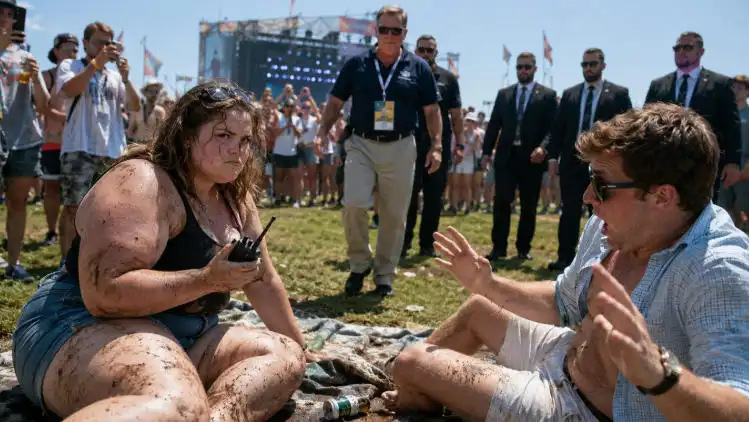
Beer was dripping from my hair.
Mud was on my knees.
And the boy who had just kicked me off my own blanket suddenly looked like he wanted to disappear.
But ten seconds earlier, he had been laughing.
“Security Command,” the radio had crackled. “Go ahead.”
I pressed the button with one muddy thumb.
“Dad,” I said. “I need you on the main lawn.”
Chase gave this ugly little laugh.
“Dad?” he said. “What, your dad gonna come yell at me?”
His friends laughed too, but not as loud as before.
One of them leaned in and whispered, “Bro, maybe chill.”
Chase shoved him back.
“No. I’m done with people acting like they own space they can’t afford.”
That sentence landed harder than the kick.
Because I knew what he meant.
He looked at my old quilt.
My cheap water bottle.
My sunburned arms.
My thrift-store denim shorts.
My body.
And he decided I was nobody.
The kind of girl people step around.
The kind of girl people laugh at.
The kind of girl who should move when prettier, louder, richer people tell her to move.
He had no idea I had been sitting on that lawn since noon because my father told me, “Pick any spot you want, kiddo. This whole field exists because people like you deserve to enjoy music safely.”
My name is Maddie Turner.
I’m nineteen.
I’m not famous.
I don’t have perfect festival outfits.
I don’t have a million followers.
I had an old blanket my grandmother made, a bag of sunscreen, and a ticket on a lanyard I kept tucked inside my shirt because I hate being treated differently.
Most people at SunRail Nation Fest had no idea who my father was.
That was the way I liked it.
My dad, Hank Turner, was not a celebrity.
He didn’t walk red carpets.
He didn’t pose with musicians.
He didn’t wear gold chains or smile for influencer cameras.
He was the man with a headset, a black polo, and tired eyes.
The man who knew every gate.
Every camera angle.
Every emergency lane.
Every medical tent.
Every drunk idiot before the idiot knew he was drunk.
He was also the largest private backer of the festival and the head of its security operation.
Not “security” like a mall cop.
Security like retired law enforcement, emergency response, crowd control, artist protection, insurance compliance, and enough legal paperwork to make arrogant men suddenly remember manners.
But Chase Whitmore didn’t know that.
To him, I was just a plus-size girl on an old blanket.
And he wanted my spot.
The main lawn was packed that afternoon.
People had been sweating for hours under a white-hot sun.
The headliner was still forty minutes away, but the crowd had already tightened toward the stage.
Every square foot mattered.
Families had blankets.
Couples had coolers.
College kids had flags.
I had my grandmother’s quilt.
It was faded yellow and blue, with one corner patched in red cloth because I tore it when I was thirteen.
My grandma used to say, “A quilt remembers where it’s been.”
That quilt had been to hospital rooms, beach trips, backyard birthdays, and one funeral where my dad cried so hard he couldn’t stand.
So when Chase stepped on it with muddy shoes, it wasn’t just a blanket.
It was a line.
He came stumbling down from the beer garden with five friends behind him.
All white teeth.
Fraternity letters.
Expensive sunglasses.
Shirts cut low on the sides.
The kind of boys who called every woman “sweetheart” when they wanted something and “crazy” when they didn’t get it.
One of them whistled at two girls sitting near me.
Another kicked a paper tray out of the walkway and laughed when sauce splattered on someone’s ankle.
People moved out of their path.
Not because Chase had power.
Because public bullies are exhausting.
Most decent people don’t want a scene.
And men like Chase survive by counting on that.
He stopped at the edge of my quilt and looked down.
“Perfect,” he said. “This works.”
I looked up from my phone.
“Sorry?”
He pointed at my blanket like he was choosing furniture.
“We need this area.”
I blinked.
“I’ve been here since noon.”
He laughed and looked back at his friends.
“She’s been here since noon.”
They laughed too.
One of them said, “That’s dedication.”
Another said, “That’s real estate, bro.”
Chase looked down at me again.
“Come on. Be reasonable.”
“I am being reasonable,” I said. “You can stand behind me.”
His smile changed.
It didn’t disappear.
It sharpened.
“Behind you?”
“Yes.”
“Sweetheart, I did not fly in, pay for VIP lodging, and drink warm beer all day to stand behind a girl sitting on a picnic blanket.”
I felt heat rise in my face.
Not from the sun.
From that terrible little pause nearby.
People heard him.
They were pretending not to.
A woman in a straw hat glanced over.
A dad with a little boy on his shoulders looked uncomfortable.
Two girls behind Chase started recording, then lowered their phones when one of his friends stared at them.
I said, “Please step off my blanket.”
Chase looked down.
His muddy sneaker was already on the edge of it.
Instead of moving, he lifted his other foot and stepped fully onto it.
My stomach dropped.
“Chase,” one of his friends said. “Dude.”
Chase ignored him.
He looked at me like I was a stain on the grass.
“You people always do this.”
I frowned.
“What people?”
“People who show up early and act like that means something.”
“It does mean something,” I said. “That’s how general admission works.”
He bent down.
His breath smelled like beer and lime.
“No. That’s how poor people pretend they’re important.”
The woman in the straw hat gasped.
A few people turned.
I should have stood up then.
I should have moved.
That’s what the old version of me would have done.
But my dad had spent nineteen years teaching me something simple.
“Rules don’t protect you if you’re too scared to use them.”
So I stayed seated.
I looked him in the eye and said, “Get off my blanket.”
That’s when his friends started whistling.
Loud.
Mocking.
Like I was entertainment.
Chase lifted both arms to the crowd.
“Everybody hear that? She’s the queen of the grass.”
A few people laughed nervously.
Not because it was funny.
Because crowds sometimes laugh when they’re scared of being next.
Then Chase picked up my water bottle.
He held it between two fingers.
“Is this yours?”
“Yes.”
He tossed it behind him.
It disappeared under someone’s lawn chair.
“Oops.”
My hands started shaking.
I kept my voice low.
“Pick it up.”
His eyes flashed.
“What did you say?”
“Pick. It. Up.”
He leaned closer.
For a second, I thought he might spit on me.
Instead, he lifted his beer.
Someone behind me said, “Don’t.”
Chase smiled.
Then he poured the entire cup over my head.
Cold beer hit my scalp first.
Then my forehead.
Then my eyes.
It ran down my cheeks and soaked my shirt.
The crowd made one sound.
A collective inhale.
My ears rang.
His friends exploded.
“Bro!”
“Oh my God!”
“She got baptized!”
Chase laughed so hard he had to bend over.
Then he planted his foot against the quilt and kicked.
The blanket jerked under me.
I tried to grab it.
My hand slipped.
My body rolled sideways into the mud.
My knees hit.
My palms hit.
The crowd shifted away like I had become something embarrassing to witness.
Beer dripped from my chin.
Grass stuck to my arm.
My grandmother’s quilt was under Chase’s shoes.
And he said, “Now it’s my spot.”
That was the moment everything inside me became quiet.
Not weak quiet.
Not scared quiet.
The other kind.
The kind my father got when someone lied in a report.
The kind my mother got when a doctor talked over her.
The kind my grandmother got the day she told a landlord, “Try me.”
I sat up slowly.
A woman reached toward me.
“Honey, are you okay?”
I nodded once.
Chase pointed at her.
“Don’t enable this. She’s fine.”
The woman’s mouth fell open.
“She’s covered in beer!”
“She should’ve moved.”
His friends were still laughing, but now some of them looked nervous.
Phones were up again.
Lots of them.
That mattered.
Because the festival had rules.
Written rules.
Posted rules.
Ticket-agreement rules.
Rules about harassment.
Rules about assault.
Rules about intoxication.
Rules about interfering with another guest’s reserved or established space.
Rules about staff commands.
Rules about wristband revocation.
Rules about permanent removal.
And one rule my father had personally added after a young woman got shoved near a barricade two years earlier:
Any guest who uses physical force to displace another guest may be removed, banned, and referred for prosecution at the discretion of Security Command.
Chase had broken all of them in under sixty seconds.
I reached into my canvas bag.
My fingers found the small black radio clipped inside.
My father made me carry it because I was his daughter.
I hated carrying it because I wanted one normal day.
But he made me promise.
“Only emergencies,” he had said.
I looked down at my muddy hands.
Then at the beer soaking my shirt.
Then at Chase standing on my grandmother’s quilt.
That felt like an emergency.
I pressed the button.
“Security Command,” the radio crackled. “Go ahead.”
Chase stopped laughing.
“What is that?”
I wiped beer out of my eyes.
“Dad,” I said. “I need you on the main lawn.”
There was a pause.
Then my father’s voice came through.
“Are you hurt?”
Chase’s face changed.
Just a little.
I said, “I was kicked into the mud.”
The radio went silent.
Then my father said, “Stay where you are.”
That was it.
Three words.
Stay where you are.
Chase scoffed, but his throat moved when he swallowed.
“Your dad works security?”
I didn’t answer.
He looked at his friends.
“Whatever. This is pathetic.”
One friend whispered, “Chase, dude, maybe say sorry.”
Chase snapped, “Shut up.”
Then the music dropped slightly.
Not off.
Just lower.
Like the festival itself had taken one step back.
People noticed.
Heads turned toward the main aisle.
There was a lane through the crowd that most guests never saw unless medics needed it.
A security corridor.
Black barriers opened near the sound tower.
The first two guards came through fast.
Then four more.
Then a line of black suits with earpieces and laminated credentials.
They didn’t run.
They didn’t need to.
The crowd separated for them.
And behind them came my father.
Hank Turner is not a tall man.
Maybe five-ten on a good day.
He has gray in his beard, sun damage on his neck, and the permanent squint of someone who has spent thirty years watching crowds for danger.
But when my father walks with purpose, grown men stop testing the world.
He wore his black command polo.
His radio harness.
His festival credentials.
And the gold-edged sponsor badge that only five people on the entire property had.
Chase saw the badge.
Then he saw the guards.
Then he saw me.
His mouth opened, but no sound came out.
Dad did not look at Chase first.
He walked straight to me.
He knelt in the mud without caring about his pants.
“Are you hurt?”
“I’m okay,” I said.
His jaw flexed.
“That’s not what I asked.”
“My knees hurt. My hands too. I’m mostly just…”
I looked at the quilt.
“…angry.”
Dad followed my eyes.
Chase was still standing on it.
My father stood up.
Slowly.
He looked at Chase’s shoes.
Then at Chase’s face.
“Step off my daughter’s blanket.”
The words didn’t sound loud.
But everyone heard them.
My daughter.
That phrase moved through the crowd like electricity.
A girl behind me whispered, “Oh, no way.”
The woman in the straw hat put both hands over her mouth.
Chase finally stepped back.
He lifted his hands.
“Sir, this is a misunderstanding.”
Dad looked at the beer on my hair.
The mud on my arms.
The kicked-over quilt.
Then the phones recording all around us.
“A misunderstanding?”
Chase nodded too fast.
“She was blocking the area. We were just trying to—”
“No,” said a man in the crowd.
Everyone turned.
It was the dad with the little boy on his shoulders.
He lowered the child down and pointed at Chase.
“He dumped beer on her. Then he kicked the blanket out from under her.”
The woman in the straw hat said, “I saw it too.”
Another voice said, “I have it on video.”
Then another.
“Me too.”
“Same here.”
“He called her poor.”
“He said she didn’t belong near the stage.”
Chase spun around.
“Are you serious? You people are insane.”
That was his second mistake.
My father lifted one hand.
A female security supervisor stepped forward with a tablet.
“Command has camera coverage from Tower Three, Stage Left, and Beverage Lane,” she said.
Dad asked, “Audio?”
“Partial from field mics. Enough to document escalation.”
Chase’s face went pale.
His friends stopped moving.
One of them slowly took off his sunglasses like that might make him less involved.
My dad said, “Names.”
The supervisor pointed.
“Chase Whitmore. Wristband Tier Gold. Purchased through a corporate package. Five associated wristbands under the same lodging block.”
Chase blinked.
“How do you know my name?”
Dad looked at him.
“Because this is my operation.”
A murmur spread through the crowd.
Chase tried to laugh.
“Your operation?”
Dad pointed toward the sponsor tower beside the stage.
On it were several logos.
One of them said Turner Event Protection & Capital Partners.
Chase stared at it.
Then at my dad’s badge.
Then at me.
The math finally arrived.
Dad said, “My daughter chose to sit in general admission because she loves music and hates special treatment. You mistook kindness for weakness.”
Chase shook his head.
“Look, I didn’t know she was your daughter.”
The crowd reacted instantly.
“Ohhh.”
“That’s your apology?”
“So if she wasn’t his daughter, it was fine?”
My father’s expression went colder.
“Thank you for clarifying that your behavior depends on who a woman is related to.”
Chase’s mouth snapped shut.
Dad turned to the supervisor.
“Remove the wristband.”
Chase stepped back.
“Wait. No. You can’t do that.”
Dad said, “You agreed to guest conduct rules when you activated your wristband.”
“I paid for this.”
“And you violated the terms.”
“I have VIP access.”
“You had VIP access.”
Two guards moved in.
Chase jerked his arm away.
“Don’t touch me.”
Dad’s voice hardened.
“Do not make a third mistake.”
For once, Chase listened.
The supervisor took his wrist and cut the fabric wristband with a small black tool.
Snip.
The sound was tiny.
The reaction was not.
People cheered.
Not wildly.
Not like a concert.
Like relief.
Like the air had been waiting for someone to say enough.
Chase’s friends backed away as if the cut wristband were contagious.
The supervisor turned to them.
“All associated wristbands are suspended pending review.”
“What?” one of them shouted.
“We didn’t do anything!”
A teenager in the crowd yelled, “You laughed!”
The woman in the straw hat said, “You whistled while he kicked her!”
Dad said, “Pull their wristbands.”
One by one, the guards cut them.
Snip.
Snip.
Snip.
Each sound took a little more swagger out of them.
Chase’s face twisted.
“This is abuse of power.”
Dad nodded once.
“No. Abuse of power is using your size, your friends, and public shame to force a young woman into the mud because you wanted her view.”
He stepped closer.
“This is enforcement.”
Chase pointed at me.
“She’s fine!”
That was his third mistake.
My father looked at the medical supervisor.
“Document injuries.”
A medic knelt beside me.
She cleaned my palms.
My right knee was scraped.
My left wrist was sore from catching myself.
Nothing broken.
But enough.
Enough for a report.
Enough for a statement.
Enough for the county deputies already walking in from the service gate.
Chase saw their uniforms and finally panicked.
“Whoa, whoa. Police? For beer?”
Dad said, “For assault, disorderly conduct, public intoxication, and interference with guest safety.”
“I barely touched her!”
The dad from the crowd shouted, “You kicked her down!”
A woman raised her phone.
“I have it from the side.”
Another person said, “I already sent it to festival security.”
Chase looked around.
All those people he thought would stay silent were now holding proof.
That is the thing bullies forget.
A crowd can be scared.
But once one person speaks, everyone remembers what they saw.
The deputies took Chase aside.
He kept talking.
“I’m a student at Westbridge.”
No one cared.
“My father knows people.”
No one cared.
“This is going to ruin my life.”
My dad finally answered that.
“No. Your choices are going to interrupt your plans. There’s a difference.”
Chase’s friends were escorted out next.
One cried.
One kept saying, “I told him to stop,” even though he hadn’t.
One asked if he could still see the headliner from outside the fence.
The guard just stared at him.
Chase was led past me with mud on his knees because he had slipped while resisting the first escort.
Not tackled.
Not beaten.
Just caught by his own panic on the grass he thought belonged to him.
His sunglasses were gone.
His face was red.
His voice cracked.
“Maddie, come on. Tell them it wasn’t a big deal.”
I looked at him.
For a second, I saw the boy behind the performance.
Not powerful.
Not funny.
Not untouchable.
Just spoiled.
Scared.
Used to doors opening after someone else cleaned up the damage.
I said, “It was a big deal when you thought I was nobody.”
He had no answer.
The deputies took him toward the service road.
The crowd watched every step.
Phones followed.
Not because people loved drama.
Because sometimes people need to see a line drawn in public.
My dad picked up my grandmother’s quilt.
He shook the mud off as carefully as he could.
His hands trembled.
That almost broke me.
“I’m sorry,” he said.
I frowned.
“Dad, you didn’t do it.”
“I told myself you’d be safe out here if we built the right system.”
“I was safe,” I said. “Because the system worked.”
He looked at me then.
Really looked.
Beer in my hair.
Mud on my legs.
Tears I refused to let fall.
Then he wrapped the quilt around my shoulders, even though it was dirty.
The woman in the straw hat started clapping.
Then the dad with the little boy.
Then dozens of people.
Soon the whole patch of lawn was clapping.
I hated attention.
I still do.
But that moment didn’t feel like attention.
It felt like people saying, We saw it.
You’re not crazy.
You didn’t deserve that.
The festival staff escorted me backstage to clean up.
A medic checked my wrist.
A security liaison took my statement.
A deputy took witness names.
My dad disappeared for about twenty minutes.
When he came back, his face had that command-room look.
“What happened?” I asked.
He sat beside me on a road case.
“Chase Whitmore has been removed from the property.”
“I figured.”
“His wristband is void. His group’s credentials are void. Their lodging package has been canceled under the behavior clause.”
I blinked.
“All of it?”
“All of it.”
Dad handed me a bottle of water.
“And because SunRail Nation shares security-ban data with our partner venues, he’s now under review for a nationwide event exclusion.”
I stared at him.
“Nationwide?”
“He assaulted a guest at a national festival, on camera, while intoxicated, after using intimidation to displace her. That triggers more than one policy.”
I thought of Chase saying, “I paid for this.”
I thought of him calling me poor.
I thought of the beer hitting my face.
“What about charges?”
“The deputies filed the initial report. Whether prosecutors move forward depends on the evidence and your statement.”
I looked down at my bandaged palm.
“Then they can have my statement.”
Dad nodded.
No smile.
Just pride in his eyes.
“Good.”
Later, I found out more.
Chase had not just been drunk.
He had been warned twice that day.
Once at the beer garden for harassing a bartender.
Once near the merch tent for pushing through a family.
Both warnings were logged.
Both were connected to his wristband scan.
That meant his removal wasn’t emotional.
It wasn’t special treatment.
It was policy.
That mattered to me.
Because I didn’t want revenge built on being Hank Turner’s daughter.
I wanted consequences built on what Chase did.
And that’s exactly what happened.
By Monday morning, clips were everywhere.
Not from me.
From the crowd.
One video showed Chase stepping on the quilt.
One showed him dumping the beer.
One showed me falling.
One showed him saying, “I didn’t know she was your daughter.”
That was the one people hated most.
His fraternity suspended him pending investigation.
His university opened a conduct review.
The festival issued a statement without naming me, confirming that a guest had been removed for assaultive behavior and banned from future events managed by Turner Event Protection.
Then three other venues followed.
Then two major ticketing partners flagged his account.
Not forever at first.
But long enough that his summer disappeared overnight.
No backstage parties.
No sponsored trips.
No “VIP lifestyle” posts.
No festival-boy image.
Just a blurry video of him learning that cruelty has witnesses.
His friends tried to save themselves.
One posted, “We don’t support what happened.”
People found footage of him whistling.
Another posted, “We were drunk and confused.”
People found footage of him laughing.
Chase posted an apology story.
It lasted eleven minutes before he deleted it.
It started with, “To anyone offended…”
That tells you everything.
My dad didn’t celebrate any of it.
He never said, “I ruined him.”
He said, “I hope he becomes a better man before he hurts someone without cameras around.”
That’s my father.
Hard hands.
Soft heart.
Rules first.
Ego never.
The headliner heard what happened.
I didn’t know that until an hour before their set.
I was sitting backstage in an oversized festival hoodie, still smelling faintly like beer, when a woman with a headset walked over.
“Maddie?”
“Yes?”
“The band would like to meet you.”
I almost laughed.
“What?”
She smiled.
“They heard you had a rough day.”
I looked at my dad.
He raised both hands.
“Not me.”
The lead singer came into the room ten minutes later.
He was kind.
Not fake kind.
Real kind.
The first thing he said was not, “I heard what happened.”
It was, “I’m sorry somebody tried to take the music from you today.”
That made me cry.
Finally.
Not because of Chase.
Because someone understood.
The worst part wasn’t the beer.
It wasn’t the mud.
It wasn’t even the laughter.
It was that for one awful minute, I thought maybe I should disappear so everyone else could stay comfortable.
The singer handed me a clean towel and said, “You still want to watch the show?”
I wiped my face.
“Yes.”
“Good,” he said. “You’re watching from side stage.”
So I did.
My grandmother’s quilt was being cleaned by festival staff.
My knees were bandaged.
My hair was a mess.
My dad stood behind me with his arms crossed like a guard dog trying not to cry.
And when the first song started, the whole field roared.
From the side of the stage, I could see the spot where Chase had kicked me down.
Someone else was sitting near it now.
The woman in the straw hat.
She had saved me a little square of grass with her own blanket.
When she saw me looking, she lifted both thumbs.
I laughed through tears.
After the show, my dad drove me home in silence.
Not awkward silence.
Safe silence.
The kind where you don’t have to explain every bruise.
At a red light, he said, “Your grandma would’ve hated that her quilt got muddy.”
I smiled.
“She would’ve hated Chase more.”
Dad nodded.
“True.”
Then he said, “She also would’ve been proud you didn’t let him turn you cruel.”
I looked out the window.
That part stayed with me.
Because people think standing up for yourself means becoming as ugly as the person who hurt you.
It doesn’t.
I didn’t scream insults at Chase.
I didn’t chase him.
I didn’t lie.
I didn’t ask my father to destroy him.
I pressed a radio button.
I told the truth.
The rules did the rest.
That is the kind of justice I believe in.
Not revenge for applause.
Not power for ego.
Consequences.
Witnesses.
Paperwork.
A line that says: No, you don’t get to humiliate someone just because you think nobody important loves them.
The next week, my grandmother’s quilt came back from cleaning.
The stain never fully came out.
There’s still a faint mark on one yellow square where the beer hit.
I thought that would make me sad.
It doesn’t.
Now that mark reminds me of the day I learned something important.
I don’t have to look powerful to be protected.
I don’t have to be thin, rich, loud, or cruel to deserve space.
And nobody’s worth is determined by how quickly a bully recognizes their last name.
Chase lost his festival access.
His fraternity title.
His summer sponsorship deal.
His clean reputation.
And maybe, hopefully, the belief that cruelty is harmless when the victim looks ordinary.
As for me?
I got to meet my favorite band.
I got my blanket back.
And the next year, I went to the same festival.
Same lawn.
Same old quilt.
Only this time, when people asked if the space beside me was taken, I smiled and said:
“No. Sit down. Everyone deserves a good view.”
So choose a side:
Was Chase’s punishment too harsh…
Or was it exactly what happens when a bully finally kicks the wrong girl?
Disclaimer: Mention of any brand or trademark is for identification only and does not imply partnership or endorsement
Thrift Store Customer Harper Was SLAPPED and Soaked in Coffee by Her Millionaire Ex… But He Had NO IDEA Who Really Controlled His Mansion 😳

His Fiancée Slapped His Penniless Ex-Wife in Public — Then KARMA Walked Into His Charity Gala Wearing Diamonds
She Was Just an Elderly Woman in a Straw Hat… Until One Paper Made a BILLION-DOLLAR Project Freeze