


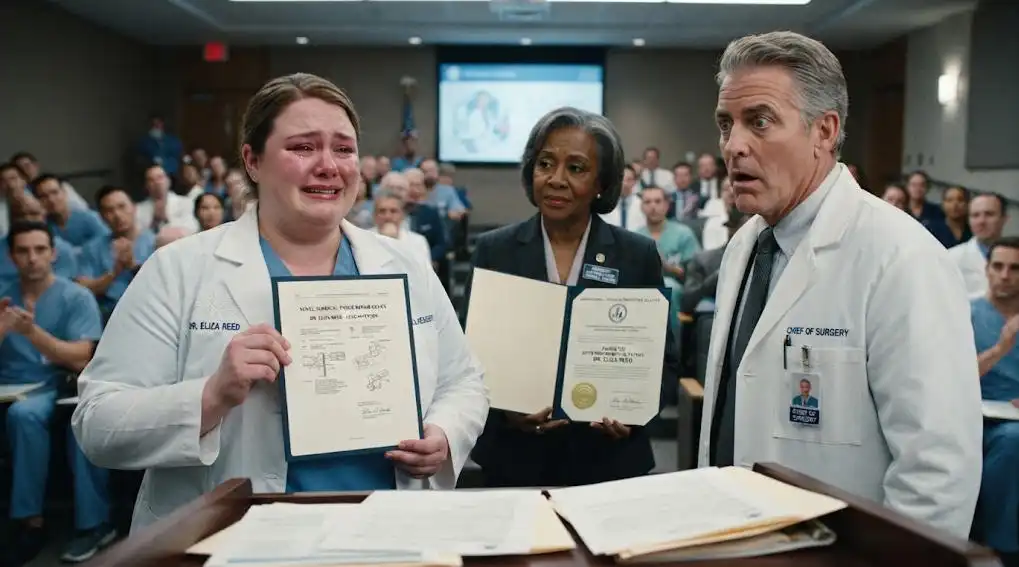
Dr. Miller was still standing on the auditorium stage when the hospital president opened the second folder.
He had spent years convincing everyone that I was an incompetent resident who had been lucky to work under him.
Now, hundreds of doctors watched as the president reviewed the documents he had never expected anyone to see.
My hands trembled.
Not because I was afraid of him anymore.
Because, for the first time in three years, I knew I wouldn't have to defend the truth alone.
My name is Dr. Nora Bennett.
I was thirty-one years old, a surgical resident at Johns Hopkins Hospital, and the person Dr. Miller had repeatedly described as the weakest member of his department.
He mocked my weight.
He questioned my intelligence in front of colleagues.
He took credit for my work.
And whenever I tried to defend myself, he reminded me that he controlled my professional future.
What he never understood was that my silence had never meant I lacked evidence.
It meant I was waiting for the right people to examine it.
I didn't enter medicine because I wanted a prestigious title.
When I was a child, my mother worked as a nurse at a community hospital. She often came home exhausted, but she still found time to ask about my day.
I remember sitting at our kitchen table while she explained how frightened patients could become when they didn't understand what was happening to them.
“People trust doctors with the most vulnerable moments of their lives,” she told me. “Never forget that the person in the bed is more important than the person wearing the white coat.”
I carried that lesson into medical school.
I studied relentlessly, volunteered in underserved communities, and became fascinated by surgical techniques that could make difficult procedures safer and more efficient.
My interest eventually turned toward surgical innovation.
I wanted to understand why certain procedures remained unnecessarily complicated and whether better instruments, clearer workflows, and improved procedural planning could reduce avoidable risks.
The work was demanding.
I spent evenings reviewing published research, studying surgical workflows, and discussing technical problems with engineers and experienced clinicians.
I learned that a promising idea was only the beginning.
It had to be tested carefully.
Its limitations had to be understood.
Its safety had to be established before it could be used in clinical practice.
And the evidence had to be strong enough for independent experts to evaluate it.
I loved that process.
It rewarded patience, precision, and intellectual honesty.
When I began my residency, I believed those qualities would matter more than anything else.
I was wrong about one thing.
I hadn't understood how much professional power could be used to silence someone who lacked the right connections.
Dr. Richard Miller was the chief of our surgical department.
He had a prestigious résumé, an impressive publication record, and a reputation for being a demanding leader.
He was also extraordinarily protective of his status.
At conferences, he spoke about innovation as though every meaningful discovery had originated in his own mind.
During meetings, he interrupted junior physicians and dismissed questions that challenged his conclusions.
If someone praised another surgeon's work, he found a way to redirect the conversation toward his own accomplishments.
At first, I interpreted his behavior as arrogance.
Then I became one of his targets.
My first serious disagreement with Dr. Miller occurred during a surgical research meeting.
I had presented an analysis suggesting that a particular procedural workflow could be simplified without compromising the established safety requirements.
I supported the proposal with published literature, technical measurements, and a detailed explanation of its limitations.
Dr. Miller barely looked at the slides.
“Have you actually spent enough time in the operating room to understand what you're proposing?” he asked.
“Yes, Doctor. The analysis includes observations from the approved research sessions.”
He leaned back.
“Then perhaps you should spend less time staring at spreadsheets and more time learning surgery.”
Several people lowered their eyes.
I explained that the proposal was intended to support further investigation, not replace clinical judgment.
He cut me off.
“Your enthusiasm is not expertise, Dr. Bennett.”
The meeting moved on.
My analysis was never discussed again.
A month later, Dr. Miller presented a similar concept at a departmental seminar.
The technical framework was nearly identical to the one I had submitted.
Several diagrams had been rearranged.
Some wording had changed.
But the underlying concept, the measurements, and the proposed design were unmistakably familiar.
He introduced it as a development project he had personally led.
The audience applauded.
I sat in the third row, staring at the screen.
Afterward, I approached him in the corridor.
“Dr. Miller, I noticed that your presentation includes the framework from my research proposal.”
He stopped walking.
“Your proposal?”
“Yes. I submitted the original analysis last month.”
He gave a short laugh.
“Research is collaborative, Nora. You should be pleased that your department is using your ideas.”
“I would be pleased to contribute. I just want the research record to reflect everyone's work accurately.”
His expression hardened.
“Be very careful about what you're implying.”
“I'm asking for accurate attribution.”
He stepped closer.
“You are a resident. I am the department chief. You should be concentrating on your training instead of trying to claim credit for work you don't fully understand.”
I felt my stomach tighten.
“I understand the analysis.”
“Then you should understand that your future here depends on your ability to work with your supervisors.”
He walked away.
That evening, I went home and opened the original project files.
I checked the submission timestamps.
I saved the original drafts.
I exported the dated laboratory notes and archived the correspondence associated with the project.
I also documented what had happened in the meeting while the details were still fresh.
I didn't alter a single record.
I didn't add anything to make my case stronger.
I simply preserved what already existed.
I had no idea how important that decision would become.
Over the following months, Dr. Miller's behavior grew worse.
He began criticizing me in front of other residents.
When I asked a question during a research discussion, he called it a distraction.
When I offered to help with a technical review, he assigned the task to another physician and later presented the resulting work without acknowledging my contribution.
He also began making comments about my body.
“You need to take better care of yourself if you expect patients to trust you,” he remarked one morning.
Another time, after I had completed a demanding overnight shift, he glanced at me in the corridor.
“Perhaps if you had more discipline outside the hospital, you'd have more discipline here.”
I stood still.
“Are you referring to my clinical performance?”
He smiled.
“I'm referring to the overall impression you make.”
I knew what he meant.
He had decided that my weight made me less credible, regardless of my knowledge, judgment, or work ethic.
The comments were humiliating.
They were also dangerous because they encouraged others to view me through the same distorted lens.
A resident who might otherwise have asked for my help began avoiding me during group discussions.
A research coordinator stopped including me in meetings where my own project was being reviewed.
I started second-guessing myself.
I checked my work repeatedly.
I rehearsed simple questions before asking them.
I wondered whether every mistake, no matter how small, would become another excuse for Dr. Miller to question my ability.
Some nights, I sat in my apartment and stared at my medical textbooks without absorbing a single word.
I was exhausted.
I was angry.
And I was frightened that speaking up would cost me the career I had spent so many years building.
My family had made sacrifices to help me reach medical school.
I had taken on financial obligations.
I had worked too hard to walk away because one senior surgeon had decided that humiliating me was an acceptable form of leadership.
So I kept going.
I did my clinical work carefully.
I asked for feedback from appropriate supervisors.
I documented concerns.
And I continued developing my research.
The innovation involved a specialized surgical planning and instrument-guidance system designed to help clinicians organize complex procedural steps more consistently.
The concept had emerged from a series of technical problems I had studied during my research.
It wasn't a miracle device.
It didn't eliminate surgical risk.
It didn't replace a surgeon's judgment.
Its potential lay in making certain parts of a complicated workflow easier to analyze, standardize, and evaluate.
I worked with qualified technical collaborators and research advisers to develop the concept.
Every design revision was documented.
The team reviewed the relevant intellectual-property questions before proceeding.
When the invention reached the appropriate stage, I worked with patent counsel to prepare and submit the application.
The filing identified the inventors according to their actual contributions.
After the required examination and registration process, the relevant patent was granted in my name.
The registration did not mean the technology had automatically been proven safe for every clinical setting, nor did it replace the approvals needed for future testing or use.
But it established an important fact about the documented invention and its registered ownership.
The underlying research history also remained preserved in the original records.
Dr. Miller knew the project was moving forward.
What he didn't know was that I had maintained an independent record of the development process and completed the formal intellectual-property work before he attempted to claim the innovation publicly.
He believed I was too intimidated to challenge him.
That belief would become his greatest mistake.
Several weeks after the patent was registered, I attended a departmental research meeting.
Dr. Miller announced that he had developed a breakthrough system for improving surgical workflow.
He displayed the diagrams I had created during the earliest stages of the project.
He presented technical findings from my research.
He described the innovation as the result of his own leadership.
Then he turned toward me.
“Some of our junior residents have been very fortunate to participate in this work,” he said. “They've had the opportunity to observe what genuine innovation looks like.”
The room was silent.
I raised my hand.
“Dr. Miller, could we clarify the research contributions and the inventor information before this presentation is circulated?”
He stared at me.
“Not now.”
“The documentation has already been completed.”
He slammed his hand against the table.
“I said not now.”
I lowered my hand.
The meeting continued.
Afterward, he summoned me to his office.
He shut the door and pointed toward a chair.
“You are becoming a serious problem.”
“I have asked for accurate attribution.”
“You are undermining your department chief in front of colleagues.”
“I am trying to ensure that the research record is accurate.”
He leaned forward.
“Let me make this simple. You can withdraw your objections, stop making accusations, and complete your residency. Or you can continue this campaign and discover how difficult your future can become.”
I looked at him.
“Are you asking me to withdraw a documented intellectual-property claim?”
He stood.
“I'm telling you to stop behaving as though a patent makes you an expert.”
I left his office without answering.
That night, I contacted an attorney who specialized in research integrity and intellectual property.
I showed her the original drafts, dated research notes, patent documents, correspondence, and presentation files.
She reviewed the materials and explained the distinction between a dispute over professional credit, a question of inventorship, and potential misconduct involving research records.
She advised me not to make public accusations before an independent review.
She also explained the available reporting channels.
I followed her advice.
I submitted a confidential report to the hospital's research integrity office, attaching the relevant records and identifying the specific discrepancies I believed required examination.
I asked for an independent review.
I did not demand that Dr. Miller be fired.
I did not ask anyone to declare me the winner.
I wanted the records examined by people who had no personal stake in the dispute.
The research integrity office acknowledged the report.
The process took time.
Investigators reviewed the original files, submission histories, patent documentation, and correspondence.
They interviewed relevant members of the research team.
They compared the materials Dr. Miller had presented with the records showing how the work had developed.
I cooperated fully.
I answered questions.
I provided original documents when requested.
I also made it clear which parts of the project had been completed by other collaborators, because I did not want their contributions erased while I was trying to correct my own.
Dr. Miller, meanwhile, continued behaving as though nothing could touch him.
He told colleagues that I was an insecure resident who couldn't accept criticism.
He claimed I was trying to exploit the patent system for personal advancement.
And he continued presenting himself as the sole intellectual force behind the innovation.
Then came the annual surgical research ceremony.
It was held in the hospital's main auditorium.
Hundreds of physicians, researchers, residents, administrators, and invited guests attended.
The program included research presentations, professional recognition, and announcements about upcoming departmental initiatives.
Dr. Miller was scheduled to present his surgical innovation.
I had been invited to attend as a member of the research team.
I arrived early and took a seat near the aisle.
I wore a simple navy suit over my professional attire.
I had barely slept the night before.
The independent review was still underway, and I had no idea whether the committee would finish before the ceremony.
I told myself to focus on the work.
Then Dr. Miller walked onto the stage.
He received enthusiastic applause.
He began describing the innovation as the product of his leadership and vision.
He showed diagrams derived from my original research.
He discussed the technical improvements as though he had developed them alone.
My hands tightened around the program.
I could feel my pulse in my throat.
When he reached the final slide, he invited questions.
I stood.
“Dr. Miller, will you be identifying the registered inventors and the research contributors in the final publication?”
The auditorium grew quiet.
He stared at me.
“This is a recognition ceremony, Dr. Bennett, not an opportunity for you to air your grievances.”
“I am asking about the accuracy of the research record.”
He stepped away from the podium.
“You have repeatedly demonstrated that you don't understand professional boundaries.”
“I have submitted documentation regarding the invention and the original research.”
His face reddened.
“Enough.”
He grabbed the printed medical report that had been placed on the table beside the podium.
It contained a summary of my concerns and the supporting documentation I had submitted through the proper channel.
He held it up.
“This is what happens when a resident becomes obsessed with recognition instead of learning her profession.”
Then he struck the report against my face.
The papers fell to the floor.
The sound echoed through the auditorium.
For a moment, I couldn't move.
Hundreds of people had seen it.
Some gasped.
One physician stood halfway out of his chair.
A resident near the front whispered, “That's completely unacceptable.”
Dr. Miller pointed toward me.
“You should be grateful you're even here. A woman like you has no business leading a surgical team.”
I felt tears burning behind my eyes.
I bent down and began collecting the papers.
Not because he had won.
Because I refused to let him turn my humiliation into a spectacle that defined me.
Then the auditorium doors opened.
The hospital president entered with the director of research integrity and a representative from the international medical association.
The president walked directly to the stage.
“Dr. Miller, please step away from the podium.”
He looked offended.
“I'm in the middle of my presentation.”
“Your presentation will be paused.”
She turned toward the director.
“Please proceed.”
The director held up a sealed envelope.
“This letter arrived from the international medical association this morning. It concerns the surgical innovation that was scheduled for presentation today.”
Dr. Miller straightened his jacket.
A smile returned to his face.
“Excellent. I assume this is the recognition we discussed.”
The representative from the association looked at him.
“Please allow the letter to be read in full.”
The director opened the envelope.
He began reading the formal commendation, which recognized the documented technical contribution and the work supporting the registered invention.
Then he reached the section identifying the inventor.
“Dr. Nora Bennett.”
A murmur swept through the auditorium.
The director continued.
The association had reviewed the patent registration and the supporting materials provided through its recognition process.
Its letter acknowledged my documented contribution to the innovation and commended the research discipline behind the work.
It did not claim that the invention had eliminated surgical risk or bypassed the need for appropriate clinical evaluation.
It recognized the work for what it was: a meaningful technical contribution with the potential to support further development and independent assessment.
The representative then stepped forward.
“Dr. Bennett, on behalf of the association, we congratulate you on this recognition.”
I stood slowly.
For three years, I had listened to Dr. Miller describe me as an unqualified resident who was fortunate to be allowed into the room.
Now an independent international organization had formally recognized the contribution he had tried to claim as his own.
The applause began near the back of the auditorium.
Then it spread.
I could barely hear it over the sound of my own heartbeat.
Dr. Miller stared at the letter.
“This is a misunderstanding.”
The hospital president opened the second folder.
“No, Dr. Miller. The research integrity review has reached a separate conclusion.”
The auditorium fell silent again.
She explained that the investigation had compared the original research records, document histories, patent filings, presentation materials, and relevant correspondence.
The findings showed that Dr. Miller had presented work developed by Nora and her collaborators without accurately identifying their contributions.
The review also found that he had pressured me to withdraw my objections and had used his supervisory position to discourage legitimate questions about research attribution.
The investigators had distinguished documented facts from disputed interpretations and had provided Dr. Miller with the opportunity to respond.
His explanations had not resolved the discrepancies.
The evidence supported formal findings of research misconduct and serious professional misconduct under the institution's applicable policies.
The president looked directly at him.
“You were entrusted with leadership, mentorship, and the responsible reporting of scientific work. The investigation found that you failed those obligations.”
Dr. Miller shook his head.
“I built this department.”
“You have contributed to this institution,” she replied. “That does not place you above its rules.”
He turned toward me.
“Nora, tell them this has gone too far.”
I looked at him.
“You had years to correct the record.”
His face twisted.
“You owe your career to this department.”
“I owe my career to the people who taught me, the patients who trusted me, the colleagues who worked honestly, and the work I did.”
I took a breath.
“I never asked anyone to punish you for criticizing me. I asked them to examine the evidence.”
The president closed the folder.
“Your appointment as department chief is suspended pending the formal disciplinary process. You are relieved of supervisory duties effective immediately.”
A stunned silence filled the auditorium.
Dr. Miller looked around as though someone might rescue him.
Nobody moved.
The hospital had followed its established procedures.
The research integrity findings would be handled through the institution's disciplinary process, and any issues involving professional licensing would be referred to the appropriate licensing authority.
The international association's recognition was one part of the record.
The patent documents were another.
The independent investigation was the part that established the misconduct.
For the first time in years, Dr. Miller had no way to dismiss the evidence by attacking my appearance or my position in the department.
I stood beside the hospital president while the director collected the remaining papers.
My hands were still trembling.
But I no longer felt small.
The consequences unfolded over the following months.
The hospital completed its disciplinary proceedings and formally dismissed Dr. Miller from his leadership position.
The research misconduct findings were reported through the appropriate professional channels.
The state medical licensing authority conducted its own review, examining the relevant evidence under its legal standards and giving Dr. Miller the opportunity to respond.
The authority ultimately revoked his medical license after concluding that his documented professional misconduct met the applicable grounds for revocation.
The decision was not based on a public argument or a single embarrassing moment.
It followed a formal review of the evidence and the required procedures.
Dr. Miller appealed through the available process, but the revocation remained in effect.
He could no longer practice medicine under that license.
The reputation he had built through years of academic presentations and professional titles collapsed under the weight of the findings.
For the hospital, the case became a painful lesson about the danger of allowing one person's authority to go unquestioned.
For me, the outcome was more complicated.
I was relieved.
I was also exhausted.
I had spent years believing that if I worked harder, documented more carefully, and avoided confrontation, I could somehow prevent Dr. Miller from hurting my career.
I eventually understood that there had never been a perfect way to make an unfair person behave fairly.
My responsibility was to do my work honestly, preserve the evidence, and use the appropriate channels when something went wrong.
The institution's responsibility was to examine the facts and act on them.
I had done my part.
Now I needed to decide what kind of leader I wanted to become.
Several weeks after the investigation concluded, the hospital president invited me to her office.
She explained that the surgical department needed new leadership.
The board had reviewed the candidates, their professional records, their leadership experience, and their plans for improving the department.
They wanted someone who could strengthen research integrity, support trainees, and maintain rigorous clinical standards.
They offered me the position of surgical department chief.
I was stunned.
“I appreciate the confidence,” I said. “But I want to be clear about something.”
“Go ahead.”
“I don't want this appointment to be seen as a reward for what happened to Dr. Miller. I want to be evaluated on my qualifications and my ability to lead.”
The president nodded.
“That is precisely why the board conducted a formal selection process. Your appointment is based on your record, your research contribution, your clinical evaluations, and your proposed leadership plan.”
I accepted.
On my first day as chief, I arrived early.
The office was quiet.
Sunlight came through the windows, falling across the desk where Dr. Miller had once sat.
I placed my medical books on the shelf.
Then I opened the department's policies and began reviewing the work ahead.
I wanted a culture where residents could question an idea without fearing retaliation.
I wanted research contributions documented accurately.
I wanted clear procedures for reporting misconduct, with protections against retaliation and independent review when allegations involved senior leaders.
I also wanted the department to maintain the highest standards of clinical judgment and patient safety.
Fairness did not mean lowering expectations.
It meant applying those expectations consistently.
A surgeon should be challenged when the evidence is weak.
A researcher should be questioned when the methods are flawed.
A resident should be corrected when a mistake occurs.
But nobody should have to endure humiliation, discrimination, or stolen work as the price of professional training.
I announced the new research-integrity initiative at the department's next meeting.
Several residents approached me afterward.
One young physician admitted that she had been afraid to raise concerns about how her contributions were recorded.
Another said he had watched senior staff dismiss junior researchers simply because they lacked the confidence to argue.
I listened.
I could not promise that every dispute would end in someone's favor.
I could promise that legitimate concerns would be reviewed fairly and that professional disagreements would not be treated as personal disloyalty.
That promise became the foundation of our new reporting system.
I also wanted to address a broader problem.
During my years in medicine, I had met talented clinicians and researchers whose opportunities were limited by their financial circumstances, their backgrounds, or their lack of professional connections.
Some struggled to access research funding.
Others lacked mentors who could help them navigate academic institutions.
Some had been dismissed before anyone seriously examined their work.
I knew that one new department chief could not solve every form of inequality in medicine.
But I could help build a program that made opportunities more transparent.
With support from colleagues, philanthropic partners, and independent advisers, I established the National Medical Equity Fund.
The fund was designed to support qualified early-career medical researchers and clinicians who faced barriers to training, mentorship, research resources, or professional development.
Its grants were awarded through published criteria and independent review.
We provided mentorship programs, research-development grants, professional training, and support for institutions seeking to improve fair reporting and evaluation practices.
The fund did not promise success to every applicant.
It promised a fair opportunity to be considered.
That distinction mattered to me.
A few months after the fund launched, I visited one of its partner programs.
A young researcher named Emily approached me after the session.
She had developed a promising idea for improving a clinical workflow, but she was nervous about presenting it to more senior colleagues.
“What if they think it's stupid?” she asked.
I remembered sitting in the third row while Dr. Miller presented my work.
I remembered how my hands had trembled when I stood to ask a question.
I looked at Emily.
“Then they should explain why they disagree with the idea. They should examine your evidence and challenge your methods. That's how research improves.”
She nodded.
“And if they take credit for it?”
“Keep accurate records. Ask for help early. Use the reporting process if something is wrong. You don't have to handle it alone.”
She looked relieved.
I couldn't promise that she would never encounter an unfair supervisor.
I could help make sure she had tools, mentors, and a process for seeking accountability.
That was what the fund was for.
Months later, the international medical association invited me to speak at a research conference.
I accepted.
When I walked onto the stage, I saw physicians, engineers, researchers, and trainees filling the auditorium.
For a moment, I remembered the hospital ceremony.
I remembered the report striking my face.
I remembered the papers scattered across the floor.
I remembered the fear that had followed me through so many meetings.
Then I looked at the audience.
I spoke about the importance of documenting research contributions, protecting the integrity of scientific records, and ensuring that junior researchers could raise legitimate concerns without fear of retaliation.
I also spoke about the limits of recognition.
“A patent does not replace clinical evidence,” I told the audience. “A title does not replace integrity. And a person's appearance does not tell you whether their work deserves serious examination.”
The room was quiet.
I continued.
“We should demand excellent work from everyone in medicine. But excellence and humiliation are not the same thing. Accountability and cruelty are not the same thing. We can insist on high standards without destroying the dignity of the people expected to meet them.”
The applause came slowly at first, then grew.
After the conference, I returned to the hospital and walked through the corridor outside the auditorium.
A group of residents stood near the research display.
One of them recognized me.
“Dr. Bennett, we're presenting our first independent project next month.”
“That's wonderful. Have you checked the submission requirements?”
“We have. And we've documented every contribution.”
I smiled.
“Good. Make sure the work speaks clearly, and make sure the record is accurate.”
They thanked me and returned to their discussion.
I watched them for a moment.
They looked nervous, excited, and full of questions.
They reminded me of the resident I had been before Dr. Miller convinced me that speaking up was dangerous.
I wished I could go back and tell that younger version of myself something.
I would tell her that she did not need to become smaller to make an arrogant person feel powerful.
I would tell her that her body was not a verdict on her intelligence.
I would tell her that asking for accurate attribution was not arrogance.
And I would tell her that patience was useful, but silence should never be mistaken for the only acceptable form of professionalism.
I still had difficult days.
The department chief's job was demanding.
There were staffing challenges, research disputes, budget decisions, and clinical responsibilities that could not be solved by a single meeting or a well-written policy.
I made mistakes.
I asked for advice.
I changed my mind when the evidence required it.
And I tried to remember that leadership meant taking responsibility for decisions, not demanding that everyone admire me.
I never became a different person because I received an international commendation or took over the department.
I was still Nora.
I still loved surgical research.
I still spent long hours reviewing data.
I still believed that the patient mattered more than the prestige of the person treating them.
And I still preferred a comfortable pair of shoes to anything designed to impress strangers.
My weight did not determine my qualifications.
My patent did not make me infallible.
My new title did not make me more deserving of respect than the residents working under me.
Those things were separate.
The real measure of my leadership would be what happened when someone without power brought forward a difficult truth.
Would I listen?
Would I examine the evidence?
Would I protect the integrity of the process even if the facts were uncomfortable?
That was the responsibility I had inherited when the board appointed me chief.
One afternoon, I returned to my office after a long clinical day and found a handwritten note on my desk.
It was from a resident who had recently completed a research presentation.
Thank you for letting us ask questions without being afraid.
I read the sentence twice.
Then I placed the note beside my first patent certificate.
The two documents represented different parts of my life.
One recorded a technical achievement.
The other reflected the kind of workplace I wanted to build.
I thought about Dr. Miller.
For years, he had believed that authority gave him the right to decide whose work mattered.
He had used his position to silence questions, claim credit, and humiliate someone he considered inferior.
In the end, the records were examined.
The truth was established through independent review.
His leadership position ended.
His medical license was revoked through the appropriate process.
And the work he had tried to claim was recognized under the correct name.
I did not need to humiliate him in return.
The evidence had been enough.
I closed the folder and looked out across the hospital.
Somewhere below, residents were preparing for another demanding shift.
Researchers were reviewing data.
Nurses were comforting frightened families.
Surgeons were planning difficult procedures.
Every one of them deserved a workplace where professional standards were high, questions were welcomed, and no one had to surrender their dignity to earn the opportunity to learn.
That was the kind of department I intended to lead.
Not because I wanted revenge.
Because I knew what it felt like when a powerful person treated fairness as a privilege rather than a responsibility.
And I knew how much damage that could do.
I had once entered an auditorium believing my career might be destroyed by the man standing at the podium.
I left that chapter of my life as the department chief, the registered inventor behind a recognized surgical innovation, and the founder of a fund dedicated to widening access to medical opportunity.
But the most important change was quieter.
I no longer measured my worth by whether someone like Dr. Miller approved of me.
I measured it by the honesty of my work, the care I gave my patients, and the standards I upheld when I held power of my own.
Choose your side: NORA WAS RIGHT TO EXPOSE THE MISCONDUCT AND DEMAND ACCOUNTABILITY, or DR. MILLER DESERVED A SECOND CHANCE AFTER YEARS OF LEADING THE DEPARTMENT.
Comment your choice and share this story with someone who believes that medical excellence requires both skill and integrity.
Disclaimer: Mention of any brand or trademark is for identification only and does not imply partnership or endorsement
A Chemical Plant Guard Mocked an OVERWEIGHT Water Scientist and Smashed Her Sample Case in Public. He Had NO IDEA What She’d Already Recorded 😱

A Polished Developer Had His Men Shove a Postpartum Home Repairwoman Into the Mud. He Had NO IDEA What She Was Bringing to City Hall 😱
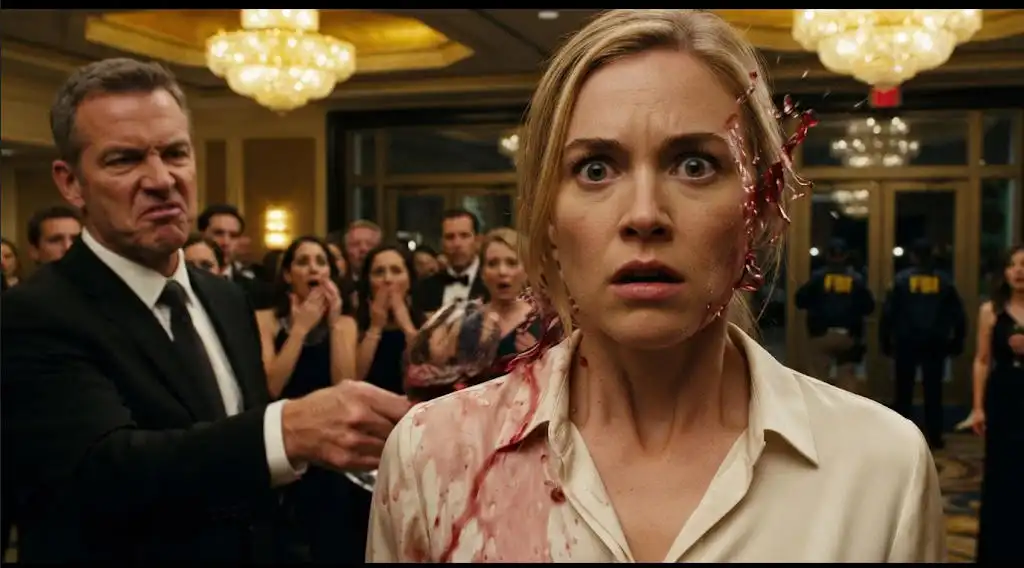
A Quiet Las Vegas Hotel Auditor Was DRENCHED in Red Wine by a Powerful VP in Front of Dozens of Guests. He Had NO IDEA What She’d Already Saved... 😱