


For one long second, nobody moved.
Then the clerk pressed PLAY.
A soft click echoed through the city hall chamber.
Grant Mercer folded his arms, wearing the same thin smile he had worn while my tools lay in the mud.
I could hear my own heartbeat over the speaker's low static.
Then a woman's voice filled the room.
“This is the scheduled compliance review for Westbridge Urban Development. All participants have been notified that this meeting is being recorded.”
Grant's voice followed.
“Use the signatures from the old title scans. The residents never signed those consent forms.”
Someone in the audience gasped.
A second voice, unmistakably that of Deputy Planning Director Alan Price, asked, “And the emergency demolition declarations?”
Grant answered without hesitation.
“You certify the homes as unsafe. The forty-thousand-dollar payment goes to Blue Harbor Consulting on Friday. The permits clear, and we get the block before anyone can object.”
Price's voice grew quieter.
“You said this recording would stay internal.”
Grant laughed.
“It will. Nobody outside this company will ever hear it.”
The recording continued.
The hearing officer leaned forward.
Grant's smile vanished.
I stood motionless beside the microphone, listening to the sound of the truth finally catching up with the men who had tried to bury it.
For the first time since this nightmare began, nobody was looking at my muddy boots.
Everyone was looking at Grant Mercer.
And I knew exactly why.
My name is Nora Whitlock. I am 33 years old, and I make my living repairing houses that other people have stopped caring about.
I fix rotting porch steps, replace broken window frames, repair fences, patch leaking roofs, and restore old kitchens one cabinet at a time.
I have never owned a luxury car. I have never worn a designer suit. Most of my working clothes have paint stains that refuse to come out, and my hands are permanently rough from years of lifting tools.
After childbirth, my body changed. I carried more weight than before, and people who barely knew me seemed to think that gave them permission to judge my intelligence, my work, and my worth.
Grant Mercer was one of those people.
He represented Westbridge Urban Development, a company that wanted to transform our modest neighborhood in San Mateo County, just south of San Francisco, into an expensive collection of luxury townhouses.
Our neighborhood was not glamorous.
The houses were old. Some needed new roofs. Several front gardens had uneven paths, and the sidewalks had cracks from decades of tree roots.
But families had lived there for generations.
My mother, Evelyn, had lived in our house since she and my father purchased it decades ago. After my father's death, the home became even more precious to her. Every room held a memory. Every mark on the kitchen doorway reminded her of a birthday, a family gathering, or a year when we had somehow managed to get through another difficult season.
My mother was chronically ill. She needed regular care, a stable home, and the reassurance that the life she had built would not disappear overnight.
I took care of her while running my repair business.
It was not easy, but it was our life.
Then Westbridge arrived.
At first, the company sent polite letters offering to buy properties.
The offers were low, but the letters were professional. They spoke about revitalization, investment, and improving the neighborhood.
Some residents considered selling. Others declined.
My mother and I declined.
We were not against improvements. I had spent years improving houses myself. I knew that neighborhoods changed and that old buildings sometimes needed repairs.
But there was a difference between improving a neighborhood and forcing its residents out because their homes were worth more to someone else.
Grant did not understand that difference.
Or perhaps he understood it perfectly and simply did not care.
During our first meeting, he looked around our living room as if he were inspecting a condemned building.
“You should take the offer,” he told me. “The market isn't going to get better for a property like this.”
“This house is worth more to us than the number on your paper,” I replied.
He smiled at my mother, but the expression never reached his eyes.
“Sentiment doesn't pay property taxes, Mrs. Whitlock.”
My mother said nothing.
I walked him to the door.
He paused on the porch and examined the peeling paint around the frame.
“People who can't maintain a property shouldn't stand in the way of progress.”
I wanted to tell him that I had repaired the very porch on which he was standing.
Instead, I closed the door.
I thought that would be the end of it.
I was wrong.
Within weeks, Westbridge began sending increasingly aggressive notices. The company claimed that several houses in the neighborhood had serious safety problems and that residents had signed agreements permitting expedited redevelopment.
We had signed nothing.
Neither had most of our neighbors.
At a public neighborhood meeting, Grant arrived with a polished presentation, a row of neatly printed maps, and a team of men wearing matching jackets.
He spoke about investment and property values.
He described our homes as outdated obstacles.
Then he turned toward me.
“Nora, why don't you explain to everyone why you refuse to cooperate?”
I stood up.
“I've already explained. My mother and I aren't selling.”
Grant gave a theatrical sigh.
“Your house is falling apart. You work with your hands, but you clearly can't see the bigger picture.”
“My house is safe, and the repairs are documented.”
“According to whom? You?”
A few people shifted uncomfortably in their seats.
Grant continued.
“This neighborhood needs professionals, not people who think a toolbox makes them property experts.”
I felt the humiliation burn through me, but I kept my voice steady.
“Then show us the inspection reports. Show us the signed agreements. Show us the lawful orders authorizing what you're threatening to do.”
For the first time, his expression hardened.
He signaled to his foreman.
The man approached me and shoved me backward.
My feet slipped on the muddy ground outside the meeting hall.
I fell hard.
Before I could get up, two workers grabbed my tool bag and dumped it onto the pavement. My measuring tape, hammer, screwdrivers, and carefully sorted repair materials scattered through the mud.
One of them stepped on my measuring tape.
Another kicked my tool case away.
I looked toward Grant.
He stood beneath the redevelopment banner, his suit spotless, watching his men destroy equipment I had spent years buying one piece at a time.
“Maybe now you'll understand what happens when you refuse to cooperate,” he said.
Several neighbors raised their phones.
Someone shouted that he should stop.
Grant merely straightened his cuff.
“Progress is never comfortable for everyone.”
I was kneeling in the mud, trying to retrieve my tools, when I heard a familiar voice from the crowd.
“Nora, leave those for a second. Are you hurt?”
It was Ruth Caldwell, a neighbor who had lived across the street for more than thirty years.
She helped me stand.
I wanted to cry. I wanted to scream. I wanted to throw every one of those polished redevelopment brochures back into Grant's face.
Instead, I picked up my damaged toolbox.
I had learned something over the years.
When a repair job goes wrong, you do not fix it by swinging the hammer harder. You find out what failed, identify the source of the damage, and work through the problem one step at a time.
Grant had made his first mistake.
He thought humiliation would make me surrender.
I went home and checked on my mother.
Then I began documenting everything.
The next morning, I photographed the damaged tools. I saved the video recordings neighbors had taken. I wrote down the names of the workers present and recorded the time and location of the incident.
I filed a police report about the assault and property damage.
Then I made a list of every notice Westbridge had sent us.
That list changed everything.
A week later, the water stopped.
Then the electricity went out.
My mother's medical equipment switched to backup power, and a warning tone filled the room.
I moved quickly, checking her condition and arranging for her to stay with Ruth while I contacted the utility company.
I was told our account was current.
There was no ordinary service disconnection scheduled.
The utility representative said a work order had been submitted under an emergency city authorization.
I requested a copy.
The following day, the company confirmed that the paperwork needed further investigation because the authorization did not match its normal records.
I kept the email.
I kept the work order.
I kept every envelope and every message.
Grant called that afternoon.
“Are you ready to be reasonable?” he asked.
“My mother's electricity was cut off.”
“Administrative matters are complicated.”
“Then explain the work order.”
“I don't have time to walk you through every city procedure.”
“You're the one threatening to take our house.”
His voice became cold.
“Accept the offer, Nora. You don't want to discover how expensive resistance can become.”
I hung up.
My hands were shaking.
But I was no longer simply frightened.
I was beginning to see a pattern.
Westbridge was not merely trying to buy our homes. It was using a combination of official-looking notices, alleged safety violations, and supposedly voluntary agreements to make residents believe they had no choice.
If we could establish that those documents were fraudulent, the entire operation might fall apart.
I called Ruth.
Then I knocked on doors.
We met at her dining table with folders, receipts, property tax statements, and copies of the notices.
At first, people were reluctant to speak.
Some were elderly. Others had spent their lives working to pay off their mortgages. They worried that challenging a developer with expensive lawyers would cost them everything.
One neighbor, a retired mechanic named Walter Bennett, placed a letter on the table.
“They say I agreed to sell my house six months ago,” he said. “I was in Arizona visiting my daughter that week.”
Another woman found a consent form bearing her signature.
She stared at it for several seconds.
“That isn't how I sign my name.”
We compared the documents.
The dates were inconsistent. Some signatures did not match the residents' other records. Several notices referred to inspections for which nobody could find a legitimate report.
Then we discovered something even more disturbing.
One of the purported sellers had died before the date on the agreement.
His family had never authorized a sale.
We had enough reason to seek professional help, but we needed to do everything properly.
A volunteer housing attorney named Daniel Brooks agreed to review our documents.
He was direct.
“Do not confront their employees. Do not alter the files. Do not trespass on company property. We need records that can stand up in court.”
He explained that a private developer could not simply seize a home because its residents refused an offer. The company needed lawful authority and had to follow the applicable legal procedures.
An official-looking notice did not make an unlawful order legitimate.
We began requesting certified property records from the county recorder. Our attorney also requested the underlying permit files, inspection records, and utility work orders.
The certified records showed a clear history of ownership for our house.
The alleged sale documents did not fit that history.
A signature attributed to one resident was inconsistent with the signatures in the property's existing records. Another document cited a notarization that could not be reconciled with the notary's journal.
Our attorney arranged for a qualified examiner to review the disputed signatures.
Meanwhile, Ruth remembered someone who might know more.
Three doors down lived Tessa Cole, a former records analyst for Westbridge.
Tessa had resigned months earlier. People knew she had worked for the company, but few knew why she had left.
When Ruth explained what we had discovered, Tessa came to the next meeting carrying a thick folder.
She looked exhausted.
“I kept telling myself it wasn't my problem anymore,” she said. “But when I saw what happened to Nora, I realized they were going to keep doing this to other families.”
She had worked with Westbridge's compliance records.
Her responsibilities had included maintaining the official files for internal meetings and project approvals.
Several months before her resignation, she had been assigned to preserve the recording of a scheduled compliance review attended by Grant Mercer and Deputy Planning Director Alan Price.
Everyone at the meeting had been notified that the session was being recorded.
During the meeting, the participants had discussed the disputed sale agreements, the emergency demolition declarations, and a payment to a consulting company connected to Price.
Tessa had preserved the original recording as part of her records responsibilities.
Later, she said, she was instructed to replace the full recording with a shortened version.
She refused.
“I couldn't prove every part of the scheme by myself,” she told us. “But I knew the original file existed, and I knew it mattered.”
She had retained the original file and its associated records through appropriate preservation steps. She brought the material to Daniel, who reviewed how it had been obtained and how it could be submitted lawfully.
We did not simply copy the audio onto a random drive and hope someone would believe us.
Our attorney arranged for a digital forensic examiner to preserve the original file, document its metadata, calculate a file hash, and compare it against the company's archived version obtained through formal legal process.
The examiner found that the versions matched.
The file had not been edited to create the incriminating statements.
Tessa provided a sworn account of the meeting, the recording notice, and her role in preserving the record.
The attorney assembled the audio with the certified deeds, the disputed agreements, the notary records, the utility correspondence, and the available inspection documents.
Every item had a source.
Every item had a record of how it was obtained.
Every item could be examined independently.
For the first time, we had more than suspicion.
We had a case.
Our attorney filed an emergency motion in county Superior Court. Based on the evidence presented, the judge issued a temporary restraining order preventing demolition work from proceeding while the disputed documents were reviewed.
The order did not decide the entire case.
But it stopped the immediate threat to our homes.
Westbridge responded with another letter.
This one warned that anyone who interfered with the redevelopment process could face substantial legal costs.
Grant also began calling residents individually.
He told some that their neighbors were exaggerating.
He told others that the city would eventually approve the project anyway.
To me, he said, “You have no idea how many people you are upsetting.”
I understood the message.
The more evidence we found, the more determined he became to silence us.
Then the intimidation became harder to ignore.
For three nights, I noticed the same dark SUV following me after work.
A man I did not recognize stood near my driveway one evening, watching the house.
The next morning, I found a note under my windshield wiper.
It contained a short warning telling me to stop digging into the redevelopment records.
My stomach tightened.
My mother was inside.
For a moment, I considered giving up. I imagined what would happen if someone frightened her or damaged the house while I was away working.
But I also thought about Walter, about Ruth, and about the family whose deceased relative had supposedly signed away a home.
If I backed down, the others might be left alone to face the same pressure.
I photographed the note, recorded the dates and locations of the incidents, and reported the threats to the police. Neighbors supplied relevant doorbell-camera footage. Daniel documented the incidents and provided the information to investigators.
We did not confront the men following me.
We preserved the evidence and let the authorities investigate.
Then came the city hall hearing.
The room was packed.
Residents who had barely spoken at our first meeting now filled the benches. Some held copies of their property deeds. Others carried photographs of the damaged tools, the utility notices, and the disputed agreements.
My mother sat beside Ruth near the front.
She looked tired, but she insisted on attending.
Grant arrived with his legal team. Deputy Planning Director Alan Price sat nearby, reviewing papers.
Grant saw me and gave me a small, dismissive smile.
He still believed he could control the room.
The hearing officer reviewed the documents and allowed our attorney to present the evidence.
Daniel explained the chain of ownership for the affected properties. He described the inconsistencies in the purported sale agreements and the questions surrounding the emergency work orders.
He also explained how the original recording had been preserved and authenticated.
Grant's attorney objected to the recording being played before the full review was completed.
The hearing officer considered the objection, reviewed the submitted materials, and permitted the relevant portion to be played as part of the evidentiary presentation.
That was when the clerk placed the sealed drive beside the microphone.
That was when Grant's confidence began to crack.
And that was when the recording exposed what had been happening behind the polished redevelopment presentations.
The voices in the chamber heard Grant discuss copying signatures from old property records.
They heard him explain how the emergency declarations would be used.
They heard him describe a forty-thousand-dollar payment to a consulting company associated with the deputy planning director.
They heard Price discuss the approval process.
The recording did not stand alone. The certified property records, disputed documents, payment records, and sworn testimony gave investigators independent ways to examine the claims.
When the audio ended, the room erupted.
A woman in the second row began to cry.
Walter Bennett stood up, his face red with anger.
“You told me my own signature meant I'd agreed to leave,” he shouted. “You told me I had no choice!”
The hearing officer called for order.
Grant stood abruptly.
“This recording is being taken out of context,” he said. “Westbridge has invested substantial resources in this community.”
The hearing officer looked directly at him.
“Mr. Mercer, you will have an opportunity to respond through your counsel. You will not interrupt the proceedings.”
Grant sat down.
For once, his money could not make the room forget what it had heard.
The city suspended the disputed demolition approvals pending further review and referred the evidence to the appropriate investigative authorities. Our attorney continued pursuing the court case, and the temporary restraining order remained in effect.
The immediate threat to our homes had been stopped.
But the fight was not over.
Over the following weeks, investigators examined the original files, the payment trail, and the circumstances surrounding the utility work orders.
They questioned the people involved in preparing the documents.
They reviewed the notary records.
They examined the evidence of intimidation.
The case grew beyond our street.
The investigation found that Westbridge personnel had used copied signatures to create false impressions of consent and had relied on questionable emergency declarations to pressure residents into selling. Investigators also developed evidence linking the payments to the effort to obtain favorable official action.
The recording was a crucial piece of the case, but it was the combination of the audio, the certified records, the financial trail, and the witness statements that established what had happened.
The county Superior Court ultimately declared the fraudulent transfer documents invalid and barred demolition based on those filings.
The disputed permits were revoked.
The district attorney brought criminal charges against Grant, Price, and others implicated in the scheme.
The threats against me were also investigated. Evidence connecting a security subcontractor to Westbridge's efforts to pressure witnesses became part of the broader case.
Months later, Grant pleaded guilty to forgery-related offenses and commercial bribery. Price resigned and pleaded guilty to accepting bribes and falsifying public records.
Westbridge's redevelopment project collapsed.
Its lenders withdrew financing. Contractors walked away. Civil claims from residents mounted, and the company entered bankruptcy.
The luxury townhouses that had been presented as an inevitable future for our neighborhood were never built.
The old homes remained.
For a long time, I had thought winning would feel like watching Grant lose everything.
There was some satisfaction in seeing the truth established in court. I will not pretend otherwise.
But the greatest relief came on an ordinary morning when I woke up and realized that I no longer had to check the driveway before opening the front door.
My mother's electricity was stable. Her medical equipment worked. The notices threatening our home had been withdrawn or invalidated through the legal process.
I could return to repairing houses without wondering whether someone would try to take mine while I was away.
The damaged tools were replaced gradually. Some neighbors helped me repair the fence. Others brought lumber, paint, and food.
Ruth organized a small workday in the shared courtyard.
Walter repaired a loose gate. A retired teacher planted flowers beside the walkway. Two young neighbors rebuilt a garden bed that had been damaged during the utility work.
Nobody received a luxury development brochure that afternoon.
Instead, we passed around cups of tea.
My mother sat in a chair near the garden, wrapped in a light cardigan. She watched our neighbors talking and laughing, then looked at me.
“You kept the house,” she said softly.
I looked around at the people who had refused to abandon one another.
“No, Mom,” I told her. “We kept our home together.”
She took my hand.
For years, I had believed that protecting a home meant repairing its walls, maintaining its roof, and making sure the doors locked properly.
I still believe those things matter.
But I understand something else now.
A home is also the people who stand beside you when powerful strangers tell you that you do not belong.
It is the neighbor who helps you stand after you fall.
It is the person who brings evidence forward when silence would be easier.
It is the community that chooses lawful action over fear, and truth over the promise of an easy escape.
Grant had looked at my muddy clothes and decided I was insignificant.
He saw an ordinary woman with a toolbox, an aging house, and a sick mother.
He never understood that I was not fighting alone.
He mistook our modest homes for weakness. He mistook our patience for surrender. And he believed that money could make a forged signature more powerful than the truth.
He was wrong.
Today, when I sit in our restored courtyard with my mother and my neighbors, I sometimes remember the day I knelt in the mud, gathering the tools his men had scattered.
I remember how small I felt.
Then I remember the hearing room, the original recording, and the moment the entire room finally listened.
I do not need to be wealthy to deserve respect.
My neighbors do not need expensive lawyers to deserve a fair hearing.
And nobody should have to surrender a family home because a powerful company believes its profits matter more than the people living there.
Choose a side: stand with the families who used lawful evidence to protect their homes, or excuse the people who forged signatures and abused their power to force a sale.
If you believe that a home is more than a number on a developer's spreadsheet, share this story for every family fighting to keep the place they call home.
Disclaimer: Mention of any brand or trademark is for identification only and does not imply partnership or endorsement
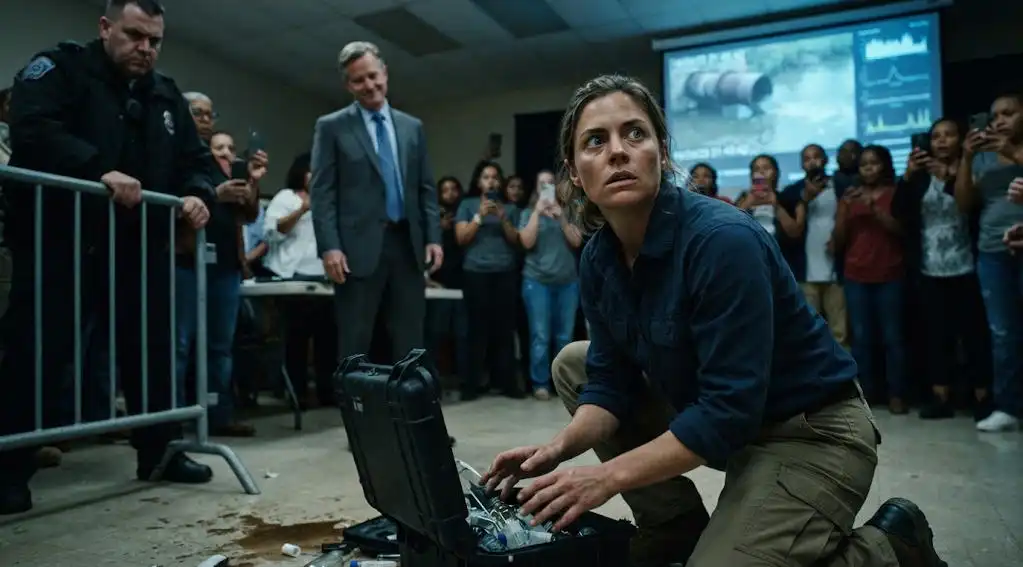
A Chemical Plant Guard Mocked an OVERWEIGHT Water Scientist and Smashed Her Sample Case in Public. He Had NO IDEA What She’d Already Recorded 😱

A Quiet Las Vegas Hotel Auditor Was DRENCHED in Red Wine by a Powerful VP in Front of Dozens of Guests. He Had NO IDEA What She’d Already Saved... 😱

A Powerful Surgeon Slapped a Plus-Size Resident’s Medical Report Against Her Face and Stole Her Research. He Had NO IDEA Her Name Was Already on the International Patent... 😱