

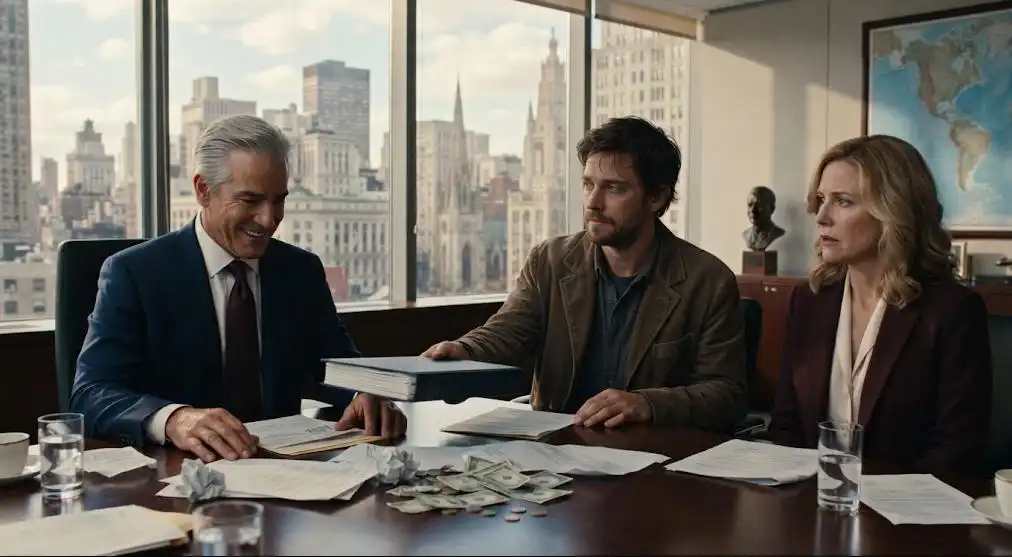
Victor stared at the agreement.
For several seconds, the only sound in the conference room was the air conditioning.
Then he laughed.
It was a shorter, less confident laugh than before.
“You expect me to believe this?” he said. “Some offshore shell company bought my business while I was sitting in this room?”
Daniel folded his hands.
“Not your entire business. Your controlling holding company, its secured debt, and the operating assets you pledged against it.”
Victor's expression hardened.
“You don't have the money.”
“I didn't need to have it sitting in my personal bank account.”
Daniel turned the document around and pointed to the closing certificate.
“The acquisition vehicle was funded through a private investment consortium. The capital was deposited into escrow before today's market close. The transfer agreements were signed in advance. The remaining condition was confirmation of the closing price and the completion of the final exchange.”
Victor looked down again.
Daniel continued.
“At three o'clock, that condition was satisfied. The closing agent released the funds, the transfer documents became effective, and the voting rights passed to the new holding company.”
Victor shook his head.
“Who is behind this?”
“I am.”
“That's ridiculous.”
Daniel didn't answer.
Instead, he pulled another document from his briefcase and placed it beside the agreement.
It contained a list of companies, transaction dates, and financial transfers.
Victor glanced at the first page.
His face changed.
Three months earlier, Victor had arranged a series of transfers from his company's operating subsidiaries into related private entities. The transactions had been structured to appear as separate commercial arrangements.
But the public filings contained a detail he had overlooked.
The subsidiaries had continued reporting the liabilities even after the corresponding cash had moved elsewhere.
The financial statements also showed unusual related-party transactions and a growing gap between reported revenue and available operating cash.
Daniel had spent weeks comparing those disclosures.
He had not needed stolen emails, secret recordings, or an employee willing to risk his career.
The information had been sitting in publicly available filings.
He had reconstructed the transfer sequence, identified the connected entities, and commissioned independent financial professionals to verify the figures.
The findings had been delivered through the proper legal channels before the acquisition closed.
Victor pushed the pages away.
“These are ordinary business transactions.”
“Then you shouldn't have any trouble explaining them.”
“You have no idea what you're talking about.”
Daniel opened the second document.
“On March 14, your company transferred $18.6 million through three related entities. The operating subsidiary continued carrying the corresponding liabilities. By April, the cash reserves had fallen below the level required to support your short-term obligations.”
Victor's jaw tightened.
Daniel pointed to another entry.
“And when your lenders began asking questions, you used the remaining credit facilities to cover operating expenses. That bought you time, but it also made the company more vulnerable.”
Margaret looked from one page to another.
She had spent the previous several months trying to understand why Victor's investment firm seemed so eager to take control of her company.
Now she was beginning to understand.
Victor hadn't simply been pursuing a profitable acquisition.
He had been protecting a financial structure that was already beginning to collapse.
“You knew?” Margaret asked quietly.
Daniel turned toward her.
“I suspected it. Then I verified it.”
“Why didn't you tell me?”
“Because until the transaction closed, telling you could have exposed the acquisition.”
Margaret looked at the agreement again.
For months, she had believed Daniel was simply trying to help her negotiate a better restructuring arrangement.
She hadn't known that he was preparing to take apart the machinery Victor had built to destroy her company.
Victor suddenly stood.
“I'm calling my attorneys.”
“You can,” Daniel said.
“I'll have this agreement challenged before the end of the day.”
“You have every right to seek legal advice.”
Daniel's calmness seemed to anger Victor more than any insult could have.
Victor grabbed his phone and called his chief financial officer.
No answer.
He tried again.
This time the call connected.
“Martin! What is happening? Get the board on the phone. Now!”
The voice on the other end was tense.
“Victor, you need to listen to me.”
“I'm not interested in excuses.”
“The acquisition has closed.”
“I can read a piece of paper, Martin!”
“Then you need to read the bank notice. The company accounts have been placed under restriction following the court-authorized preservation action. The bank has received the ownership documents and the related compliance instructions.”
Victor stopped moving.
“What preservation action?”
“The financial transfers. The transaction records. The material submitted by the outside counsel. The bank has acknowledged the restriction.”
Victor looked toward Daniel.
Daniel said nothing.
“Martin, tell them to release the money.”
“They won't.”
“I'm still the CEO!”
There was a pause.
“No, Victor. The board resolution was included in the closing documents. Your appointment has been terminated.”
Victor lowered the phone.
For the first time, the man who had controlled the room seemed unable to find a sentence.
Margaret slowly stood.
“Victor, you told me my company was finished.”
He turned toward her.
“Margaret, don't pretend you understand what's happening.”
“I understood enough when you told me my employees were just numbers on a balance sheet.”
She placed her folder on the table.
“You gave me forty-eight hours to accept your offer. You said you would take the factories, sell the equipment, and dismiss the people who had worked for me for decades.”
Victor opened his mouth.
She continued.
“You told me there was nothing I could do.”
Daniel looked at her.
“There's still something we need to finish.”
He reached toward the conference room's control panel.
With one press, the projector came to life.
The large screen displayed a formal banking notice, followed by the ownership structure of the newly acquired holding company.
Victor looked at the screen.
The notice confirmed that the affected accounts had been restricted under the relevant preservation order. The ownership chart showed the acquisition vehicle at the top of the newly transferred structure.
Beneath it were the operating companies and the core assets Victor had once considered untouchable.
The final page displayed the board resolution.
Daniel Reed had been appointed executive chairman of the new holding company.
Victor Hargrove's appointment as CEO had been terminated upon completion of the transaction.
Margaret stared at the screen.
Then she looked at Daniel.
“You really did it.”
Daniel nodded.
“It's closed.”
Victor stepped toward the projector.
“This is my company!”
Daniel turned off the remote and faced him.
“Your company?”
He pointed to the ownership chart.
“Your company was built on assets you no longer control. Your voting rights have transferred. Your board appointment has ended. And the liabilities you tried to hide are now part of a formal investigation.”
Victor's face reddened.
“You can't just walk in here and take everything!”
Daniel's voice remained quiet.
“I didn't walk in here and take anything. I bought the controlling interest through a documented transaction. You signed the agreements that made the collateral available. Your lenders accepted the terms. The closing conditions were satisfied.”
He paused.
“You just never considered that the person on the other side of the table might be someone you had already decided was worthless.”
Victor looked at the money scattered near Daniel's briefcase.
Then he looked at the man himself.
“Who are you?”
Daniel reached into his pocket.
He took out the same few crumpled bills Victor had thrown at him.
He walked around the table.
Victor instinctively stepped backward.
Daniel stopped in front of him.
“These are yours.”
He placed the bills inside Victor's expensive suit pocket.
Victor stared at him.
Daniel adjusted the edge of the man's lapel with two fingers, then stepped away.
“You told me to buy decent clothes.”
He glanced at the dark-blue agreement on the table.
“I think I'll manage.”
Margaret covered her mouth.
A tear rolled down her cheek.
Daniel turned toward the conference room door.
Two building security officers were already standing outside. They had been contacted by the company's new administrative team following the closing.
Daniel addressed them.
“Mr. Hargrove's executive appointment has ended. Please escort him from the premises as a nonemployee. Allow him to collect his personal belongings through the appropriate process.”
Victor turned sharply.
“You're ordering them to throw me out?”
Daniel looked at him.
“No. I'm informing them that you no longer work here.”
One of the officers stepped forward.
“Mr. Hargrove, we'll need you to come with us.”
Victor looked around the room.
He searched Margaret's face for sympathy.
He looked at the agreement, then at the projector.
Nobody moved to help him.
He had spent years believing that wealth gave him the right to decide who deserved respect.
Now the same room in which he had humiliated another man was watching him lose his position.
He gathered his phone and personal watch.
His face remained stiff as the security officers escorted him toward the door.
Just before he disappeared into the hallway, he turned around.
“This isn't over, Reed!”
Daniel didn't follow him.
“Then you'll have to make your case through the proper channels.”
The door closed.
For a moment, Margaret stood motionless.
Then she began to cry.
Not the quiet tears of someone trying to hide her fear.
These were the tears of a woman who had spent months believing she was about to lose everything she had built.
Daniel pulled out a chair for her.
“Sit down, Margaret.”
She lowered herself into it.
“I thought I was going to lose the company.”
“You almost did.”
She looked at him.
“Why did you risk so much?”
Daniel glanced at the documents.
“Because I knew what he was doing. And because I knew you weren't the only person who would lose something if he succeeded.”
Margaret wiped her face.
“You could have told me.”
“I couldn't tell you everything before the closing. Too many people were watching the negotiations. If Victor had learned the identity of the acquisition vehicle, he could have changed the terms, moved assets, or attempted to interfere with the transaction.”
“And you were willing to let me believe there was only one option?”
Daniel considered that.
“I was willing to let you believe there was a chance. I wasn't willing to promise you a victory before I had earned one.”
Margaret looked at his worn coat.
Then she looked at the old briefcase.
“Daniel, I need to know something.”
“Go ahead.”
“Why were you on the street?”
For the first time that afternoon, Daniel looked away.
He sat down opposite her.
“Three years ago, I founded a financial technology company. We built a platform that helped manufacturing businesses manage complicated supply chains and financing.”
Margaret nodded. She remembered hearing about a promising young founder whose business had collapsed.
“I had investors. I had employees. I had a beautiful office. And I thought I understood how the financial world worked.”
He paused.
“Then Victor's investment network began targeting companies like mine. They acquired distressed debt, pressured lenders, and used financial arrangements that made it nearly impossible for small businesses to survive.”
“Your company was one of them?”
Daniel nodded.
“I lost the company. I lost my apartment. I lost almost everything.”
Margaret's expression softened.
“I heard you had disappeared.”
“I didn't disappear. I just stopped being someone people wanted to meet.”
He looked down at his hands.
“People used to return my calls when I had an office and a company name. When I had nowhere to go, they wouldn't even look at me.”
“Why didn't you start over?”
“I tried. But every time I approached investors, they saw the bankruptcy records. Nobody wanted to fund someone who had already failed.”
He gave a faint smile.
“So I started studying the companies that had bought us. I read their disclosures. Their debt structures. Their acquisitions. Their mistakes.”
“And Victor?”
“He made one mistake repeatedly.”
“Which was?”
“He thought financial strength and personal superiority were the same thing.”
Daniel leaned back.
“He also believed nobody would examine the transactions because the people he had pushed out of business no longer had the resources to challenge him.”
Margaret looked toward the closed door.
“And the investment consortium?”
Daniel explained that he had spent months building relationships with distressed-debt investors, independent financial advisers, and former business partners. He had presented a detailed acquisition opportunity based on the documented financial weaknesses of Victor's holding company.
The investors had committed capital to a special acquisition vehicle.
The funds were secured before the closing date.
The legal team had prepared the transaction documents, reviewed the ownership structure, and arranged the conditional closing.
Daniel had contributed the research, the strategy, the negotiations, and the management plan.
The investors had supplied the capital.
Neither part alone would have been enough.
“And the money Victor moved?” Margaret asked.
“It's being examined through the appropriate channels. We have the public disclosures, the transaction analysis, and independent verification. The relevant authorities and legal teams will determine responsibility.”
“So he could lose more than his position.”
“Yes.”
Daniel did not smile.
“He'll have to answer for what he did.”
Margaret sat quietly for a moment.
Then she reached across the table and took his hand.
“Thank you.”
Daniel looked at her.
“Don't thank me yet. We still have a company to rebuild.”
She laughed through her tears.
For the first time in months, it was a genuine laugh.
The weeks that followed were not easy.
The acquisition had changed the ownership structure, but it had not magically repaired every financial problem.
Several factories needed immediate working capital. Suppliers were demanding overdue payments. Employees were worried about layoffs. Some customers had already begun searching for alternative manufacturers.
Daniel refused to make promises he couldn't keep.
He began by reviewing every major operating division.
He met plant managers, walked through production facilities, and spoke directly with employees who had spent decades keeping the company alive.
At one factory in Ohio, a maintenance supervisor named Robert asked him a question that nobody else had dared to ask.
“Are you going to sell this place?”
Daniel looked at the machinery.
Then he looked at the workers standing nearby.
“No.”
Robert frowned.
“You can't guarantee that.”
“I'm not going to promise that nothing will change. But I didn't buy this company to sell its factories for scrap.”
He explained the restructuring plan.
The company would preserve its strongest manufacturing operations, renegotiate supplier contracts, and eliminate unnecessary financial expenses. Production would be adjusted according to actual demand rather than optimistic projections.
It would take time.
Some positions would change. Certain divisions would be reorganized.
But the objective was to keep the business operating and protect the people whose work had made it valuable in the first place.
Daniel knew what it meant to watch a company disappear.
He had no intention of treating its employees as disposable.
Margaret became his closest partner in the restructuring.
She knew the customers, the suppliers, and the history of the company. Daniel understood the financial structures, the investment market, and the weaknesses that had nearly destroyed it.
Their abilities complemented each other.
Within months, the company began stabilizing.
The factories secured new orders.
Suppliers gradually restored normal terms.
The operating divisions began reporting positive results.
The financial investigation into Victor's former transactions continued separately. His personal liabilities and the consequences of the disputed transfers were no longer matters he could settle with a phone call.
His former investment empire was broken apart.
The lenders pursued outstanding debts, investors withdrew their support, and the regulatory process continued examining the transactions.
He was no longer the powerful executive who could walk into a meeting and decide another person's future.
And Daniel never forgot the money.
He kept one of the crumpled bills from that afternoon inside the old canvas briefcase.
Not as a trophy.
As a reminder.
One year later, Daniel stood in front of the windows of a newly renovated executive office overlooking Manhattan.
His old brown coat was gone.
He wore a perfectly tailored charcoal suit, a crisp white shirt, and a dark tie. His hair was neatly styled, his beard carefully trimmed.
He looked like the man he might have become if life had gone differently.
Margaret entered carrying two folders.
“The board has approved the expansion plan,” she said.
Daniel turned from the window.
“All divisions?”
“All three manufacturing regions. And the investment committee has approved the new joint venture.”
He smiled.
“Then we have work to do.”
Margaret placed the folders on his desk.
“You know something?”
“What?”
“When you first walked into Victor's office wearing that old coat, I wondered whether I was making the biggest mistake of my life.”
Daniel laughed.
“That's understandable.”
“I didn't know you had a plan. I didn't know whether you could save the company. I only knew you were the one person who hadn't told me to give up.”
She looked at him.
“You gave me a second chance.”
Daniel shook his head.
“We gave each other one.”
They stood together by the windows.
Below them, Manhattan continued moving. Cars crossed the avenues. Office lights illuminated the buildings. Thousands of people were heading home, beginning another day, or working late to keep their businesses alive.
Daniel remembered the conference room.
The money hitting his face.
The laughter.
The way Victor had looked at his worn clothes and decided he knew everything about the man sitting across from him.
He remembered picking up those bills from the floor.
He remembered the clock striking three.
And he remembered the moment the agreement became effective.
Margaret handed him a glass of water.
“To the next chapter,” she said.
Daniel raised his glass.
“To building something that lasts.”
That evening, he stepped onto the rooftop terrace of the company's headquarters.
The wind moved gently across the top of the building. Manhattan's financial district stretched beneath him, its towers reflecting the lights of the city.
Daniel stood in his tailored suit, hands resting lightly on the railing, looking out over the skyline.
A year earlier, he had been treated as though he didn't belong in a Wall Street conference room.
Now he stood above the district that had once watched him fall.
He didn't look back.
He looked toward the future.
And this time, nobody could decide his worth by the clothes he was wearing.
Disclaimer: Mention of any brand or trademark is for identification only and does not imply partnership or endorsement
A Chemical Plant Guard Mocked an OVERWEIGHT Water Scientist and Smashed Her Sample Case in Public. He Had NO IDEA What She’d Already Recorded 😱
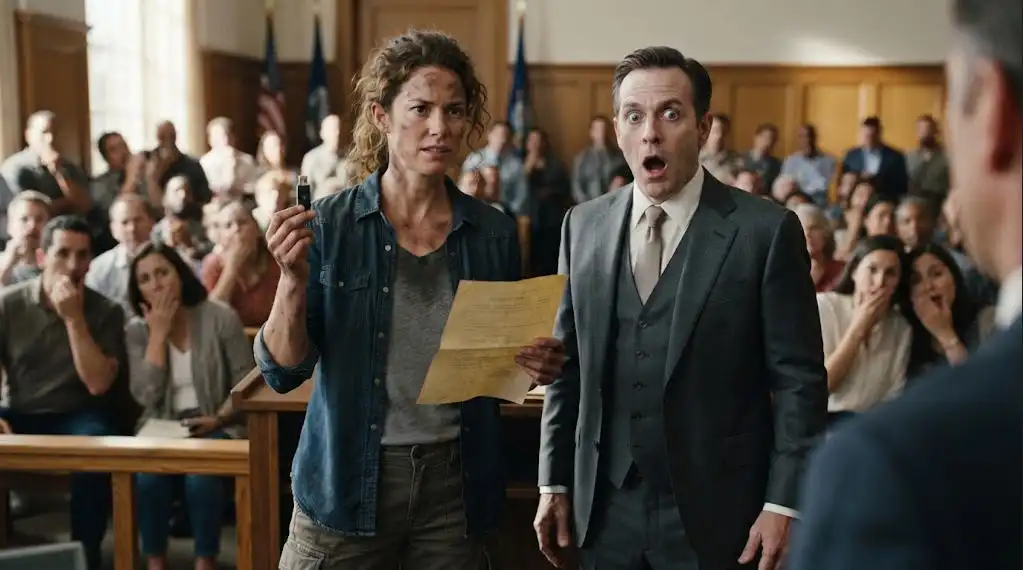
A Polished Developer Had His Men Shove a Postpartum Home Repairwoman Into the Mud. He Had NO IDEA What She Was Bringing to City Hall 😱

A Quiet Las Vegas Hotel Auditor Was DRENCHED in Red Wine by a Powerful VP in Front of Dozens of Guests. He Had NO IDEA What She’d Already Saved... 😱