
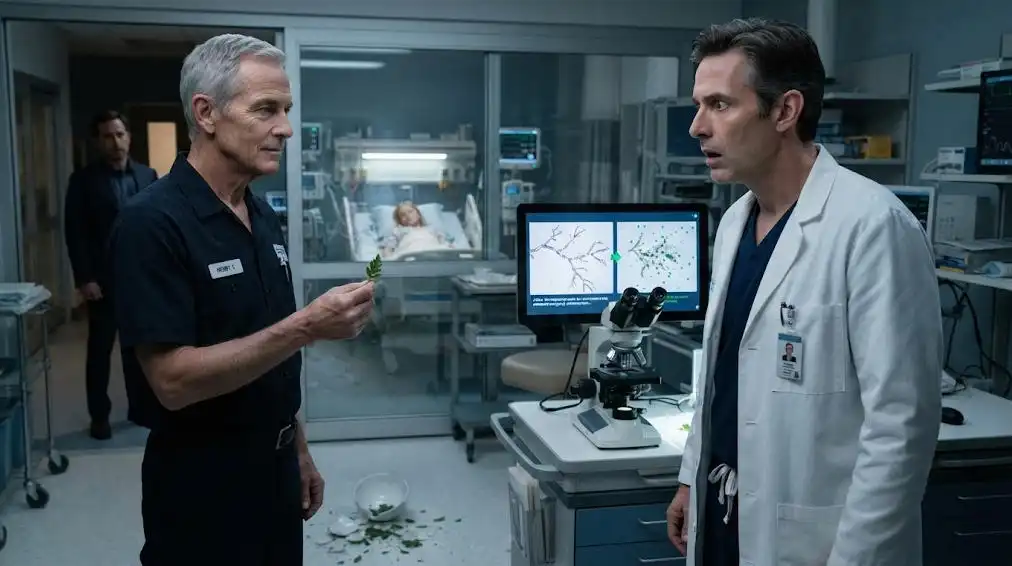
Henry looked at the father kneeling on the hospital floor.
Richard Whitmore's expensive suit was now wrinkled at the knees. His hands were trembling, and his eyes were fixed on the old man's face.
For several seconds, Henry said nothing.
Then he glanced through the glass partition at Emily.
The little girl was still lying beneath the white hospital blanket. Her chest rose and fell in short, uneven movements.
"Please," Richard repeated. "I'll give you anything. Just don't let her die."
Henry gently pulled his hand away.
"Get up, Mr. Whitmore."
Richard shook his head.
"Not until you agree to help her."
"I'll try," Henry said. "But you need to understand something. I cannot promise you what will happen."
Dr. Mercer pushed himself upright behind them.
"Absolutely not."
His voice had lost some of its earlier confidence, but his pride was still fighting to regain control.
"An experiment on a microscope slide does not establish that a substance is safe for a child. You cannot put an unidentified botanical compound into an ICU patient."
Henry turned toward him.
"For once, Doctor, you're asking the right question."
Mercer frowned.
Henry pointed toward the microscope.
"That experiment doesn't prove everything. It proves that something in her blood is responding to that leaf. Now we need to understand what is happening inside her."
Richard looked between them.
"Then tell me what is happening to my daughter."
Henry took a slow breath.
"Your daughter doesn't have the infection you've been treating."
He glanced at the diagnostic tablet.
"She has something much rarer."
For the first time since entering the room, Dr. Mercer didn't interrupt.
Henry walked toward the monitor and examined the graph again.
"Tell me exactly where she traveled before becoming sick."
Richard swallowed.
"Guyana. We were there for a conservation project. We spent four days near the rainforest. Emily came with me because she wanted to see the wildlife."
"Did she get scratched?"
Richard's expression changed.
"She brushed against a thorny plant during a walk. It was a tiny scratch on her wrist. We cleaned it immediately. It healed within a couple of days."
Henry nodded.
"When did the fever begin?"
"Four days after we returned."
"And when did the antibiotics begin?"
"Almost immediately after she was admitted."
Henry looked at Mercer.
"Did you examine the raw blood smear, or did you rely entirely on the automated bacterial analysis?"
Mercer tightened his jaw.
"The hospital uses one of the most advanced diagnostic platforms in the country."
"That wasn't my question."
Nurse Nora Bennett, who had been standing near Emily's bedside, finally spoke.
"He reviewed the automated report."
Mercer turned sharply.
"Nora."
She looked uncomfortable, but she didn't lower her eyes.
"I sent the travel history twice. I also reported that Emily's fever kept rising after the antibiotic infusions."
"When?"
"Tuesday afternoon and again yesterday morning."
Mercer stared at her.
"You told me the medication wasn't working. That doesn't mean the treatment was wrong."
"No," Nora replied. "But I also told you that her blood markers were changing in a way that didn't match the bacterial diagnosis."
Henry listened without interrupting.
Then he turned back to the doctor.
"Your machine is very good at answering the questions it was designed to answer. But it cannot recognize something it was trained to discard."
He pointed at the diagnostic graph.
"The branching structures were classified as irregular debris. The system wasn't looking for this particular organism."
Mercer shook his head.
"That's not possible. The platform screens for thousands of pathogens."
"Thousands isn't the same as everything."
Henry reached into the inside pocket of his uniform.
He pulled out a small, worn notebook.
Its cover was cracked, and the corners had softened from years of handling.
He opened it to a page filled with faded botanical sketches.
There were drawings of several leaves, fine branching structures, and a strange microscopic pattern.
Richard stepped closer.
"What is that?"
"A record from many years ago," Henry answered.
He turned the notebook toward them.
"In the old field notes, this organism was called Vespera. It was observed in a remote tropical environment. It wasn't included in the medical reference systems we have today."
Mercer looked at the sketch.
"You're telling me you've identified an organism that our entire laboratory hasn't found?"
"I'm telling you that I recognize the pattern."
Henry tapped one of the drawings.
"This organism behaves differently from ordinary bacterial infections. It attaches to iron-rich material in the bloodstream and produces substances that trigger an extreme inflammatory response."
He paused.
"The antibiotics you've been giving Emily have been removing competing microorganisms. That has allowed this particular fungus to multiply more aggressively."
Nora looked toward the infusion pump.
"That would explain the repeated spikes."
Mercer said nothing.
Henry continued.
"I've spent decades studying traditional herbal materia medica and rare botanical organisms. I encountered a similar pattern years ago. I never forgot it."
Richard stared at the notebook.
"Then you know how to stop it?"
Henry didn't answer immediately.
He looked at the broken bowl on the floor.
"The preparation I brought contained a botanical compound that appears to affect this organism. The leaf you saw under the microscope belongs to the same preparation."
He closed the notebook.
"I have one emergency pill left."
Richard's eyes widened.
"Then give it to her!"
Mercer stepped forward.
"Wait. We don't know the toxicity, interactions, or proper clinical application. He has no medical license. He has no prescription authority. We cannot pretend that one microscope demonstration answers every medical question."
Henry looked at him.
"I know I have no license. I've never claimed otherwise."
"Then you understand why this is unacceptable."
"I understand why you should be careful. I also understand that she may not have much time."
For a moment, nobody spoke.
The monitor continued its steady electronic beeping.
Then Henry addressed Richard.
"I will not make this decision for you. I cannot tell you there is no risk. You are her father. You must understand that this is an unverified emergency intervention, not an established hospital treatment."
Richard looked through the glass.
His daughter's small hand lay motionless beside the blanket.
He remembered bringing her to the rainforest.
He remembered her excitement when she saw a brightly colored bird in the trees. He remembered the little thorn scratch and how she had laughed when he insisted on cleaning it.
He had promised her that nothing bad would happen.
Now she was fighting for her life in a hospital where money had bought every available machine, specialist, and treatment.
And none of them had helped.
Richard turned back to Henry.
"I understand."
His voice was quiet but firm.
"Please help her."
Henry nodded once.
Then he looked at Mercer.
"Keep watching her. Don't leave her unattended. If you're going to call yourself her doctor, then be her doctor now."
Mercer's face tightened.
But this time he didn't argue.
He looked toward Nora.
"Keep the monitoring active. Record everything. I'll stay at the bedside."
It was the first sensible instruction he had given in hours.
Henry walked to Emily's bed.
Up close, she looked even smaller than he remembered.
Her golden hair lay across the pillow. Her lips were dry, and her breathing came in short, hurried bursts.
Henry gently touched her hand.
"Emily," he whispered.
There was no response.
He remembered the paper star she had once dropped.
He remembered how carefully she had thanked him, even though he was only the man who cleaned the floors.
He reached into his pocket and removed a small wax-paper packet.
Inside was a single dark-green herbal pill.
It was the last prepared dose he had carried.
Nora watched carefully as Henry approached the bed.
He checked that Emily could swallow with assistance. With Richard beside her and Mercer monitoring her condition, Henry gently placed the pill on her tongue and helped her take a small sip of water.
For a moment, nothing happened.
One minute passed.
Then another.
Richard stood beside the bed, his hands clenched.
"Is it working?"
Henry didn't answer.
He was watching Emily's breathing.
Mercer checked the monitor.
"Her heart rate is still elevated."
Nora adjusted her position beside the equipment.
"Her oxygen saturation hasn't improved yet."
Richard looked at Henry.
"You said it would help."
"I said I would try."
Henry's voice remained steady, but his fingers had tightened around the edge of the bed.
He knew what failure meant.
If the preparation didn't work, Emily might die.
And the man standing beside her would be blamed for bringing an unauthorized substance into a hospital.
He had no powerful friends, no medical degree, no wealthy family, and no protection against the consequences.
He had only his knowledge and the last preparation he had spent years refining.
Three minutes passed.
Emily's breathing remained rapid.
Then Nora noticed something.
"Wait."
She leaned toward the monitor.
"Look at the respiratory pattern."
Mercer moved closer.
The intervals between Emily's breaths were beginning to lengthen.
Her chest was no longer rising with the same desperate urgency.
"Check the temperature," he said.
Nora looked at the continuous core-temperature reading.
"It was 105.1 degrees."
She watched the number change.
"104.8."
Another few seconds passed.
"104.3."
Richard covered his mouth.
Mercer checked the reading again.
"Verify it."
Nora examined the equipment and confirmed that the sensor was functioning normally.
"It's accurate."
Five minutes had passed.
The fever was finally moving downward.
The monitor showed another change.
Emily's heart rate, which had been dangerously elevated, began to slow.
Henry didn't smile.
He simply watched her.
At seven minutes, Emily's breathing became noticeably more regular.
At eight minutes, the temperature reading had fallen further.
The fever had not disappeared, and the girl still needed intensive medical care. But the immediate downward spiral had stopped.
Nora looked at Henry.
"It's changing."
Mercer stared at the monitor.
For the first time, he seemed to understand the possibility that his entire diagnosis had been wrong.
At nine minutes, Emily's fingers moved.
Richard immediately reached for her hand.
"Emily?"
Her eyelids fluttered.
She opened them slightly.
Her gaze wandered across the room before settling on her father.
"Dad?"
Richard broke.
He bent over the bed and kissed her forehead.
"I'm here, sweetheart. I'm right here."
Emily blinked slowly.
Then her eyes moved toward the man standing beside her.
"Mr. Vale?"
Henry's expression softened.
"Hello, little one."
Her lips moved into the faintest smile.
"You're here."
Henry nodded.
"I told you I'd keep the hallway clean."
Emily gave a tiny, tired laugh.
Richard lowered his head over her hand, unable to hold back his tears.
The next several hours were not a miracle that could be completed with one dramatic moment.
Emily remained in intensive care.
Her doctors continued monitoring her breathing, temperature, blood markers, and organ function. The hospital laboratory repeated its observations, and the treated samples showed that the unusual organism was no longer multiplying as it had before.
The fever continued to fall.
By the following morning, the immediate danger had passed.
The hospital's specialists still had work to do. Emily needed careful observation and recovery, and the team had to make sure the infection did not return.
But she was alive.
And for the first time in days, her father could sit beside her without watching every monitor in terror.
Henry was no longer in the room.
He had quietly returned to the corridor.
He had picked up the broken ceramic pieces, collected the scattered leaves, and cleaned the green liquid from the floor.
He was pushing his cleaning cart toward the service elevator when Nora found him.
"Mr. Vale?"
He stopped.
She approached him with a different expression than before.
"I wanted to say thank you."
Henry gave a small nod.
"She's the one who needs your attention."
Nora hesitated.
"Dr. Mercer has been asking about you."
Henry continued arranging his cleaning supplies.
"What does he want?"
"I think he wants to understand how you recognized it."
Henry looked down at his hands.
"Then he should start by looking carefully at what is in front of him."
Nora smiled faintly.
"I think he has started doing that."
Dr. Mercer eventually came out of Emily's room.
His white coat was slightly wrinkled. His face looked exhausted.
He approached Henry in the corridor.
For a moment, neither man spoke.
Then Mercer said, "I was wrong."
Henry continued holding the handle of his cleaning cart.
Mercer swallowed.
"I trusted the diagnostic system. I thought the results were conclusive. I believed that because I had access to the best equipment, I couldn't be missing something so basic."
Henry looked at him.
"Equipment is useful, Doctor. Knowledge is useful. Experience is useful."
He paused.
"But none of them are worth much when you stop being willing to question yourself."
Mercer lowered his eyes.
"I should have listened."
"Yes."
"I should never have treated you that way."
Henry looked toward the ICU door.
"Emily was the one who needed help. Not me."
Mercer had no answer.
His face turned red.
He had spent years building a reputation as one of Boston's most respected specialists. He was accustomed to being listened to, obeyed, and introduced with impressive titles.
Yet the person who had recognized the danger was a man whose name most hospital employees barely knew.
Henry picked up his broom.
Before he turned away, he said:
"Medicine is about caring for the sick—not letting your title kill them."
Then he walked down the corridor.
Mercer remained standing where he was.
For the first time in his professional life, his title offered him no comfort.
The hospital launched an independent review of Emily's case.
At first, Mercer insisted that he had acted according to the information available to him.
But the records told a more complicated story.
The original diagnostic platform had clearly stated that its automated analysis was designed to evaluate specific bacterial signatures. It had not ruled out unknown fungal organisms.
Nora's timestamped notes showed that she had reported Emily's rainforest exposure and the repeated fever spikes.
The raw laboratory images also showed that unusual structures had appeared in the samples before Henry entered the room.
Mercer's signed assessment, however, had stated that an atypical fungal infection had been ruled out.
It had not.
Investigators also found that he had dismissed repeated requests for further examination because he believed the automated report had already settled the question.
The hospital temporarily removed him from patient care while the investigation proceeded.
The matter was eventually referred to the state medical licensing board.
Several months later, after an independent review and formal hearing, the board revoked Mercer's medical license.
The decision was not based simply on the fact that he had made a wrong diagnosis.
It was based on his professional negligence, misleading documentation, and failure to respond appropriately to information that should have prompted further investigation.
The news spread through the hospital.
Some people called it a disgrace.
Others said it was a necessary consequence.
Henry never commented.
He had no interest in watching another man lose his career.
He only cared that a little girl had survived.
Richard Whitmore came looking for Henry two days after Emily was transferred out of intensive care.
He found him in a service corridor, pushing a cleaning cart.
"Mr. Vale."
Henry turned.
Richard approached carrying a large envelope.
"I've been trying to find the right words."
Henry looked at the envelope.
Richard held it out.
"I want to thank you properly. Whatever amount you need, name it. A house, a lifetime allowance, a position with my foundation. Anything."
Henry didn't take it.
Richard looked confused.
"Please. You saved my daughter."
"I helped her."
"You did more than help her."
Henry returned his attention to the cleaning cart.
"I don't need your money, Mr. Whitmore."
"Then let me do something for you."
Henry considered that for a moment.
"Make sure Emily grows up knowing that people deserve respect, no matter what uniform they're wearing."
Richard's expression softened.
"I promise."
Henry nodded.
"Then that's enough."
Richard lowered the envelope.
For a man accustomed to solving problems with money, it was difficult to understand that the person standing before him wanted nothing in return.
But he finally accepted it.
He put the envelope away.
Then he extended his hand.
Henry shook it.
This time, Richard didn't look at the uniform.
He looked directly at the man wearing it.
A week later, Emily was well enough to leave the hospital.
Her recovery still required follow-up appointments, and her father made sure she received every necessary checkup.
Before leaving, she asked him to take her to the corridor where Mr. Vale worked.
Richard wheeled her small overnight bag beside him.
"Are you sure you're not tired?"
Emily shook her head.
"I want to see him."
They found Henry near the end of the hallway.
He was cleaning the glass partition outside another patient's room.
Emily stopped her father.
"That's him!"
Henry heard the small voice and turned.
For a second, he looked surprised.
Then he smiled.
"Well, look who's feeling better."
Emily approached him slowly.
"I wanted to say thank you."
Henry leaned down slightly.
"You already said that once."
"I know. But I wanted to say it again."
She held out a folded piece of paper.
Henry accepted it.
It was a little paper star.
He recognized it immediately.
It looked almost exactly like the one she had dropped days earlier, when she was still well enough to smile at him from her hospital bed.
Emily looked up.
"I made it for you."
Henry carefully unfolded the little note tucked inside.
It contained only a few words:
Thank you for not giving up on me.
He stared at it for a moment.
Then he folded it carefully and placed it in his uniform pocket.
Richard stood nearby, watching silently.
Emily stepped closer.
"Can I hug you?"
Henry lowered his broom against the wall.
"Of course."
He opened his arms.
And Emily wrapped both arms around his waist.
Several weeks later, Henry was back doing what he had always done.
The morning shift was busy.
Nurses hurried between rooms. Doctors discussed test results. Visitors moved through the polished corridors.
Henry pushed his cleaning cart slowly along the hallway, sweeping dust away from the edges of the floor.
He was passing the ICU when he heard footsteps behind him.
"Mr. Vale!"
He turned.
Emily was running toward him, her golden hair bouncing against her shoulders.
She was no longer connected to machines or lying beneath hospital blankets.
She was wearing a little blue sweater and smiling as brightly as she had the first time they met.
Henry barely had time to put down his broom before she reached him.
She threw her arms around him in a tight hug.
He gently wrapped his arms around her.
For a moment, the old janitor stood completely still, his silver head resting lightly above the little girl's golden hair.
Then he smiled.
His broom remained leaning against the wall.
And in that bright hospital corridor, the little girl who had once been too weak to open her eyes was the one holding him up.
Disclaimer: Mention of any brand or trademark is for identification only and does not imply partnership or endorsement
A Chemical Plant Guard Mocked an OVERWEIGHT Water Scientist and Smashed Her Sample Case in Public. He Had NO IDEA What She’d Already Recorded 😱
A Polished Developer Had His Men Shove a Postpartum Home Repairwoman Into the Mud. He Had NO IDEA What She Was Bringing to City Hall 😱
A Quiet Las Vegas Hotel Auditor Was DRENCHED in Red Wine by a Powerful VP in Front of Dozens of Guests. He Had NO IDEA What She’d Already Saved... 😱