

The man in the charcoal suit did not raise his voice.
He did not have to.
“Mr. Henry Whitmore,” he said again, holding out the glossy cover proof with both hands, “the new issue’s layout is ready. The board needs your final approval before print.”
For three seconds, nobody moved.
Not the servers.
Not the diners.
Not Jessica’s boyfriend, whose phone was still pointed at my face.
Not the manager, whose hand was still raised like he expected me to disappear into the kitchen like a scolded child.
And not Jessica.
She stood beside her table with an empty pasta plate in her hand, red sauce on her fingers, her mouth slightly open.
A minute earlier, she had called me a nobody.
Now the most powerful man in the room was waiting for my answer.
I wiped marinara from my eyebrow with a napkin.
Slowly.
Carefully.
Then I looked at the proof in his hand.
“Caleb,” I said, “you’re early.”
Caleb Monroe smiled faintly.
“I thought you might need witnesses.”
That was when Jessica’s boyfriend stopped laughing.
The dining room was packed that Friday afternoon. Business lunches. Tourists. A retired couple sharing tiramisu by the window. Two young servers pretending not to stare.
It was exactly the kind of room Jessica loved.
Bright.
Expensive.
Public.
Perfect for humiliation.
And that was why I had chosen it.
Three weeks earlier, my editorial assistant had dropped a folder on my desk at Metropolitan Palate Magazine and said, “Henry, you need to see this.”
I was the editor-in-chief.
For twenty-six years, I had eaten in diners, hotel kitchens, food trucks, Michelin-starred restaurants, barbecue pits, bakeries, and roadside cafés where the pie was better than anything served on white linen.
I had written about food before social media turned every dinner table into a stage.
I had watched chefs cry over one honest review.
I had watched good restaurants survive because someone finally told the truth about them.
And lately, I had watched something uglier grow.
Influencers walking into restaurants like tax collectors.
Free meals.
Free wine.
Private rooms.
Cash “collaboration fees.”
And if the owner said no?
A fake review.
A staged complaint.
A viral meltdown.
That folder on my desk had Jessica Vane’s name on it.
She was known online as “Jessica Eats First.”
Two million followers.
Perfect hair.
Perfect lighting.
Perfect outrage.
Her videos always followed the same pattern.
She walked into a restaurant.
She found something wrong.
She made staff members look small.
Then she posted the clip with a caption like:
“Should I expose them?”
Most people thought it was entertainment.
But my assistant had gathered emails from six restaurant owners.
One in Milwaukee.
Two in Nashville.
One in St. Louis.
Two in Chicago.
All small or family-owned.
All had refused Jessica’s “brand partnership fee.”
All were punished within forty-eight hours.
One owner wrote, “She told us $8,000 would make the problem go away.”
Another wrote, “Her boyfriend filmed my teenage daughter crying.”
The last email was from a widow named Maria, who owned a tiny Italian place near Oak Park.
She wrote one sentence I could not forget.
“She did not review my food. She reviewed my fear.”
That was when I stopped reading like an editor.
And started planning like a witness.
Metropolitan Palate was preparing a cover story on modern food extortion.
We had names.
Receipts.
Contracts.
Video clips.
But legal needed one thing.
A clean incident.
Fresh.
Documented.
Public.
No rumor.
No anonymous accusation.
No “he said, she said.”
Jessica had just announced she was visiting a well-known Italian restaurant on Michigan Avenue called Bellavita.
The restaurant’s owner, Luca, had quietly contacted us after Jessica’s team requested a private comped tasting plus a “reputation package.”
The price was $12,000.
In exchange, she would post three glowing videos.
If they declined, her assistant wrote, “Jessica’s audience values honesty.”
Luca was furious.
But he was also scared.
A bad viral clip could kill a restaurant faster than bad food.
So I made him a proposal.
“I’ll come in as temporary floor help,” I told him. “No one but you and your security consultant knows who I am.”
Luca stared at me.
“You? In an apron?”
“I started as a dishwasher in 1978,” I said. “An apron won’t scare me.”
Caleb Monroe, our majority shareholder and a media man who had built half the magazines in the country, agreed to arrive near the end with the physical cover proof.
Not to rescue me.
To confirm my identity in front of cameras.
Legal arranged notices for security footage.
The restaurant already had visible cameras.
The staff wore microphones for training purposes, which Jessica’s team had signed off on when they accepted the reservation policy.
Everything would be inside the rules.
No tricks.
No traps that made anyone do wrong.
Just a stage.
And Jessica was the kind of person who brought her own spotlight.
That afternoon, she arrived thirty-one minutes late.
Her boyfriend, Kyle, came in first, filming the hostess stand.
“Bellavita,” he said to the phone. “Let’s see if they live up to the hype.”
Jessica followed in a cream coat that probably cost more than most line cooks made in a month.
She did not say hello.
She scanned the room.
Then she said, “This table is ugly.”
The hostess blinked.
“It’s one of our best window tables.”
Jessica laughed.
“Best for regular people, maybe.”
The manager on duty, Brad, rushed over.
Brad was not part of the plan.
That was the problem.
Luca had wanted to use his assistant manager, a steady woman named Denise, but Brad begged for the shift when he heard Jessica was coming.
He loved attention.
He loved status.
And most of all, he loved being close to people he thought were important.
“Miss Vane,” he said, bending slightly at the waist, “we are so happy to have you.”
Jessica did not look at him.
“My followers are going to want a good experience.”
“Of course.”
“I don’t wait.”
“Of course.”
“I don’t eat cold food.”
“Never.”
“I don’t do attitude from staff.”
Brad glanced at me.
I was standing near the server station with a notepad.
Plain black apron.
White shirt.
No watch.
No title.
No power visible.
Jessica’s eyes landed on me.
“And who is that?”
Brad smiled like he was offering her a sacrifice.
“That’s Henry. He’ll take care of whatever you need.”
Kyle looked me up and down.
“This guy?”
Jessica smirked.
“He looks like he should be explaining soup at a nursing home.”
A few diners heard it.
One woman looked down at her plate, embarrassed for me.
I walked over.
“Good afternoon. Welcome to Bellavita.”
Jessica lifted her phone.
“Say it again. Smile this time.”
“I’m here to take your order.”
She tilted her head.
“Are you always this stiff, or did they bring you out of storage for lunch?”
Kyle laughed.
Brad laughed too.
That bothered me more than Jessica.
Because Jessica was performing cruelty.
Brad was volunteering for it.
“May I start you with sparkling water?” I asked.
Jessica sighed dramatically.
“Do you hear that, babe? Sparkling water. Groundbreaking.”
Kyle leaned closer and jabbed two fingers into my chest.
“Listen, old man. She’s got two million followers. Don’t embarrass yourself.”
The poke was not hard.
It was meant to show ownership.
Like I was furniture.
The room saw it.
So did the ceiling camera.
I glanced at the small black dome above the bar.
Then I looked back at Kyle.
“Please don’t touch me.”
Jessica gasped with fake delight.
“Oh, he has boundaries.”
Brad snapped, “Henry, don’t be difficult.”
There it was.
The first crack.
Not from Jessica.
From the man who was supposed to protect his staff.
I wrote nothing down.
Jessica ordered burrata, calamari, truffle risotto, and spaghetti alla chitarra with lobster.
Then she added, “And make sure the pasta is photogenic.”
“It’s food,” I said. “Not a vase.”
The retired man near the window coughed into his napkin to hide a laugh.
Jessica’s smile vanished.
“What did you say?”
“I said our kitchen focuses on taste.”
Brad moved in quickly.
“He’s joking, Miss Vane. Henry has a dry sense of humor. Too dry.”
Jessica leaned toward me.
“People like you always have little comments. That’s why you stay where you are.”
I looked at her for a long moment.
Then I said, “And where is that?”
She pointed to the floor beside her table.
“Serving me.”
That clip later became the opening line of my article.
But at that moment, I stayed quiet.
Because silence makes arrogant people comfortable.
And comfortable people reveal themselves.
Lunch went exactly the way I expected.
Jessica complained the calamari was “too beige.”
She said the burrata looked “emotionally lazy.”
She made Kyle film her cutting into the risotto and whispering, “This better not disappoint me.”
Brad hovered beside her like a nervous dog.
Every time she frowned, he apologized.
Every time she snapped her fingers, he moved.
At one point, a young server named Emily walked by with two plates for another table.
Jessica stopped her.
“Hey. Background girl.”
Emily froze.
Jessica pointed at the plates.
“Don’t walk through my shot.”
Emily’s cheeks went red.
“I’m sorry. I’m just serving table twelve.”
Jessica waved her away.
“Then serve them somewhere else.”
Brad turned to Emily.
“Go around.”
The alternate route was through the kitchen doors, past the dessert station, around the back server lane, and out again.
All so Jessica’s phone could have a clean shot.
Emily looked at me.
I gave her a small nod.
Not because it was fair.
Because the cameras were watching.
The microphones were listening.
And sometimes, to expose rot, you have to let it speak in full sentences.
Then the pasta arrived.
Spaghetti alla chitarra with lobster.
Fresh basil.
A deep red sauce.
Steam rising in thin ribbons.
It was a beautiful plate.
Jessica moved her ring light closer.
Kyle whispered, “Do the bug thing if it’s boring.”
I heard it.
So did the mic clipped under the service ledge.
Jessica glanced at him, annoyed.
“Not yet.”
I placed the dish in front of her.
“Careful, the plate is hot.”
She looked up at me.
“So is my temper.”
Kyle laughed again.
I stepped back.
Jessica twirled pasta around her fork.
She lifted it toward the camera.
Then, with her left hand, she reached into the sleeve of her cream coat.
A tiny dark speck dropped onto the rim of the plate.
Not a bug.
A burnt rosemary leaf from a little paper packet she had been carrying.
She gasped.
Loud enough for the tables by the bar.
“Oh my God.”
Kyle swung the camera closer.
“What? What is it?”
Jessica pointed.
“There is a bug in my food.”
The restaurant went still.
The chef in the open kitchen looked over.
I looked at the plate.
“That is not a bug.”
Jessica’s face hardened.
“Excuse me?”
“It appears to be a piece of burnt herb.”
She stood.
“Are you calling me a liar?”
Brad came running.
“What happened?”
Jessica turned the camera toward him.
“I found a bug in my pasta, and your employee just accused me of lying.”
Brad did not inspect the plate.
He did not ask the chef.
He did not look at me.
He looked at Jessica’s phone.
Then he pointed at me.
“Apologize.”
I said, “No.”
A sound moved through the room.
Small.
Sharp.
Like everyone inhaled at once.
Brad stepped closer.
“You apologize to Miss Vane right now, or you can leave through the back door.”
Jessica smiled.
That smile told me everything.
She did not care whether the food had a bug.
She cared whether I could be made to bow.
Kyle zoomed in on my face.
“Get this,” he said. “Old guy is about to lose his job.”
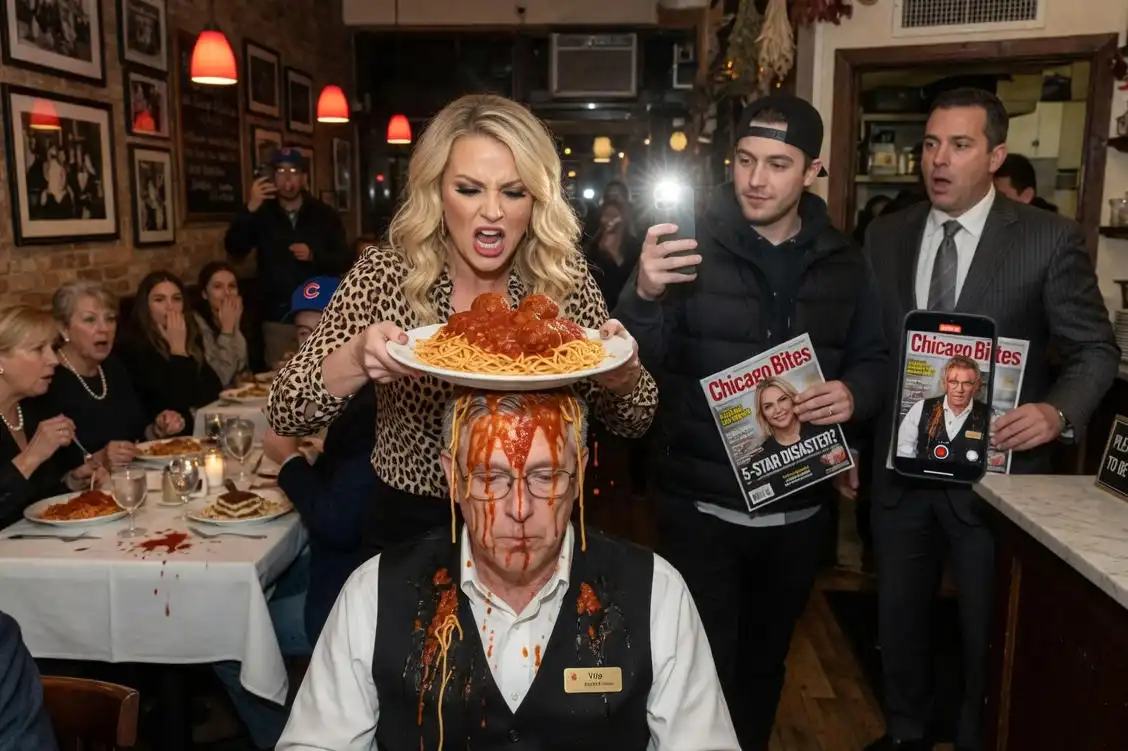
Jessica picked up the plate.
For half a second, even Brad looked uncertain.
Then she tipped it.
The pasta slid over my head.
Hot sauce down my hair.
Lobster over my shoulder.
Noodles across my apron.
A woman at table nine whispered, “Oh my Lord.”
Kyle burst out laughing.
Jessica shouted, “That’s what happens when you disrespect customers!”
Brad grabbed my arm.
Not gently.
“Back kitchen. Now.”
I looked down at his hand.
Then at Jessica.
Then at Kyle’s phone.
Then at the camera dome above the bar.
I had sauce in my left eye.
My collar was soaked.
My pride was not.
“I’ll stay here,” I said.
Brad’s face twisted.
“You are making this worse.”
“No,” I said. “I think it’s finally clear.”
Jessica rolled her eyes.
“Clear? You’re covered in lunch.”
Some of the diners laughed nervously.
Others looked angry now.
A man near the bar had his phone out.
A woman in a navy blazer was recording too.
The public pressure Jessica created was beginning to turn.
But she did not know it yet.
People like her often mistake silence for weakness.
They never consider that silence can be documentation.
That was when the front door opened.
Caleb Monroe stepped inside.
Charcoal suit.
Silver hair.
No expression except quiet authority.
He carried a black portfolio and a glossy printed sheet.
Brad saw him first.
His hand dropped from my arm.
The blood drained from his face.
He knew Caleb.
Anyone in Chicago media knew Caleb.
Restaurant people knew him too, because one favorable feature in one of his publications could fill tables for a year.
Caleb walked past the hostess.
Past Brad.
Past Jessica.
Past Kyle’s camera.
Straight to me.
“Mr. Henry Whitmore,” he said, “the new issue’s cover layout is ready. The board needs your final approval before print.”
Jessica blinked.
Kyle lowered the phone an inch.
Brad whispered, “Mr… Whitmore?”
I took the proof.
On the cover was a clean, bold headline:
THE PRICE OF A GOOD REVIEW
Under it was a photo illustration of a gold fork bent into the shape of a hook.
Jessica saw it.
Her eyes moved from the headline to my face.
Then back to the headline.
“No,” she said softly.
Caleb looked at her for the first time.
“Yes.”
I wiped my face again.
This time I used Brad’s folded pocket square from the manager stand.
He did not object.
“Jessica Vane,” I said, “my name is Henry Whitmore. I’m editor-in-chief of Metropolitan Palate.”
The room erupted in whispers.
“The magazine?”
“That Henry Whitmore?”
“Oh my God.”
Kyle muttered, “Stop filming.”
But his phone was still recording.
Jessica reached for it.
“Turn it off.”
I raised my hand.
“No. Let it run.”
Her voice sharpened.
“You set me up.”
“No,” I said. “You ordered lunch. You insulted staff. Your boyfriend touched me. You planted debris on a plate. Your manager friend ignored it. Then you assaulted a worker with a hot dish in a public restaurant while filming it for profit.”
Brad stammered, “I didn’t know—”
I turned to him.
“You knew enough to choose her camera over your employee.”
His mouth snapped shut.
Luca, the owner, came out from the kitchen then.
He had been watching from the office feed.
His face was pale with anger.
“Brad,” he said, “give me your keys.”
Brad looked like he had been slapped.
“Luca, I was trying to protect the restaurant.”
Luca’s voice shook.
“You protected a bully.”
Brad held out his keys.
The little metal ring clattered into Luca’s palm.
Jessica tried to gather herself.
She had built her career on outrage, so she reached for it again.
“This is harassment. I’m going live. My followers will destroy this place.”
Caleb opened the portfolio.
Inside were printed emails.
Not one.
Not two.
Dozens.
“Before you do that,” he said, “you may want to know that your agency sent a written proposal to this restaurant asking for twelve thousand dollars in exchange for positive coverage.”
Jessica’s face changed.
The room felt it.
She was no longer angry.
She was calculating.
“That’s standard brand work,” she said.
I nodded.
“Paid partnerships are legal when disclosed. Threatening reputational harm after a business refuses payment is something else.”
Kyle took a step back.
Jessica snapped, “Don’t say anything.”
Too late.
The retired man near the window said, “Did she say twelve thousand?”
A server whispered, “For pasta?”
Caleb placed another document on the table.
“And this,” he said, “is a signed reservation agreement acknowledging visible security recording and staff training audio in public dining areas.”
Jessica looked at Brad.
Brad looked at the floor.
I said, “You agreed to it when your assistant confirmed the table.”
Her voice dropped.
“You can’t use that.”
“Our legal team believes we can,” I said. “Especially after your team filmed our staff and repeatedly stated the footage was intended for publication.”
Jessica swallowed.
For the first time all afternoon, she looked smaller than the room.
Kyle tried to slide toward the door.
Caleb said, “Mr. Reed, I wouldn’t leave yet.”
Kyle froze.
“We have your voice on audio saying, ‘Do the bug thing if it’s boring.’”
The woman in the navy blazer gasped.
Jessica spun on Kyle.
“You idiot.”
Kyle pointed at her.
“You told me to say stuff like that because it makes the clips better.”
And there it was.
The thing about lies is that they are loyal only until consequences arrive.
Then everyone starts saving themselves.
Luca looked at me.
“Henry, what do you want done?”
I looked around the dining room.
At Emily, still holding back tears by the service station.
At the chef gripping the edge of the pass.
At the diners who had watched a man in an apron be treated like a prop.
Then I looked at Jessica.
“I want the bill paid,” I said.
Her head jerked back.
“That’s it?”
“No,” I said. “That’s lunch.”
A few people laughed.
Not loudly.
But enough.
Then I said, “After that, the law can handle the rest.”
Caleb handed me a towel.
“The publisher is prepared to support the restaurant’s claim.”
Jessica’s voice rose.
“Claim for what?”
“Defamation,” Caleb said. “Commercial disparagement. Damage to business reputation if you publish false allegations. And assault, if Mr. Whitmore chooses to pursue it.”
“I didn’t assault him,” she said.
I looked down at my sauce-covered shirt.
Jessica looked too.
Then she stopped talking.
The police were not called for a dramatic arrest.
That is not how real consequences usually work.
Real consequences come in emails.
Letters.
Deadlines.
Canceled contracts.
Quiet phone calls from sponsors who suddenly “need to pause the relationship.”
Luca asked Jessica and Kyle to leave after they paid the bill.
They tried to refuse.
Then he reminded them that the entire dining room had witnessed the incident.
Jessica threw a credit card onto the table with trembling fingers.
Kyle kept whispering, “This is bad. This is really bad.”
Brad stood near the host stand, unemployed before dessert.
Emily brought me a clean towel.
“I’m so sorry,” she said.
I smiled at her.
“You didn’t do it.”
“I should’ve said something.”
“You were working,” I said. “That’s why people in power have a duty to speak first.”
She nodded, but her eyes were wet.
Jessica walked past us toward the door.
Her coat was still perfect.
Her face was not.
At the entrance, she turned back.
“You think you won?” she said.
I looked at the sauce-stained apron in my hands.
“No,” I said. “I think everyone finally saw.”
She left without another word.
The article published the following Tuesday.
Not that night.
Not as revenge.
Not as a messy social media rant.
We took forty-eight hours to verify every document again.
Legal reviewed the footage.
The restaurants quoted in the piece approved their statements.
Two former assistants from Jessica’s own team came forward.
One said she kept a list of “pressure targets.”
Another shared a spreadsheet with restaurant names, requested payments, follower counts, and “pain points.”
Pain points.
That was the phrase that stayed with me.
Not cuisine.
Not service.
Not safety.
Pain.
She had turned small business fear into a business model.
The headline ran across the front page of our digital edition:
WHEN REVIEWS BECOME RANSOM
By Henry Whitmore
The first paragraph did not mention me.
It mentioned Maria, the widow from Oak Park, who had lost almost half her weekend reservations after Jessica posted a staged “dirty kitchen” clip from an angle that showed a mop bucket beside a delivery door.
The second paragraph mentioned the chef in Nashville who paid $5,000 he could not afford because his daughter’s college tuition depended on the restaurant surviving.
The third paragraph mentioned Bellavita.
And only then did it describe a plate of spaghetti landing on the head of a man Jessica believed had no power.
We embedded no humiliating close-up of her crying.
No cheap music.
No mocking edits.
Just the raw facts.
Her own words.
Kyle’s voice.
The planted debris.
The manager’s demand that I apologize.
The reservation agreement.
The payment proposal.
The witness statements.
Truth does not need filters.
By noon, sponsors began deleting posts featuring Jessica.
By evening, three food brands announced they were ending partnerships.
By Wednesday morning, her agency released a statement saying they had “parted ways.”
By Friday, her page was still online, but comments were turned off.
That is when the lawsuit landed.
Bellavita filed a defamation and business interference claim.
Two other restaurants joined separate actions.
Metropolitan Palate did not sue her.
We did not need to.
We published.
That was enough.
Brad sent Luca a long apology.
Luca forwarded it to me.
It said Brad had “panicked under pressure.”
Maybe he had.
But pressure reveals priorities.
He had looked at a famous woman with a camera and a quiet man in an apron and decided only one of them mattered.
Luca did not rehire him.
Instead, he promoted Denise.
The first thing Denise did was add a staff policy: no employee had to endure physical contact, filming, or verbal abuse to protect a customer’s ego.
She printed it and taped it inside the employee entrance.
Emily sent me a photo.
Under the policy, someone had written in marker:
RESPECT IS PART OF SERVICE.
I kept that photo.
Three months later, I was driving outside Indianapolis for a feature on family-owned diners when I stopped at a fast-food restaurant for coffee.
It was raining.
The kind of gray highway rain that makes every window look tired.
I walked in, ordered black coffee, and heard a familiar voice from behind the fryer.
“Order up.”
I turned.
Jessica was wearing a visor and a name tag.
Her hair was pulled back.
No ring light.
No cream coat.
No boyfriend.
She was standing over a basket of fries, face shiny from the heat.
For a second, she did not recognize me.
Then she did.
Her shoulders stiffened.
I expected anger.
A threat.
A performance.
Instead, she looked down at the fryer.
“Medium fries,” she called.
I waited by the counter.
A young cashier handed me my coffee.
Jessica avoided my eyes.
I could have left.
Maybe I should have.
But I walked closer.
Not to shame her.
I had seen enough public humiliation to know it rarely improves anyone.
“Jessica,” I said.
She kept her hand on the fryer basket.
“What?”
“How are you?”
She laughed once, without humor.
“Seriously?”
“Yes.”
She looked at me then.
There was no mascara-perfect outrage in her face now.
Just exhaustion.
“I’m paying lawyers,” she said. “I sold my condo. Kyle bailed. My sponsors vanished. People still recognize me.”
I said nothing.
She nodded toward the fryer.
“Turns out fries don’t care how many followers you have.”
I almost smiled.
But I didn’t.
She looked at the floor.
“I hated you for a while.”
“I assumed.”
“Then I watched the video.”
“That must have been difficult.”
She wiped her hand on a towel.
“I didn’t look powerful. I looked cruel.”
That was the first honest thing I had ever heard her say.
I took a sip of coffee.
“Cruelty often feels like power from the inside.”
She stared at me.
“Are you going to write about this too?”
“No.”
“Why not?”
“Because this is not a story about food media,” I said. “This is just a person working a hard job.”
Her mouth tightened.
For one moment, I thought she might cry.
Then she looked away.
“I’m sorry,” she said.
It was quiet.
No camera.
No witnesses except a teenage cashier pretending not to listen.
No applause.
No viral moment.
Just two words.
I believed she meant them.
That did not erase what she had done.
An apology is not a refund.
It is not a legal defense.
It is not a magic cloth that wipes sauce from someone’s face months later.
But it can be a beginning.
“I hope you learn from it,” I said.
She nodded.
“I am.”
Then she lifted the fryer basket and salted the fries.
Carefully.
Like the work deserved attention.
I drove back into the rain thinking about dignity.
Not the loud kind.
Not the kind rich people wear into restaurants.
Not the kind influencers perform for followers.
Real dignity is quieter.
It is the server who keeps moving after being insulted.
The owner who refuses to pay a bully.
The young employee who learns she deserves protection.
The diner who records not for gossip, but because truth may need a witness.
And sometimes, it is a fallen person standing over a fryer, finally understanding that work does not make someone small.
How you treat workers does.
Two weeks after that, Metropolitan Palate ran a follow-up.
Not about Jessica.
About Bellavita.
The headline was simple:
THE RESTAURANT THAT CHOSE ITS STAFF
Reservations filled for six months.
Maria from Oak Park received enough donations and new customers to hire two more people.
The Nashville chef wrote me a note saying his daughter was staying in school.
Emily was promoted to floor captain.
Luca kept the stained apron in a frame near the employee hallway.
I told him that was dramatic.
He said, “So was the pasta.”
Fair enough.
On the night Bellavita reopened after a small renovation, Luca invited me for dinner.
I wore a jacket this time.
No apron.
Denise greeted me at the door.
“Your table is ready, Mr. Whitmore.”
I looked across the dining room.
Busy tables.
Warm lights.
Servers laughing.
No one snapping their fingers.
No one filming someone’s fear for content.
Emily came by with menus.
“You know,” she said, “people ask about you.”
I sighed.
“I was afraid of that.”
“They ask if the pasta is still good.”
“And what do you tell them?”
She grinned.
“I tell them it’s better on a plate.”
We laughed.
Then Luca sent out spaghetti alla chitarra with lobster.
The same dish.
Same basil.
Same sauce.
This time, I ate it slowly.
It was excellent.
At the end of the meal, Caleb called.
“Did you approve the final cover?” he asked.
“I did.”
“And?”
“It needed less shine.”
He laughed.
“You always say that.”
“Because shine is not substance.”
I hung up and looked around the restaurant again.
That was the lesson Jessica had missed.
Attention is not respect.
Fear is not influence.
A camera is not character.
And a person in an apron may be carrying more power, more history, and more patience than anyone in the room can see.
So here is where I stand.
Jessica deserved consequences.
Brad deserved to lose his job.
Luca deserved to have his restaurant protected.
Emily deserved a workplace where dignity came before clout.
And every worker in America deserves to know this:
The customer is not always right.
Sometimes the customer is just loud.
Sometimes the worker is the only honest person in the room.
And sometimes karma does not storm in shouting.
Sometimes it walks through the front door in a charcoal suit, holding a magazine cover, and says your real name out loud. ⚖️
Choose your side and share it: Team “Henry waited for the perfect moment” or Team “He should have exposed her sooner.”
Disclaimer: Mention of any brand or trademark is for identification only and does not imply partnership or endorsement
The Tavern Owner Set A Trap To Make Paul Drink Again… But He Had NO IDEA The Entire Town Was Watching 👀
They Laughed When Mark Announced He Was Running for Office… Then One Sealed Envelope Made the Whole Room Go Silent 😳

My Stepdaughter Thought Her Real Father Paid for Her Golf Club Wedding… Then I Showed the Guests the Letter He Sent Me