
The woman’s voice cut through the lobby like a knife through silk.
“Mr. Whitmore… should this restaurant keep its stars?”
For one second, nobody moved.
Not Tiffany.
Not the doorman.
Not the lobby manager who had watched the whole thing happen like Samuel was a stain on his expensive marble floor.
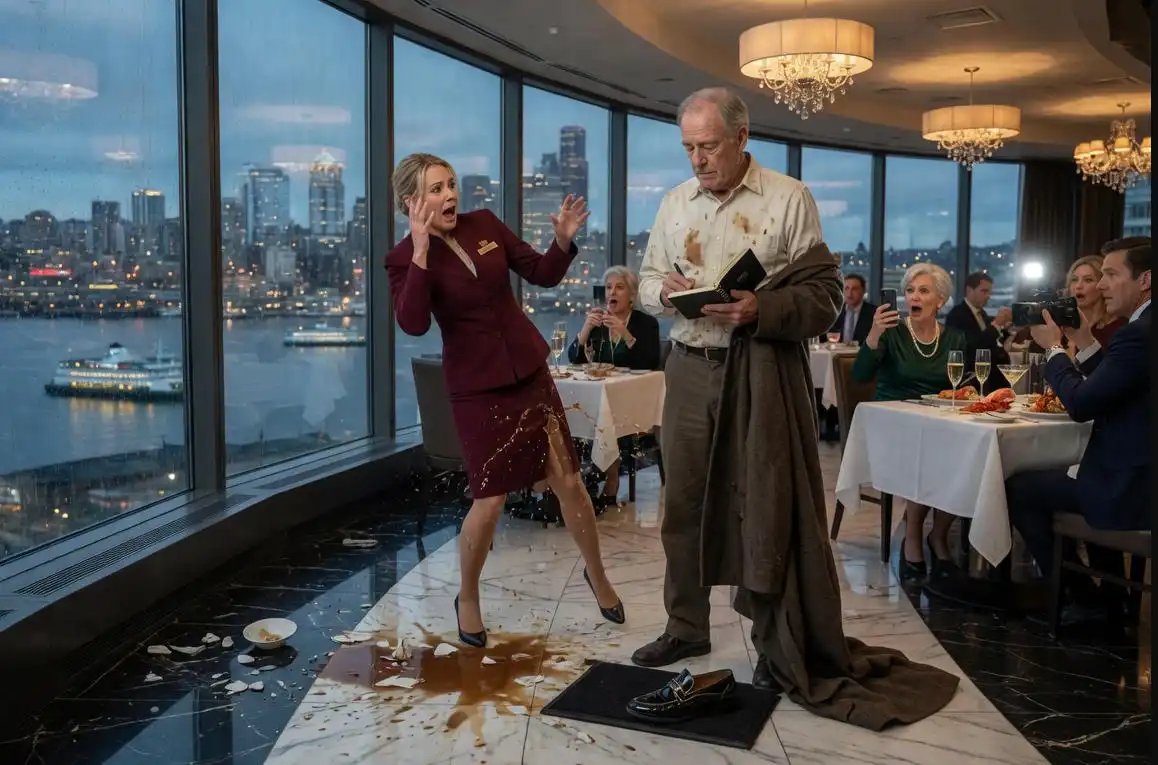
Samuel Whitmore only lowered his eyes to the coffee spreading across his shirt, then to the old coat lying under the doorman’s polished shoe.
He still didn’t raise his voice.
That somehow made it worse.
Because powerful men who shout can be dismissed as angry.
Powerful men who stay calm make rooms go cold.
The woman who had just entered was Elaine Porter, Global Director of Guest Standards for the Michelin Guide’s international inspection program. She was small, silver-haired, and dressed in a navy suit that probably cost more than Tiffany’s monthly rent.
The restaurant owner, Vincent Calder, rushed out from behind the private elevator with his hands already shaking.
“Ms. Porter,” he said. “Mr. Whitmore. There must be some kind of misunderstanding.”
Samuel looked at him.
“A misunderstanding?” he asked softly.
Vincent’s face twitched.
Tiffany suddenly found her voice.
“He came in looking confused,” she said quickly. “He was wandering near the high-tier dining area. I was protecting the guest experience.”
The doorman lifted his foot off the coat.
Too late.
The sleeve had a black heel print across it.
Samuel picked it up slowly and brushed it once.
Not because it helped.
Because everyone was watching.
And everyone understood the insult.
The restaurant was called Aurelia.
It sat at the top of a glass tower in downtown Seattle, turning slowly over the city like a crown. On a clear night, diners could see the Space Needle, Elliott Bay, and the glittering lights of ferries moving like stars on the water.
People came there for anniversaries, proposals, business deals, and the privilege of telling their friends they had eaten where ordinary people could not afford to breathe.
Aurelia did not sell dinner.
It sold status.
That was exactly why Tiffany loved working the front desk.
She loved deciding who belonged.
She loved the tiny pause before saying, “We’re fully committed tonight.”
She loved watching people shrink.
Tiffany had a way of looking at a person’s shoes before she looked at their face.
That evening, Samuel’s shoes told her everything she thought she needed to know.
Scuffed brown leather.
Old soles.
No designer logo.
His coat was clean but worn thin at the elbows. His hair was gray and slightly windblown. His small notebook had a cracked black cover, the kind a retired schoolteacher might carry.
He had entered through the main doors alone.
No chauffeur.
No assistant.
No expensive watch.
No visible power.
So Tiffany decided he was nobody.
And in that place, nobody was treated worse than a customer who looked like he might ask for tap water.
“Sir,” she had said when he approached the host stand, “are you looking for the hotel lobby? This is a private dining level.”
Samuel had smiled.
“I’m looking for Aurelia.”
“You found it,” she said. “Unfortunately, we are not taking walk-ins.”
“I have a reservation.”
“Name?”
“Whitmore.”
Tiffany tapped her screen with one long red fingernail.
She didn’t really look.
“No reservation.”
Samuel waited.
“Could you check again?”
She leaned closer, lowering her voice just enough to sound polite and cruel at the same time.
“Sir, our tasting menu starts at three hundred dollars before wine. I don’t want you to embarrass yourself.”
Behind Samuel, the doorman chuckled.
His name was Marcus, and he had spent the last six months pretending a borrowed suit made him royalty.
The lobby manager, Darren, stood near the bar with a tablet in his hand.
He heard every word.
He looked up once.
Then he looked away.
That was the first thing Samuel wrote in his notebook.
Not Tiffany’s insult.
Darren’s silence.
Because in a restaurant, bad service can be one person.
A culture is what the manager allows.
Samuel said, “I’m not embarrassed.”
Tiffany’s smile hardened.
“Well, you should be.”
A couple waiting near the window turned to look.
A businessman at the bar lowered his drink.
Someone whispered, “Oh my God.”
Samuel simply asked, “May I speak to a manager?”
That was when Tiffany decided to make it public.
“Darren,” she called, loud enough for the lobby to hear. “This gentleman is refusing to leave the premium reception area.”
Darren approached with slow, bored steps.
He looked at Samuel the same way Tiffany had.
Shoes first.
Coat second.
Face last.
“Sir,” Darren said, “we maintain a certain atmosphere here.”
Samuel nodded.
“And I disturb it?”
Darren gave a thin smile.
“I think you understand.”
Samuel didn’t move.
“I understand more than you think.”
Tiffany laughed.
That laugh was the sound that turned several heads.
It was not a nervous laugh.
It was a performance.
She wanted witnesses.
She wanted the room to know that she had power.
Then Marcus the doorman reached for Samuel’s coat, which Samuel had folded over the back of a lobby chair while checking his notebook.
“Guests only,” Marcus said.
Samuel turned.
“Please don’t touch that.”
Marcus picked it up anyway.
“Relax, grandpa.”
The room went quiet.
He let the coat fall.
Right onto the marble floor.
Then he stepped on the sleeve.
“Oops.”
A woman near the elevator gasped.
A young waiter froze with a tray of champagne.
Darren saw it.
He did not correct Marcus.
Instead, he said, “Sir, if you continue causing a disturbance, we’ll have you removed.”
Samuel crouched to pick up the coat.
That was when Tiffany made the mistake that ended Aurelia.
She grabbed a cup of coffee from the service counter.
It was meant for a guest waiting near the bar.
She thrust it toward Samuel with a sharp, angry motion, as if trying to force it into his hands.
The lid popped loose.
Hot coffee splashed across his shirt and coat.
Samuel inhaled sharply.
The lobby reacted all at once.
“Oh!”
“Did she just—?”
“Someone record that.”
Tiffany stepped back, eyes wide for half a second.
Then pride took over.
“Now you’re a safety issue,” she snapped. “Leave the fine dining area before I call security.”
Samuel looked at the coffee stain.
Then at the ceiling camera.
Then at Darren.
Then at Tiffany.
“Is that how you treat every guest who looks poor?”
Tiffany crossed her arms.
“That’s how we protect our standards.”
Samuel wrote that sentence down.
Word for word.
“What are you writing?” Darren asked.
“A pattern,” Samuel said.
Tiffany snorted.
“You can write all the complaints you want. People like you don’t get us in trouble.”
That was the second sentence Samuel wrote down.
People like you don’t get us in trouble.
The problem was, Samuel Whitmore had built his entire career on getting restaurants in trouble.
Quietly.
Legally.
Completely.
For thirty-two years, Samuel had worked as one of the most feared anonymous inspectors in fine dining.
He had eaten alone in Paris, Tokyo, Chicago, Madrid, New York, and tiny coastal towns where a cook with burned hands could make a soup that felt like prayer.
He had seen arrogance before.
He had seen sloppy service, cold food, inflated menus, and chefs who cared more about cameras than flavor.
But nothing ruined a dining room faster than cruelty.
Aurelia was not being visited for an ordinary meal.
It was under a special final review.
The restaurant had spent months boasting that it was “on the edge of global recognition.” Its owner, Vincent Calder, had given interviews suggesting Aurelia was about to become the Pacific Northwest’s next serious luxury dining destination.
Investors had poured money into a planned second location in Los Angeles.
Private members had prepaid for annual dining access.
A documentary crew had been scheduled to film the chef the following week.
And the staff had been warned that Michelin representatives might appear anytime.
What they had not been told was the most important rule:
They would not arrive looking like Michelin representatives.
That night, Samuel had arrived first.
Elaine Porter was scheduled to enter ten minutes later.
Together, they were conducting what the Guide called a “threshold inspection,” a final cultural and service assessment before a restaurant could be granted a rare public designation.
Food mattered.
Consistency mattered.
Technique mattered.
But hospitality mattered too.
Especially when a restaurant claimed excellence.
A restaurant that only serves the wealthy well is not excellent.
It is obedient.
Samuel did not reveal any of this.
Not when Marcus stepped on his coat.
Not when Tiffany mocked him.
Not when Darren threatened him.
Not even when the coffee burned through his shirt.
He only collected evidence.
Because the strongest revenge in the world is not rage.
It is documentation.
Elaine Porter had been watching from outside the glass doors for part of the incident.
So had the Guide’s regional legal liaison, who sat quietly in the lobby café one floor below with access to the building’s security feed.
That was why Elaine entered at exactly the worst possible moment for Tiffany.
“Mr. Whitmore,” she said again, “should this restaurant keep its stars?”
The word stars hit the room like a dropped plate.
A man at the bar whispered, “Stars?”
Tiffany’s face drained.
Darren looked at Samuel’s notebook as if it had become a loaded weapon.
Vincent Calder swallowed hard.
“Elaine,” he said, suddenly using her first name like they were friends. “Please. Let’s discuss this privately.”
“No,” Elaine said.
That one word was enough to make several diners stop pretending not to listen.
Elaine looked at Samuel’s shirt.
“Were you burned?”
“A little.”
“Did anyone offer medical assistance?”
Samuel looked at Darren.
“No.”
Elaine turned to Tiffany.
“Did you spill coffee on this guest?”
Tiffany’s mouth opened.
Closed.
Opened again.
“It was an accident.”
Samuel said, “She told me I had become a safety problem and should leave before she called security.”
Elaine’s eyes did not blink.
“After spilling the coffee?”
“Yes.”
Darren stepped in.
“Ms. Porter, we were trying to manage a disruptive situation.”
Elaine turned slowly.
“What was disruptive?”
Darren’s confidence slipped.
“He was refusing to leave.”
“Why was he asked to leave?”
“He didn’t appear to have—”
Elaine’s eyebrows lifted.
“To have what?”
Darren stopped.
The lobby was so quiet now that the rotating floor’s soft mechanical hum could be heard under the music.
Vincent tried again.
“Samuel, surely this can be resolved. We can cover cleaning, medical expenses, anything. Tiffany is young. She made a judgment call.”
Samuel finally looked at Vincent fully.
“That is the problem.”
Vincent blinked.
“What is?”
Samuel lifted the stained coat.
“She felt allowed to make that judgment.”
A waiter near the champagne station lowered his head.
Because he knew it was true.
Everyone who worked there knew.
Tiffany had not become cruel in one night.
Marcus had not stepped on a guest’s coat because he had one bad moment.
Darren had not ignored humiliation by accident.
Aurelia had trained its staff to worship wealth.
Not service.
Vincent looked around and realized half the lobby was recording.
His face changed.
Not with shame.
With calculation.
“Tiffany,” he said sharply, “apologize.”
Tiffany turned to Samuel with tears suddenly shining in her eyes.
The tears arrived only after the word stars.
“I’m sorry,” she whispered.
Samuel said nothing.
Darren forced a tight smile.
“We all regret the misunderstanding.”
Elaine reached into her bag and removed a slim folder.
“No, Mr. Cole,” she said to Darren. “You regret the witness list.”
Darren went pale.
She opened the folder.
“Before Mr. Whitmore entered, your staff refused entry to a retired veteran and his wife because he was wearing orthopedic shoes. Last month, three separate complaints described guests being moved away from window seating after staff assumed they would not order wine. Two weeks ago, a kitchen porter reported that front staff used the phrase ‘bus people’ for guests arriving by public transit.”
Tiffany whispered, “Who told you that?”
A young waiter in the corner looked up.
His name was Luis.
He had been working double shifts to pay for his mother’s medication.
He had reported it anonymously.
He had expected nothing to happen.
Now the whole room knew someone had finally listened.
Elaine continued.
“Tonight was not a misunderstanding. It was confirmation.”
Vincent’s hands curled into fists.
“Tiffany,” he hissed. “What have you done?”
Tiffany snapped back, “Me? Darren told us to filter the lobby. He said high-value guests don’t want to sit near—”
Darren shouted, “Be quiet.”
Too late.
The room heard it.
The phones caught it.
Samuel turned one page in his notebook.
Elaine looked at Vincent.
“Did management instruct staff to filter guests by appearance?”
Vincent’s mouth moved but produced no words.
Darren pointed at Tiffany.
“She took it too far.”
Tiffany pointed at Marcus.
“He threw the coat.”
Marcus pointed at Darren.
“He said to make him leave.”
That was the moment their little kingdom collapsed.
Not because Samuel shouted.
Because guilty people started saving themselves.
One by one.
In public.
Aurelia’s wealthy guests had come to watch a skyline.
Instead, they watched a restaurant expose its own soul.
Elaine closed the folder.
“Mr. Whitmore?”
Samuel looked around the lobby.
At the diners recording.
At the young waiter holding his breath.
At the owner sweating through his collar.
At Tiffany, who had looked at his coat and decided his dignity was optional.
Then he looked at Elaine.
“No,” he said.
The word was soft.
Final.
“No, this restaurant should not keep its stars.”
Vincent made a sound like the air had been knocked out of him.
Elaine nodded once.
“Effective immediately, Aurelia’s pending recognition is withdrawn. Its current Guide listing will be suspended pending public review. All promotional use of Michelin affiliation must cease today.”
Vincent staggered back.
“You can’t do that in the lobby.”
Elaine’s expression did not change.
“We can do it wherever the evidence is collected.”
Then she turned to the regional liaison, who had stepped in quietly near the doors.
“Notify legal.”
He nodded.
“Already prepared.”
That was when Vincent lost control.
He turned toward Tiffany with a face red enough to frighten people.
“You stupid woman,” he barked. “Do you know what you cost me?”
He raised his hand.
Security moved instantly.
Samuel stepped forward.
“Don’t.”
Vincent froze.
The room froze with him.
Samuel’s voice was calm, but there was iron under it.
“You are not going to turn your failure into another public humiliation.”
Vincent lowered his hand.
But cameras had already caught enough.
The owner of Aurelia, screaming at his staff after losing the recognition he had built his entire future around.
Within an hour, clips were everywhere.
A hostess splashing coffee on an elderly man.
A doorman stepping on his coat.
A manager standing by.
A director asking the question that ended everything.
By midnight, “Seattle restaurant old coat” was trending locally.
By morning, every reservation for the next week had been canceled.
By noon, investors requested an emergency meeting.
By Friday, the documentary crew pulled out.
By the following Monday, Vincent Calder announced “temporary restructuring.”
Everyone knew what that meant.
Aurelia was bleeding.
But the public scandal was only the beginning.
Elaine’s office sent formal notice to every partner, sponsor, and investor who had been shown promotional material implying Michelin recognition was guaranteed.
That was the legal hammer.
Aurelia had not merely been rude.
It had marketed prestige it had not earned.
It had sold private memberships on the promise of a status that was still under review.
It had implied a relationship that was not final.
And now the final review had produced documented evidence of discrimination, unsafe conduct, and hostile service practices.
The prepaid members demanded refunds.
The investors alleged misrepresentation.
The insurance carrier opened a review after Samuel filed a medical incident report for the coffee burn.
Not a dramatic lawsuit.
Not a revenge fantasy.
Paperwork.
Contracts.
Emails.
Camera footage.
Witness statements.
The boring things that destroy arrogant people because they cannot be laughed off.
Tiffany was fired the next morning.
Darren was fired by lunch.
Marcus was fired before dinner service.
Vincent tried to appear on a local business podcast and claim the whole thing had been “edited out of context.”
The host played the clip of Tiffany saying, “People like you don’t get us in trouble.”
The interview ended early.
Aurelia tried to reopen with a new “hospitality values” statement taped to the front door.
Nobody believed it.
The windows that once framed Seattle’s glittering skyline became mirrors for empty tables.
The kitchen staff left first.
Good cooks can find work.
Bad owners cannot find trust.
Three months later, Aurelia closed.
The rotating restaurant that once looked down on the city went dark.
A paper sign appeared on the door.
LEASE AVAILABLE.
Samuel heard about the closure from Elaine while sitting in a small diner near Pike Place Market.
Not a luxury restaurant.
No velvet chairs.
No wine list longer than a Bible.
Just coffee, eggs, and a waitress named Marcy who called everyone “hon” whether they were rich or broke.
Elaine slid into the booth across from him.
“You were kinder than I expected,” she said.
Samuel stirred his coffee.
“I stopped Vincent from hitting her.”
“You also refused to recommend legal escalation beyond the evidence.”
“I recommended exactly what the evidence supported.”
Elaine smiled faintly.
“That is not the same as revenge.”
“No,” Samuel said. “It’s better.”
Marcy came by with the pot.
“Warm you up, hon?”
Samuel smiled.
“Yes, please.”
She filled his cup without checking his shoes.
That mattered more than most people understood.
Six weeks after Aurelia closed, Samuel saw Tiffany again.
He had gone to a grocery store outside the city to buy apples and tea.
There she was at register four.
Hair tied back.
No designer blazer.
No host stand.
No velvet rope.
Just a name tag and tired eyes.
For a moment, she didn’t recognize him.
Then she did.
Her hand froze on a carton of milk.
The color left her face the same way it had in the lobby.
“Mr. Whitmore,” she whispered.
The customer behind Samuel looked up.
Samuel placed his basket on the belt.
“Hello, Tiffany.”
She scanned the tea.
Then the apples.
Her fingers trembled.
“I didn’t know,” she said.
Samuel watched her carefully.
“That I mattered?”
Her eyes filled.
“No.” She swallowed. “That I had become that kind of person.”
Samuel said nothing for a while.
The register beeped.
The apples rolled gently forward.
Tiffany wiped her cheek quickly.
“I lost everything,” she said. “My apartment. My friends from that place. My fiancé said I embarrassed him.”
Samuel looked at her name tag.
Same name.
Different uniform.
Different power.
“Did you learn anything?” he asked.
She nodded, but he didn’t let her off that easily.
“What?”
She looked at the floor.
Then back at him.
“That people aren’t props in your little performance. That a job title isn’t character. That being near rich people doesn’t make you worth more than anybody else.”
The customer behind Samuel stopped scrolling on his phone.
Tiffany’s voice shook.
“And that I was cruel because it made me feel safe.”
That was the first honest thing Samuel had heard from her.
He paid for his groceries.
Tiffany handed him the receipt with both hands, as if it weighed something.
“I’m sorry,” she said. “Not because I got caught. I’m sorry because you stood there and I treated you like you were less than human.”
Samuel took the receipt.
Then he said something she did not expect.
“Good.”
She blinked.
“Good?”
“Now remember how that feels,” he said. “And never pass it to the next person.”
He picked up his bag and left.
No speech.
No punishment.
No forgiveness ceremony.
Just a lesson placed gently on the counter between them.
A month later, Samuel received a letter.
Not an email.
A handwritten letter.
It was from Luis, the young waiter who had reported Aurelia’s behavior before Samuel ever stepped through the door.
He had gotten a new job at a modest family-owned restaurant in Tacoma.
The owner treated the dishwasher like a chef.
The chef treated elderly guests like royalty.
Nobody cared whether a customer arrived in a Mercedes or on a bus.
Luis wrote:
“Mr. Whitmore, I used to think no one listened when ordinary workers told the truth. That night proved me wrong.”
Samuel folded the letter and put it inside the same cracked black notebook he had carried into Aurelia.
The notebook had notes from hundreds of restaurants.
Some brilliant.
Some terrible.
But that letter mattered more than most of them.
Because stars were never supposed to be about chandeliers.
They were not supposed to be about velvet ropes, designer shoes, or the smug little thrill of telling someone they did not belong.
At their best, stars point toward light.
And a restaurant that cannot see the humanity of a man in an old coat does not deserve to shine.
Samuel went back to work the next week.
Different city.
Different restaurant.
Same old coat.
The hostess at the next place saw him walk in from the rain and smiled like she meant it.
“Good evening, sir,” she said. “Let me take that for you.”
Samuel paused.
The coat was still stained faintly at the cuff.
“Careful,” he said gently. “It has a history.”
She smiled wider.
“Then we’ll treat it with respect.”
That night, her restaurant received one of the finest service notes Samuel had written in years.
Not because she knew who he was.
Because she didn’t.
That is the test.
Anyone can flatter power when it walks in wearing a tailored suit.
Character is how you treat someone when you think they have none.
So pick a side:
Was Samuel right to let Aurelia lose everything over how they treated one “poor-looking” guest — or should he have forgiven them because they didn’t know who he was?
Share this if you believe dignity should never depend on someone’s shoes.
Disclaimer: Mention of any brand or trademark is for identification only and does not imply partnership or endorsement
The Tavern Owner Set A Trap To Make Paul Drink Again… But He Had NO IDEA The Entire Town Was Watching 👀
They Laughed When Mark Announced He Was Running for Office… Then One Sealed Envelope Made the Whole Room Go Silent 😳
My Stepdaughter Thought Her Real Father Paid for Her Golf Club Wedding… Then I Showed the Guests the Letter He Sent Me