
The old sheriff did not open the envelope right away.
He let the whole room feel the weight of it.
Inside the cracked walls of the Red Cedar Police Department, in a forgotten Texas town where everyone knew everyone’s sins, David Mercer stood accused again while his own son wore a brand-new badge ten feet away.
Outside, an ambulance wailed for Mrs. Ruth Bell, the seventy-nine-year-old neighbor who had just been struck in the crosswalk.
Inside, Mayor Wade Carlyle smiled like the verdict had already been written.
“Officer Mercer,” the mayor said, turning toward Noah, “do your duty.”
Noah’s hand hovered near his cuffs.
His uniform was still stiff from the ceremony.
His badge was so new it caught the fluorescent light and threw it across David’s face.
David looked at that badge the way a starving man looks at a kitchen window.
Proud.
Hungry.
Outside of it.
“Son,” David said quietly.
Noah flinched.
“Don’t call me that in here.”
There it was again.
A wound, said in public.
A father’s name rejected in front of deputies, reporters, church women, and the mayor’s family.
Tom Carlyle leaned against the front desk, his expensive suit wrinkled, his eyes glassy, his breath carrying the sour bite of whiskey even from several feet away.
He pointed at David like pointing was proof.
“He hit her,” Tom said. “He’s got the damaged truck. He’s got beer in it. And he’s got a record.”
The word record hit the room harder than the siren outside.
David had spent eleven years in Huntsville.
Attempted murder, illegal firearm, obstruction.
A story the whole town had chewed on for nearly two decades.
A story Noah had grown up under.
A story David had never once tried to correct.
Mayor Carlyle stepped closer to Noah and lowered his voice just enough to sound fatherly.
“This is your first real test, son. Show Red Cedar you’re not your father.”
David’s eyes closed for half a second.
Noah heard that sentence.
Everyone did.
And for one terrible moment, he looked like he believed it.
Then David spoke.
“Give me sixty seconds with that truck,” he said. “If I’m lying, I’ll walk back into prison myself.”
A laugh moved through the room.
Not loud.
Worse.
Polite.
The kind of laugh people give when they think a poor man is embarrassing himself.
Tom wiped his mouth with the back of his hand.
“Listen to him. He thinks he’s CSI now.”
David didn’t look at Tom.
He looked at Noah.
“One minute.”
Noah swallowed.
The chief, who had spent the last decade learning how to nod whenever the mayor breathed, snapped, “Absolutely not. Cuff him.”
But retired Sheriff Hank Rusk lifted one weathered hand.
“Let the man speak.”
Chief Nolan glared at him.
“You don’t run this department anymore, Hank.”
“No,” Rusk said. “But I built its evidence room. And I know exactly what got buried in it.”
That shut the room up.
Mayor Carlyle’s smile flickered.
Only for a second.
But David saw it.
So did Noah.
Rusk placed the yellowed envelope on the front counter. Across the top, in faded black marker, were three words.
BARLOW CASE — BALLISTICS.
Noah stared at it.
He knew that case.
Every kid in Red Cedar knew it.
Seventeen years ago, a gun had gone off behind Barlow Feed & Grain after a Friday night football game. A young clerk had been wounded. A witness had screamed. A weapon disappeared.
The next morning, David Mercer confessed.
No trial.
No fight.
No explanation.
Noah had been seven years old.
Old enough to remember his mother crying into a dish towel.
Old enough to remember kids at school whispering, “Your daddy shot a man.”
Old enough to hate the empty chair at every birthday.
But not old enough to understand why David never came home.
“Why do you have that?” Noah asked.
Rusk didn’t answer.
Not yet.
Instead, he pointed through the glass doors toward the parking lot.
“You want proof about today? It’s sitting right outside.”
Tom scoffed.
“Old man, she was hit in the street. Everybody saw that beater truck.”
“No,” David said.
His voice was soft, but it cut clean.
“They saw a white truck.”
David walked slowly toward the front door.
Noah moved with him, still not sure if he was guarding him or following him.
The crowd spilled outside into the heat.
Phones came up.
Reporters stepped closer.
The mayor stayed behind Tom, one hand on his son’s shoulder, like power could be inherited by touch.
David stopped beside his own old pickup.
It was white, yes.
Dented, yes.
Ugly enough to be believable.
The left front bumper had a fresh scrape.
A beer can sat on the floorboard, bright and obvious, like a planted flag.
Chief Nolan pointed.
“There. Open container. Damage. Case closed.”
David crouched.
His knees cracked.
He touched the scrape with one finger and held it up.
Dust.
Old rust.
A thin smear of blue.
He turned and walked toward Tom’s truck.
A bright blue luxury pickup with a Carlyle campaign sticker on the back window.
Clean.
Polished.
Too clean.
But the right edge of the bumper had been wiped in a hurry.
David ran his thumb underneath it, where someone had forgotten to clean.
A line of white paint peeled up.
The same chalky white as David’s pickup.
Then he reached lower and pulled a tiny strip of gray rubber from the grille.
“Mrs. Bell’s walker has gray rubber tips,” David said.
No one laughed this time.
Noah’s eyes snapped toward the ambulance.
At the curb, one of Mrs. Bell’s bent walker legs lay near the crosswalk, a gray rubber cap missing.
A deputy picked it up, held it to the strip, and went pale.
It fit.
A micro-miracle.
Not a feeling.
Not a guess.
A thing anyone could see.
A missing rubber cap from an old woman’s walker, stuck in the mayor’s son’s truck.
Tom’s face changed.
The smugness drained first.
Then came anger.
Then fear.
“That doesn’t mean anything,” Tom said. “Maybe he put it there.”
David stood.
“When? While you were pointing at me?”
A murmur moved through the crowd.
Noah looked at Tom’s glassy eyes.
The unsteady stance.
The smell of liquor.
Then he looked at the open beer can in David’s truck.
It was too obvious.
Too convenient.
Too clean.
His hand slowly dropped away from his cuffs.
Mayor Carlyle stepped forward.
“Officer Mercer,” he snapped. “Do not get emotional. Your father is manipulating you.”
David finally turned to him.
For seventeen years, he had let that man speak.
At ball games.
At parades.
At elections.
At prison review hearings.
At Noah’s graduation, where Carlyle had smiled like a family man while David stood alone in the back.
But this time, David didn’t lower his eyes.
“Wade,” David said, “you already used my silence once.”
The mayor froze.
That was the first crack.
And the old sheriff opened the envelope.
Inside were photographs.
A ballistics report.
An old handwritten statement.
And a cracked cassette tape in a plastic sleeve.
Rusk laid them on the hood of David’s truck one by one.
“Seventeen years ago,” Rusk said, “David Mercer confessed to the Barlow shooting before we finished testing the bullet.”
Chief Nolan muttered, “That case is closed.”
“It was closed wrong.”
The retired sheriff lifted the ballistics report.
“The bullet pulled from the wall behind Barlow’s counter did not match David Mercer’s revolver.”
Noah’s breath stopped.
“What?”
Rusk’s eyes never left the mayor.
“It matched a .38 registered to Wade Carlyle’s house.”
Tom stepped back.
A camera clicked.
Then another.
Mayor Carlyle’s face hardened.
“That report was inconclusive.”
“No,” Rusk said. “It was hidden.”
He pointed at Chief Nolan.
“By your office.”
Chief Nolan’s mouth opened, but no sound came out.
Noah looked at David.
His father’s face had gone gray.
Not guilty-gray.
Remembering-gray.
“Dad,” Noah whispered before he could stop himself.
David’s eyes flickered.
One word.
After all that shame.
One word nearly broke him.
Then the crowd parted.
Mrs. Ruth Bell came forward from the ambulance with a bandage on her arm and fury in her eyes.
She was small.
Stooped.
White-haired.
The kind of woman who baked pies for funerals and remembered every baby born in town.
A paramedic tried to stop her.
She slapped his hand away.
“I’m not dying before I say this.”
The crowd went silent.
Ruth pointed at Tom.
“I saw him that night.”
Tom’s mouth twisted.
“You were half-blind then, Ruth. You’re ancient now.”
Rusk’s jaw tightened.
“Let her talk.”
Ruth stepped closer, shaking but clear.
“Seventeen years ago, I lived across from Barlow’s alley. I saw Tom Carlyle run out with blood on his sleeve and a gun in his hand. He was seventeen. Drunk then, too.”
A gasp tore through the crowd. 😱
Tom shouted, “Liar!”
Ruth did not flinch.
“I called Sheriff Rusk. I gave a statement. Next morning, Mayor Carlyle came to my porch with Chief Nolan. They told me my grandson’s probation could get complicated if I kept talking.”
Her voice cracked, but she kept going.
“I was a coward. David Mercer was not.”
Noah turned slowly toward his father.
David looked down.
As if the truth embarrassed him more than the lie ever had.
“Why?” Noah asked.
It was barely a word.
More like a boy’s question that had waited seventeen years to breathe.
The mayor barked, “This is nonsense.”
David said nothing.
Noah stepped toward him.
“Why didn’t you fight it?”
David’s shoulders rose and fell.
For a moment, he was not the ex-con.
Not the silent man in muddy boots.
Not the shame standing in the back of a police station.
He was just a father trying not to fall apart in front of his son.
“Your mother was sick,” David said. “You were seven. I had priors. Nobody was going to believe me over Wade Carlyle.”
Noah shook his head.
“That doesn’t answer me.”
David looked at the mayor.
Then at Tom.
Then back at Noah.
“Wade came to me before sunrise. Said if I confessed, your mama’s hospital bill would be paid. Said you’d stay out of foster care. Said if I fought him, he’d make sure I lost you forever.”
The crowd went still.
Even the cicadas outside seemed to stop.
“I thought eleven years was less than losing my boy,” David said.
Noah’s face collapsed.
Every cruel word he had ever said to his father came back like a fist.
Don’t come to my games.
Don’t write me.
Don’t tell people you’re my dad.
That convict is not my father.
He took one step back as if the ground had shifted.
Rusk lifted the cassette.
“There’s more.”
Mayor Carlyle lunged.
“Enough.”
David moved faster than anyone expected.
He slapped the mayor’s hand down before it reached the evidence, so hard the man’s gold ring cracked against the hood.
It wasn’t a punch.
It was a boundary.
Seventeen years late.
But firm.
“You don’t touch that,” David said.
Tom tried to run.
Noah saw it first.
Not as a son.
As an officer.
Tom bolted toward the blue truck, fumbling for his keys.
The same truck with Mrs. Bell’s walker rubber still caught in its grille.
Noah moved.
His boots hit gravel.
His hand caught Tom by the shoulder and spun him against the hood.
Tom cursed.
Mayor Carlyle screamed.
“Take your hands off my son!”
Noah pulled the cuffs from his belt.
The metal clicked open.
Tom twisted.
“You don’t know who I am!”
Noah’s voice came out steady.
“Yes, I do.”
Click.
One cuff closed around Tom’s wrist.
“You are Tom Carlyle. You are under arrest for leaving the scene of an injury accident, evidence tampering, and suspicion of driving while intoxicated.”
The second cuff locked. 🚨
The sound carried across the whole parking lot.
A clean sound.
A final sound.
For the first time in his life, Noah Mercer put handcuffs on the right man.
Mayor Carlyle rushed forward, red-faced.
“I will end your career before lunch.”
Noah looked at him.
The old fear in him tried to rise.
The fear of being known as David Mercer’s son.
The fear of whispers.
The fear of ruined names.
Then he turned and saw David standing there, eyes wet, hands empty, carrying seventeen years of punishment he never deserved.
Noah squared his shoulders.
“No,” he said. “You already ended my childhood. You don’t get my career too.”
The crowd erupted.
Not in cheers at first.
In shock.
In shame.
In people talking over one another as their memories rearranged themselves.
Ruth Bell leaned on the ambulance door and cried without hiding it.
Retired Sheriff Rusk handed the cassette tape to a state trooper who had arrived during the commotion.
“The tape is a copy,” Rusk said. “Original went to Austin this morning.”
Mayor Carlyle went pale.
That was the second crack.
The final one came before sunset.
The Texas Rangers took over the station.
Chief Nolan was suspended before his coffee got cold.
Tom’s blood test came back positive for alcohol.
The blue truck was impounded, scraped, photographed, and sealed.
The rubber cap from Mrs. Bell’s walker matched the piece in Tom’s grille.
Paint transfer matched David’s truck because Tom had clipped it while swerving into the station lot, planting just enough damage to frame the man his family had already ruined once.
And the ballistics report?
It was worse than the rumors.
The old Barlow bullet matched the Carlyle family weapon.
Ruth Bell’s original statement had been removed from the file.
A second page had been forged.
A clerk who had left Red Cedar years ago called the Rangers after seeing the story online and admitted she had been ordered to misfile evidence.
By Monday morning, Mayor Wade Carlyle was no longer smiling.
By Tuesday, he resigned.
By Friday, he was indicted for obstruction, witness intimidation, evidence suppression, and conspiracy.
Chief Nolan faced charges too.
Tom Carlyle faced the hit-and-run case, the evidence tampering case, and reopened questions about the Barlow shooting.
The Carlyle name, the one that had sat above banks, charity dinners, football fields, and campaign signs for thirty years, came down one screw at a time.
But none of that fixed the hardest thing.
Not right away.
Noah drove to David’s trailer three nights after the arrest.
It sat at the edge of town behind a mechanic’s yard, where the porch sagged and the light over the door buzzed with moths.
He sat in his patrol car for twenty minutes before he found the courage to get out.
David opened the door before Noah knocked.
Like he had been waiting.
Like fathers do.
Noah tried to speak.
Nothing came.
His uniform felt heavier than it had on graduation day.
Finally, he took off his hat.
“I hated you,” he said.
David nodded.
“I know.”
“I told people you were dead.”
“I know.”
“I said you weren’t my father.”
David’s mouth trembled.
“I heard.”
Noah’s face twisted.
“I don’t know how to carry that.”
David stepped onto the porch.
“You carry it by not becoming it.”
That broke him.
Noah dropped to his knees on the old porch boards, not like a police officer, not like a grown man, but like the seven-year-old boy who had waited by windows for a father who never came home.
“I’m sorry,” he choked.
David lowered himself slowly, knees bad, back stiff, pride gone.
He wrapped both arms around his son.
For a long time, neither of them moved.
No cameras.
No reporters.
No town.
Just a father and a son in the dark, trying to find the years between them.
“I should’ve told you,” David whispered.
Noah shook his head against his father’s shoulder.
“You were trying to save me.”
“I was trying to keep you.”
The next Sunday, Red Cedar held its first public meeting without a Carlyle banner on the wall.
People packed the old police station so tightly the fire marshal complained.
Mrs. Ruth Bell sat in the front row with a purple bruise on her cheek and her chin lifted like a queen.
Retired Sheriff Rusk stood beside the flag.
David stood in the back again.
Same place as before.
Same muddy boots.
Same faded shirt.
But this time, when Noah walked in, he did not let his father remain invisible.
He crossed the room in full uniform.
Every conversation stopped.
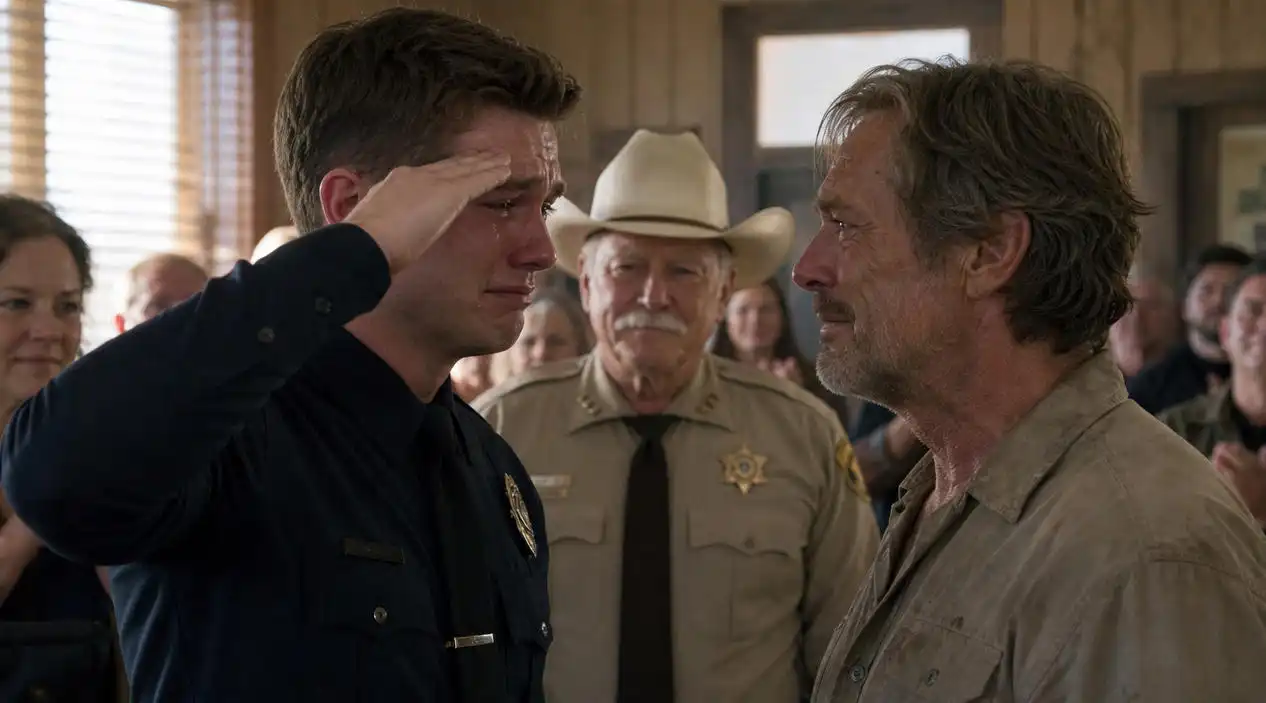
Noah stood in front of David, reached into his pocket, and pulled out a small black-and-gold nameplate.
DAVID MERCER.
He pinned it above his heart, right beside his own badge.
Then he stepped back.
Raised his hand.
And saluted his father in front of the whole town. 💔
David stared at him.
His lips parted.
No sound came out.
Noah’s voice shook, but it held.
“This town called him a convict. I called him worse. But the truth is, David Mercer paid for a crime he didn’t commit so his son could grow up free.”
He turned toward the crowd.
“I don’t deserve the name he gave me. But I’m going to spend the rest of my life trying to honor it.”
Ruth Bell began to cry first.
Then the old sheriff.
Then half the room.
David stepped forward and returned the salute with a hand that trembled.
Not because he was weak.
Because healing sometimes arrives so late that the body does not know how to hold it.
Noah lowered his hand.
Then he hugged his father in uniform.
In the same station where he had once denied him.
The town did not get to erase what it had done.
But it did have to witness what it had missed.
A guilty family lost its power.
A corrupt station lost its cover.
A son lost his shame.
And a father, after seventeen silent years, finally got his name back.
Share this if you believe a parent’s quiet sacrifice should never be mistaken for weakness.
Disclaimer: Mention of any brand or trademark is for identification only and does not imply partnership or endorsement
The Tavern Owner Set A Trap To Make Paul Drink Again… But He Had NO IDEA The Entire Town Was Watching 👀
They Laughed When Mark Announced He Was Running for Office… Then One Sealed Envelope Made the Whole Room Go Silent 😳
My Stepdaughter Thought Her Real Father Paid for Her Golf Club Wedding… Then I Showed the Guests the Letter He Sent Me