
The first sound William Mercer heard after opening the file was Carter’s voice.
Not loud.
Not dramatic.
Calm enough to turn his blood cold.
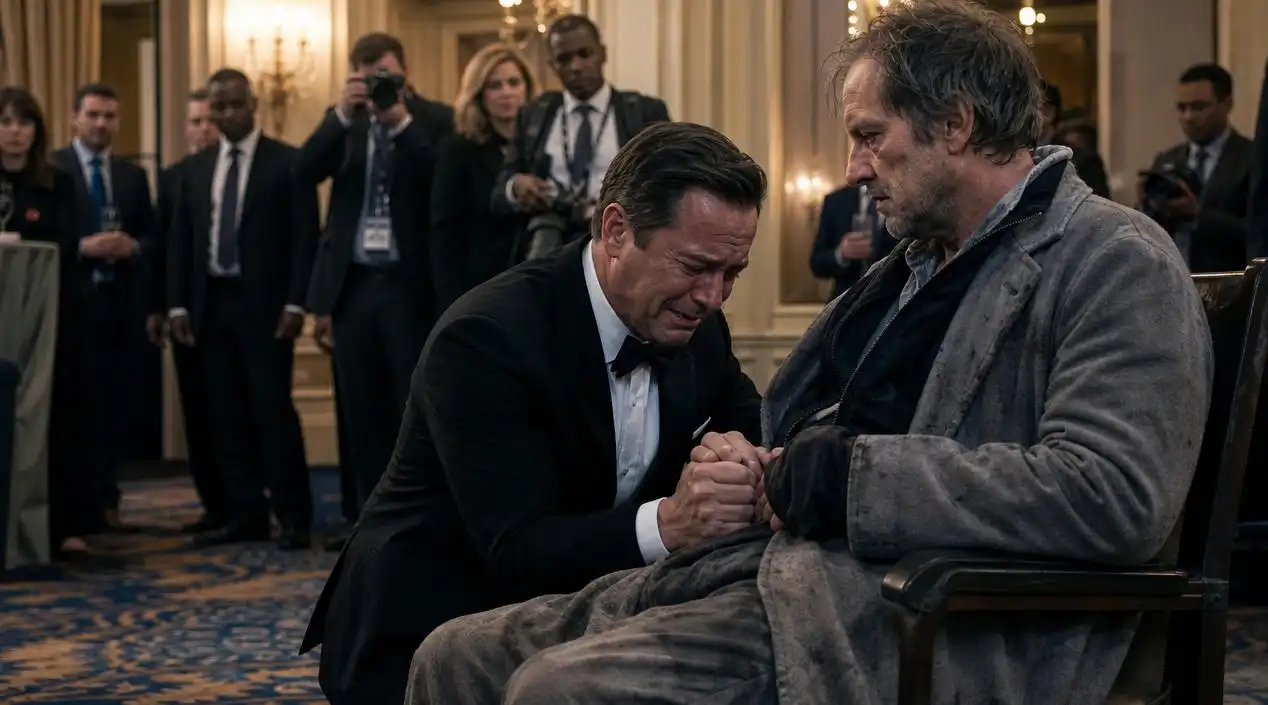
The ballroom at the Whitmore Grand Hotel in Washington, D.C. was still glittering around him—gold chandeliers, white roses, champagne towers, reporters packed shoulder to shoulder—but all William could see was his older brother Danny on the marble floor, one hand clamped over his stomach.
William had just slapped him.
In public.
In front of donors, journalists, lobbyists, and half the people who were about to decide whether he became the next mayor.
And Danny, the brother William had spent ten years hiding from his campaign photos, had only looked up at him and whispered, “Don’t drink anything else tonight.”
William stood frozen with the black USB drive in his hand.
Carter made one last desperate move.
“William,” he said, stepping in fast, “don’t play that. He’s drunk. He’s unstable. He’s been unstable for years.”
But Danny coughed.
A thin red line ran from the corner of his mouth.
And every camera in the room found it.
“Play it,” Danny rasped.
William looked at his brother’s face.
Pale.
Sweating.
Ashamed, but not of himself.
Afraid for William.
That was the first crack in the story William had believed for years.
A reporter from Channel 9 lifted her microphone and said, “Councilman Mercer, is your brother alleging a threat?”
William did not answer.
He plugged the USB into the laptop at the donor check-in table.
The projector behind the stage flickered.
Carter’s face emptied.
And then his voice filled the ballroom.
“By 9:40, Mercer takes the toast. He collapses before dessert. The press calls it exhaustion. The doctors find nothing until the blood work is useless.”
A woman screamed.
A sponsor whispered, “My God.”
William turned slowly toward Carter.
Carter raised both hands.
“That’s fake,” he said. “AI garbage. You know how politics works.”
But Danny laughed weakly from the floor.
It was not a happy laugh.
It was the kind of sound a man makes when he has already paid for the truth with his body.
“Then explain the wine,” Danny said.
The ballroom went silent again.
Carter did not move.
William looked at the champagne flute in his hand.
The same flute Danny had knocked against his own lips minutes earlier.
The same flute William had almost drunk from during the campaign toast.
The same flute Danny had begged him not to touch.
That was the impossible part.
Danny had shown up looking drunk because he had swallowed what was meant for William.
And William had slapped him for it. 💔
“Somebody call 911!” the Channel 9 reporter shouted.
Two donors rushed forward.
One of them, a retired trauma nurse, knelt beside Danny and checked his pulse.
“Stay with me,” she said. “Sir, stay with me.”
Danny’s eyelids fluttered.
William dropped beside him.
For the first time in years, he did not care what the cameras caught.
“Danny,” William said, gripping his brother’s shoulder. “What did you do?”
Danny tried to smile.
“Made you a deal,” he whispered. “You keep breathing… and I’ll take the ugly part.”
William shook his head.
“No. No, you don’t get to say that. What did you drink?”
Danny’s eyes drifted toward Carter.
“He switched the tray.”
Carter backed up half a step.
Security moved toward him, but he barked, “Stay away from me. I run this campaign.”
“You ran it into a crime scene,” the reporter said.
A strange thing happened then.
The crowd that had laughed at Danny five minutes earlier began moving away from Carter.
Not dramatically.
Not all at once.
Just enough to show everyone where the line had been drawn.
William remembered the moment Danny entered the ballroom.
The way donors had turned.
The way the music had faltered.
The way Danny’s shoes squeaked on the polished floor, old brown shoes under a wrinkled suit, his gray coat damp from the January rain.
He had looked completely out of place among million-dollar smiles and navy tuxedos.
A man from the wrong life.
A brother from the wrong chapter.
William had seen him and felt rage before he felt fear.
Because Danny was not just embarrassing.
Danny was the scar William had built his whole campaign around hiding.
Their mother had died when William was seventeen.
Their father had disappeared long before that.
Danny was twenty-nine then, already working two jobs, already tired in the way young men should never be tired.
He had promised their mother on a hospital floor, “I’ll get him through college. I’ll keep him clean. I’ll keep him away from all this.”
And he had.
Danny drove delivery trucks at night.
Washed dishes at a diner in the morning.
Picked William up from debate practice smelling like fryer oil and rainwater.
Paid application fees with money he did not have.
Showed up to William’s college graduation in the same suit he wore tonight.
But somewhere between William becoming polished and Danny becoming worn down, shame had entered the house.
William got invited into rooms Danny could not enter.
Then he learned to pretend Danny had never knocked.
The first time Danny came to a campaign event in old clothes, Carter called him “a liability.”
The second time, Carter said, “Voters love humble origins, but not if they can smell them.”
William had laughed.
Not because it was funny.
Because he was too weak to defend the man who had raised him.
That was the wound.
Danny did not leave because William pushed him away once.
He left because William pushed him away slowly, politely, professionally, until there was no place for him in the new life he had paid for.
And now Danny was dying in that new life’s most expensive room.
“William,” Carter said, voice tight, “think carefully. You can still control this. Shut the projector off. We call it a medical episode. We handle it privately.”
William looked at him.
Carter adjusted his cufflinks.
Even now.
Even with Danny on the floor.
Even with blood on the marble.
He still believed the room belonged to him.
Then the projector continued.
The next file opened automatically.
A video.
Grainy.
Time-stamped.
Carter sat in the back booth of a restaurant with a man William recognized immediately: Leonard Voss, chief strategist for the opposing mayoral campaign.
Carter’s voice was low.
“I don’t need more money. I need protection after it’s done.”
Voss slid an envelope across the table.
“You get the rest when Mercer is out.”
A donor near the stage whispered, “That’s Voss.”
Another said, “The opponent’s people paid him.”
Carter’s eyes flashed.
“It’s edited.”
Danny lifted one trembling finger.
“Third file,” he said.
William clicked it.
This time, the screen showed a bank transfer record.
Then a series of text messages.
Then a photo of Carter holding a small amber vial near the service hallway behind the ballroom.
The photo was shaky, taken from behind a curtain.
But it was clear enough.
Carter’s face.
Carter’s hand.
The vial.
The label.
The room changed temperature.
You could feel it.
The whispering stopped.
The phones rose higher.
The sponsors who had been preparing to withdraw their money were now recording evidence.
One of them, a real estate developer who had smiled through every scandal in the city, actually looked sick.
Carter lunged.
Not at William.
At Danny.
“You old drunk son of a—”
William moved before security did.
He stepped between Carter and his brother.
For one second, the whole ballroom saw it.
The polished candidate finally standing in front of the stained old brother.
Too late.
But standing there.
“Touch him,” William said, “and I’ll forget I ever wanted to look civilized.”
Carter froze.
Sirens wailed outside.
Danny’s fingers curled around William’s sleeve.
“Don’t fight,” Danny whispered. “You’re still wearing Mom’s face.”
That broke William more than the poison did.
He looked down.
“Why didn’t you call me?” William asked.
Danny’s eyes filled.
“I did.”
William stopped breathing.
Danny swallowed hard.
“Eleven times. Different numbers. Carter blocked me. Said I was harassing the campaign. So I followed him myself.”
William turned toward Carter.
Carter looked away.
There it was.
The little, ugly mechanism behind the miracle.
No magic.
No coincidence.
Danny had watched.
Danny had followed.
Danny had slept in his truck outside campaign offices.
Danny had been called unstable because he kept trying to warn a brother who no longer answered.
And when he could not get close enough to stop the plan, he had come to the fundraiser in person.
He had looked like the disgrace so William could stay alive long enough to learn who the real disgrace was.
A paramedic team burst into the ballroom.
“Move back!”
The retired nurse shouted, “Possible poisoning. He ingested alcohol from a switched glass. Blood at the mouth. Pulse weak.”
William grabbed the champagne flute and held it out.
“This one,” he said. “Test this one. And the tray near the stage.”
A young police officer took it with gloved hands.
That was the micro miracle no one could deny.
Because when the officer tested the rim with the rapid field kit from the hotel security team’s emergency box, the strip changed color.
Not faintly.
Not maybe.
Bright.
Immediate.
Visible to every camera in the room. 😱
The Channel 9 reporter whispered, live on air, “The test strip just changed. The glass appears contaminated.”
Carter stopped protesting.
For the first time that night, he looked afraid.
The man who had built a career out of controlling stories had run out of sentences.
Police pushed through the crowd.
“Carter Hale, you’re being detained pending investigation for attempted murder and conspiracy.”
Carter twisted.
“This is politics! You people are idiots! He was going to lose anyway!”
William stared at him.
“Maybe,” he said quietly. “But you were never going to let voters decide.”
Carter’s eyes cut toward the reporters.
That was when he understood.
The cameras had not captured Danny’s shame.
They had captured Carter’s collapse.
As the officers pulled him away, Carter shouted one last thing.
“You think your brother saved you? He destroyed you! Nobody elects a man who slaps his dying brother on camera!”
William looked at Danny.
The paramedics were lifting him onto a stretcher.
Danny’s lips were blue.
His eyes searched the ceiling like he was trying to stay in the room.
William walked beside him, still holding his hand.
“Then I won’t be elected,” William said.
That sentence traveled through the ballroom faster than the sirens had.
Donors turned.
Reporters leaned in.
William stopped at the ambulance doors.
He faced the microphones.
His cheek was wet.
He did not wipe it.
“My brother came here tonight to save my life,” William said. “I treated him like a stain. I let ambition teach me to be ashamed of the man who raised me.”
No consultant wrote that.
No poll tested it.
No donor approved it.
That was why everyone listened.
William continued.
“I am suspending my campaign immediately.”
Gasps.
Shouts.
Questions.
“Councilman, are you withdrawing?”
“What about the election?”
“Do you believe the opposing campaign was involved?”
William looked at the stretcher.
Danny’s hand twitched inside his.
“I don’t know what the investigation will prove about my opponent,” William said. “But I know what tonight proved about me.”
His voice cracked.
“I wanted to run a city, but I couldn’t even honor my own brother.”
No one spoke.
Not even the reporters.
William climbed into the ambulance.
The doors shut.
And the man who had spent two years chasing power left the most important night of his campaign beside the brother he once refused to be photographed with.
At the hospital, the doctors moved fast.
They pumped Danny’s stomach.
They ran blood tests.
They called poison control.
William sat outside the trauma room in his tuxedo with Danny’s old gray coat across his lap.
It smelled like rain, cheap soap, hospital antiseptic, and something sharp beneath the whiskey.
Not drunkenness.
Chemicals.
Poison.
A detective came at 2:13 a.m.
He told William the hotel’s security footage confirmed Danny’s story.
Carter had entered the service hallway twice.
The first time alone.
The second time with a waiter who had no idea what he was carrying.
Danny had followed from the lobby after sneaking past security.
He had seen Carter touch the tray.
He had tried to warn William.
When Carter intercepted him, Danny grabbed the glass meant for the toast and drank from it before William could.
Then he stumbled into the ballroom, already poisoned, smelling like alcohol because that was the carrier.
William closed his eyes.
“So he wasn’t drunk.”
The detective paused.
“He had alcohol in his system,” he said. “But based on the footage and timing, he drank it to keep you from drinking it.”
William bent forward.
The old coat slid to the floor.
He covered his face.
The sound that came out of him did not sound like a politician.
It sounded like a little brother.
At dawn, Danny survived the first night.
Barely.
His kidneys were stressed.
His nerves were damaged.
The doctors warned there might be lasting effects.
“We need to prepare for weakness, tremors, possibly mobility issues,” one physician said gently.
William nodded.
He signed every form.
Called every specialist.
Canceled every interview except one.
By noon, Carter’s arrest had become national news.
By evening, Leonard Voss resigned from the opposing campaign.
Within forty-eight hours, federal investigators opened a conspiracy probe into illegal campaign money and the attempted poisoning.
The opponent’s entire operation collapsed under subpoenas, leaked transfers, and panicked staffers trying to save themselves.
Sponsors who had been ready to abandon William called again.
Some cried.
Some apologized.
Some offered to restart the campaign with an even bigger war chest.
William listened.
Then he said the same thing to all of them.
“No.”
One donor snapped, “William, you could win now. After this? You’d win in a landslide.”
William looked through the hospital glass at Danny sleeping in a brace, tubes in his arms, gray hair flattened against the pillow.
“I know,” William said.
“Then why walk away?”
William’s answer was simple.
“Because my brother spent his life getting me into rooms. I’m done choosing the room over him.”
Three months later, Carter pleaded not guilty.
But the evidence was ugly.
The USB.
The footage.
The bank transfers.
The contaminated glass.
The waiter’s testimony.
The field test.
The hospital blood work.
And most damaging of all, Carter’s own voice on the recording describing exactly how the night was supposed to end.
He had not planned a public murder.
He had planned a quiet disappearance disguised as stress.
A young candidate collapses.
Campaign mourns.
Opponent wins.
Money disappears.
City moves on.
Except Danny Mercer did not move on.
He limped through the back doors of a hotel where nobody wanted him and dragged the truth into the light with poisoned blood in his mouth.
That is the part people remembered.
Not William’s speeches.
Not Carter’s tailored suits.
Not the chandeliers.
Danny.
The old brother in the stained coat.
The man they photographed to mock.
The man who made the whole city ashamed of what it had laughed at.
Six months after the fundraiser, Danny left the rehab center in a wheelchair.
William was waiting outside.
Not with staff.
Not with cameras.
Not with a campaign bus.
Just a navy sweater, two coffees, and a suitcase.
Danny squinted at him.
“What’s that?”
William smiled.
“Your bag.”
“For what?”
“Paris first,” William said. “Then Rome if your doctor clears it. Then wherever you want.”
Danny stared at him.
“You lost your mind?”
“No,” William said. “I lost an election. There’s a difference.”
Danny looked away.
“Will, you don’t owe me a world tour.”
William crouched in front of the wheelchair.
For once, he did not care who saw him low.
“I owe you every graduation you worked through,” he said. “Every birthday I missed because I was ‘busy.’ Every call I ignored. Every time I let someone make you feel small in a room I only entered because of you.”
Danny’s jaw tightened.
“Don’t make me cry in front of nurses.”
William laughed.
Then he cried anyway.
A nurse near the door wiped her eyes.
Danny shook his head, embarrassed.
“You always were dramatic.”
William rested his forehead against Danny’s hand.
“No,” he said. “I was proud. There’s a difference.”
Danny looked at the suitcase again.
“You really quit?”
William nodded.
“The city needed a mayor.”
Danny’s voice softened.
“And you?”
William stood and took the handles of the wheelchair.
“I needed my brother.”
They went to Paris in September.
There is a photo from that trip that people still share.
Not an official portrait.
Not campaign material.
Just William pushing Danny’s wheelchair along the Seine at sunset, both men laughing because Danny had spilled espresso on his own shirt and claimed it made him look “European.”
Another photo came from Rome.
Danny feeding pigeons like a child.
William pretending to be annoyed.
Then Kyoto.
Then Lisbon.
Then a small fishing town in Maine because Danny said all those fancy places were fine, but he wanted clam chowder and a view of water that “didn’t act rich.”
The man who once hid his brother from donors now posted him everywhere.
No captions about strategy.
No speeches about redemption.
Just ordinary proof.
Danny in a wool hat.
Danny asleep on a train.
Danny smiling in front of a cheap roadside diner.
Danny alive.
That was the victory.
Carter went to prison after a plea deal that exposed the black-money pipeline behind the opposing campaign.
Leonard Voss lost his license to consult on federal races.
The opponent withdrew from public life.
Another candidate eventually became mayor.
William did not regret it.
People kept asking whether he would run again someday.
For a while, he gave careful answers.
Then, one afternoon in Maine, Danny fell asleep in his wheelchair beside the ocean, a blanket over his knees, his face peaceful in the salt air.
William watched him breathe.
In.
Out.
Still here.
Still stubborn.
Still his brother.
A reporter called that day.
“Mr. Mercer, voters still talk about you. Do you ever think about returning to politics?”
William looked at Danny.
Then at the waves.
“I used to think public service meant standing on a stage,” he said.
“And now?”
William smiled.
“Now I know sometimes it means pushing a wheelchair slowly enough for the person who saved you to enjoy the view.”
The reporter went quiet.
That quote spread farther than any campaign ad he ever bought.
But William never tried to turn it into a comeback.
He had already received the only office that mattered.
Little brother.
Caretaker.
Witness.
Repenting man.
And Danny, who had once been shoved out of a ballroom like trash, spent his remaining years being wheeled through places he had only seen on postcards.
Not as charity.
Not as pity.
As honor.
Because some heroes do not arrive clean.
Some smell like rain and cheap liquor because they stepped between you and the poison.
Some look like a disgrace because they have been carrying your life so long they forgot how to stand up straight.
And some brothers only become men the night they finally choose love over applause.
William slapped Danny in front of the world.
Danny saved William in front of the world.
Only one of those moments deserved to be remembered forever.
Share this if you believe family loyalty is not proven when someone looks perfect beside you…
It is proven when they are broken, humiliated, and still willing to take the hit first. 👇
Disclaimer: Mention of any brand or trademark is for identification only and does not imply partnership or endorsement
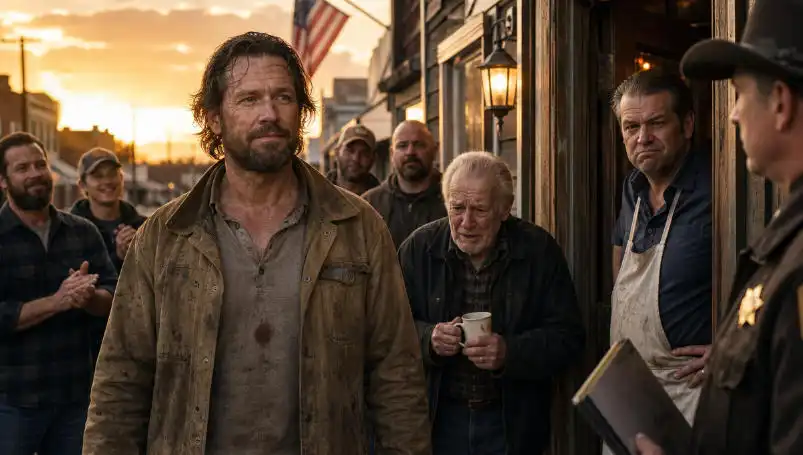
The Tavern Owner Set A Trap To Make Paul Drink Again… But He Had NO IDEA The Entire Town Was Watching 👀
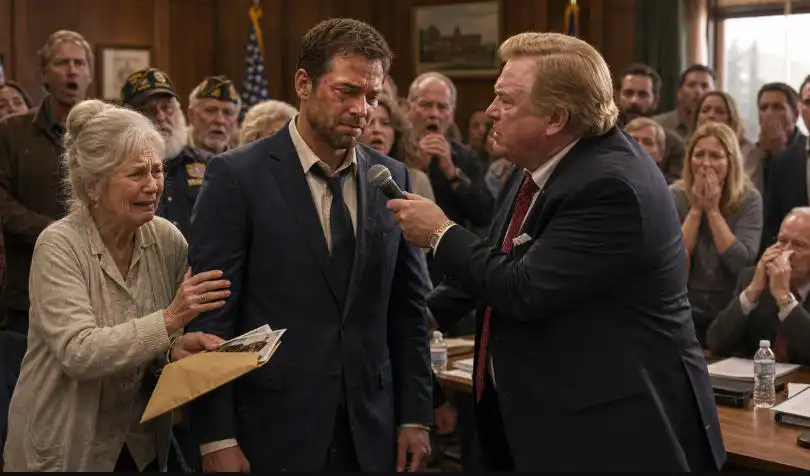
They Laughed When Mark Announced He Was Running for Office… Then One Sealed Envelope Made the Whole Room Go Silent 😳
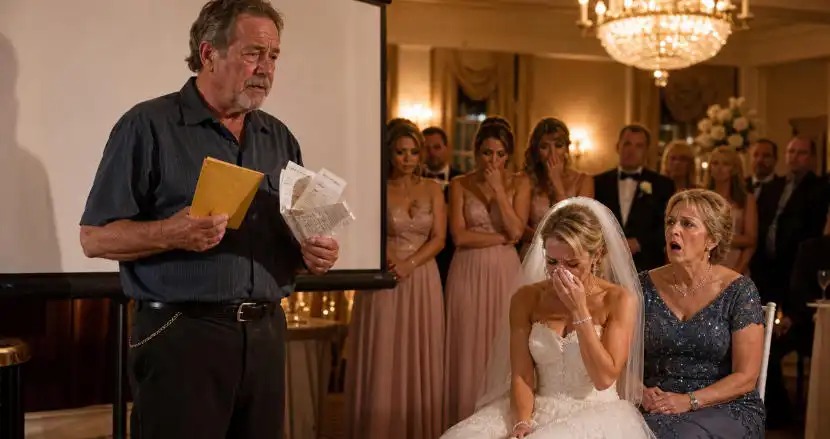
My Stepdaughter Thought Her Real Father Paid for Her Golf Club Wedding… Then I Showed the Guests the Letter He Sent Me