
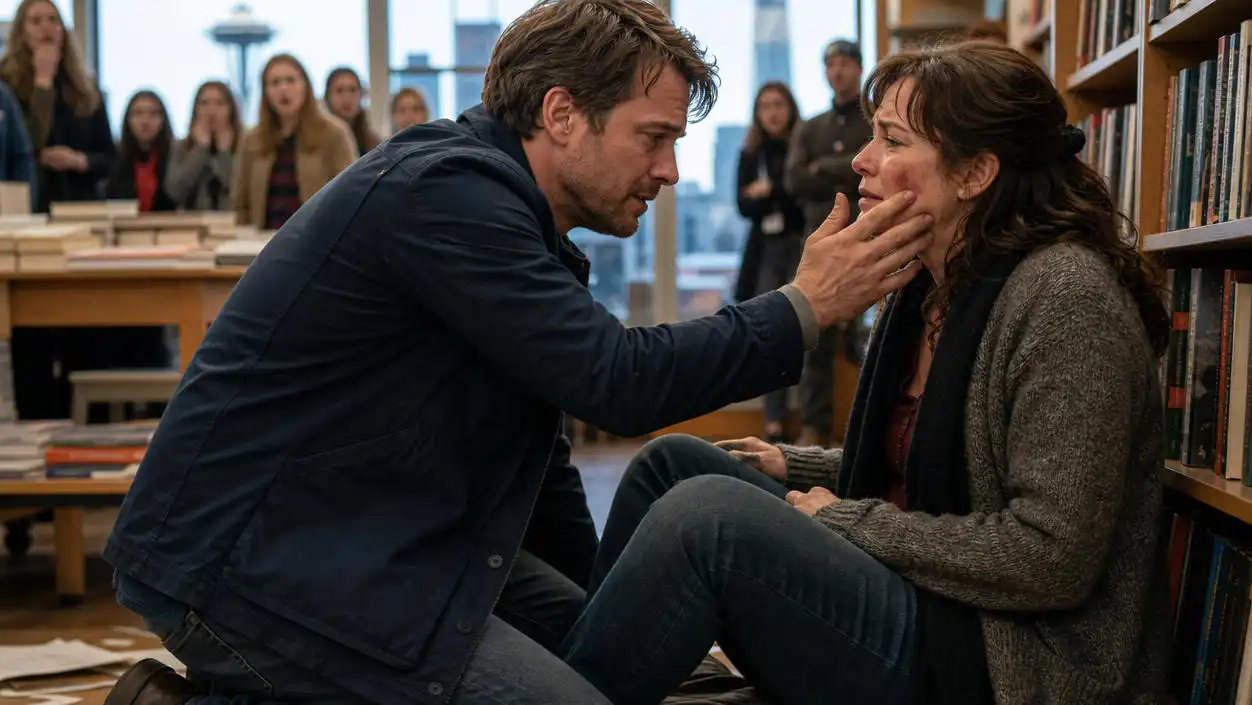
Maggie held the torn page above her head, her cheek still burning red under the bookstore lights.
James stared at the tiny paragraph she was pointing to, but the words blurred because his hand was still shaking from what he had done.
Downtown Seattle’s largest bookstore had gone so quiet that the rain tapping against the front windows sounded louder than the crowd.
On that stage stood a brother who had finally become famous, a sister he believed had come to ruin him, and a publisher in a cream-colored suit who suddenly looked like she wanted the floor to swallow one specific page.
“Page forty-seven,” Maggie said again.
Elena Cross took one slow step toward her.
“Maggie,” she said, smiling without warmth, “you’re embarrassing yourself.”
Maggie did not look at her.
She looked only at James.
“Ask her,” she whispered. “Ask her why this clause is printed in six-point font. Ask her why your attorney never received the final copy. Ask her why the penalty is tied to projected global licensing, not your advance.”
James blinked.
The crowd shifted.
Someone near the front said, “What does that mean?”
Elena laughed, but it came out too sharp.
“It means his sister has been reading legal phrases she doesn’t understand.”
Maggie’s coat dripped rainwater onto the polished wood stage.
Her hands trembled, but her voice did not.
“It means if James signs tonight and misses one promotional obligation, one delivery window, one companion manuscript, one ghostwritten sequel, one foreign media appearance, Elena’s company can claim breach.”
James frowned.
“That’s not in my deal.”
Maggie turned the page toward him.
“It is now.”
He took it.
For the first time all night, James really looked at the paper instead of the cameras, the banners, the applause, and Elena’s perfect smile.
His name was printed at the top.
His dream was printed in the middle.
And at the bottom, hidden under language so dense it looked harmless, was a number that made his stomach drop.
Liquidated damages.
Ten million dollars.
James swallowed.
“No,” he said. “That can’t be right.”
Maggie’s eyes filled.
“That’s what I said too.”
Elena reached for the page again.
“This is ridiculous. The document is proprietary.”
Maggie snapped, “It stopped being private when you tried to turn my brother into a prisoner.”
The crowd murmured.
Phones lifted higher.
The assistant who had threatened to call the police now stood frozen with 911 half-dialed on his screen.
James looked at Elena.
“Elena?”
She adjusted the diamond bracelet on her wrist.
“James, listen to me carefully. Every major contract has penalties. This is normal. She is weaponizing your ignorance because she can’t stand seeing you succeed.”
That word landed exactly where Elena wanted it.
Ignorance.
James felt all the old shame crawl up his throat.
For twelve years, he had written at kitchen tables, bus stops, diners, laundromats, and borrowed desks. He had collected rejection letters like bruises. He had watched Maggie cover rent twice, sell their mother’s old sewing machine once, and pretend she was not hungry on nights when he bought printer paper instead of groceries.
Then Elena had appeared.
A real publisher.
A real advance.
A real stage.
A real crowd chanting his name.
And Maggie had ruined it.
Hadn’t she?
His palm burned.
Her cheek was still red.
A terrible question opened inside him.
What if he had not struck the person destroying his life?
What if he had struck the only person standing between him and a cage?
“Maggie,” he said, softer now, “how did you get this?”
She lowered the page.
For the first time, she looked ashamed.
“I followed the money.”
Elena’s smile disappeared.
James stared at his sister.
“What money?”
Maggie took a breath that seemed to scrape her chest.
“The money behind the company. The shell firm. The same firm that owns the ‘independent’ publicity agency. The same agency that charges authors for missed campaign deliverables after trapping them in impossible schedules.”
Elena said, “Careful.”
Maggie turned toward the crowd.
“Three authors before James signed variations of this same deal. One lost his home. One declared bankruptcy. One stopped publishing completely after Elena sued him for damages he could never pay.”
A woman in the third row gasped.
“That was Daniel Price,” she said. “My book club followed him. He just disappeared.”
Elena lifted her chin.
“Allegations.”
Maggie nodded.
“Yes. They were allegations yesterday.”
Then she reached into her wet canvas bag.
The assistant stepped forward. “Ma’am, don’t make this worse.”
Maggie looked at him.
“You already helped make it worse.”
He recoiled.
“What?”
“You sent James the ‘final contract’ at 2:13 this afternoon. Elena told him the only change was the signing date. But the metadata says the penalty schedule was inserted at 1:58 by her legal department.”
The assistant’s mouth opened.
“How would you—”
“Because I paid someone who knew how to check.”
James’s eyebrows pulled together.
“You paid who?”
Maggie’s voice cracked.
“A retired contract investigator.”
James almost laughed, because the sentence made no sense.
“Maggie, we don’t have money for that.”
Her eyes finally broke.
“No,” she said. “We don’t.”
And that was when James understood before she said it.
The house.
Their little blue house in Tacoma.
The one with the crooked porch.
The one their mother had left them.
The one Maggie had guarded like a holy thing after their father walked out and medical bills swallowed every other piece of their childhood.
James whispered, “What did you do?”
Maggie looked down.
“I borrowed against it.”
The room seemed to tilt.
“No,” James said.
“I had to.”
“No, Maggie.”
“I had to, Jamie.”
There it was.
Jamie.
Nobody had called him that in public since he was a boy hiding under the kitchen table while creditors knocked on the door and Maggie, sixteen years old and too young to be anyone’s shield, told him, “Stay quiet. I’ll handle it.”
She had handled everything.
His school lunches.
Their mother’s prescriptions.
His college applications.
His first laptop.
His first heartbreak.
His first manuscript.
And now, apparently, his contract.
He had repaid her with a slap.
A woman in the crowd covered her mouth. 💔
Elena recovered fast.
“That is a touching little performance,” she said, “but emotional debt is not legal expertise.”
Maggie nodded.
“You’re right.”
Then she pulled out a folder thick enough to make Elena stop breathing.
“So I brought legal expertise.”
A silver-haired man in a navy coat stood from the back row.
James recognized him vaguely from one of the author dinners Elena had hosted but never introduced properly.
The man walked to the front with a leather briefcase in one hand.
Elena’s face hardened.
“You.”
He nodded politely.
“Me.”
Maggie said, “This is Warren Bell. He spent thirty-one years reviewing entertainment contracts before retiring. He also reviewed the agreements from the other authors.”
James looked from Maggie to Warren.
“Why would he help us?”
Warren set his briefcase on the stage.
“Because your sister came to my office soaked from the rain, carrying a folder of documents, and said, ‘I can pay you with borrowed money, but I need to know if my brother is about to lose his life.’”
James closed his eyes.
The bookstore was no longer a celebration.
It was a courtroom made of bookshelves and raised phones.
Elena tried to laugh.
“This is absurd. James, sign the clean copy. We’ll deal with your sister privately.”
“Clean copy?” Warren asked.
He opened his briefcase and removed two contracts.
“Excellent phrase.”
Elena froze.
Warren held up the first one.
“This is the version James’s attorney reviewed last week.”
He held up the second.
“This is the version Elena’s team placed on the signing table tonight.”
He turned to the crowd.
“They are not the same document.”
The room erupted.
Elena said, “Stop this immediately.”
But Warren did not stop.
He walked to the table, took James’s pen, and circled three sections.
“Here. Here. And here.”
James leaned closer.
His eyes moved over the words.
Companion works.
Mandatory appearances.
Failure to participate.
Assignment of rights.
Cross-collateralized liability.
He had been excited to sign his name.
He had not realized he was about to sign away his future.
Warren tapped the page.
“This clause would allow Elena’s company to demand additional manuscripts under the same rights purchase, with penalties tied to missed delivery.”
James whispered, “I only sold one book.”
Elena snapped, “You sold a brand.”
Warren looked at her.
“There it is.”
That sentence hit the room like a dropped glass.
A brand.
Not a person.
Not a writer.
Not a man who had spent years bleeding over sentences in a kitchen chair.
A brand.
James looked at Elena, and suddenly all the warmth she had shown him looked rehearsed.
Every compliment.
Every “I believe in you.”
Every “Trust me, James.”
Even the signing event itself.
Public pressure.
Bright lights.
Fans cheering.
A contract placed in front of him when backing out would look like failure.
Maggie had not torn up his dream.
She had torn up a trap.
James turned toward his sister.
The red mark on her cheek had deepened.
His stomach twisted.
“Maggie,” he said, but his voice failed.
She shook her head once.
Not now.
That tiny gesture hurt more than any shout would have.
Elena stepped to the microphone.
“Everyone, this is a private family matter that has been distorted by a mentally unstable woman.”
Maggie flinched.
James saw it.
The old wound.
The label Elena had used was not random.
It was a knife sharpened by history.
Years earlier, after their mother died, Maggie had spent six weeks barely speaking. She had missed bills, lost weight, forgotten appointments, and once left a grocery cart full in the parking lot because she started crying beside the canned soup.
James had been young enough to resent her for falling apart.
Old enough to remember it.
Cruel enough, tonight, to throw it back at her without saying the exact words.
“You’re acting sick again.”
That was what his eyes had said when she ran onto the stage.
That was what the slap had meant.
Maggie had heard it all.
Elena had seen the crack and pushed her finger into it.
But this time, James moved before Elena could say another word.
He stepped between the microphone and his sister.
“Don’t call her that.”
The bookstore went silent again.
Elena blinked.
“Excuse me?”
James’s voice shook.
“I said don’t call my sister unstable.”
Maggie looked up.
For the first time since he slapped her, hope and heartbreak crossed her face together.
Elena lowered her voice.
“James. Think very carefully. Your career begins tonight or ends tonight.”
He laughed once, empty and bitter.
“There’s the deal line.”
“What?”
“You promised me the world if I signed, and ruin if I didn’t. That’s not publishing. That’s a hostage note.”
A few people clapped.
Then more.
Then the entire back half of the store began to clap.
Elena’s face turned red.
She snapped at the assistant.
“Call security. Remove them both.”
The assistant looked at James.
Then at Maggie.
Then at the two contracts.
He put his phone down.
“No.”
Elena whipped around.
“What did you say?”
He swallowed.
“I said no.”
That was the first micro miracle.
Small.
Visible.
Undeniable.
The same young man who had threatened to have Maggie arrested now stepped away from Elena and placed his phone on the table, screen facing up.
“I sent the final copy when Ms. Cross told me to,” he said. “I didn’t know the changes were material. But I have the email chain.”
Elena’s lips parted.
The crowd surged with sound. 🤯
“You signed an NDA,” Elena hissed.
“I didn’t sign up to help bankrupt someone.”
James stared at him.
The assistant’s hands trembled.
“Mr. Whitaker,” he said, “I’m sorry.”
James could barely nod.
Warren pointed to the phone.
“With your permission, that email chain should go to your attorney.”
The assistant nodded.
“You have it.”
Elena stepped back as if the stage itself had betrayed her.
Maggie sank slightly into a chair.
James reached toward her, then stopped.
He had no right to touch her without asking.
“Maggie,” he said.
She would not look at him.
“I am so sorry.”
Her mouth pressed tight.
“I didn’t come for an apology.”
“I know.”
“I came so you wouldn’t sign.”
“I know.”
“No,” she said, turning toward him at last. “You don’t.”
The words were quiet, but they cut through him.
“You think I’m jealous because you made it,” Maggie said. “You think I don’t know what people say. That I’m the sad older sister. The one who never left. The one who never became anything.”
“Maggie—”
“No. Let me say it once.”
James fell silent.
She stood again, slower this time.
Every phone in the room was still recording, but she did not perform for them.
She spoke to the boy she had raised.
“When Mom got sick, I stopped applying to nursing school. When the bills came, I worked double shifts. When you needed quiet to write, I took the late bus so you could have the kitchen table. When your first book failed, I bought twenty-seven copies and gave them to people who never read them.”
James’s face crumpled.
“I didn’t know that.”
“I didn’t want you to know.”
“Why?”
“Because I never wanted you to feel like my sacrifice was your debt.”
That broke him.
He stepped down from the stage.
In front of every fan, every camera, every stranger who had shouted at her minutes before, James knelt on the wooden floor.
“I made it your punishment instead,” he said.
Maggie’s chin trembled.
“I wanted you safe, Jamie.”
“I hit you.”
The words came out like a confession in church.
Maggie looked away.
People in the crowd cried quietly.
James did not reach for forgiveness.
He did not demand it.
He stayed kneeling.
“I will spend the rest of my life being sorry for that,” he said. “But tonight, I need everyone here to hear me say something.”
He stood and faced the crowd.
“My sister did not ruin my career. She saved my life.”
The store erupted.
This time, the applause was not for fame.
It was for truth.
Elena tried one final time.
“You are making a catastrophic mistake.”
James turned to her.
“No. I almost made one.”
Warren gathered the torn pages.
“Elena Cross, I strongly recommend you leave before more of this happens on camera.”
She smiled coldly.
“You have no idea who you are dealing with.”
Maggie answered before anyone else could.
“Yes, we do. That’s why I came.”
A security guard approached Elena, not Maggie.
“Ma’am,” he said, “the manager would like you to step outside.”
Elena looked at the crowd that had belonged to James five minutes earlier and realized it had turned into a jury.
She walked out under the glow of a hundred phones.
By midnight, the video had spread across Facebook, TikTok, and local Seattle news.
By morning, three authors contacted Warren Bell.
By noon, seven more did.
By Friday, Elena’s company released a statement calling the incident “a misunderstanding involving emotionally charged family dynamics.”
By the next Monday, the email chain leaked.
There was no misunderstanding.
There were draft changes.
There were hidden clauses.
There were internal messages discussing “pressure signing environments.”
There was even one line from Elena herself:
“Once he signs in front of the fans, he won’t fight us.”
That line ended her.
The state attorney general opened an investigation.
Authors came forward.
Contracts were reviewed.
Foreign rights deals collapsed.
Investors withdrew.
Within six months, Elena’s company filed for bankruptcy.
James never signed with her.
He also did not become the overnight literary darling Elena had promised.
Not immediately.
For a while, he disappeared.
People speculated.
Some said he had been canceled.
Some said he was ashamed.
Some said his sister had taken control of his life.
The truth was simpler.
James went home.
Not to a penthouse.
Not to a tour bus.
Not to the hotel Elena had booked for press week.
He went to the little blue house in Tacoma with the crooked porch.
He fixed the loose railing Maggie had complained about for years.
He refinanced what he could.
He took meetings with real attorneys.
He sold his car.
He worked with Warren to help other authors understand their contracts.
And every morning for two months, he made Maggie coffee and left it outside her bedroom door because she was not ready to sit at the table with him yet.
He did not ask her to hurry.
He did not ask her to forgive.
Healing was not a speech.
It was proof repeated quietly.
One morning, Maggie opened the door while he was placing the mug down.
She looked tired.
Older.
Still hurt.
But she said, “You used too much sugar.”
James froze.
Then he laughed through tears.
“You used to like it sweet.”
“I used to be twenty-three.”
He nodded.
“Fair.”
She took the mug.
It was not forgiveness.
Not fully.
But it was a door cracked open.
A year later, James published a new book.
Not the one Elena wanted.
Not the one designed to become a brand.
It was called The Sister Who Tore The Page.
He wrote about a boy who mistook sacrifice for resentment.
He wrote about a young woman who gave up nursing school and never called herself a hero.
He wrote about a publishing stage, a torn contract, a red handprint, and the worst mistake of his life.
But he did not write Maggie as perfect.
She made him promise that.
“Don’t turn me into a saint,” she told him.
“Why not?”
“Because saints don’t get tired. Sisters do.”
So he wrote the truth.
He wrote that love can be fierce and messy.
He wrote that protection can look like betrayal when someone is standing too far away to see the trap.
He wrote that shame does not disappear because the world claps for your apology.
It disappears when you change.
The book hit number one on the New York Times bestseller list in its third week.
At the celebration dinner, there were no champagne towers.
No corporate banners.
No staged signing table.
Just a long table at a neighborhood restaurant, Maggie in a blue dress, Warren Bell eating too much bread, the former assistant now working for an author advocacy nonprofit, and James sitting beside his sister with tears in his eyes.
He slid the first signed copy across the table.
Maggie opened it.
The dedication was only one sentence.
For Maggie, who tore the contract before it tore me apart.
She stared at it for a long time.
Then she closed the book and pressed it to her chest.
“You still owe me a porch railing that doesn’t wobble,” she said.
James smiled.
“Already fixed.”
She raised an eyebrow.
“The back step?”
“Tomorrow.”
“The basement leak?”
“Don’t push it.”
For the first time in years, Maggie laughed without covering her mouth.
And James cried.
Not dramatically.
Not for cameras.
Just quietly, because the sound of his sister laughing felt like mercy he had not earned but would spend his life honoring.
Later that night, he posted one photo.
No caption about success.
No sales link.
No polished author quote.
Just Maggie standing on the repaired porch, holding the book, rain shining on the steps behind her.
Under it, James wrote:
The world saw the night my sister tore up my dream. I saw the night she saved my future. Believe the person who has loved you the longest, even when the truth arrives looking like disaster.
That post was shared more than any book announcement he had ever made.
Because people understood.
Everyone has seen someone loyal get called dramatic.
Everyone has watched a powerful person smile while setting a trap.
Everyone has had to choose between the shiny promise and the trembling voice saying, “Please, don’t.”
James chose wrong first.
Then he spent the rest of his life choosing better.
So stand with the sister who lost almost everything to save her brother, not the publisher who tried to buy his soul with applause. Share this for every quiet protector who was called crazy before the truth came out.
Disclaimer: Mention of any brand or trademark is for identification only and does not imply partnership or endorsement
The Tavern Owner Set A Trap To Make Paul Drink Again… But He Had NO IDEA The Entire Town Was Watching 👀
They Laughed When Mark Announced He Was Running for Office… Then One Sealed Envelope Made the Whole Room Go Silent 😳
My Stepdaughter Thought Her Real Father Paid for Her Golf Club Wedding… Then I Showed the Guests the Letter He Sent Me