
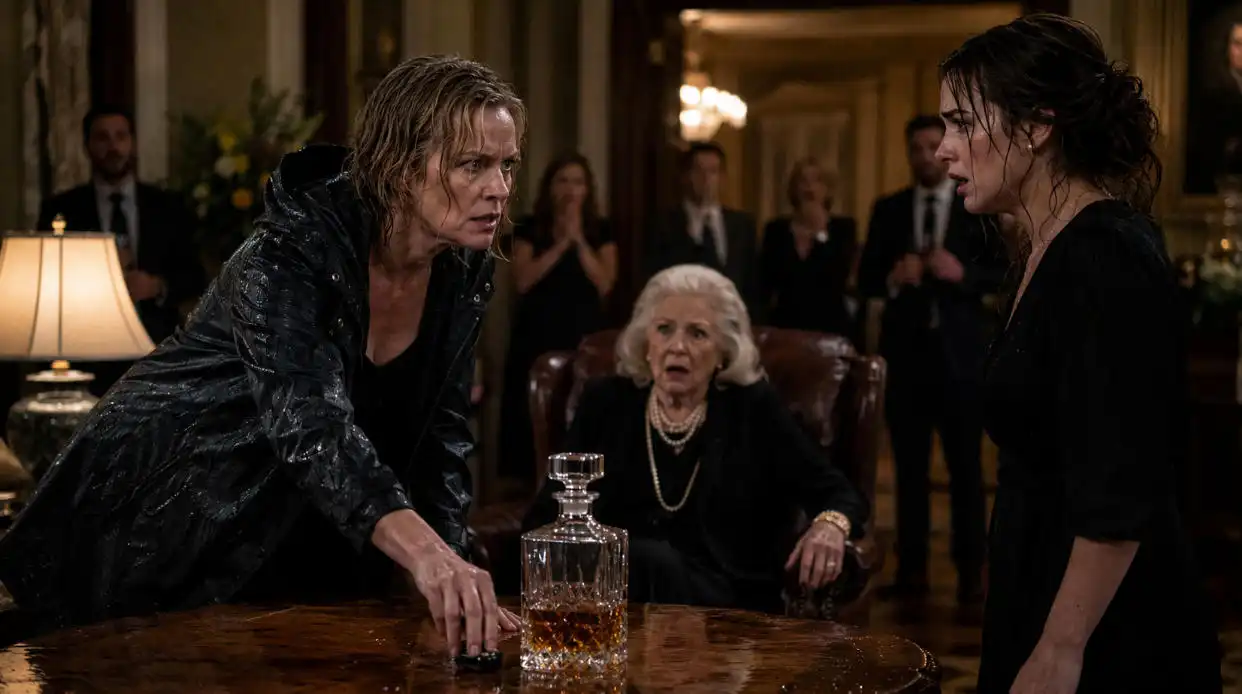
For one second, the room went silent.
Not polite silent.
The kind of silence where even guilty people forget how to breathe.
Linda’s finger was still resting on the laptop key. The black flash drive sat half-hidden beside my father’s crystal decanter, like a tiny piece of plastic could not possibly threaten a whole dynasty.
But it did.
Across the room, my grandmother Eleanor Carter sat in my father’s leather chair as if she had been born there.
Her pearls were perfect.
Her gray hair was pinned smooth.
Her black dress looked expensive enough to buy a year of rent for someone like me.
And she was smiling.
Not because she missed my father.
Because she thought she had won.
“Linda,” Eleanor said, calm and sharp, “whatever little performance you are planning, remember where you are.”
Linda looked at her.
Then she looked at me.
I was standing near the doorway in the same wrinkled black dress I had worn to my father’s funeral three days earlier.
My hair smelled faintly like the grocery store parking lot where I had been sleeping.
My shoes were muddy.
My purse had twenty-three dollars in it.
And every rich relative in that room looked at me like I had crawled in through a drain.
My cousin Madison leaned toward her brother and whispered, “Did she sleep outside?”
He laughed.
“Looks like it.”
I heard them.
Linda heard them too.
But she didn’t blink.
She simply said, “Robert asked me to play this only if Eleanor tried to use the amended will.”
The notary at the desk went pale.
His name was Gerald Pruitt.
He had stood at the funeral with a Bible voice and a banker’s smile, telling everyone the papers were “perfectly in order.”
Now his hand twitched toward his briefcase.
Linda noticed.
“Don’t,” she said.
That one word cut through the room.
Gerald froze.
Eleanor gave a soft, ugly laugh.
“Are we really going to let this woman control the room?” she asked. “Three days ago, Avery threw water in her face and accused her of murder. Now they’re partners?”
My cheeks burned.
Because she was right about one thing.
I had done that.
At my father’s funeral, in front of mourners, board members, church ladies, and half of Atlanta’s old-money crowd, I had thrown water in Linda’s face.
I had called her a gold digger.
I had said she married my father for his money.
I had said she waited for him to die.
And Linda had stood there, soaked and shaking, saying only, “Avery, please listen.”
But I didn’t listen.
I had spent two years being fed poison.
Not in one big speech.
In tiny, daily doses.
Eleanor saying, “Your father is lonely. Linda knows that.”
My uncle Brent saying, “Second wives always have a plan.”
Madison whispering, “She’s not your mother, Avery. Don’t forget that.”
Even after my father got sick, they framed every kind thing Linda did as strategy.
If she drove him to treatment, she was performing.
If she kept visitors away when he was weak, she was isolating him.
If she reviewed medical bills, she was counting the money.
And I believed them.
Because grief makes you desperate for a villain.
Linda was easy to hate.
She was younger than my father by fifteen years.
She was beautiful in a quiet, polished way.
She never raised her voice.
She never chased anyone’s approval.
And worst of all, my father trusted her.
More than he trusted them.
Maybe more than he trusted me.
That hurt too much to admit.
So I let Eleanor turn hurt into rage.
Then came the funeral.
The fake will.
The announcement that Linda would control my father’s company.
The cousins smirking.
The family elders nodding like judges.
And me, standing there with a glass of ice water in my hand, shaking so hard I could hear the cubes rattle.
Eleanor had leaned close and whispered, “Your mother would be ashamed of what Linda let happen.”
That broke me.
I threw the water.
Linda gasped.
People stared.
And Eleanor got exactly what she wanted.
She turned to the room and said, “See? This child is unstable.”
Child.
I was twenty-eight.
I had helped my father build inventory spreadsheets at the kitchen table when I was sixteen.
I had spent summers filing invoices at Carter Heritage Foods while my cousins were in Europe.
But in that room, I became “unstable.”
“Ungrateful.”
“Dangerous.”
They voted me out of the house that same afternoon.
Not officially, of course.
Rich families know how to make cruelty sound administrative.
“For everyone’s comfort.”
“Until emotions settle.”
“For the dignity of the estate.”
My uncle Brent took my key.
Madison carried my overnight bag with two fingers like it smelled bad.
Her brother Cole opened the front door and dropped it on the stone steps.
“Careful,” he said. “There’s probably nothing expensive in it.”
People heard him.
People laughed.
That was the worst part.
Not being thrown out.
Being thrown out while people enjoyed it.
I walked down that long driveway with my father’s house behind me and nowhere to go.
Three nights later, Linda found me.
I was in my car behind a Kroger, curled under a coat, trying not to cry because crying wastes energy.
At first I thought security had come.
Then I saw her face through the rain-smeared glass.
No makeup.
No pearls.
No lawyer.
Just Linda.
I rolled the window down an inch.
“What do you want?”
She looked at me like the answer hurt.
“To bring you home.”
I laughed because it was either laugh or scream.
“You got the house, Linda. Congratulations.”
“I didn’t get anything yet.”
“That’s not what the will said.”
“The will they read at the funeral was not your father’s final will.”
My body went still.
Linda opened her palm.
A small black flash drive lay there.
“Robert recorded a video the night before his surgery,” she said. “He was afraid your grandmother would pressure Gerald Pruitt to change the date on the amendment.”
I stared at her.
“Why didn’t you say that at the funeral?”
“Because Gerald didn’t file the amended version until after Robert died. I needed proof of when he changed the document. I needed him to bring the false papers into the house and put them in front of witnesses.”
“Witnesses?”
“The board. The family elders. The cousins who think they’re untouchable.”
Rain tapped the roof of my car like nervous fingers.
I wanted to hate her.
It would have been easier.
But her eyes were swollen.
Her hands were trembling.
And she was wearing my father’s old raincoat.
The green one he kept by the back door.
The one he wore when he taught me how to check the peach trees after storms.
My voice cracked.
“You let me sleep in a car?”
Linda flinched like I had slapped her.
“I looked for you every night,” she said. “Your phone was off. Your grandmother told security to keep me away from you. I finally found your car because your father put an emergency tracker in the spare tire kit after your accident last year.”
I remembered that.
He had annoyed me for weeks about safety.
I used to roll my eyes.
Now I missed being annoyed by him.
Linda swallowed.
“Avery, I am not asking you to forgive me tonight. I am asking you to stand beside me long enough to hear your father speak.”
That was how we returned to the mansion.
Not as friends.
Not yet.
As two women who had both been underestimated by the same room.
Now, in the living room, everyone watched Linda’s laptop screen glow blue.
Eleanor’s smile had thinned.
“This is absurd,” she said. “Robert was heavily medicated near the end. Anything on that drive is meaningless.”
Linda nodded once.
“I expected you to say that.”
Then she reached into her leather folder and removed a second document.
“This is a sworn statement from Dr. Elaine Porter, Robert’s oncologist, confirming his mental clarity on the evening the video was recorded.”
Gerald Pruitt’s forehead shined with sweat.
Uncle Brent shifted in his chair.
Madison stopped whispering.
Linda continued.
“And this is a copy of the estate security log showing Gerald entered the property on March 14 at 9:42 p.m., two days after Robert signed his final documents.”
Gerald stood.
“I should leave.”
“No,” Linda said. “You should sit.”
Eleanor snapped, “You do not give orders in this house.”
Linda finally turned to her fully.
For the first time since I had known her, Linda’s softness disappeared.
She did not yell.
She did not tremble.
She became cold steel.
“Robert gave me voting control of his shares for exactly one reason,” she said. “To stop you from gutting his company and stealing from his daughter.”
The room erupted.
“What?”
“That’s a lie.”
“Watch your mouth.”
Eleanor’s hand tightened around the armrest.
“My son loved his family.”
Linda’s voice stayed level.
“He loved his family. That is why he documented what you were doing.”
Then she pressed play.
My father appeared on the screen.
Alive.
Thin.
Tired.
Wearing his navy robe in the sunroom.
For a second, I forgot the room existed.
My knees nearly buckled.
Linda touched my elbow, just lightly enough to give me balance without pretending everything was okay.
My father looked directly into the camera.
“Hello, Avery.”
My hand flew to my mouth.
A sound came out of me that I didn’t recognize.
On the screen, my father gave a weak smile.
“If you’re watching this, it means my mother did exactly what I feared she would do.”
Eleanor stood so fast her pearls swung.
“Turn it off.”
Nobody moved.
Not even her own sons.
My father continued.
“I am of sound mind. Dr. Porter has evaluated me today. My attorney, not Gerald Pruitt, prepared my final estate plan. The date is March 12.”
Linda paused the video and looked at Gerald.
“The will you presented at the funeral was dated March 15.”
Gerald said nothing.
My father’s voice filled the room again.
“I leave temporary voting control of my company shares to my wife, Linda Carter, not as a gift to her, but as a shield for Avery. Linda is to remove any family member who used Carter Heritage Foods for personal enrichment, coercion, or fraud. After the internal audit is complete, controlling interest is to be transferred to my daughter, Avery Carter.”
The room exploded again.
This time, nobody laughed.
My cousin Cole shouted, “He can’t do that!”
Linda looked at him.
“He did.”
Madison’s face twisted.
“Avery doesn’t even understand the company.”
That hit an old bruise.
I opened my mouth.
But my father answered from the screen.
“Avery knows more about the company than most of you because she worked when you performed.”
Madison went red.
My father coughed softly in the video, then continued.
“Brent, I know about the vendor kickbacks.”
Uncle Brent went gray.
“Cole, I know you charged personal travel to the regional expansion account.”
Cole looked at his shoes.
“Madison, I know Eleanor promised you the communications department after you helped pressure Avery.”
Madison’s eyes filled with panic.
“And Mother…”
The room changed.
Even the air seemed to step back.
My father stared into the camera.
“I know what you did to Avery’s college fund after her mother died.”
My heart stopped.
My college fund?
Eleanor’s face hardened.
“That money was family money.”
On the screen, my father shook his head slowly, like he had expected her answer even from the grave.
“That money belonged to Avery. Her mother left it to her. You moved it through a trust account and used it to cover Brent’s failed real estate deal. I found the transfers.”
I turned toward Eleanor.
For years, I had believed my scholarship gap was my fault.
I had believed there had been less money than expected.
I worked two jobs.
I sold my mother’s jewelry.
I dropped out for one semester because I couldn’t cover tuition.
And Eleanor had watched me struggle.
She had called it character-building.
I whispered, “You stole from me?”
Eleanor’s chin lifted.
“I protected this family.”
“No,” I said. “You protected your sons.”
She looked me up and down.
That old contempt returned.
“You were never built to carry the Carter name.”
There it was.
Not hidden.
Not polished.
The truth under all the manners.
I was not useful to her.
So I was disposable.
Linda stepped forward.
“Thank you, Eleanor.”
Eleanor frowned.
“For what?”
Linda tilted her head toward a small device on the mantel.
“For saying that clearly.”
Gerald whispered, “Is that recording?”
Linda did not answer him.
She didn’t have to.
Then she opened another folder.
This one was thick.
Too thick.
“Before this meeting began,” she said, “Robert’s outside counsel sent notice to every board member. The audit has already been filed. The amended funeral will has been challenged in probate court. Gerald Pruitt’s commission has been notified. So has the district attorney’s office.”
Gerald sat down slowly.
Like his legs had forgotten their job.
My uncle Brent lunged to his feet.
“You vindictive little—”
Linda cut him off.
“Careful. There are cameras in this room.”
He stopped.
That was when I realized something.
Linda had not come here to beg.
She had come here to execute.
Every insulting word.
Every forged paper.
Every laugh at my expense.
Every greedy assumption.
She had let them gather in one room because my father had built the trap, and she had been brave enough to spring it.
Eleanor’s breathing turned harsh.
“Robert would never humiliate his mother like this.”
Linda’s face softened, but only for a second.
“Robert begged you to stop.”
Eleanor looked away.
“He begged you after you tried to have Avery removed from the succession plan. He begged you after you told him I was manipulating him. He begged you after you tried to get him to sign that March 15 version while he was sedated.”
My stomach twisted.
“Sedated?”
Linda nodded.
“Gerald brought papers to the hospital. Robert refused to sign. Two nurses documented it.”
Gerald murmured, “I was acting under family instruction.”
Eleanor snapped, “Be quiet.”
Too late.
The room heard him.
My father’s video resumed.
“If Linda is watching this with you, it means she kept her promise. Avery, I know you may not trust her at first. That will be my fault too. I allowed too many people to speak around you instead of speaking to you.”
Tears blurred the screen.
My father took a breath.
“Linda loved me when I was not easy to love. She also protected you when you didn’t see it.”
I looked at Linda.
She was crying silently now.
Not the polished tears people show in public.
Real ones.
The kind you try to hide and fail.
My father continued.
“I need you both to do something hard. Do not become what they are. Use the law. Use the truth. Then build something better.”
The video ended.
No dramatic music.
No thunder.
Just my father’s face disappearing into a black screen.
And the family he left behind sitting in the wreckage of their own greed.
For a long moment, nobody moved.
Then Eleanor grabbed her chest.
At first, I thought it was another performance.
So did everyone else.
She gasped once.
Then again.
Her face lost color.
“My pills,” she said.
Madison looked around like the pills might appear out of guilt.
Cole backed away.
Uncle Brent muttered, “Somebody call someone.”
Nobody rushed to her.
That was the ugly truth.
All those people who had worshipped Eleanor when she controlled the money suddenly became statues when helping her offered no advantage.
Linda moved first.
Of course she did.
She called 911.
She told the operator Eleanor’s age, symptoms, medication history, and the estate address.
Then she looked at me.
“Get the aspirin from the kitchen drawer by the sink.”
I ran.
Not because Eleanor deserved my mercy.
Because my father had raised me better than she treated me.
The ambulance came fast.
Paramedics carried Eleanor out through the same foyer where she had watched me be thrown away.
No one clapped this time.
Madison cried, but not from love.
From fear.
Because without Eleanor standing tall, the cousins looked small.
The board members began making calls.
Gerald Pruitt tried to leave again, but two officers arrived before he reached the driveway.
He kept saying, “This is a misunderstanding.”
Linda handed over copies of the security logs, email trails, video file hash records, medical statements, and the forged will packet.
It was not luck.
It was preparation.
Legal.
Clean.
Devastating.
By midnight, Carter Heritage Foods had an emergency board session in my father’s living room.
By 1:00 a.m., Brent was suspended pending audit results.
By 1:30 a.m., Cole’s company card was frozen.
By 2:00 a.m., Madison was removed from all communications access.
By sunrise, every family member who had used my father’s illness as a ladder was locked out of the building.
And Eleanor?
She survived.
That mattered.
Not because she deserved a happy ending.
Because now she had to watch the consequences in full clarity.
Two weeks later, the probate judge accepted my father’s video as supporting evidence alongside the properly executed documents.
The March 15 will was challenged as fraudulent.
Gerald Pruitt lost his notary commission first.
Then his law license came under review.
Then came criminal charges related to estate fraud and falsified documents.
He did what weak men do when the powerful woman they obeyed could no longer protect him.
He talked.
He confirmed Eleanor arranged the date change.
He confirmed Brent knew.
He confirmed the cousins were promised positions and payouts if they helped paint me as unstable.
The word unstable appeared in seven family emails.
Seven.
They had planned to make my grief look like madness.
They had planned to use the funeral as a stage.
They had planned for me to break.
And I did.
But they did not plan for Linda.
That was their mistake.
The first time I returned to the company building, I stood outside the glass doors for ten minutes.
My reflection looked different.
Still tired.
Still grieving.
But not homeless.
Not powerless.
Linda stood beside me with two coffees.
“I don’t expect this to feel good right away,” she said.
“It doesn’t.”
“I know.”
I looked at her.
“Why didn’t Dad tell me everything?”
Linda sighed.
“Because he was ashamed. He thought he could fix the family quietly before it reached you.”
“He should have trusted me.”
“Yes,” she said. “He should have.”
That answer surprised me.
No excuse.
No defense.
Just truth.
Inside the lobby, employees pretended not to stare.
Some had heard rumors.
Some had seen the funeral video.
Because of course someone had recorded it.
For a while, the internet only knew me as the stepdaughter who threw water on the widow.
Then the court filings became public.
Then the video will was referenced in the hearing.
Then people understood there had been another story under the spectacle.
But Linda never leaked the video.
Neither did I.
My father’s final words were not content.
They were inheritance.
Six weeks after the funeral, the board held the formal transfer meeting.
It happened in the same Atlanta estate living room where everything had collapsed.
This time, the bourbon was gone.
So were the cousins.
The leather chair where Eleanor used to sit was empty.
She had been moved to a private recovery residence, paid for from her own remaining assets under court supervision.
She sent one letter.
Not an apology.
A warning.
“You will regret letting outsiders run this family.”
I folded it once and placed it in the shredder.
Linda watched me do it.
“Good,” she said.
At the meeting, the attorney read my father’s final instructions.
Linda held temporary voting control until the audit was certified.
The audit was now complete.
Millions had been misused.
Accounts had been frozen.
Civil recovery actions were underway.
My mother’s stolen education trust had been traced and restored with interest from Eleanor’s personal holdings.
When the attorney handed me the transfer documents, my hand shook.
Not because I was afraid of signing.
Because I could feel my father in the room.
Not as a ghost.
As a standard.
A voice asking, What will you build now?
I signed.
Avery Carter.
Controlling shareholder.
The same cousins who called me poor had begged for settlement meetings.
The same uncle who let me sleep outside asked whether we could “keep this within the family.”
The same grandmother who said I was not built to carry the Carter name was removed from every trust position she had abused.
No screaming.
No revenge speech.
Just signatures.
Court orders.
Audit trails.
Locked doors.
That is the kind of justice rich bullies fear most.
The kind that does not need to shout.
After the meeting, Linda remained standing by the fireplace.
She looked exhausted.
Older somehow.
Not weak.
Just human.
I walked over with one more document in my hand.
She gave a small smile.
“More signatures?”
“One.”
I handed it to her.
She read the first page.
Then her eyes lifted to mine.
“Avery…”
“It’s a board appointment.”
“I know what it is.”
“Then you know Dad trusted you.”
Her lips trembled.
“That doesn’t mean you have to.”
“No,” I said. “It doesn’t.”
The room felt very still.
I thought about the funeral.
The water.
Her wet face.
The way she had taken my hatred because the truth needed time.
“I’m not ready to call you Mom,” I said.
Linda gave a broken little laugh through tears.
“I would never ask that.”
“But I am ready to stop calling you the villain.”
She covered her mouth.
I kept going before my courage left.
“I want you as co-CEO.”
She shook her head.
“Avery, the company is yours.”
“And I need someone beside me who knows how to stay calm while everyone else is lying.”
That made her cry for real.
I signed first.
Then Linda signed.
For the first time since my father died, the room did not feel haunted.
It felt cleared.
Like a storm had finally broken and left the air honest.
A month later, we held our first company town hall.
Not at the mansion.
At the main warehouse.
My father always said you can tell the truth of a company by how it treats the people in hairnets and steel-toed shoes.
So that was where we went.
Linda stood on my right.
Our new CFO, an actual professional with no family ties, stood on my left.
I told the employees what had happened without dragging them through every ugly detail.
I told them the company was stable.
I told them the stolen funds were being recovered.
I told them no Carter family member would ever again receive a title without qualifications, oversight, and board approval.
People applauded.
Not politely.
With relief.
Afterward, an older warehouse supervisor named Mr. Daniels came up to me.
He had worked for my father for thirty-one years.
He removed his cap.
“Your daddy would be proud,” he said.
I almost lost it right there.
Linda squeezed my shoulder.
This time, I did not pull away.
That evening, we returned to the estate.
The house was quieter now.
Less like a museum of power.
More like a place where grief could finally sit down.
In the kitchen, Linda made tea.
I opened the drawer by the sink and saw the aspirin bottle.
The one I had grabbed for Eleanor.
I stared at it for a while.
Linda noticed.
“You did the right thing that night,” she said.
“I didn’t do it for her.”
“I know.”
“I did it because Dad would have.”
Linda nodded.
“Yes.”
I sat at the kitchen island.
“I hated you.”
“I know.”
“I’m sorry.”
She set the mugs down slowly.
“I forgive you.”
That was too quick.
Too generous.
So I shook my head.
“You don’t have to say that yet.”
Linda sat across from me.
“Avery, I had two years with your father. You had a lifetime. I knew your anger was grief with nowhere safe to go.”
My eyes filled.
“I threw water in your face.”
“And then you came back and stood beside me.”
“You came for me first.”
She smiled sadly.
“Your father made me promise I would.”
For a while, neither of us spoke.
Then I asked the question that had been sitting in my chest since the video.
“Did he suffer?”
Linda’s face changed.
Not hiding.
Choosing care.
“At the end, no. He was tired. He was worried about you. But he was not afraid.”
I nodded, crying quietly.
She reached across the counter.
This time, I took her hand.
Not because everything was repaired.
Because repair had started.
Three months later, the mansion living room looked different.
The heavy portraits of dead Carter men came down.
Photos of the company’s first warehouse went up.
My mother’s portrait returned to the front hall.
Linda insisted on that.
“She belongs here,” she said.
That healed something in me I had not known was still bleeding.
Eleanor never returned to the board.
Brent settled after the forensic accountants found enough to ruin him twice.
Cole moved out of state when no Atlanta firm wanted his name near their accounts.
Madison tried to rebrand herself online as a “family trauma survivor.”
The comments did not go how she hoped.
Gerald Pruitt pled guilty to lesser charges and testified in the civil case.
Every one of them lost the thing they had chosen over decency.
Access.
Status.
Control.
And Linda?
She never took my father’s office.
She kept her smaller one with the window over the loading docks.
When I asked why, she said, “Your father’s office should be yours when you’re ready.”
I waited six months.
Then I moved in.
On the first morning, I found a note in the top drawer.
My father’s handwriting.
Avery,
If you are reading this, then the truth survived us.
Do not spend your life proving them wrong.
Spend it building something they could never understand.
Love,
Dad
I framed it.
Not for visitors.
For me.
Some people think justice is one explosive moment.
A video.
A courtroom.
A villain finally exposed.
But real justice is what happens after the applause.
It is changing the locks.
Reading the contracts.
Returning stolen money.
Choosing competence over bloodline.
Letting the woman you misjudged sit beside you because truth matters more than pride.
The last time I saw Eleanor in person, she was in a private medical office for a court-ordered deposition.
She looked smaller.
Still elegant.
Still cold.
She stared at me and said, “You let that woman take my son’s place.”
I looked at Linda.
Then back at Eleanor.
“No,” I said. “I let the truth take yours.”
For once, she had no answer.
When we walked out, Linda and I didn’t celebrate.
We just stood in the parking lot under a bright Georgia sky.
Then she started laughing.
Not cruelly.
Not loudly.
Just enough that I laughed too.
Maybe because we were exhausted.
Maybe because we had survived something designed to break us apart.
Maybe because my father had somehow known the two women his family underestimated most would be the ones left standing.
Today, Carter Heritage Foods is still family-owned.
But family means something different now.
It does not mean cousins with open hands.
It does not mean elders who confuse age with wisdom.
It does not mean protecting thieves because they share your last name.
Family means the people who show up in the rain.
The people who hold the evidence until the law can use it.
The people who tell the truth even when you threw water in their face.
So yes, I exposed my stepmother at my father’s funeral.
I was wrong.
But the real villains were counting on that.
They wanted my grief loud.
They wanted Linda silent.
They wanted the world watching the wrong woman.
And for three days, it worked.
Then Linda walked into that room, pressed play, and let my father finish what they tried to bury.
Now she and I run the company together.
Every board meeting ends with the same rule my father wrote into our governance charter:
“No inheritance without integrity.”
And every time Linda and I sit across that long table from people who once laughed at us, she catches my eye.
We don’t gloat.
We don’t need to.
We just smile.
Because the woman they called a gold digger became the shield.
The daughter they called unstable became the owner.
And the family that tried to steal everything lost the only thing they ever really worshipped:
Power.
Pick a side: Avery was wrong to throw the water, but right to come back — or Linda should never have forgiven her. Share this if you believe truth always deserves witnesses. ⚖️
Disclaimer: Mention of any brand or trademark is for identification only and does not imply partnership or endorsement
The Tavern Owner Set A Trap To Make Paul Drink Again… But He Had NO IDEA The Entire Town Was Watching 👀
They Laughed When Mark Announced He Was Running for Office… Then One Sealed Envelope Made the Whole Room Go Silent 😳
My Stepdaughter Thought Her Real Father Paid for Her Golf Club Wedding… Then I Showed the Guests the Letter He Sent Me