

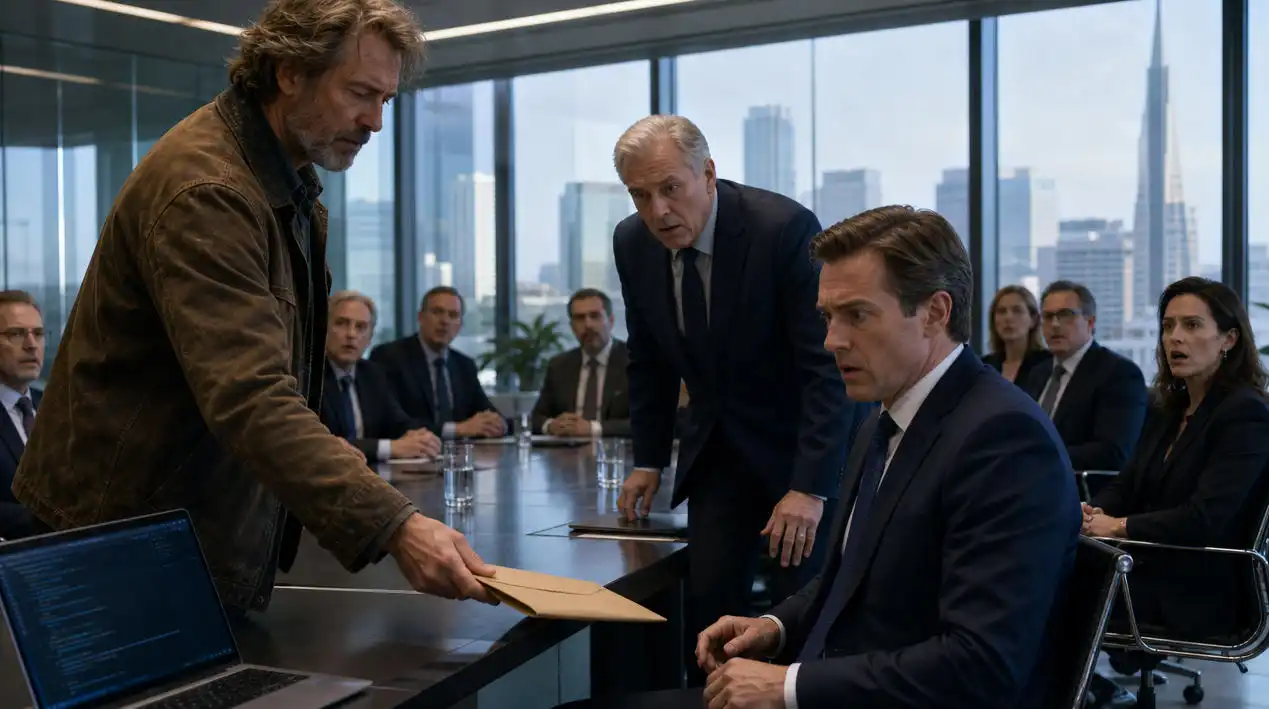
The boardroom did not move.
Not Kevin.
Not the CEO.
Not the security guard still standing behind me with one hand near his radio like I was dangerous.
Robert, my stepfather, stood at the end of the long black conference table in that same old brown jacket I had mocked less than ten hours earlier.
And the chairman of our company, a man whose name appeared on Forbes lists and airport lounges, had just bowed to him.
Not nodded.
Bowed.
Kevin’s smile died so fast it looked painful.
The CEO, Martin Hale, cleared his throat.
“Mr. Whitaker,” he said, and his voice cracked on the word “Mister.”
I stared at Robert.
Robert Whitaker.
For twelve years, I had known him as the quiet man who fixed our sink, overcooked steaks on Sundays, and wore sneakers with suit pants because he said comfort mattered after sixty.
To me, he was my mother’s second husband.
A kind man.
A boring man.
An old man.
That morning, I had shoved him into a kitchen cabinet.
I can still hear the sound.
Thud.
My mother crying, “Ethan!”
And me, full of arrogance and fear, yelling, “You don’t know anything about my world!”
Now my world was standing around him like schoolboys caught cheating.
Kevin recovered first.
That was his talent.
He could find confidence the way rats find holes.
“I’m sorry,” Kevin said, smoothing his tie. “I don’t know what kind of intimidation tactic this is, but Ethan was removed for cause. We have evidence he leaked proprietary material.”
Robert looked at him.
Not angrily.
That was worse.
Calmly.
“Do you?”
Kevin blinked.
“Yes. His credentials accessed restricted repositories last night.”
Robert nodded.
“And who told you to say that?”
The room shifted.
Just slightly.
A few board members looked at Kevin.
Kevin laughed once.
“That’s absurd.”
Robert placed the sealed envelope on the table.
Then a second item.
A small black flash drive.
Then a third.
A printed copy of a patent assignment agreement.
I recognized it immediately.
It was the document HR made me sign when I joined the company.
The one Kevin waved in my face whenever I asked for credit.
“Everything you build here belongs to the company,” he used to say. “Don’t get emotional.”
Robert tapped the paper with one finger.
“Ethan’s work may belong to the company,” he said, “but Kevin’s theft, falsified audit trail, and retaliatory termination do not.”
Kevin turned red.
“Who are you?”
Martin Hale, the CEO, answered before Robert could.
“He’s Robert Whitaker.”
Silence.
Kevin looked around, annoyed.
Like the name should mean something to him and he hated that it didn’t.
The chairman finally spoke.
“Robert founded Whitaker Systems.”
A board member sucked in air.
Another whispered, “The security architecture firm?”
Robert gave a tired half-smile.
“I sold it in 2009.”
The chairman said, “For $3.8 billion.”
Kevin’s mouth opened.
No sound came out.
My whole body went cold.
Robert?
Our Robert?
The man I had called an old fossil?
The man who clipped coupons and drove a dented Ford because he said cars were not investments?
That Robert?
He did not look at me.
Maybe he knew I could not survive it yet.
Instead, he looked at the board.
“I don’t work in the industry anymore,” he said. “But I still know people who do. Auditors. General counsel. Investors. Insurance underwriters. Journalists. Patent attorneys. Federal compliance consultants.”
Kevin’s face hardened.
“Are you threatening us?”
“No,” Robert said. “I’m documenting risk.”
It was the most terrifying sentence I had ever heard.
The chairman slowly sat down.
“Robert,” he said carefully, “what exactly do you have?”
Robert opened the envelope.
“First, Ethan’s local build logs from the last eight months.”
Kevin snapped, “Those were on his company laptop. He no longer has access.”
Robert turned to him.
“I said local build logs, Kevin. Not laptop logs.”
Kevin’s eyes flicked toward me.
That was the first crack.
Robert continued.
“Ethan called me twice this month because he suspected someone was copying his architecture. He didn’t believe me when I told him to keep independent evidence. But he did take one piece of advice.”
My throat tightened.
The old external drive.
I had forgotten.
Three weeks earlier, Robert had handed me a small metal drive after dinner.
“Back up your personal notes,” he said.
“I don’t need your Stone Age backup drive.”
“Humor an old man.”
I had rolled my eyes.
But I used it.
Not because I respected him.
Because I was tired, and it was sitting there.
Robert looked at me then.
Just for one second.
Not angry.
Not smug.
Just sad.
That hurt more.
He turned back to the board.
“Second, time-stamped design notes Ethan created at home, before the corresponding internal commits appeared under Kevin’s credentials.”
Martin Hale’s jaw tightened.
Kevin stood up.
“This is ridiculous. Any employee could fabricate notes.”
Robert nodded.
“Correct. That’s why we also have third-party metadata. Cloud sync records. Device hash history. Router logs from Ethan’s home network. Git branch comparisons. And the original architectural diagrams Kevin forgot to delete from his executive folder.”
The room changed.
You could feel it.
Before that moment, people were watching a dispute.
After that moment, they were watching a burial.
Kevin sat down slowly.
The same coworkers who had whispered about me now stood outside the glass walls pretending not to look.
But they were looking.
Everyone was.
That was the thing about a glass office.
Humiliation never stays private.
I remembered how it felt thirty minutes earlier when security dragged me through the lobby.
My ID badge had hit the floor.
A junior analyst named Brianna had stepped back like I was contagious.
Someone had laughed.
Kevin had leaned over the balcony railing and said, “Make sure he doesn’t take anything that belongs to us.”
People recorded it.
People always record the fall.
They rarely record the theft that pushed you.
Robert lifted the flash drive.
“Third, an internal access report prepared by an independent cyber-forensics team at my request.”
Martin’s head snapped up.
“At your request?”
“Yes.”
“You had our system audited?”
“No,” Robert said. “I had Ethan’s devices audited. But your system reached into his accounts, so your fingerprints came with it.”
The general counsel, a woman named Denise, leaned forward.
“Mr. Whitaker, may I see that report?”
Robert did not hand it to her.
“After we discuss preservation of evidence.”
Denise froze.
Then she slowly pulled her hand back.
Robert looked at the chairman.
“If this company destroys, alters, or overwrites relevant logs after today, the legal exposure will not remain internal.”
Kevin shot up.
“This is insane! Ethan was leaking. I saw the transfer.”
Robert looked at him.
“You mean the transfer you initiated from Ethan’s account at 11:42 p.m. using a privileged admin token?”
Kevin stared.
Robert continued.
“The one routed through a maintenance script created from your workstation?”
Kevin’s lips moved.
No words.
“The one that copied files to an external staging folder you controlled, then triggered an alert under Ethan’s credentials?”
Martin turned to Kevin.
“Is that true?”
Kevin threw his hands up.
“How would I know? Tech systems are complicated.”
That line almost made me laugh.
Because Kevin never admitted anything was complicated unless blame was approaching him.
Robert slid the printed audit summary across the table.
Denise read the first page.
Her face changed.
Then she handed it to the chairman.
He read.
The chairman looked at Kevin like he had just found something dead in his expensive rug.
“Kevin,” he said quietly, “did you represent Ethan’s platform as your own work at this morning’s executive demo?”
Kevin swallowed.
“I led the initiative.”
“That is not what I asked.”
“I managed him.”
“That is not what I asked.”
Kevin’s voice sharpened.
“Look, Ethan is talented, but he’s unstable. Everyone knows it. Ask the team. He’s emotional. Defensive. He overreacts.”
Through the glass wall, several employees were gathered now.
The same people who had watched me leave.
Watching him sweat.
Kevin pointed toward them.
“They’ll tell you. They saw his behavior.”
A voice came from the doorway.
“I saw yours.”
Everyone turned.
It was Brianna.
The junior analyst who had stepped away from me in the lobby.
Her hands were shaking, but she kept speaking.
“I’m sorry,” she said to me first.
Then she looked at the board.
“Kevin told us last week Ethan was going to be removed. Before any leak happened.”
Kevin barked, “Brianna, stop talking.”
She flinched.
Robert said gently, “Let her finish.”
Brianna looked at Robert like she had been waiting for permission from someone safe.
“He said Ethan was ‘too attached’ to the project. He said after the demo, Ethan would probably make accusations and we should not engage.”
The room went deadly quiet.
Another employee appeared behind her.
Then another.
A product manager named Leila stepped in.
“Kevin asked me to change the slide deck author fields Friday night,” she said.
Kevin slapped the table.
“You people have no idea what you’re doing.”
That was the moment he lost the room.
Not because he had stolen.
Not because he had lied.
But because, finally, everyone saw the entitlement underneath.
He believed the office belonged to him.
The people belonged to him.
My work belonged to him.
Even the truth was supposed to wait for his permission.
Martin Hale stood.
“Kevin, you are suspended effective immediately.”
Kevin laughed.
“You can’t suspend me in front of my team.”
The chairman said, “We just did.”
Denise added, “And do not leave the building with any device, document, or storage media.”
Kevin looked toward the door.
The same security guard who had grabbed me earlier stepped in front of it.
This time, he did not touch me.
This time, he looked at Kevin.
“Sir,” the guard said, “I’m going to need your badge.”
Kevin’s face twisted.
“You were escorting him out twenty minutes ago!”
The guard looked uncomfortable.
“Yes, sir.”
“Now you’re taking orders from them?”
The guard said nothing.
He just held out his hand.
Kevin ripped the badge from his belt and threw it on the table.
It slid across the glossy surface and stopped in front of me.
I stared at it.
The badge looked smaller than mine had on the lobby floor.
Robert finally turned to me.
“Ethan,” he said, “pick it up.”
I looked at him.
“I don’t want it.”
“I know.”
“Then why?”
“Because nobody gets to throw dignity at your feet and decide you should leave it there.”
My hands shook as I picked up Kevin’s badge.
Not as revenge.
As proof.
Proof that power is often just a costume until truth walks in wearing an old jacket.
The next week was ugly.
That is the part people skip when they tell stories like this.
They want the boardroom moment.
The gasp.
The bow.
The villain turning pale.
But consequences take paperwork.
They take depositions.
They take lawyers using calm voices to say devastating things.
The company hired an outside investigation firm.
Robert insisted on it before he advised me to sign anything.
Yes, advised.
Not controlled.
Not commanded.
He sat beside me in meetings, but he never spoke over me.
When Denise asked me a question, he stayed quiet unless I looked at him.
That made me feel worse.
Because all my life, I had mistaken quiet support for weakness.
I thought Robert stayed calm because he had nothing to say.
The truth was he stayed calm because he had learned which words mattered.
The investigation found everything.
Kevin had been copying my architecture notes for months.
He had created a private folder labeled “K_STRATEGY_FINAL,” where he stored pieces of my design and rewrote them in executive language.
He had pressured Leila to remove my name from the demo slides.
He had told the CEO I was “difficult” and “a flight risk.”
Then, after realizing I might object publicly, he staged the leak.
He used an admin token from a legacy maintenance account.
He copied restricted files into a staging area.
He triggered an alert.
Then he walked into the office the next morning and pretended to be shocked.
But he made one mistake.
Arrogant people always do.
He scheduled the maintenance script from his own workstation because he thought no one would ever look closely.
He thought the company needed him too much.
He thought I was too young.
He thought Robert was too old.
He was wrong on all three.
By Friday, Kevin was terminated for cause.
Not “transitioned.”
Not “moving on to new opportunities.”
Terminated.
His equity grant was frozen pending civil claims.
His pending promotion vanished.
The company filed a claim with its insurer, but the insurer flagged Kevin’s conduct as intentional misconduct.
The startup he had secretly been courting as an advisor withdrew its offer.
Two venture firms removed him from advisory boards.
His professional references evaporated.
Then came the worst part for him.
The chairman sent a confidential notice to industry partners stating that Kevin had been dismissed following substantiated findings of intellectual property misappropriation, retaliation, and falsified internal security reports.
No insults.
No drama.
Just facts.
Facts travel faster than gossip in Silicon Valley.
Within a month, Kevin’s consulting LLC lost its two biggest clients.
Within three months, he filed for personal bankruptcy after legal fees and clawbacks buried him.
I never cheered.
Not because I felt sorry for him.
Because watching a man get crushed by the machine he used against others is not funny.
It is sobering.
He built his career on fear.
Then fear collected interest.
As for the company, they tried to settle quietly.
Robert warned me before the first offer.
“They’ll offer comfort before they offer fairness.”
He was right.
The first number was insulting.
The second was better.
The third came after my attorney presented the full forensic timeline and witness statements.
I received compensation for wrongful termination, retaliation, and reputational harm.
The company issued a formal written apology.
My employment record was corrected.
Every internal announcement about the product was revised to name me as the lead architect.
Then Martin Hale asked me to come back.
I said no.
At first.
I was too angry.
Too embarrassed.
Too tired.
But then the chairman asked for a private meeting.
Robert came with me.
This time, I wanted him there.
The chairman looked older than he had in the boardroom.
“I failed you,” he said.
I did not expect that.
Executives usually say, “Mistakes were made.”
He said, “I failed you.”
Then he said something else.
“Companies like ours love the word innovation. But innovation dies when managers can steal from quiet builders. I want you to rebuild the engineering culture here.”
I laughed.
It came out bitter.
“You want the guy who was dragged out by security to fix your culture?”
“Yes,” he said. “And I want every person who watched it to see us admit we were wrong.”
Robert looked at me.
Not pushing.
Just waiting.
I thought about Kevin on the balcony.
I thought about my badge on the floor.
I thought about Brianna trembling in the doorway.
And I thought about every quiet engineer who has ever watched someone louder take credit.
“I’ll come back,” I said, “on conditions.”
The chairman folded his hands.
“Name them.”
“No retaliation against anyone who testified.”
“Agreed.”
“Public correction inside the company.”
“Agreed.”
“Independent reporting channel outside Kevin’s old chain.”
“Agreed.”
“Leila and Brianna get protected status and written commendations.”
“Agreed.”
“And security apologizes to me in the same lobby where they dragged me out.”
The room went still.
Martin looked uncomfortable.
Robert’s mouth twitched.
Not quite a smile.
The chairman said, “Agreed.”
So the following Monday, I walked back into the same lobby.
Same marble floor.
Same glass walls.
Same badge scanners.
Only this time, the company had gathered everyone.
Not forced.
Invited.
Most came.
The security guard who had grabbed my arm stood at the front.
His name was Paul.
He looked miserable.
“I followed an order based on false information,” he said. “But I still treated you without dignity. I’m sorry.”
I nodded.
“Thank you.”
Then Martin Hale stood in front of the whole company and said:
“Ethan Cole did not leak company data. He was falsely accused. His work was misappropriated. The company failed to protect him, and we are correcting that failure publicly.”
People stared at the floor.
Some cried.
Brianna did.
Leila stood beside her.
Then Martin said:
“Effective today, Ethan Cole will serve as Director of Technical Architecture.”
A murmur went through the lobby.
Director.
Not because Robert demanded it.
Not because the board felt guilty.
Because the product I built worked.
Because the evidence proved the truth.
Because sometimes the person they drag out is the one holding the foundation together.
Robert stood in the back.
Old jacket.
Hands in pockets.
Trying not to be noticed.
After the announcement, people came up to me.
Some apologized.
Some avoided my eyes.
One man from finance said, “I should have said something.”
I told him, “Next time, do.”
That was all.
No speech.
No forgiveness parade.
Just a line drawn.
Then I walked to the back of the lobby.
Robert looked at me.
“You okay?”
I shook my head.
“No.”
He nodded.
“That’s honest.”
“I’m sorry,” I said.
He looked away.
For the first time since I had known him, he looked close to breaking.
“I pushed you,” I said. “I called you useless. I made you feel small in your own home.”
Robert swallowed.
“You were scared.”
“That’s not an excuse.”
“No,” he said softly. “It isn’t.”
That hurt.
But I needed it.
I said, “Why did you still come?”
He looked at me like the answer was obvious.
“Because you’re my son.”
I had spent years calling him my stepfather.
Not cruelly.
Just accurately, I thought.
But standing there in the lobby where my life had been ripped apart and handed back to me, that word felt too small.
I hugged him.
At first, he froze.
Then he hugged me back.
My mother later told me he cried in the garage that night where no one could see.
That sounded like him.
A month later, I became Director of Technical Architecture officially.
Six months later, the product launched under its real history.
My name was on the patent filings.
Leila became product lead.
Brianna transferred into trust and safety, where she now helps review retaliation claims.
The company changed.
Not perfectly.
Companies do not become moral overnight.
But people started speaking sooner.
Managers started documenting credit.
Engineers started backing up meeting notes.
And every year, during onboarding, the company now teaches a module called “Attribution and Retaliation Risk.”
They do not use Kevin’s name.
They do not need to.
Everyone knows.
Kevin tried to come back through a small vendor contract the next year.
Procurement rejected him.
Then another company called me for an informal reference.
I did not insult him.
I did not exaggerate.
I just said, “Ask for the findings from his prior termination before you put him near anyone’s intellectual property.”
They thanked me.
He did not get the role.
Some people called that blacklisting.
I call it consequences.
As for Robert, he still wears that old jacket.
Even though I offered to buy him a new one.
He says it has “good pockets.”
Every Friday after work, I stop at Tony’s and bring home his favorite pizza.
Pepperoni.
Extra mushrooms.
Light sauce.
The first time I did it, he laughed.
“What’s this?”
“Payment plan,” I said.
“For what?”
“For being an idiot.”
He opened the box and smiled.
“Going to take a lot of pizza.”
“I figured.”
Now it is our routine.
Friday night.
Pizza.
Old movies.
My mother pretending she is not listening when Robert and I talk about systems architecture.
And sometimes, when he explains something brilliant, I still feel a sting of shame.
Not the kind that destroys you.
The kind that teaches you.
Because I had looked at a quiet man in an old jacket and decided he had nothing to offer.
Kevin looked at me the same way.
That is the poison.
It travels downward unless someone stops it.
Robert stopped it.
Not by screaming.
Not by humiliating Kevin for fun.
But by using records, rules, witnesses, and truth.
The legal hammer landed clean.
And when it did, every person in that glass tower learned the same lesson at the same time:
Never confuse kindness with weakness.
Never confuse silence with ignorance.
And never, ever steal from someone just because you think no one powerful loves them. ⚖️
So choose a side:
Was Robert right to save me after I disrespected him, or should he have let me fall so I could learn the hard way? Share this if you believe quiet people deserve respect before the world finds out who they are.
Disclaimer: Mention of any brand or trademark is for identification only and does not imply partnership or endorsement
The Tavern Owner Set A Trap To Make Paul Drink Again… But He Had NO IDEA The Entire Town Was Watching 👀
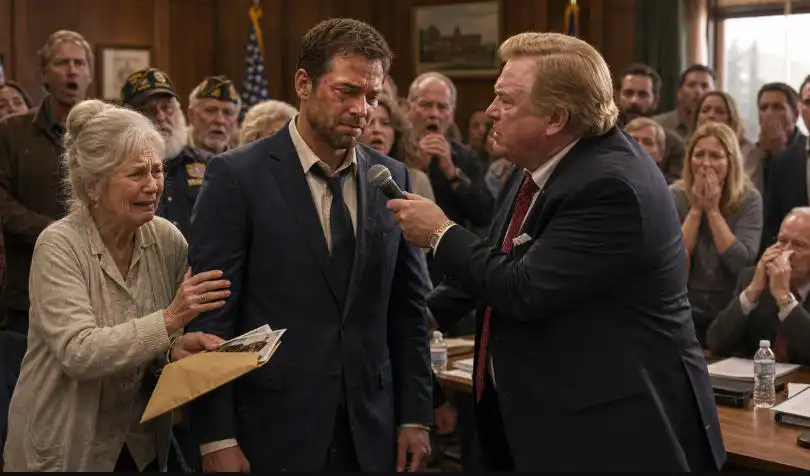
They Laughed When Mark Announced He Was Running for Office… Then One Sealed Envelope Made the Whole Room Go Silent 😳

My Stepdaughter Thought Her Real Father Paid for Her Golf Club Wedding… Then I Showed the Guests the Letter He Sent Me