
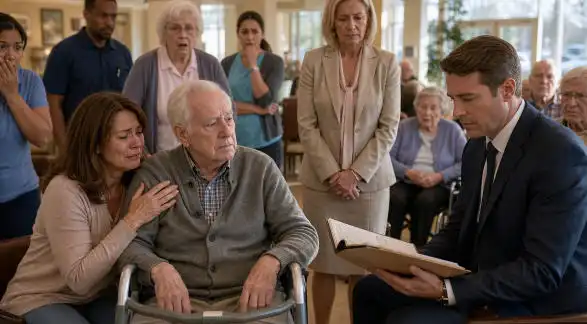

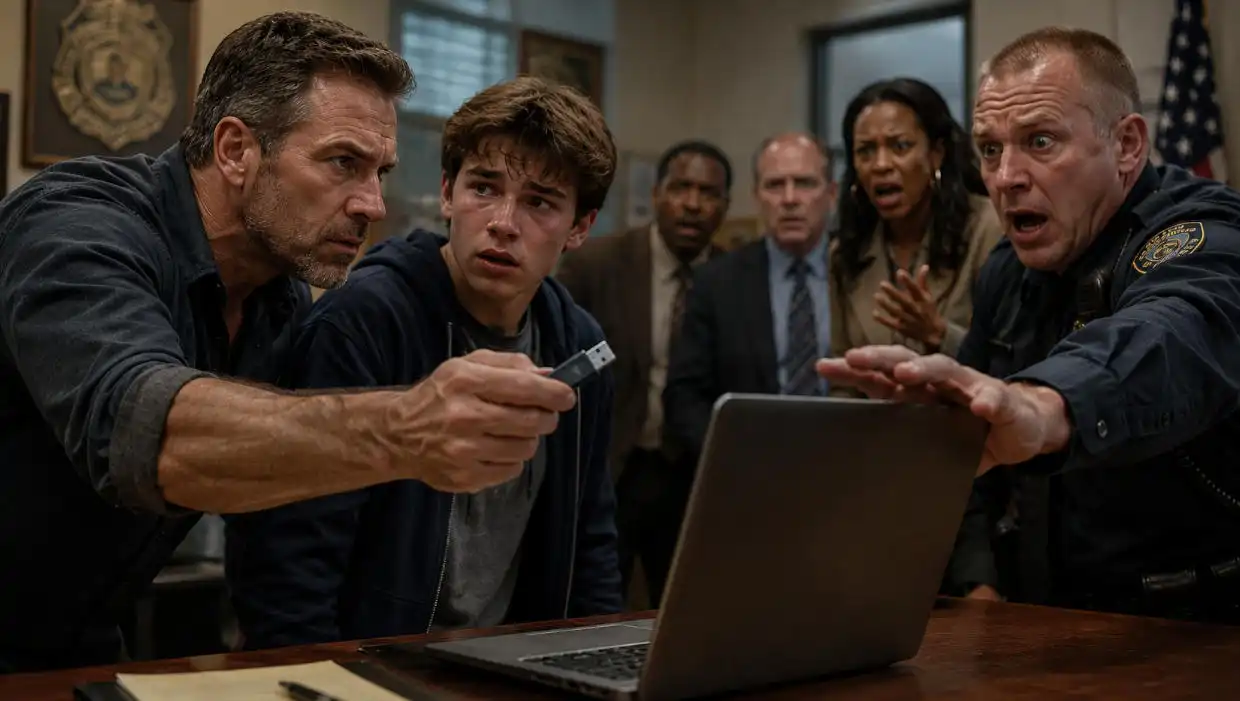
The screen flickered once.
Officer Reeves reached for the laptop like a man trying to stop a fire with his bare hands.
I moved my arm in front of him.
“Don’t touch it,” I said.
Nobody breathed.
Tyler stood beside me with his hoodie sleeves pulled over his hands, looking smaller than any 16-year-old should ever look inside a police chief’s office.
That morning, the whole school had watched him get treated like trash.
Not questioned.
Not protected.
Displayed.
A public warning.
A lesson for anyone poor enough, scared enough, or unpopular enough to be useful.
Officer Reeves had shoved him against the locker so hard the metal door rattled.
“Open it,” he barked.
Tyler’s voice cracked. “I didn’t do anything.”
Marcus “King” Bell laughed from six feet away.
Marcus was the kind of teenager adults called “troubled” when they were afraid of him, and “promising” when his mother was standing nearby in designer sunglasses.
He had money.
A following.
Older boys who waited for him near the alley after school.
And a school full of kids who lowered their eyes whenever he walked past.
Tyler had been trying to impress him for months.
Wrong friends.
Wrong attitude.
Wrong kind of pride.
At home, he had acted like I was the enemy.
I was his stepfather, William Carter.
Not rich.
Not flashy.
Just a 49-year-old man with cracked hands, bad knees, and an old Ford I kept alive with prayer and spare parts.
Tyler had made sure everyone knew what he thought of me.
Three days before the locker search, he scratched a long line down the driver’s side of my car with a key.
Right in our driveway.
When I came outside, he was standing there with two boys from school, pretending not to care.
His mother, Denise, gasped.
“Tyler!”
He looked straight at me and said, “What? It’s not like it’s worth anything.”
I stared at the scratch.
Silver paint curled up from the door like a wound.
Then Tyler said it louder, so the boys could hear.
“You’re not my dad anyway.”
The boys laughed.
Denise put a hand over her mouth.
I didn’t yell.
I didn’t grab him.
I didn’t tell him how many double shifts I had worked so his mother could sleep at night.
I just said, “Go inside.”
He rolled his eyes.
“Whatever, William.”
Not Dad.
Not sir.
William.
That one word hurt more than the scratch.
But pain does not excuse giving up on a child.
Especially when that child is trying so hard to look grown that he forgets he is still a child.
The next morning, the school called at 9:13 a.m.
Denise answered.
I watched her face change.
“What do you mean police?”
Then she looked at me.
Her lips barely moved.
“It’s Tyler.”
By the time we reached Detroit Central High, two patrol cars were outside, and the hallway near the junior lockers was packed.
Kids were whispering.
Some were recording.
A few were grinning because cruelty always finds an audience.
Tyler was against the lockers with Officer Reeves standing in front of him.
Reeves was a broad man with a shaved head and a polished badge.
He liked that badge.
You could tell by the way he tapped it when he talked to parents.
Like it made him taller.
Like it made every sentence he said automatically true.
Principal Hanley stood nearby, sweating through a pale blue shirt.
He was the kind of man who said “zero tolerance” when he meant “I don’t want trouble.”
On the floor was Tyler’s backpack.
His notebooks were scattered open.
A cracked phone case.
A pencil pouch.
A small family photo from last Thanksgiving.
Tyler, Denise, me, and his little half-sister, Molly.
The picture had landed face-up near Marcus’s shoe.
Marcus looked down and smirked.
“Cute family,” he said.
Tyler lunged half an inch before Reeves shoved him back.
“Don’t make it worse,” Reeves snapped.
I stepped forward.
“What exactly was found?”
Reeves looked me over.
Work jacket.
Old boots.
Grease under one fingernail from fixing the Ford’s alternator before sunrise.
His expression said he had already decided what kind of man I was.
“Controlled substances,” he said. “In his locker.”
“Show me.”
Reeves gave a short laugh.
“This isn’t a parent-teacher conference.”
Denise said, “He’s a minor.”
Principal Hanley lifted both hands. “Mrs. Carter, we are following procedure.”
“Procedure?” I asked.
That made Reeves turn.
“You need to calm down.”
I was calm.
That bothered him.
Men like Reeves expect anger from people they plan to dismiss.
They know what to do with shouting.
They do not know what to do with quiet.
Marcus leaned against the lockers like he owned the hallway.
“Maybe your boy’s not as innocent as you think,” he said.
Then he looked at Tyler and smiled.
“Should’ve paid attention.”
Tyler’s face went white.
Not guilty-white.
Recognizing-something-white.
I saw it.
I saw the fear land in him.
Not fear of school discipline.
Fear of Marcus.
I looked at my stepson.
“Tyler,” I said, “did you put anything in that locker?”
His eyes filled.
“No.”
Reeves snorted.
“Of course he says that.”
I looked at the locker.
Then the hallway.
Then the ceiling.
Central High had cameras near the main office, the cafeteria, and the entrance.
But that junior hallway had a blind spot near the old trophy case.
I knew because two years earlier, the district had asked for a quote to upgrade their security system.
They never approved the job.
Too expensive.
Too much paperwork.
Too easy to ignore until a child’s future was on the floor.
But I also knew something the school did not.
The alley behind the vocational wing had businesses with private cameras.
A barber shop.
A liquor store.
A closed tire place.
And a small market owned by a man named Mr. Alvarez, whose alarm system I had serviced after two break-ins.
The school had blind spots.
The neighborhood did not.
I turned back to Tyler.
“Did Marcus say anything to you this morning?”
Tyler looked at Marcus.
Marcus smiled wider.
Reeves stepped closer.
“That’s enough.”
It was not enough.
But I stopped talking.
Not because I believed them.
Because I understood the room.
A stepfather yelling in a school hallway becomes “aggressive.”
A scared teenager crying becomes “guilty.”
A principal hiding behind policy becomes “professional.”
And a bully with a clean jacket becomes “a student with potential.”
So I did what I have learned to do when the system is waiting for you to lose control.
I shut my mouth.
I watched.
I memorized.
Reeves bagged the evidence himself.
That mattered.
He did not let the responding officer do it.
He did not let anyone else touch it.
He held the little clear bag between two fingers like a trophy.
Marcus watched him do it.
Their eyes met for half a second.
Half a second is not proof.
But it is enough to make a good man start digging.
At the station, they kept saying “possession with intent.”
“Felony.”
“School zone.”
“Serious consequences.”
Each phrase hit Denise like a hammer.
Tyler sat with his head down.
He had stopped trying to look tough.
He looked sixteen.
Just sixteen.
At one point, he whispered, “Mom, I’m sorry.”
Denise took his hand.
“For what?”
“For everything.”
I heard him.
But I did not turn it into a speech.
A scared child does not need a lecture while his life is cracking open.
He needs an adult who does not leave.
So I told Denise, “Stay with him.”
She grabbed my sleeve.
“Where are you going?”
“To check something.”
Reeves heard me from across the room.
His head lifted.
“Mr. Carter, I wouldn’t interfere with an investigation.”
I looked at him.
“I’m not.”
Then I walked out.
Detroit in late October has a way of making every alley look like it is keeping secrets.
The sky was low.
The pavement was wet.
Behind Central High, the alley smelled like oil, old leaves, and somebody’s cigarette.
I started with the barber shop.
No camera covering the school gate.
Then the liquor store.
Camera broken.
Of course.
Then the tire place.
Closed six months.
The old camera was still mounted over the back door, but no power ran to the building.
Then I crossed to Alvarez Market.
Mr. Alvarez was behind the counter, reading a newspaper with reading glasses low on his nose.
He looked up.
“William?”
“I need a favor.”
His smile disappeared when he saw my face.
“What happened?”
“My stepson may have been framed at school.”
He came around the counter without asking another question.
Good people still exist.
They are just usually quieter than the bad ones.
The back office smelled like coffee and cardboard boxes.
A dusty monitor sat beside a stack of invoices.
Mr. Alvarez clicked through footage.
The camera over his rear delivery door covered the alley, the school’s side gate, and part of the vocational wing entrance.
At 7:03 a.m., Marcus Bell appeared.
Varsity jacket.
Black backpack.
Two older boys with him.
One had a red hoodie.
The other had a tattoo on the side of his neck.
A small crown with a line through it.
I leaned closer.
I knew that tattoo.
Not personally.
But I had seen it.
Two months earlier, I installed cameras for a diner on Gratiot after they were robbed.
The owner showed me footage of the same tattooed man collecting envelopes from teenagers near the back lot.
He said, “Everybody knows who he is. Nobody says his name.”
His name was Darnell Price.
Street name: Dice.
A local dealer who used kids because kids were easier to scare.
On Alvarez’s screen, Marcus took something from Dice.
Small.
Wrapped.
Then Marcus looked toward the school door.
At 7:08, Officer Reeves appeared in the same alley.
Not patrolling.
Not responding.
Waiting.
Marcus walked toward him.
They spoke for twelve seconds.
Marcus handed Reeves something flat.
An envelope.
Reeves put it inside his jacket.
My stomach went cold.
Mr. Alvarez whispered, “Lord have mercy.”
I said, “Keep recording.”
At 7:12, Marcus slipped through the side entrance with his backpack.
At 7:19, Tyler entered the building through the front doors on a different camera angle from the school entrance.
Different time.
Different door.
At 7:26, Reeves walked into the junior hallway.
At 7:31, the “random search” started.
Random.
That word makes evil sound clean.
I asked Mr. Alvarez for a copy.
He burned the footage to a USB.
Then he did something I will never forget.
He printed a receipt from his register showing the time stamp and wrote on the back:
“I, Miguel Alvarez, confirm this footage came from my store camera on this date.”
He signed it.
Then he looked at me.
“William, be careful.”
I nodded.
“I am.”
But that was only half true.
Because the next stop was not careful.
It was necessary.
I drove to the diner on Gratiot.
The owner, Mrs. Whitaker, was a woman in her sixties who had no patience for foolishness and even less for criminals using children.
When I asked about the tattoo, she locked the front door and pulled up her archived footage.
There he was.
Dice.
Same tattoo.
Same red hoodie.
Same way of standing like the world owed him fear.
In one clip, Marcus stood beside him.
In another, two Central High students handed over cash.
Mrs. Whitaker shook her head.
“They’ve been using that school for months.”
“Did you report it?”
“To who?” she said bitterly. “One officer came by and told me to stop making accusations unless I wanted trouble near my business.”
“Was it Reeves?”
She clicked another file.
There he was.
Officer Reeves, standing near her back door, talking to Dice like they were old friends.
My throat tightened.
Not because I was surprised.
Because Tyler had been one locker away from becoming another name buried under “procedure.”
I asked for copies.
Mrs. Whitaker gave them to me.
Then she said, “That boy yours?”
I paused.
“He’s my wife’s son.”
She stared at me over her glasses.
“That’s not what I asked.”
I thought about Tyler scratching my car.
I thought about him saying I was not his dad.
I thought about him looking at me in that hallway like he had fallen into deep water and suddenly realized I was the only one reaching in.
“Yes,” I said.
“He’s mine.”
By 5:30 p.m., Denise called.
Her voice shook.
“They’re saying Tyler might be transferred tonight.”
“No,” I said.
“William—”
“No. Tell them I’m on my way.”
When I got back to the station, Marcus’s mother was already there.
Her name was Simone Bell.
She wore a cream coat, gold earrings, and the expression of a woman who believed volume was proof.
“My son is a student athlete,” she told the desk sergeant. “He is not going to be slandered by some delinquent trying to save himself.”
Tyler sat nearby.
His eyes were red.
Denise had one arm around him.
Principal Hanley hovered with his phone in his hand, pretending to be busy.
Officer Reeves stood near the hallway doors.
When he saw me, his jaw tightened.
“What is he doing here?” Simone said.
I looked at the desk sergeant.
“I need to speak to the chief.”
Reeves laughed.
“The chief?”
“Yes.”
“You don’t get to demand—”
The desk sergeant looked at the USB in my hand.
Then he looked at my face.
Maybe he had been doing this long enough to recognize when a quiet man was carrying something heavy.
He made a call.
Ten minutes later, we were inside Chief Marlene Brooks’s office.
Chief Brooks was a woman in her late fifties with silver at her temples and eyes that did not waste time.
She had known my late father years ago.
Not as friends.
As men and women in Detroit know each other after enough funerals, block meetings, and bad winters.
She pointed to the chairs.
“Sit.”
I stayed standing.
Tyler sat.
Denise sat beside him.
Principal Hanley sat like a man hoping furniture could hide him.
Reeves did not sit.
Neither did Simone.
Marcus stood beside his mother, hands in his pockets, acting bored.
Chief Brooks looked at me.
“Mr. Carter, I was told you have evidence.”
“I do.”
Reeves cut in. “Chief, this is highly inappropriate. He’s emotionally involved.”
I looked at Reeves.
“You searched my stepson’s locker at 7:31 this morning.”
“That’s correct.”
“You said the search was based on an anonymous tip.”
“It was.”
“You bagged the evidence yourself.”
“That is standard.”
Chief Brooks looked at him.
“Let him finish.”
I plugged the USB into the laptop on her desk.
That was when Reeves moved.
Not fast enough to look innocent.
Not slow enough to pretend.
His hand reached toward the computer.
I blocked him.
“Don’t touch it.”
The room went silent.
The first frame appeared.
Alley camera.
7:03 a.m.
Marcus.
Dice.
The red hoodie.
The small package.
Simone frowned.
“That doesn’t prove anything.”
I said nothing.
The video kept playing.
Marcus took the package.
Dice spoke close to his ear.
Marcus nodded.
Then Officer Reeves entered the frame.
Reeves went pale.
Chief Brooks leaned forward.
Nobody in that room blinked.
On the screen, Marcus handed Reeves the envelope.
Reeves put it in his jacket.
Tyler whispered, “Oh my God.”
Denise covered her mouth.
Simone said, “That could be anything.”
Chief Brooks did not look at her.
She looked at Reeves.
“What was in the envelope?”
Reeves swallowed.
“Chief, I can explain.”
That sentence is the sound of a guilty man realizing silence would have been smarter.
I clicked the next file.
Mrs. Whitaker’s diner footage.
Dice.
Marcus.
Two Central High students.
Cash changing hands.
Then Reeves standing behind the diner, talking to Dice.
The time stamps ran across the bottom like a judge reading a sentence.
Chief Brooks picked up her phone.
“Lieutenant Grant. My office. Now. Bring Internal Affairs.”
Reeves said, “Chief, wait—”
“Do not speak,” she said.
Marcus finally stopped smiling.
His mother looked at him.
“Marcus?”
He stared at the floor.
That was the first honest thing he had done all day.
Chief Brooks turned to Tyler.
“Son, did anyone threaten you?”
Tyler’s lips trembled.
He looked at Marcus.
Then at Reeves.
Then at me.
I nodded once.
Not pushing.
Just there.
Tyler took a breath.
“Marcus told me if I didn’t hold a package for him, he’d make sure my little sister got followed home.”
Denise made a sound like she had been struck.
Tyler kept going.
“I said no. He said I’d regret it. This morning he walked past me and said, ‘Check your locker, hero.’ I thought he was just messing with me.”
Chief Brooks wrote that down.
I asked gently, “Why didn’t you tell anyone?”
Tyler’s voice broke.
“Because Officer Reeves was always talking to him. I thought nobody would believe me.”
There it was.
The whole rotten machine.
A dealer using kids.
A bully using fear.
A corrupt officer using a badge.
A principal using policy as a shield.
And my stepson sitting in the middle, ashamed not only of being framed, but of needing help from the man he had spent months rejecting.
Internal Affairs arrived.
Then two detectives.
Then another officer asked Reeves to remove his badge and duty weapon.
He stared at Chief Brooks.
“You’re making a mistake.”
Chief Brooks said, “No. I’m correcting one.”
They escorted him out in front of everyone in the station lobby.
Not violently.
Not dramatically.
Just firmly.
But sometimes firm justice is louder than shouting.
Parents waiting on benches turned to watch.
Officers stopped typing.
Reeves walked past Tyler and would not look at him.
Marcus tried to back toward the door.
A detective blocked him.
“Marcus Bell, you need to come with us.”
Simone exploded.
“He’s a minor! He has rights!”
Chief Brooks said, “And so did Tyler Carter.”
That shut the room down.
Tyler looked at me when she said Carter.
Not Tyler Bennett, his legal last name.
Not “the suspect.”
Tyler Carter.
It was not official.
It was not paperwork.
But it landed.
Marcus was not dragged away like some movie villain.
He was taken to juvenile processing.
His mother followed, shouting into her phone, calling lawyers, blaming “bad influences,” blaming the school, blaming everyone except the boy who had laughed while another child’s life nearly burned.
Later, the full investigation moved fast because the footage gave detectives a starting point.
They got warrants.
They pulled call logs.
They found messages between Marcus, Dice, and Reeves.
They found payments.
They found a list of lockers.
Not just Tyler’s.
Six students had been used, threatened, or set up over the past year.
Three had already been suspended.
One had dropped out.
Another had been too afraid to come back to school.
The campus drug network was not a rumor.
It was a pipeline.
Dice recruited through fear.
Marcus enforced it through status.
Reeves protected it through silence and false reports.
And Principal Hanley?
He had ignored warning signs because Marcus brought attention to the basketball program and because Reeves told him everything was “under control.”
That phrase again.
Under control.
It usually means the wrong person is holding the controls.
Within two weeks, Reeves was stripped of his badge and charged.
Dice was arrested after a raid connected him to distribution near multiple schools.
Marcus was sent to juvenile detention while the court sorted through the damage he had caused.
Principal Hanley resigned before the school board hearing finished.
The district announced new camera coverage, independent evidence handling rules, and a parent review panel.
They said it was about “restoring trust.”
I was glad.
But I also knew trust is not restored by press releases.
It is restored one protected child at a time.
As for Tyler, the charges disappeared.
The school tried to welcome him back quietly.
I refused quietly.
Denise refused quietly.
So did Chief Brooks.
At the next school board meeting, Tyler walked into the auditorium with his mother on one side and me on the other.
The same parents who had whispered about him now turned to look.
Some looked ashamed.
Some looked curious.
Some looked like they had already rewritten the story in their heads so they would not feel guilty for believing the worst.
Tyler wore a clean shirt.
His hands shook a little.
When public comments opened, he stood.
I leaned toward him.
“You don’t have to.”
He looked at me.
“I know.”
Then he walked to the microphone.
“My name is Tyler Bennett,” he said.
His voice trembled.
“I was accused of something I didn’t do. A lot of people filmed me. A lot of people laughed. A lot of adults believed the easiest story because it was convenient.”
The room went still.
He swallowed.
“I also made mistakes before that. I treated someone badly who didn’t deserve it.”
He turned from the microphone and looked at me.
“In front of people, I said William wasn’t my dad.”
My chest tightened.
Tyler looked back at the board.
“But when everybody else saw me as a problem, he saw me as his son.”
Denise started crying.
I looked down because I was not going to cry in front of a school board.
Then Molly, who was seven and had no respect for a man’s pride, climbed onto my lap and whispered, “You’re crying.”
“I am not.”
“You are.”
I wiped my eye.
“Dust.”
“There’s no dust.”
Children are brutal.
Tyler continued.
“I want this school to stop treating scared kids like criminals before anyone asks who scared them.”
No shouting.
No drama.
Just truth.
And truth can embarrass a room more deeply than anger ever could.
After the meeting, parents came up to apologize.
Some to Tyler.
Some to Denise.
A few to me.
I accepted the ones that sounded real.
I ignored the ones that sounded like reputation management.
In the parking lot, Tyler stopped beside my Ford.
The scratch was still there.
Long.
Ugly.
Catching the light under the streetlamp.
He stared at it.
“I’ll fix it,” he said.
I said, “You don’t know how.”
“I can learn.”
That was the first time all year he had said something without trying to sound cool.
So the next Saturday, we went to a parts store.
I bought sandpaper, primer, touch-up paint, and cheap coffee.
He paid for half with money from mowing Mrs. Whitaker’s lawn.
We spent four hours in the driveway.
He complained twice.
I made him redo the sanding once.
He got paint on his hoodie.
Molly laughed at him from the porch.
Denise took pictures when she thought we were not looking.
Near sunset, Tyler stepped back and looked at the repair.
It was not perfect.
But it was honest.
He said, “I’m sorry.”
I kept wiping the rag over the door.
“I know.”
“No, I mean… for all of it.”
I nodded.
“I know.”
He looked at me.
“Why did you help me after what I said?”
I stopped.
Because that was the question under all the other questions.
The one he had been afraid to ask.
I leaned against the Ford.
“My father wasn’t perfect,” I said. “But he told me something when I was young. He said, ‘A man doesn’t become family when it’s easy. He becomes family when leaving would make sense, and he stays anyway.’”
Tyler looked away.
His eyes filled.
“I don’t know how to be better.”
“That’s fine,” I said.
“Nobody starts knowing.”
He laughed a little through his nose.
Then he said, very quietly, “Could you teach me?”
I looked at the repaired scratch.
Then at him.
“Yeah,” I said. “I can do that.”
A year later, Tyler stood on a stage in the school gym.
Different principal.
Different school resource officer.
New cameras in the hall.
He had pulled his grades up from barely passing to honor roll.
He volunteered with a youth safety program Chief Brooks helped start.
He spoke to freshmen about pressure, fear, and the cost of trying to impress the wrong people.
He did not pretend to be perfect.
That was what made younger kids listen.
At the end of his junior year, he came home with a folder.
He set it on the kitchen table.
Inside was information about police academy requirements.
Not because he wanted power.
Not because he wanted a badge to feel big.
Because he wanted to be the kind of officer Reeves should have been.
Denise read the papers and cried again.
Molly said, “Everybody cries in this house.”
Tyler looked at me.
“What do you think?”
I thought about the hallway.
The locker.
The camera footage.
The USB.
The way his voice sounded when he said, “I didn’t do it.”
Then I thought about the board meeting.
The driveway.
The paint on his hoodie.
The boy who once called me William like an insult now standing in my kitchen asking my opinion like it mattered.
“I think,” I said, “you’d better learn how to write a clean report.”
He grinned.
“Yes, sir.”
Sir.
Not William.
Not babysitter.
Not stranger.
Sir.
A few months later, on Father’s Day, Tyler gave me a small box.
Inside was a keychain.
Nothing expensive.
Just a metal tag engraved with five words:
Thanks for staying, Dad.
I had faced down dealers, a corrupt cop, an angry mother, and a police chief’s office full of silence.
But that keychain almost took me out.
I keep it on the Ford keys now.
The scratch is still faintly visible if you know where to look.
I never had it professionally repaired.
People ask why.
Because some scars are not there to shame you.
Some are there to remind you what love survived.
So here’s the line I still stand on:
A child who messes up still deserves the truth.
A man who is rejected can still choose loyalty.
And any adult who uses a badge, a title, or a reputation to crush a kid should lose the privilege of being trusted.
William did not save Tyler because Tyler had earned it.
He saved him because family is not a reward for perfect behavior.
Family is the hand that reaches for you when everyone else has decided you are not worth reaching for. ⚖️
Share this if you believe William did the right thing.
And pick a side: was he too forgiving, or was that exactly what a real father does?
Disclaimer: Mention of any brand or trademark is for identification only and does not imply partnership or endorsement
The Tavern Owner Set A Trap To Make Paul Drink Again… But He Had NO IDEA The Entire Town Was Watching 👀
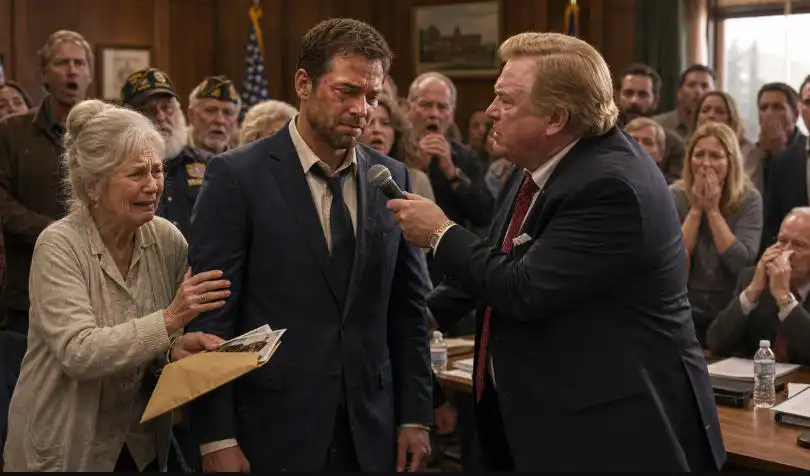
They Laughed When Mark Announced He Was Running for Office… Then One Sealed Envelope Made the Whole Room Go Silent 😳

My Stepdaughter Thought Her Real Father Paid for Her Golf Club Wedding… Then I Showed the Guests the Letter He Sent Me