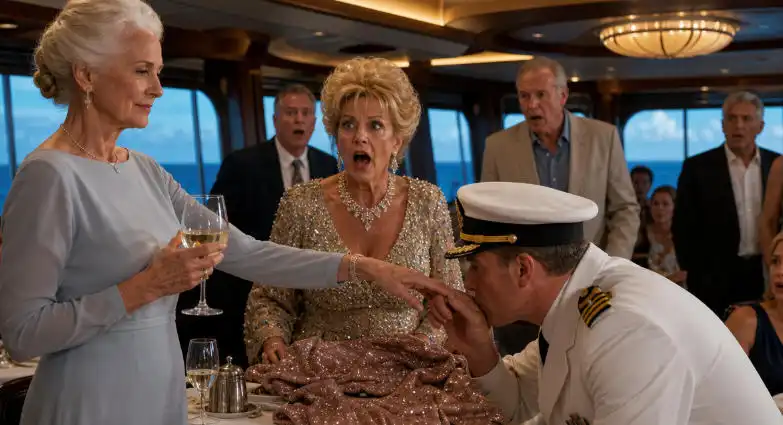




Then the attorney stepped forward with the sealed envelope.
The dock went so quiet that even the soft slap of water against the yacht sounded loud.
Jack’s smile disappeared, but only for a second.
He forced it back onto his face, lifted both hands like this was all some misunderstanding, and said, “Mother… what is this?”
Katherine Whitmore did not answer him.
Not yet.
She stood beneath the yacht club lights in a navy suit that fit like armor, with rain still shining on the dock behind her.
Three nights earlier, that same dock had treated her like trash.
Three nights earlier, her own son had looked into her eyes and pretended not to know her.
Three nights earlier, champagne guests had watched a seventy-year-old woman get shoved, laughed at, and called a crazy beggar.
Now those same guests were staring at her pearls.
Her private security.
Her attorneys.
And the sealed envelope in the lawyer’s hand.
Jack swallowed.
“Mom,” he said, softer this time. “You should’ve called me. I was worried sick.”
Mary, standing near the edge of the crowd in a plain black dress she had worn to church and funerals, made a sound under her breath.
Not a laugh.
Not a cry.
Something in between.
Because Mary had been the one walking through Seattle rain with a flashlight at midnight.
Mary had been the one calling hospitals.
Mary had been the one driving through old blocks where the streetlights flickered and strangers yelled from porches.
Mary had been the one who found Katherine at a bus stop, soaked to the skin, holding an empty paper cup.
Jack had been on this yacht.
Drinking.
Laughing.
Telling rich men he was about to control a shipping empire.
Katherine finally turned her head toward him.
“You were worried sick?”
Jack stepped closer. “Of course I was. You know I’ve been under pressure. The board. The lawyers. Your condition—”
“My condition,” Katherine repeated.
The words landed like a blade.
Jack gave a sad little smile for the crowd.
It was a performance.
He was good at performances.
“My mother has been declining,” he told the guests. “It’s painful for the family. She has episodes. Wandering. Confusion. Sometimes she says things she doesn’t mean.”
A few people nodded awkwardly.
That was Jack’s talent.
He could take the ugliest truth and dress it in expensive words.
He had done it with gambling debts.
He had done it with unpaid loans.
He had done it with forged signatures.
And for months, he had done it with Katherine.
He told cousins she was forgetful.
He told board members she was unstable.
He told investors she was ready to retire.
He told anyone who would listen that the family needed “a stronger hand.”
His hand.
Katherine looked at the crowd.
“My son wants you to believe I am unwell.”
Jack opened his mouth.
She lifted one finger.
He shut it.
The attorney, Mr. Ellis, held the envelope at his side and waited.
Katherine’s voice stayed calm.
“That is why, three weeks ago, I asked my physicians for a complete cognitive evaluation.”
Jack’s face tightened.
Just slightly.
Most people missed it.
Mary did not.
Katherine continued, “I also asked our family counsel to record a legal capacity review. And I asked my security team to conduct a private audit of everyone who claimed to care about my future.”
A murmur moved through the yacht club.
Jack laughed sharply.
“You had me followed?”
“No,” Katherine said. “I had myself followed.”
That silenced him.
Katherine looked beyond him at the massive white yacht tied behind him.
Its lights glowed gold against the rainy water.
The name painted on the side read: Second Chance.
Katherine almost smiled.
Jack had bought it with money he did not have, to impress men he did not like, to celebrate an inheritance he had not received.
“I wanted to know,” Katherine said, “what would happen if Katherine Whitmore disappeared without her name, her car, her credit cards, or her title.”
Her eyes moved from guest to guest.
“Would my children search for me?”
No one spoke.
“Would they protect me?”
Still nothing.
“Would they love me when there was nothing to gain?”
Jack’s jaw worked.
“Mom, this is sick.”
Katherine’s eyes snapped back to him.
“Sick?”
He pointed at her, angry now. “You pretended to be helpless. You humiliated me in front of my friends.”
The crowd shifted.
Someone whispered, “Humiliated him?”
Mary’s son, Ethan, stood behind his mother, fists clenched at his sides.
He was seventeen.
Tall, thin, with borrowed dress shoes and a face too serious for his age.
He had spent the last three nights making tea for Katherine, helping her up the apartment stairs, and pretending he was not scared by the way she stared quietly at the wall after Mary fell asleep.
He had thought she was sick.
He had been gentle anyway.
Now he was watching Jack act like the victim.
Katherine took one step forward.
“Three nights ago, I came to you hungry, cold, and wet.”
Jack shook his head. “I didn’t recognize you.”
A woman near the bar whispered, “He called her Mom after she left.”
Jack snapped his head toward her.
The woman looked down at her phone.
Katherine said, “You recognized me.”
Jack’s voice turned hard. “You looked like a homeless person.”
“Yes,” Katherine said. “And that was enough for you to stop seeing your mother.”
The sentence struck the dock like thunder.
Jack’s cheeks reddened.
He glanced at the investors behind him.
“Mother, don’t do this here.”
“Why not?” Katherine asked. “You did.”
That was when Mr. Ellis handed her the sealed envelope.
Katherine did not open it.
She held it up so everyone could see the Whitmore Shipping seal pressed into the wax.
“This envelope contains the amended trust documents I signed before my little walk through Seattle.”
Jack stared at it.
For the first time, he looked afraid.
Not sad.
Not guilty.
Afraid.
Katherine turned toward Mary.
Mary immediately shook her head.
“Katherine, please. I didn’t know any of this. I didn’t help you for—”
“I know,” Katherine said gently.
Mary stopped.
Her eyes filled.
Katherine’s voice softened for the first time that night.
“When my oldest son died, people treated you like a leftover piece of the family. Like your marriage ended the moment his funeral did. Jack told me you were dramatic. Bitter. After money.”
Mary closed her eyes.
Jack scoffed. “Because she was.”
Katherine turned on him.
“You mean because she asked for the college fund your brother set up for his son?”
Jack’s face went blank.
Mary looked up.
Ethan looked at Jack.
The crowd went still again.
Jack said, “That account was complicated.”
“No,” Katherine said. “It was stolen.”
A heavy gasp moved through the guests.
Jack pointed at Mr. Ellis. “You can’t say that.”
Mr. Ellis finally spoke.
His voice was dry, polished, and lethal.
“I can. The account records have been reconstructed by a forensic accountant. The transfers were routed through two shell entities connected to your private gambling debts.”
The champagne glass in Jack’s hand trembled.
Katherine looked at her son like she was seeing him clearly for the first time, even though the entire point had been to see him clearly all along.
“You took your dead brother’s money.”
Jack’s lips parted.
“You took from his widow.”
Mary pressed a hand to her mouth.
“You took from his child.”
Ethan stared at the dock.
Katherine’s voice grew colder.
“And then you told the family Mary was irresponsible because she lived in a small rental in an old neighborhood.”
Mary whispered, “I thought the fund was gone because of market losses.”
Mr. Ellis shook his head. “It was not.”
Jack lunged one step toward the lawyer.
Security moved faster.
Two men in dark suits blocked him without touching him.
The guests backed away.
Phones rose higher now.
Jack realized he was being recorded from every angle.
That made him more careful.
“Everyone needs to calm down,” he said. “This is a private family matter.”
Katherine looked around at the yacht club.
“At what point did it become private, Jack? When you spit at my feet? When you shoved me? When you told security I was a crazy beggar? When you called Mary a charity case in front of half the harbor?”
Jack’s mouth opened and closed.
No words came.
Katherine finally broke the seal.
The sound of paper tearing felt enormous.
She unfolded the document.
“Before my test,” she said, “my estate plan divided voting control of Whitmore Shipping between my sons’ branches. You were to receive a minority stake. Mary’s household was to receive her late husband’s share in trust for Ethan.”
Jack’s eyes darted.
“But after reviewing the audit, the medical evaluation, and your conduct,” Katherine continued, “I amended the plan.”
Jack shook his head. “You can’t. You’re not competent.”
Mr. Ellis stepped forward.
“We have three physicians, two independent witnesses, video documentation, and a judge’s emergency certification that Mrs. Whitmore had full legal capacity at the time of signing.”
Jack looked like someone had cut the floor beneath him.
Katherine read from the page.
“Effective immediately, Jack Whitmore is removed from all advisory roles related to Whitmore family trusts, pending civil litigation and criminal review.”
Someone whispered, “Oh my God.”
Katherine kept reading.
“His access to family credit facilities is revoked.”
Jack’s face drained.
“His personal guarantees on unauthorized loans taken against projected inheritance are formally rejected by the estate.”
One of the investors cursed under his breath and stepped away from Jack.
Mary did not understand that line at first.
Then she saw Jack’s expression.
His whole body sagged.
Katherine lowered the page.
“You borrowed against money you thought you would inherit.”
Jack said nothing.
“You promised lenders I was too impaired to stop you.”
No answer.
“You told them you would control Whitmore Shipping by summer.”
The dock erupted in whispers.
Jack turned toward the investors. “It’s not like that.”
One older man in a gray suit said, “You told us the transition was approved.”
“It was going to be,” Jack snapped.
Katherine folded the paper once.
“No, Jack. It was never going to be.”
Mary’s voice shook. “What happens now?”
Katherine turned to her.
The hardness left her face.
“Now the stolen college fund is restored with interest.”
Mary started crying silently.
“Now the house your husband meant for you and Ethan to keep is returned to your name.”
Mary shook her head. “The bank said—”
“The bank was given incomplete information,” Mr. Ellis said. “We have already filed the corrections.”
Ethan looked at his mother. “Mom?”
Mary couldn’t speak.
Katherine stepped closer to them.
“And now,” she said, “Ethan receives admission sponsorship through the Whitmore Maritime Scholars Program, including full tuition support. The Ivy League admissions office has already confirmed his early placement through our endowment partnership, pending his final transcript.”
Ethan’s eyes widened.
“I… I got in?”
Katherine smiled at him.
“You earned it long before I showed up at your door.”
Ethan covered his face.
Mary pulled him into her arms.
For one moment, the yacht club disappeared.
There was no champagne.
No rich people.
No cameras.
Just a mother who had carried too much for too long, and a boy who finally got to breathe.
Jack ruined it.
As he always did.
“This is insane!” he shouted. “You’re giving everything to them because they played poor little victims?”
Katherine’s smile vanished.
“No,” she said. “I am giving them what was already theirs.”
Jack pointed at Mary.
“She manipulated you!”
Mary stepped back as if struck.
Katherine moved between them.
“Mary fed me soup when she believed I had nothing.”
Jack laughed bitterly. “Soup. Great. That’s worth a shipping company now?”
Katherine looked at him for a long time.
“No, Jack. Character is.”
That line finished him with the crowd.
You could feel it.
The investors turned their shoulders away.
The yacht club manager stopped pretending not to listen.
The guests who had laughed at Jack’s jokes three nights earlier now looked embarrassed to be near him.
Then Mr. Ellis delivered the legal hammer.
“Mr. Whitmore, our firm filed civil action this afternoon for financial misconduct, elder coercion, misrepresentation, and recovery of misappropriated funds connected to your nephew’s trust.”
Jack’s face twisted.
“You filed?”
“Yes.”
“You can’t do that without warning me.”
Mr. Ellis blinked. “That was the warning.”
Two uniformed officers stepped onto the dock.
No sirens.
No shouting.
Just quiet steps on wet wood.
That somehow made it worse.
Jack looked at his mother.
For a tiny second, Katherine saw the boy he used to be.
The boy who once ran through the shipyard with a toy boat in his hand.
The boy who begged her to watch him jump from the pier.
The boy who cried when his father died and slept outside her bedroom door for a week.
Then the man returned.
Angry.
Entitled.
Cornered.
“You did this to me,” Jack said.
Katherine’s eyes filled, but her voice did not break.
“No. I gave you every chance to choose love without an audience.”
The officers asked Jack to step aside.
He refused.
Security moved closer.
The officers repeated themselves.
This time, Jack went.
Not proudly.
Not gracefully.
He stumbled like a man whose entire life had been built on a floor of wet paper.
As they led him past Mary, he hissed, “You think they’ll love you now?”
Mary looked at him through tears.
“No,” she said. “I think they finally know you.”
That was the last thing he heard before the officers guided him off the dock.
The legal process took months.
Not days.
Real justice almost never moves like lightning.
But it moved.
The forensic audit uncovered gambling debts in Nevada, private loans in California, and forged letters claiming Katherine’s mental decline had made Jack the “natural successor” of the family business.
He had not just been greedy.
He had been building a cage around his own mother.
He wanted her declared incompetent.
He wanted Mary discredited.
He wanted Ethan’s trust emptied before the boy could ask questions.
And he wanted the world to call it leadership.
The lawsuit stripped him of family authority first.
Then came the criminal investigation.
Then the plea.
Jack avoided the dramatic trial he once threatened to “win in five minutes.”
Instead, facing records, witnesses, video from the yacht club, and testimony from lenders he had misled, he accepted prison time for gambling-related fraud and financial misconduct.
The newspapers called it the fall of Seattle’s golden heir.
Katherine never read those articles twice.
She took no pleasure in seeing her son’s mugshot.
That part hurt.
Justice can feel clean from the outside.
From inside a family, it bleeds.
But Mary noticed something after Jack was gone.
Katherine slept better.
She stopped gripping her phone at dinner.
She stopped checking the windows when a car slowed down outside the rental.
And slowly, the old woman who had built a shipping empire from one leased cargo boat began to laugh again.
Mary and Ethan moved out of the old neighborhood before winter.
Not into a mansion.
Mary refused that.
“I need walls that feel like home,” she told Katherine.
So Katherine found them a modest Craftsman house with a garden, a safe street, and a kitchen big enough for Sunday dinners.
The deed listed Mary’s name.
No conditions.
No strings.
No “family oversight.”
Just dignity returned.
Ethan finished his senior year with a scholarship letter framed above his desk.
On graduation day, Katherine sat in the front row beside Mary.
When Ethan crossed the stage, the entire row stood.
Mary cried.
Katherine clapped like she was twenty years younger.
After the ceremony, Ethan handed Katherine a small gift bag.
Inside was a paper cup.
The same kind Katherine had held during her test.
But this one was clean, decorated with blue marker, and filled with folded notes.
Katherine unfolded the first one.
It read:
“Thank you for trusting us with the truth.”
The second:
“Thank you for seeing my mom.”
The third:
“When I run the company one day, I’ll remember the night you taught me that power means nothing without mercy.”
Katherine had to sit down.
Mary put an arm around her.
For once, the woman who had commanded ship captains, lawyers, bankers, and boardrooms had no words.
Years later, people in Seattle still talked about the night Katherine Whitmore walked back onto that yacht dock.
Some told it like a revenge story.
The cruel son.
The hidden billionaire.
The black SUVs.
The sealed envelope.
The arrest.
And yes, that part was satisfying.
But Mary always told it differently.
She said the real turning point did not happen at the yacht club.
It happened in a tiny bathroom in a rough neighborhood, when a shivering old woman sat wrapped in a towel and whispered, “I’m sorry to be a burden.”
Mary had knelt beside her and said, “You are not a burden. You are somebody’s mother.”
That was the moment Katherine made her final decision.
Not when Jack rejected her.
But when Mary chose her.
When the amended documents were fully settled, Whitmore Shipping’s voting shares moved into a protected family trust for Ethan, with Mary as trustee until he finished school.
Katherine remained chairwoman long enough to teach him everything Jack had never cared to learn.
How to read a balance sheet.
How to look a dockworker in the eye.
How to never sign a contract you would be ashamed to explain.
How to treat the janitor and the board member with the same respect, because both of them can see who you really are.
On Ethan’s first day as a summer intern at the port, Katherine did not send him in a suit.
She sent him in work boots.
Mary laughed when she saw him.
Katherine winked.
“Ships don’t care about your last name,” she said. “Neither should you.”
At Christmas, they visited Jack in prison once.
Only once.
Katherine did not go to punish him.
Mary did not go to gloat.
Ethan went because he said, “I don’t want hate to be the thing I inherit.”
Jack looked older behind the glass.
Smaller.
For the first time in his life, there was no yacht, no champagne, no borrowed money, no crowd to impress.
Just him.
He apologized.
Some of it sounded real.
Some of it sounded rehearsed.
Katherine listened.
Then she said, “I hope you become a man your brother would recognize.”
Jack cried then.
Mary looked away.
Ethan kept his hand on his grandmother’s shoulder.
They left without promising anything.
Forgiveness, Katherine said later, is not the same as access.
That became the family rule.
Mercy did not erase consequences.
Love did not require stupidity.
And blood did not outrank character.
The following spring, at a Whitmore Shipping charity dinner, Katherine announced a new fund for widows and children of maritime workers.
She named it after her late oldest son.
Mary stood beside her onstage.
Ethan stood behind them.
No one mentioned Jack.
No one needed to.
Katherine looked out at the room and said, “A family is not proven by who stands closest to the money. A family is proven by who shows up when there is no reward.”
The applause lasted nearly a minute.
Mary squeezed her hand.
Katherine squeezed back.
And for the first time in years, she felt not like a queen guarding a throne, but like a woman sitting at a table where love had finally been separated from greed.
So pick a side and say it plainly:
Team Jack if you believe inheritance belongs to blood no matter what.
Team Mary if you believe character should decide who deserves trust.
Share this if you believe disrespecting an elder should never be rewarded. ⚖️
Disclaimer: Mention of any brand or trademark is for identification only and does not imply partnership or endorsement

The Tavern Owner Set A Trap To Make Paul Drink Again… But He Had NO IDEA The Entire Town Was Watching 👀
They Laughed When Mark Announced He Was Running for Office… Then One Sealed Envelope Made the Whole Room Go Silent 😳

My Stepdaughter Thought Her Real Father Paid for Her Golf Club Wedding… Then I Showed the Guests the Letter He Sent Me