
“Before I open this… I need to thank the only family member who answered his phone.”
That sentence did not sound like revenge when I said it.
It sounded like an old man trying not to cry in front of the most polished room in America.
The Dolby Theatre went still.
Three thousand people in tuxedos and gowns stared up at me, waiting for a name inside a gold envelope.
But I was looking at my daughter.
Mia sat in the third row with her chin lifted, diamonds on her neck, a studio executive on one side and a camera lens pointed straight at her face.
She was smiling.
The same smile she had used forty minutes earlier when she called me a beggar.
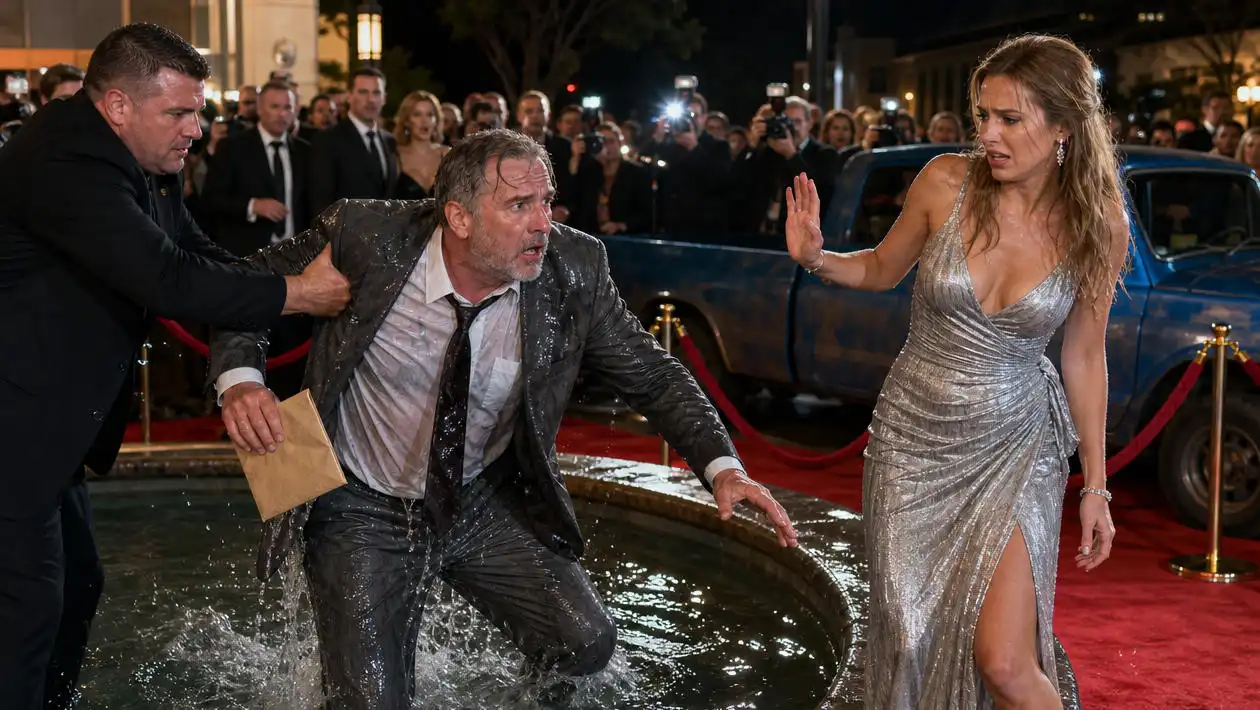
The same smile she held while two security guards shoved me into a fountain outside a Beverly Hills hotel.
The same smile she used when she told photographers, “Mental illness is heartbreaking.”
My brother John sat two seats away from me.
He did not belong in that room, according to Hollywood.
He wore a borrowed black jacket over a blue work shirt.
His hands were rough.
His boots still had sawdust in the seams.
And when I said “the only family member who answered his phone,” he lowered his head like he wished the cameras would leave him alone.
That was John.
He never chased attention.
He just showed up when it mattered.
Twelve hours earlier, I had woken up in a motel room off Sunset Boulevard with a leaking air conditioner and a Bible in the drawer.
The carpet smelled like old cigarettes.
My suit hung over a chair, wrinkled at the elbows.
On the television, entertainment hosts were already whispering about me.
“Legendary producer James Whitaker reportedly facing financial collapse…”
“Sources say his estate may be liquidated…”
“His daughter, actress Mia Whitaker, is expected to attend tonight’s ceremony alone…”
I watched them say my name like I was already dead.
Then I buttoned my shirt slowly and looked at the little black folder on the nightstand.
Inside were copies of three things.
A trust amendment.
A studio option contract.
And a private investigator’s report.
I did not smile.
At sixty, a man learns that the truth is not always something you shout.
Sometimes it is something you let people reveal about themselves.
My lawyer, Evelyn Parks, had warned me.
“James,” she said three weeks earlier, sitting across from me in her Century City office, “once this story leaks, people will treat you differently.”
“That’s the point.”
“You understand what I’m saying? You are not bankrupt. But if you allow people to believe the investment loss is worse than it is, they may panic.”
“I’m not asking anyone for money.”
“No. But you are asking them for character.”
She took off her glasses and studied me.
“Character is the most expensive thing in Hollywood.”
She was right.
I had spent forty years building things people watched.
Movies about fathers and sons.
Movies about sacrifice.
Movies where the hero stands alone in the rain and still does the right thing.
But my own family had become a script I could not control.
My wife, Helen, used to say, “Money doesn’t change people, Jimmy. It gives them permission.”
When she died, Mia did not ask how I was sleeping.
She asked whether the beach house would still be transferred into her name.
I told myself grief made people strange.
Then came the lawsuits from stylists she refused to pay.
The unpaid bills from designers.
The fake charity appearances.
The “emergency” calls at midnight that always ended with wire instructions.
I helped her.
Again and again.
Because fathers are fools in predictable ways.
Mia was my youngest.
My baby.
The little girl who used to fall asleep on editing room couches while I finished rough cuts.
The child who once made paper Oscars for everyone at Thanksgiving.
Then the industry discovered she was beautiful.
And she discovered that beauty opened doors faster than gratitude.
By thirty-two, she was not a star.
Not really.
She had been in two streaming thrillers, a perfume campaign, and one reality competition where she cried because a judge said she lacked range.
But she moved like royalty.
She called waiters “sweetheart” in a tone that meant servant.
She called working actors “background people.”
She called John “that trailer-park uncle,” even though he had built half the sets on which my early films were shot.
John and I had not spoken in twelve years.
That was my fault.
Mostly.
After our mother died, we fought over her house in Bakersfield.
Not because of money.
Because of pride.
John wanted to keep it.
I wanted to sell it and put the money into a foundation in Mom’s name.
We said ugly things.
He accused me of being ashamed of where we came from.
I accused him of being small.
A rich man should be careful with that word.
Small.
It can make you lose the biggest people in your life.
After that, birthdays passed.
Christmases passed.
Helen died, and John sent flowers but did not come to the funeral.
I told myself I did not care.
That was another lie.
The “bankruptcy” began as a boardroom rumor.
One of my investments did fail.
A production-tech startup collapsed after a fraud investigation involving its CFO.
I lost money.
A lot of money.
But not everything.
What mattered was what Mia did when she heard the exaggerated version.
The day the rumor hit the trades, she called me seventeen times.
Not to ask if I was okay.
To ask whether her trust payments were safe.
“Dad, tell me you didn’t do something stupid,” she snapped.
“I’m reviewing options.”
“What does that mean?”
“It means things may change.”
There was silence.
Then her voice went cold.
“You promised me financial stability.”
“I promised to be your father.”
“That’s not the same thing.”
I remember staring at Helen’s picture on my desk.
Mia continued.
“I have contracts tied to my lifestyle. Brand expectations. Social positioning. If you become some tragic cautionary tale, it reflects on me.”
“Your father being in trouble reflects on you?”
“Yes,” she said. “Everything reflects on me.”
That was when I called Evelyn.
We made the test legal.
Clean.
No fraud.
No false documents.
No asking for money under false pretenses.
Just a controlled disclosure of a true loss and a temporary move into a cheap motel while my Beverly Hills estate underwent a trust audit.
The people who loved me would not need my balance sheet.
The people who loved my balance sheet would panic.
Mia panicked immediately.
She stopped inviting me to family events.
She removed my photos from her social media.
She told a magazine we were “emotionally estranged due to his instability.”
Then she did something worse.
She contacted my assistant and asked for a copy of my medical records.
When the assistant refused, Mia texted:
“He’s old, he’s declining, and if he embarrasses me during awards season, I need legal options.”
Evelyn put that text into the black folder.
“Do not engage,” she told me. “Let her keep talking.”
So I stayed quiet.
I moved into the motel.
I took calls from old friends and listened to the difference between concern and curiosity.
Some offered help.
Some offered lunch that never happened.
Some asked, “How bad is it?” in the same tone vultures circle highways.
Mia never visited.
Then came the Oscars.
My film, The Last Porch Light, had been nominated for Best Picture.
I had produced it quietly through a small company I still controlled.
It was a modest movie about a carpenter raising his grandson after his son died overseas.
John did not know this, but the main character was based on him.
His patience.
His stubbornness.
His habit of fixing things nobody paid him to fix.
The film had also been nominated for Best Original Screenplay and Best Director.
The director was supposed to be Martin Vale, a safe studio choice with three previous nominations.
But six months before filming, Martin quit after a budget fight.
The person who saved the movie was a young man named Caleb Whitaker.
John’s son.
My nephew.
Caleb had been making short films while working construction with his father.
I had watched one of his videos online at 2 a.m., unable to sleep.
A five-minute piece about an old man repairing a church door after a storm.
No music tricks.
No famous actors.
Just truth.
I called him the next morning.
He almost hung up on me.
“Uncle James?”
“Caleb, I know I have no right to ask.”
“You’re right.”
“I want you to direct something.”
He laughed once, bitter.
“Is this a joke?”
“No.”
“My dad won’t like this.”
“I know.”
“Then why call?”
“Because you see people clearly.”
He was silent for a long time.
Then he said, “Does my dad know?”
“No.”
“Good. Let’s keep it that way for now.”
Caleb directed The Last Porch Light under the professional name C.J. Walker.
No one in the press connected him to John.
No one connected him to me.
That was intentional.
Caleb wanted the work judged on its own.
I respected that.
Mia did not know.
Mia thought the film was another sentimental old-man project.
She asked if I could get her a role in it.
I said no.
She did not forgive that.
On Oscar afternoon, I called her.
Not because I needed a ride.
Because a father still hopes for one final proof that he is wrong.
“Mia,” I said, “I’m at the Sunset Palms Motel. I need to get to the ceremony.”
She sighed like I had asked her to carry bricks.
“Dad, why are you at a motel?”
“You know why.”
“I know what people are saying.”
“I need help.”
“No, you need management.”
“I’m asking as your father.”
She paused.
Then she said, “Fine. Meet me at the Beverly Crest entrance. But do not talk to press. Do not say anything about money. Do not touch me if cameras are on.”
I closed my eyes.
“All right.”
“And please wear something presentable.”
“It’s the gray suit.”
“The funeral suit?”
“Yes.”
“Oh my God.”
She hung up.
I took a cab because I did not want hotel cameras catching the studio car.
When I arrived, the red carpet looked like another planet.
Lights.
Velvet ropes.
Fans screaming names.
Women in gowns worth more than John’s truck.
Men with white teeth pretending not to look nervous.
And there was Mia.
Silver dress.
Diamonds.
Hair swept back.
A face trained for cameras.
For one second, I saw her at eight years old again, standing on my shoes while we danced in the kitchen.
Then she turned and saw me.
The child vanished.
“What are you doing?” she whispered.
“You told me to meet you here.”
“Not like this.”
“This is the suit I have.”
“You smell like motel soap.”
A photographer shouted, “Mia! Over here!”
She snapped into a smile.
Her hand shot up in a wave.
Under that smile, she hissed, “Stand behind the hedge.”
“Mia.”
“You are not walking in with me.”
“I produced a nominated film.”
“You produced a public relations disaster.”
People began noticing.
A young influencer lifted her phone.
A security guard glanced over.
Mia’s publicist, a thin woman named Rochelle, rushed in with panic in her eyes.
“Is this your father?”
Mia did not answer.
I did.
“Yes.”
Rochelle whispered, “We need to move him.”
I looked at my daughter.
“Mia, all I asked for was a ride.”
Her eyes hardened.
“You don’t get to ruin my night because you ruined your life.”
The words hit harder than the shove that came later.
A few people nearby heard.
One man lowered his champagne.
A woman in emerald silk covered her mouth.
I said quietly, “Is that what you think happened?”
Mia laughed.
Not loud.
Worse.
Soft.
Cruel.
“Dad, people like us don’t fall this far unless we deserve it.”
People like us.
I looked down at my old shoes.
Then I looked at her diamonds.
“Those are your mother’s earrings.”
Her hand flew to her ear.
“She wanted me to have them.”
“No,” I said. “She wanted you to earn them.”
Mia’s face changed.
The cameras kept flashing.
She stepped closer and whispered, “Listen to me, old man. I will not be dragged down by your collapse.”
“Old man.”
That was new.
I saw Rochelle signal security.
“Mia,” I said, “don’t do this.”
She smiled brightly and turned to the guard.
“This man is bothering me.”
The guard hesitated.
“He says he’s your father.”
Mia lifted her voice.
“My father is unwell. Please remove him before he makes a scene.”
“I’m not making a scene,” I said.
She leaned toward the crowd, every syllable sharp enough to bleed.
“He’s a beggar.”
That word traveled.
I felt it move through people.
Beggar.
Not producer.
Not father.
Not man.
Beggar.
The first guard took my elbow.
I pulled back.
“Don’t touch me.”
The second guard moved behind me.
Mia gave him the smallest nod.
He pushed.
Not hard enough to break bones.
Hard enough to erase dignity.
My heel caught on the wet stone rim of the fountain.
For half a second, the world tilted.
Lights above me.
Mia’s silver dress.
A hundred phones rising.
Then cold water swallowed me.
The crowd gasped.
Someone laughed.
Someone said, “Oh my God, is that James Whitaker?”
I sat in the fountain, soaked to the skin, my gray suit clinging to me.
Mia did not move.
She looked at Rochelle and said, “Tell them he’s having an episode.”
That was when I stopped being her fool.
I reached into my wet pocket and felt the small recorder Evelyn had given me.
California law is strict about private recordings, but public spaces are different when people shout in front of cameras.
Besides, I did not need my recorder.
Half the red carpet had filmed her.
Still, I pressed the stop button.
Evidence is evidence.
My phone buzzed.
A message from a number I still knew by heart.
John.
“I saw the livestream. Stay there. I’m coming.”
I stared at the words until they blurred.
Then I typed back with shaking hands.
“You don’t have to.”
His reply came fast.
“Shut up, Jimmy.”
That was the first time I laughed all day.
Forty minutes later, the old blue pickup rolled up like it had taken a wrong turn into a jewelry box.
The valet tried to wave him away.
John leaned out the window.
“I’m picking up my brother.”
“You can’t stop here.”
“Watch me.”
He got out in work boots, jeans, and a black jacket that fit badly across his shoulders.
The red carpet cameras turned.
Not because he looked famous.
Because he looked real.
He walked straight past the velvet rope.
A guard moved to block him.
John pointed at me.
“That man in the fountain is James Whitaker. He has produced more films than you have birthdays. Put your hand on me and your boss will be apologizing by breakfast.”
The guard stepped aside.
John reached down.
I took his hand.
Neither of us spoke for a moment.
Then he said, “You got old.”
“You got uglier.”
He grunted.
“Still rich enough to buy a towel?”
“Long story.”
“I figured.”
He helped me out.
His truck door was open, heat blasting from inside.
Then he pulled an envelope from his jacket.
It was thick.
Old.
Worn at the edges.
“What’s that?”
“My pension cash-out papers. Bank draft too.”
I stared at him.
“No.”
“Yes.”
“John, I didn’t ask—”
“You never ask. That’s your problem.”
“I can’t take that.”
“You can. You won’t. But you can.”
My throat closed.
“You hate me.”
“I’ve been mad at you,” he said. “That’s not the same thing.”
Across the carpet, Mia watched us.
Her face twisted when she saw the envelope.
She leaned toward Rochelle and muttered, “This family is so embarrassing.”
A camera caught it.
Of course it did.
Inside the truck, John tossed me an old towel.
“You going to the ceremony?”
“I have to.”
“You look like a drowned accountant.”
“I feel like one.”
He looked at me for a long second.
Then he said, “You got another suit?”
“No.”
He started the engine.
“Then we’ll dry this one.”
We drove to a twenty-four-hour cleaners run by a Korean couple who recognized me but pretended not to.
That small mercy nearly broke me.
John waited in the truck while they pressed my suit.
I sat beside him wearing a spare flannel shirt and sweatpants from a grocery bag.
For a while, neither of us talked.
Then he said, “How bad is it?”
I knew what he meant.
The money.
The rumors.
The motel.
The humiliation.
I looked at the envelope in his lap.
“Not as bad as people think.”
His eyes narrowed.
“What does that mean?”
“It means I needed to know who would come when there was nothing left to gain.”
John’s jaw tightened.
“So this was a test?”
“Partly.”
He stared through the windshield.
“You always did like producing tragedy.”
“I didn’t produce what Mia did.”
“No,” he said. “You raised it.”
That hurt because it was true.
I nodded.
“I know.”
He looked at me then, the anger draining into something older.
“I raised anger too. Caleb barely talks to me some days.”
“He talks about you.”
John froze.
“What?”
I should not have said it.
But the night had already cracked open.
“Caleb directed The Last Porch Light.”
John turned slowly.
“No, he didn’t.”
“Yes.”
“My Caleb?”
“Yes.”
“That C.J. Walker?”
“His middle name is James. Your wife’s maiden name was Walker.”
John stared at me like I had slapped him.
“You gave my son a movie?”
“No. He earned it.”
His eyes shone.
“He never told me.”
“He wanted the work judged first.”
John looked away fast.
“He always was stubborn.”
“Family trait.”
He laughed once.
Then he wiped his face with the back of his hand and pretended it was sweat.
When my suit was ready, John drove us to the theatre entrance.
Not the red carpet.
The working entrance.
The one caterers, stagehands, and late presenters used.
A young production assistant checked my name and froze.
“Mr. Whitaker, we were looking for you.”
“I got delayed.”
She glanced at my wet shoes.
“I can see that.”
I pointed to John.
“He’s with me.”
“Is he on the list?”
“He is now.”
In Hollywood, confidence is often mistaken for paperwork.
She waved us through.
Backstage, Evelyn was waiting with a tablet in her hand.
She looked at John.
“Mr. Whitaker?”
“Depends which one you’re suing.”
“I like him,” she said.
Then she turned to me.
“The red carpet footage is everywhere.”
“How bad?”
“For her? Career-ending if the studios decide cruelty is bad for business this week.”
“And the trust?”
“Already filed. The morality and conduct clause is enforceable.”
John frowned.
“What clause?”
Evelyn explained.
Helen and I had created a family trust years ago.
It supported Mia’s housing, health coverage, and professional training.
But Helen insisted on one clause.
A dignity clause.
No beneficiary could exploit, defame, or financially abuse another family member for personal gain.
At the time, Mia laughed at it.
“Mom thinks we’re in a church play,” she said.
Helen replied, “No. I think money should never reward cruelty.”
After Helen died, I never enforced the clause.
I kept telling myself Mia would mature.
But in the last year, Mia had tried to pressure my staff for medical records.
She had leaked rumors about my instability.
She had used my name to secure endorsements while privately telling brands she was “separating from his decline.”
And now, in front of witnesses, she had publicly declared me a beggar and told staff to frame the assault as a mental episode.
Evelyn tapped the tablet.
“This is clean. We notify the trustee tomorrow. Her distributions stop pending review. Her image licensing agreement through Whitaker Holdings can be terminated for cause.”
John whistled.
“English?”
“She loses the money she thought made her untouchable,” Evelyn said.
“What about the security guards?”
“The hotel will settle before sunrise.”
“I don’t want blood,” I said.
Evelyn looked at me.
“James, accountability is not blood.”
That stayed with me.
Accountability is not blood.
It is a locked door that arrogance built for itself.
When I walked into the theatre, people pretended not to stare.
That is a Hollywood skill.
They notice everything and acknowledge nothing.
Mia was already seated in the third row.
She saw my damp hair first.
Then John.
Her mouth opened slightly.
I nodded once.
She looked away.
The ceremony moved like a dream.
Awards.
Speeches.
Laughs that felt too loud.
My phone kept buzzing, but I did not check it.
John sat beside me, stiff as a church pew.
When The Last Porch Light won Best Original Screenplay, Caleb walked up.
John stopped breathing.
Caleb accepted under the name C.J. Walker.
He thanked “the men who build things no one applauds.”
John’s hand covered his mouth.
I heard him whisper, “That boy.”
Mia leaned forward then.
She finally understood there was something happening she had not been invited to control.
When the host announced Best Picture, my category, my hands were calm.
That surprised me.
The host smiled.
“And presenting the award, legendary producer James Whitaker.”
I walked onto the stage.
The applause was warm.
Then uneven.
Because by then, everyone had seen the clip.
They had seen the fountain.
They had seen Mia.
They had seen John pull up in the pickup.
I took the gold envelope.
I looked out at the room.
And I said the sentence that made Mia’s smile lock in place.
“Before I open this… I need to thank the only family member who answered his phone.”
A murmur moved through the theatre.
I continued.
“Tonight, a lot of people saw an old man get pushed into water.”
A nervous laugh.
Not because it was funny.
Because guilt makes people reach for noise.
“I have spent my life making stories about dignity. I forgot, somewhere along the way, that dignity is not proven when people applaud you. It is proven when no one thinks you are worth standing beside.”
The camera found John.
He looked furious about it.
Perfect.
“This film exists because of a carpenter.”
John’s head snapped up.
“A man who taught his son how to measure twice, cut once, and never leave family standing in the rain.”
Mia’s face changed.
The director next to her leaned away.
“And it exists because that son, Caleb Whitaker, had the courage to tell the truth under a name no one could buy.”
The room erupted.
Not polite applause.
Real applause.
John stood halfway, then sat down, overwhelmed.
Caleb, in the nominee section, covered his face.
Mia turned white.
Because now she understood.
The “washed-up” old man she had thrown away still controlled the film everyone wanted.
The “trailer-park uncle” she mocked was the father of the director whose career was about to explode.
The “beggar” she humiliated owned the company that licensed her last name, funded her lifestyle, and held the conduct clauses she had violated on camera.
I opened the envelope.
“And the Oscar goes to… The Last Porch Light.”
The sound hit like thunder.
Caleb rose.
John rose.
I stepped back so father and son could reach each other.
They met in the aisle.
Caleb hugged John so hard the older man stumbled.
The camera caught that too.
It became the image of the night.
Not my speech.
Not Mia.
A carpenter in borrowed formalwear holding his son while Hollywood finally clapped for the right man.
Backstage, Mia came running.
Her heels clicked like panic.
“Dad.”
I turned.
She looked smaller without the red carpet behind her.
“Dad, please. Can we talk?”
John stepped forward.
I touched his arm.
“It’s okay.”
Mia’s eyes were wet, but I had seen her cry for cameras before.
“That got out of hand,” she said.
“The fountain?”
“The whole thing.”
“You called me a beggar.”
“I was scared.”
“Of what?”
“Losing everything.”
I nodded.
“That is exactly what you were scared of.”
She reached for my hand.
I did not give it.
“Dad, you know I didn’t mean it.”
“Mia, you meant it. You just didn’t mean for people to hear it.”
That landed.
Her mouth trembled.
“Are you cutting me off?”
“No.”
Hope flashed.
“The trust is.”
Her face hardened for one second before she hid it.
“You can’t do that.”
“Your mother did. I ignored the clause for years.”
“She’s dead.”
The hallway went silent.
Even Rochelle, standing behind her, looked away.
I stepped closer.
“Do not use your mother as a shield for behavior she wrote rules to prevent.”
Mia whispered, “What am I supposed to do?”
“Work.”
She stared at me like I had said “drown.”
“Work?”
“Yes.”
“My agent will fix this.”
“He already called Evelyn. So did the perfume company. So did the studio.”
Rochelle swallowed.
Mia looked at her.
Rochelle did not speak.
That was the first honest thing she had done all night.
Within forty-eight hours, Mia lost the fragrance campaign.
Then the streaming thriller.
Then the fashion house “paused partnership conversations.”
Public statements came dressed in soft words.
“Values alignment.”
“Family respect.”
“Mutual reassessment.”
Hollywood loves gentle language for brutal doors.
But the result was simple.
Mia became the woman who called her father a beggar on the Oscars red carpet.
The clip played everywhere.
Not because I paid for it.
Because cruelty, when filmed clearly enough, does not need marketing.
The hotel issued an apology.
The guards were suspended pending review.
I asked that they not be ruined.
They had obeyed the wrong wealthy woman.
That is a mistake worth correcting, not destroying.
Mia’s team tried to claim I had staged the whole thing.
Evelyn released one short statement:
“Mr. Whitaker did not ask to be pushed into a fountain. He did, however, retain the right to respond lawfully to public defamation, family trust violations, and misuse of his name.”
That ended that.
A month later, I sold the Beverly Hills estate.
Not because I needed to.
Because it had too many rooms for ghosts.
I bought a smaller house with a long porch, a real yard, and a workshop in the back.
Then I gave John the keys to the guesthouse.
He refused.
Of course he did.
“I’m not your charity case,” he said.
“No. You’re my brother.”
“I have a house.”
“You have a roof that leaks.”
“I can fix it.”
“I know. That’s why the workshop has your name on it.”
He cursed at me for ten minutes.
Then he moved in by Friday.
Caleb’s career changed overnight.
Studios called.
Actors called.
Producers who had ignored his emails suddenly discovered his genius.
He signed to direct a drama about a small-town bridge collapse.
Then a western.
Then something bigger.
But the first thing he did with his new money was buy his father a new set of tools.
John opened the case and cried in the garage where he thought no one could see.
I saw.
I let him keep his pride.
As for Mia, the industry did not forgive her quickly.
She moved out of the house the trust had paid for.
Sold the diamonds.
Including Helen’s earrings.
That hurt.
But perhaps they had already stopped belonging to our family the night she wore them while denying what family meant.
Six months later, I received a letter.
Not a text.
A letter.
Mia wrote it by hand.
The first line was not “I’m sorry you felt hurt.”
It was not “I was under pressure.”
It was not “My team handled it badly.”
It said:
“Dad, I became exactly the kind of person Mom warned me about.”
I sat on the porch and read it twice.
She had taken a job teaching scene study at a community arts program.
Part-time.
Nothing glamorous.
She wrote that the kids did not care about followers.
They cared whether she listened.
She wrote that one boy asked why she never talked about her father.
She wrote that she cried in her car for twenty minutes.
At the end, she said:
“I don’t deserve forgiveness because I’m your daughter. But I’m going to try to become someone who could receive it.”
I folded the letter.
John was sanding a chair beside me.
He glanced over.
“From her?”
“Yes.”
“She asking for money?”
“No.”
He nodded.
“That’s new.”
I laughed softly.
“It is.”
“ You going to answer?”
“Eventually.”
He kept sanding.
“Don’t take twelve years.”
That was his apology.
And mine.
A year after the Oscars, The Last Porch Light was rereleased in theaters for Father’s Day.
Caleb insisted the premiere happen in Bakersfield, not Los Angeles.
At the old movie house near our mother’s street.
The marquee lights flickered.
The popcorn was too salty.
The seats creaked.
It was perfect.
John wore a suit that actually fit.
I wore the gray one.
Cleaned.
Pressed.
No longer a symbol of humiliation.
Just cloth.
Mia came alone.
No diamonds.
No publicist.
No cameras following her.
She stood near the back, unsure whether she was welcome.
John saw her first.
He looked at me.
I looked at her.
Then I walked over.
She did not reach for me.
She just said, “Hi, Dad.”
I said, “Hi, Mia.”
Her eyes filled.
“I’m not here to be seen.”
“I know.”
“I bought a ticket.”
“I know.”
“I can sit in the back.”
“You can sit with us.”
That was not forgiveness.
Not all of it.
Forgiveness is not a light switch.
It is a porch light.
You turn it on so someone can find the door.
They still have to knock.
During the film, Mia cried quietly when the carpenter character sold his truck to save his grandson’s home.
John pretended not to notice.
Afterward, Caleb stood on the stage and thanked the town.
Then he thanked his father.
Then he looked at me.
“And my Uncle James, who taught me that stories don’t heal people because they’re perfect. They heal people because someone finally tells the truth.”
The audience stood.
John squeezed my shoulder.
Mia stood too.
Not in front.
Not posing.
Just standing.
For once, she was not trying to own the room.
She was trying to deserve a place in it.
And that was enough for that night.
So when people ask me whether I regret letting the world see what Mia did, I tell them the truth.
No.
I regret raising a daughter who thought love was a lifestyle account.
I regret letting money do the parenting when grief made me tired.
I regret waiting until public humiliation forced private honesty.
But I do not regret the consequence.
Because sometimes mercy without accountability is just permission.
Mia lost her brand.
John found his son.
Caleb found his voice.
And I found my brother in a blue pickup truck outside the cruelest red carpet in America.
So pick a side:
Was I wrong to let the cameras expose my daughter’s cruelty…
Or did she finally learn the lesson her mother tried to teach her years ago?
Share this if you believe family should never be measured by money. 🎬
Disclaimer: Mention of any brand or trademark is for identification only and does not imply partnership or endorsement
The Tavern Owner Set A Trap To Make Paul Drink Again… But He Had NO IDEA The Entire Town Was Watching 👀
They Laughed When Mark Announced He Was Running for Office… Then One Sealed Envelope Made the Whole Room Go Silent 😳
My Stepdaughter Thought Her Real Father Paid for Her Golf Club Wedding… Then I Showed the Guests the Letter He Sent Me