


Helen’s face went white.
Not pale.
White.
The kind of white people turn when the lie they built their whole life on suddenly walks back into the room wearing a clean navy coat.
The harbor master stood beside me with a clipboard in his hand.
Behind us, one hundred boats sat silent in the gray Maine morning.
Not one engine started.
Not one crate moved.
Not one lobster trap came ashore for Helen Doyle’s restaurant.
And the same woman who had told me to eat off the ground the night before now whispered, “Dad?”
I looked at her for a long second.
Then I lowered my raised hand.
“Good morning, Helen.”
The dock went quiet.
Even the gulls seemed to hold still.
Twenty-four hours earlier, she had not called me Dad.
She had called me a problem.
A liability.
A dirty old man.
A stray.
I was seventy-five years old, soaked through my torn yellow raincoat, standing outside Helen’s Harbor Table, the fanciest seafood restaurant on that stretch of Maine coast.
Her name was painted in gold letters on the glass.
Mine was hidden behind every lobster crate that had ever made her rich.
Thomas Doyle.
Founder of Doyle Atlantic Seafood.
The man fishermen from Bar Harbor to Portland still called “Captain Tom.”
But that night, I didn’t look like Captain Tom.
I looked like a beggar.
That was the point.
The rain had been coming sideways since sundown.
Cold Maine rain.
The kind that gets into your bones and stays there.
My boots were old.
My hands shook.
My beard was untrimmed.
I had bought the raincoat from a thrift store two towns over, and it smelled like mildew and diesel.
I stood near the back service entrance first.
I watched.
A delivery truck backed in.
Two kitchen boys unloaded crates stamped with my company’s blue anchor mark.
Doyle Atlantic Seafood.
Fresh lobster.
Sea scallops.
Haddock.
All going into my daughter’s kitchen.
A kitchen she had built with the contracts I gave her.
A restaurant she had opened after I loaned her the money and quietly guaranteed her first three years of supply.
I never put that on Facebook.
I never bragged.
Fathers don’t usually keep receipts against their children.
But businessmen do.
And by then, I had learned I needed to be both.
I walked around to the front.
Inside, warm light spilled over white tablecloths.
Couples in nice coats lifted wine glasses.
A pianist played something soft near the bar.
Helen stood near the host stand in a black dress and pearls, smiling at a table of tourists.
She looked powerful.
Polished.
Untouchable.
For a second, I saw the little girl she used to be.
The one who sat on overturned buckets and waited for my boat to come in.
The one who would run down the pier yelling, “Daddy, did you bring me a big one?”
That little girl used to kiss lobster shells before throwing them back.
She said everything deserved respect.
I almost turned around.
Then the hostess opened the door.
“Can I help you?”
“I’m looking for something warm,” I said. “Soup, maybe. I can pay a little.”
Helen heard my voice but did not recognize it.
Or maybe she recognized something deeper and chose not to see it.
She came to the door slowly.
Her eyes moved over my coat, my boots, my beard.
Not a daughter looking at a father.
A business owner measuring a mess.
“Sir,” she said, loud enough for the lobby to hear, “this is not a shelter.”
“I’m cold,” I said.
“That’s unfortunate.”
“I haven’t eaten.”
“Also unfortunate.”
A man at the bar turned to watch.
A woman near the window lowered her fork.
I kept my voice soft.
“I used to work on the water.”
Helen gave a small laugh.
“Everyone in Maine has ‘worked on the water.’ That doesn’t mean you get to wander into my restaurant bothering paying guests.”
My restaurant.
That was the first knife.
I looked at the gold letters on the glass.
Helen’s Harbor Table.
She had named it after herself, but the harbor had fed three generations before she was born.
“I’m not bothering anyone,” I said.
“You’re bothering me.”
A waiter came up behind her and whispered, “Ms. Doyle, should I call someone?”
“No,” Helen said. “I’ll handle it.”
Then she turned toward the kitchen.
“Bring the scraps.”
The word hit harder than the rain.
Scraps.
A busboy hesitated.
“Ma’am?”
Helen smiled without warmth.
“The pan by the prep sink. The one for the trash.”
The boy looked embarrassed.
He disappeared.
By then, people were openly watching.
Phones were half-raised.
Not fully recording yet.
Just waiting to see if the show got worse.
It did.
The boy came back carrying a dented metal pan.
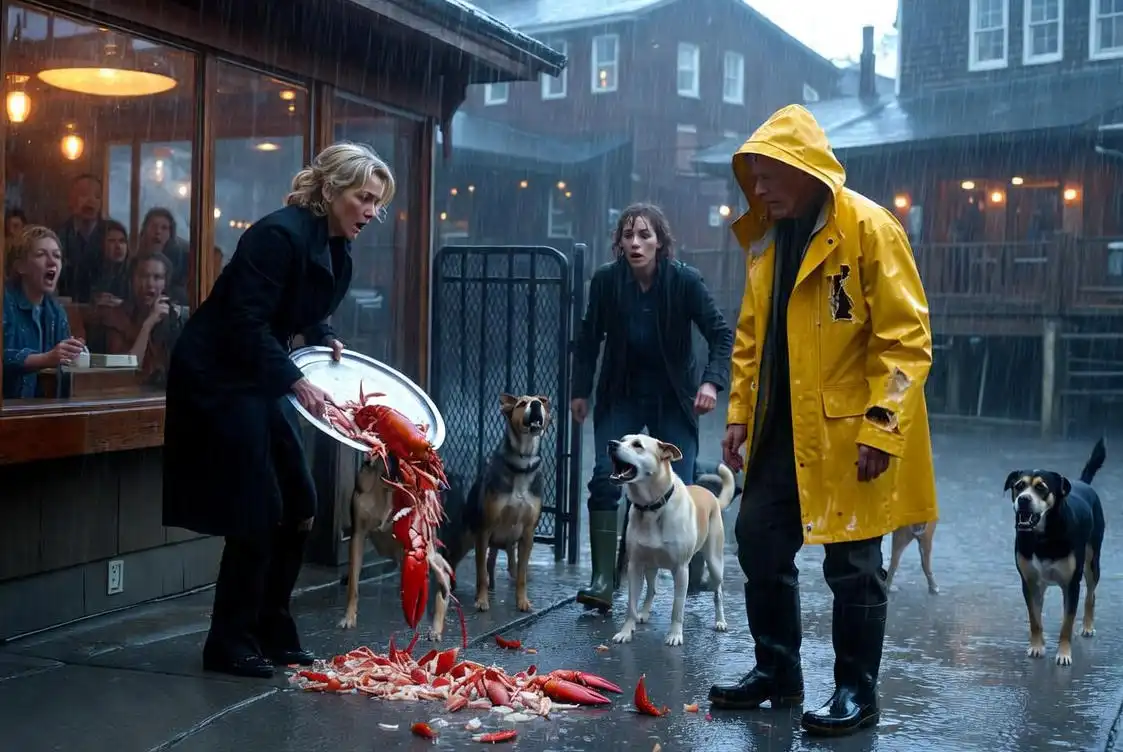
Inside were lobster shells, cold fries, wilted greens, and spilled chowder sliding around in a milky mess.
Helen took the pan from him.
She stepped through the door onto the sidewalk.
Her heels clicked against the wet stone.
She held the pan out like she was offering charity.
For one foolish second, I thought maybe she would hand it to me.
She did not.
She tipped it over.
The scraps hit the pavement at my feet.
Chowder splashed onto my boot.
A lobster shell cracked open and slid into the gutter.
Someone inside gasped.
Helen pointed at the ground.
“Since you want charity, there it is.”
I stared down.
Rainwater carried bits of food toward the drain.
“Go on,” she said. “Eat.”
A low laugh came from somewhere behind the glass.
One of Helen’s dogs barked from the gated side patio.
Then the other joined in.
They were big dogs.
Expensive dogs.
The kind people buy when they want protection but really want status.
Helen turned her head slightly and called, “Easy, boys.”
Then she looked back at me.
“Don’t make me let them convince you.”
That was when the first phone came all the way up.
A young couple by the window had started recording.
Helen noticed.
Instead of stopping, she performed.
That was always Helen’s weakness.
She never simply did wrong.
She needed witnesses.
She needed a room to know she was above someone.
“People like you think kindness means weakness,” she said. “But I worked for everything I have.”
That almost made me laugh.
Not because it was funny.
Because it was the cleanest lie she had ever told.
I had signed the loan.
I had guaranteed the lease.
I had introduced her to distributors.
I had covered her payroll twice in the first year and told her mother it was just “a slow season.”
I had fired men I trusted because Helen said they were “old harbor trash” who made the company look small.
One of those men was named Patrick Bennett.
He had worked for Doyle Atlantic for thirty-two years.
Never stole.
Never missed a storm run.
Never left a crewman behind.
Helen said he was rude to investors.
She said he smelled like bait.
She said modern companies needed a clean image.
I let her push him out.
That mistake had kept me awake for seven years.
Patrick died two winters later.
His daughter Lily took over his little skiff and started hauling traps before sunrise to keep their family cabin.
I had helped her once, quietly, through a church fund.
She never knew.
At least, I thought she didn’t.
That night, Lily Bennett saw everything.
She was across the street, loading bait buckets into the back of an old pickup.
She wore rubber boots, a faded knit hat, and a brown work jacket darkened by rain.
She didn’t look fancy.
She looked tired.
Honest.
Dangerous in the way decent people become dangerous when they’ve finally seen enough.
She crossed the street fast.
Helen rolled her eyes when she saw her.
“Oh, perfect. The bait girl.”
Lily stepped between us.
She didn’t shout.
That made her voice stronger.
“Nobody eats off the ground in my harbor.”
Helen laughed.
“Your harbor?”
Lily pointed toward the water.
“My father bled on those docks before you knew how to spell lobster.”
Helen’s smile sharpened.
“And look where that got him.”
The words landed like a slap.
Several people inside reacted.
Even the waiter looked down.
Lily’s jaw tightened.
I saw her hands curl, then uncurl.
She could have said plenty.
She could have told Helen that Patrick Bennett had taught half the captains in that harbor how to come home alive in fog.
She could have told her that restaurants like Helen’s survived only because people with cracked hands did brutal work before sunrise.
Instead, Lily turned to me.
“Come on,” she said. “You’re freezing.”
Helen called after her, “Be careful, Lily. Feed one stray and they all come back.”
Lily stopped.
Slowly, she turned.
“If they do,” she said, “I’ll put more soup on.”
Then she led me away.
No applause.
No dramatic music.
Just rain, diesel, and the sound of Helen’s dogs barking behind us.
Lily’s cabin sat at the far end of the pier.
It was small.
Old wood.
Fish nets hanging beside the door.
A stove pipe coughing smoke into the rain.
Inside, it smelled like coffee, salt, and cedar.
She gave me a towel.
Then a blanket.
Then a bowl of fish chowder that tasted better than anything Helen had ever charged $48 for.
“Careful,” Lily said. “It’s hot.”
I wrapped my hands around the bowl.
For a while, neither of us spoke.
That’s how harbor people are.
They understand silence better than most folks understand speeches.
Finally, Lily sat across from me.
“You picked a rough door to knock on.”
I looked at her.
“You know her?”
“Everybody knows Helen Doyle.”
There was no admiration in the way she said it.
I nodded.
“Did you record what happened?”
Lily looked toward the window.
“No.”
“Why not?”
“Because you were already embarrassed enough.”
That answer hurt me more than Helen’s cruelty.
I had spent my whole life thinking money showed character.
It doesn’t.
Money only gives character a louder microphone.
Lily got up and added wood to the stove.
“My dad used to say your company fed this town,” she said.
I kept my face still.
“Did he?”
“He also said it changed after your daughter started coming around.”
I looked into the fire.
“I heard that from some folks.”
Lily studied me.
“You’re not from around here, are you?”
“I was.”
She didn’t push.
That was another kind of mercy.
After I ate, she put a small first-aid kit on the table and cleaned a scrape on my wrist from when Helen’s gate had hit me during the commotion.
Her hands were rough but gentle.
“My father used to do this for deckhands,” she said.
“Patrick Bennett was a good man.”
Lily froze.
Only for a second.
But I saw it.
“How did you know his first name?”
I set the spoon down.
“I knew a lot of men on these docks.”
She stared at me.
The stove cracked softly.
Outside, the rain eased.
“Who are you?”
I could have told her then.
I almost did.
But the test was not finished.
Not for Helen.
Not for the company.
Not for me.
So I said, “An old man who needed soup.”
Lily did not believe me.
But she nodded.
“You can sleep in the chair until morning.”
I slept maybe two hours.
At four-thirty, Lily’s alarm rang.
She moved like someone who had been waking before dawn her whole life.
Coffee.
Boots.
Gloves.
Knife on belt.
She thought I was asleep.
I watched her take one envelope from a drawer and tuck it into her jacket.
The envelope was stamped FINAL NOTICE.
Fuel bill.
People think poverty is dramatic.
Most of the time, it is paper.
Quiet paper.
Paper you fold and unfold until the creases tear.
When she stepped outside, I followed.
The sky was still black-blue.
The harbor lights trembled on the water.
Men and women moved along the docks, preparing boats.
Lily turned and saw me.
“You shouldn’t be out here.”
“I wanted to see the harbor wake up.”
She gave me a tired smile.
“It doesn’t wake up. It just changes shifts.”
That line stayed with me.
Near the fuel pump, two captains were talking.
They stopped when they saw Lily.
One nodded toward me.
“Your guest?”
“Just a man who needed warmth,” Lily said.
The older captain looked me up and down.
Then his eyes narrowed.
For a terrible second, I thought he recognized me.
Instead, he said, “Helen’s people called last night. She wants extra lobster for some private party.”
Lily snorted.
“Let her catch it herself.”
The captain leaned closer.
“She’s been squeezing prices again. Said if we don’t like it, Doyle Atlantic has other boats.”
I said quietly, “Does it?”
Both men looked at me.
The captain laughed once.
“Not enough. But she talks like she owns the tide.”
There it was.
Helen’s poison had spread beyond one restaurant.
She was using my company name as a weapon.
Threatening fishermen.
Cutting prices.
Pushing out the small boats.
Acting like every dock from here to Portland belonged to her because her last name was Doyle.
I asked, “Do you have contracts?”
The captain shrugged.
“Some do. Some just sell through the usual morning call.”
“What do the written ones say?”
He frowned.
“Why?”
I pulled my old waterproof notebook from my coat.
The same kind I had carried for fifty years.
“Curiosity.”
By sunrise, I had heard enough.
Helen had delayed payments.
Rejected full crates for tiny defects.
Demanded “brand loyalty discounts.”
Threatened to report captains for safety violations if they sold to anyone else.
And worst of all, she had been telling people Doyle Atlantic required exclusivity.
That was false.
Doyle Atlantic had never forced independent fishermen to sell only to us.
My father taught me that rule.
“You don’t own a man’s boat unless you paid for the wood.”
Helen knew it.
She had signed updated vendor ethics terms herself.
Which meant she had not made a mistake.
She had made a choice.
At 6:12 a.m., I borrowed Lily’s phone.
She raised an eyebrow.
“You got someone to call?”
“A few.”
The first call went to Ben Carver, our general counsel.
He answered on the second ring.
“Mr. Doyle?”
Lily turned so fast her boot scraped the dock.
I looked straight ahead.
“Ben, I need you at the harbor in ninety minutes.”
“Yes, sir.”
“Bring Helen’s supply agreement, her personal guarantee, the vendor ethics clause, and the emergency suspension notice.”
A pause.
Then Ben said, “Understood.”
“And Ben?”
“Yes?”
“Send the captains the standard independent seller notice. Every boat. Effective immediately. No one is obligated to supply Helen’s Harbor Table through Doyle Atlantic.”
Another pause.
Longer this time.
“Mr. Doyle… are we terminating her supply?”
“We are suspending her preferred account pending review.”
“That will shut her down.”
“No,” I said. “Her conduct will.”
I hung up.
Lily stared at me.
Not angry.
Not impressed.
Just stunned.
“Thomas Doyle,” she said.
I nodded.
“Most people call me Tom.”
Her face went hard.
“My father called you something else after you fired him.”
“I know.”
The words came out low.
“And he was right.”
That stopped her.
The gulls screamed overhead.
The harbor kept moving around us, but for a moment we stood in a little circle of truth.
“I signed the paper,” I said. “Helen pushed it. I allowed it. I told myself I was protecting the company.”
Lily’s eyes shone, but she did not cry.
“My dad lost more than a job.”
“I know.”
“No,” she said. “You don’t. He lost his place. Men like him don’t retire easy. They need to feel useful.”
I swallowed.
“You’re right.”
She looked away toward the water.
“Why are you here?”
“Because I started hearing stories. About Helen. About the docks. About my own people being afraid to speak. I didn’t believe all of it.”
“And now?”
“Now I do.”
Lily shook her head.
“So you dressed like a beggar to test your daughter?”
“Yes.”
“That’s cruel.”
“It was.”
“To yourself too.”
I looked down at my hands.
Old hands.
Hands that had pulled rope until the skin split.
Hands that had signed checks big enough to change lives and termination letters cold enough to ruin them.
“I needed to know if she still had a heart when nobody important was watching.”
Lily’s voice softened, but only a little.
“And?”
I looked toward Helen’s restaurant at the end of the pier.
The gold letters caught the morning light.
“I found out.”
By 7:30, the harbor was buzzing.
Not loudly.
Fishermen don’t need to yell to make a decision.
They talk in clusters.
They nod.
They make calls.
They untie nothing.
Helen’s first kitchen truck arrived at 7:45.
It left empty at 7:58.
The second truck called before even coming down the road.
The third never showed.
At 8:20, Helen came out of her restaurant in a cream coat, holding her phone like it had personally betrayed her.
Her hair was perfect.
Her makeup was perfect.
Her face was not.
She walked quickly at first.
Then she saw the boats.
All of them sitting still.
Captains standing on deck.
Deckhands leaning on railings.
Lily beside me near the harbor office.
And me no longer in the torn raincoat.
Lily had insisted I wear her father’s old navy peacoat.
It fit across the shoulders better than I expected.
“He would hate this,” she had said.
“Me wearing it?”
“No. You looking good in it.”
That was the first time she smiled.
Helen spotted me.
Her steps slowed.
Recognition moved across her face like a storm front.
Confusion.
Fear.
Calculation.
Then performance.
“Daddy?”
A few people murmured.
I said nothing.
Helen came closer.
“Daddy, thank God. Something is wrong with the suppliers. No one is answering me.”
I looked at the scraps still staining the sidewalk from the night before.
Rain had washed most of it away.
Not all.
A small lobster shell lay near the curb.
Helen followed my eyes.
Her mouth tightened.
“You should have told me it was you.”
There it was.
Not apology.
Defense.
“You should have told me.”
As if cruelty only counted when the victim had money.
As if dignity required identification.
As if a father needed to present credentials before his daughter behaved like a human being.
Lily stepped slightly forward, but I lifted one hand.
This was mine.
Helen lowered her voice.
“Can we talk privately?”
“No.”
Her eyes flicked toward the watching captains.
“Dad, please.”
“You liked an audience last night.”
A ripple moved through the dock.
Helen’s cheeks flushed.
“That was different.”
“How?”
“I thought you were—”
She stopped.
The silence finished the sentence for her.
Poor.
Homeless.
Worthless.
I nodded.
“You thought I was someone you could hurt without consequence.”
Her voice sharpened.
“That is not fair.”
“No,” I said. “Last night was not fair.”
The harbor master cleared his throat.
Ben Carver arrived in a dark overcoat, carrying a leather folder.
He looked tired in the way lawyers look tired when they know the truth is going to be expensive.
“Mr. Doyle,” he said.
Helen stared at him.
“Ben? What is this?”
Ben did not answer her.
He handed me the folder.
I opened it slowly.
Not for drama.
Because my hands hurt in cold weather.
Inside were three documents.
Helen’s preferred supply agreement.
Her vendor ethics certification.
Her personal guarantee for outstanding purchases.
I took out the first page.
“Helen Doyle,” I said, “your restaurant currently receives preferred pricing through Doyle Atlantic Seafood under a family-affiliated hospitality account.”
Her lips parted.
“Dad, don’t do this here.”
I continued.
“That account is conditional on fair vendor dealings, timely payment, truthful representation of company policy, and conduct that does not damage Doyle Atlantic’s name.”
A captain behind me muttered, “Well, that ship sailed.”
Someone else laughed under their breath.
Helen spun around.
“You people have no idea what you’re talking about.”
Lily said, “We have a pretty good idea.”
Helen pointed at her.
“You stay out of this. Your father was fired for cause.”
That was the second mistake.
The first had been humiliating me.
The second was lying about a dead man in front of the harbor that loved him.
Every captain on that dock went still.
I looked at Ben.
He removed another paper from the folder.
“Patrick Bennett’s personnel file,” Ben said quietly. “As requested.”
Helen blinked.
“You had no right to—”
“I own the company,” I said.
Her mouth shut.
Ben handed me a copy.
I had read it the night before after he emailed it over.
But paper has weight.
Truth should have weight.
“Patrick Bennett was not fired for theft,” I said. “Not for misconduct. Not for violence. Not for cause.”
Helen looked away.
“He was terminated after an internal restructuring recommendation submitted by Helen Doyle.”
Lily’s breathing changed beside me.
I kept reading.
“The recommendation described Mr. Bennett as ‘not aligned with the modern brand image’ and ‘unlikely to adapt to investor-facing operations.’”
A few captains cursed.
Lily’s face crumpled for half a second, then hardened.
“My dad thought he did something wrong,” she said.
Helen snapped, “He was rude to clients.”
“He saved my brother in a squall,” one captain said.
“He taught me to read fog,” said another.
“He fixed my engine for free,” a third added.
The public pressure Helen loved so much turned around and faced her.
No shouting mob.
Just witnesses.
The worst kind.
Helen looked at me.
“Dad, this is business.”
“No,” I said. “Business is honest exchange. This was vanity wearing a blazer.”
Her nostrils flared.
“You built this company by being hard.”
“I built it by being fair.”
“You built it by winning.”
“I built it because fishermen trusted my word.”
She laughed bitterly.
“Trust doesn’t pay invoices.”
“Neither does arrogance.”
Ben stepped forward.
“Ms. Doyle, as of 8:30 this morning, Doyle Atlantic Seafood has suspended your preferred account pending a full ethics review.”
Helen’s head jerked.
“You can’t.”
“I can,” I said.
“My dinner service starts at five.”
“I know.”
“I have reservations.”
“I know.”
“I have a private party of forty tonight.”
“I know.”
She looked past me at the boats.
“Fine. I’ll buy direct.”
The captains did not move.
Not one.
Helen forced a laugh.
“Are you all serious? You’re going to refuse money because of some dockside theater?”
Lily took one step forward.
“No. We’re refusing you because you used his name to threaten us.”
Helen’s eyes narrowed.
“I never threatened anyone.”
An older captain named Roy lifted his phone.
“You left voicemails.”
Helen went still.
Roy tapped the screen.
Her voice came out tinny but clear.
“If you sell around my kitchen again, I’ll make sure Doyle Atlantic reviews your safety record. You understand me, Roy? I can make your life very difficult.”
The dock listened.
Helen looked smaller with every word.
Another captain raised a printed email.
Another had text messages.
Another had unpaid adjustment notices.
The trap had not been mine alone.
Helen had built it plank by plank, lie by lie.
All I had done was stop holding the door open for her.
Ben documented everything.
The harbor master did too.
Helen’s supplier debt was already ugly.
I had known she was behind.
I did not know how bad until the review began.
She owed three independent boats for rejected deliveries she had still used.
She owed Doyle Atlantic for two months of premium shellfish.
She owed a packaging vendor.
A fuel cooperative.
A linen company.
Her restaurant looked rich because she had delayed paying everyone who made it possible.
That is an old trick.
Polish the dining room.
Starve the kitchen.
Helen turned to me again, and this time her voice cracked.
“Dad, please. You’re angry. I understand that. But this will ruin me.”
I looked at my daughter.
Really looked.
For a moment I wanted to reach for her.
Not because she deserved it.
Because fathers are cursed with memory.
I remembered her at six, asleep on my chest after her mother died.
I remembered teaching her to tie a cleat hitch.
I remembered buying her first restaurant toy set because she said she wanted to “feed people fancy.”
Somewhere between grief and money and praise, I had mistaken ambition for strength.
I had rewarded polish over kindness.
I had let her think success meant never bending.
That failure was partly mine.
But the bill had come due in other people’s names.
“No, Helen,” I said. “I am not ruining you.”
I pointed toward the restaurant.
“You built a business on credit, fear, and my last name. I’m removing the last name.”
She whispered, “You’re my father.”
“Yes.”
My voice shook then.
“And last night, you showed me exactly what kind of woman my silence helped create.”
Tears filled her eyes.
I wanted them to be real.
Maybe they were.
But tears do not pay fishermen.
Tears do not restore Patrick Bennett’s final years.
Tears do not lift soup off a sidewalk and put it back in a bowl.
So I turned to Ben.
“Begin the audit.”
Helen grabbed my sleeve.
The dock inhaled.
I looked down at her hand.
She let go.
“Daddy,” she said, smaller now.
I closed the folder.
“You will receive formal notice by noon.”
By that afternoon, the story had spread through town.
Not because I posted it.
I didn’t.
Other people did.
The couple from the window had recorded Helen dumping the scraps.
A kitchen worker recorded the dogs barking and Helen saying, “Go on. Eat.”
Someone else filmed the dock confrontation.
Within hours, locals were sharing it with captions like:
“Would she have done this if she knew?”
And the answer was the whole point.
No.
She would not have.
Which meant she knew it was wrong.
Helen closed for dinner that night.
The sign on her door said: TEMPORARILY CLOSED DUE TO SUPPLY ISSUES
Nobody believed it.
The private party canceled.
Then two weddings.
Then a corporate booking.
By the end of the week, three vendors had filed collection claims.
Two captains reported her threats to the state fisheries office.
Doyle Atlantic’s audit found enough violations to terminate the preferred account permanently.
Because Helen had personally guaranteed the outstanding supplier balance, the debt followed her.
Not the staff.
Not the cooks.
Not the dishwashers.
Her.
That mattered to me.
I made sure every hourly worker got two weeks’ emergency pay from a hardship fund I created the same day.
Helen called it humiliating.
I called it cleaning up my own mess.
The restaurant lasted eighteen more days.
Then the gold letters came down.
Helen’s Harbor Table closed on a Monday morning under a sky so clear it felt almost rude.
She stood outside while workers removed the sign.
No pearls.
No cream coat.
No audience she controlled.
Just townspeople passing by slowly enough to see, but not stopping long enough to comfort her.
I did not attend.
Lily did.
Not to gloat.
She had a delivery to make two doors down.
That’s the thing about working people.
Even when justice happens, the day still has to be worked.
Two weeks later, I asked Lily to meet me at the old harbor office.
She arrived suspicious.
“I’m not taking charity,” she said before sitting down.
I smiled.
“Good. I’m not offering any.”
Ben placed a folder on the table.
Lily looked at it like it might bite.
“What is this?”
“An offer,” I said. “Doyle Atlantic is restructuring its coastal purchasing division. We need a local supplier cooperative manager for this bay. Someone the boats trust.”
She stared.
“You’re offering me Helen’s place?”
“No,” I said. “Helen never had this place.”
That landed.
I continued.
“I’m offering you a contract to build what should have existed years ago. Fair pricing. Transparent weights. Thirty-day guaranteed payments. No exclusivity. No threats. No games.”
Lily opened the folder.
Her eyes moved across the numbers.
Then stopped.
“This is too much.”
“It’s market rate.”
“For someone with a business degree maybe.”
“For someone with trust,” I said. “That’s rarer.”
She looked up.
“My father would have laughed in your face.”
“I know.”
“He would have said you were trying to buy forgiveness.”
“He would have been right to wonder.”
“Are you?”
I took a breath.
“No. Forgiveness is yours to keep or give. I’m trying to repair policy, not purchase peace.”
Lily studied me for a long time.
Then she turned a page.
“What happens to the boats?”
“They choose whether to join. Each captain keeps independence. The cooperative negotiates cold storage, transport, fuel discounts, and buyer access. You run local operations. Doyle Atlantic backs infrastructure for three years.”
“And after three years?”
“You own the cooperative with the members.”
Her eyes widened.
“You’d give it away?”
“I should have built it that way from the start.”
She leaned back.
Outside, a gull landed on the railing and screamed like it objected to paperwork.
Lily almost smiled.
“My dad used to say rich men only get generous when they’re old enough to fear judgment.”
“He sounds accurate.”
“He usually was.”
She looked down again.
Then her voice softened.
“Why me?”
“Because when you had every reason to hate my family, you still fed a cold old man.”
“That’s not business experience.”
“No,” I said. “That’s character. Business can be taught.”
She signed three days later.
Not alone.
She brought six captains with her.
Then twelve.
Then twenty-eight.
By the end of the season, Lily Bennett was running the largest independent seafood supply cooperative in the bay.
Not because I handed her a crown.
Because the harbor did.
She knew every boat.
Every captain’s kid.
Every engine that needed help.
Every widow who still got a Christmas box because her husband had once worked the water.
She paid on time.
She posted weights publicly.
She kept a coffee pot in the office and a stack of dry socks by the heater.
Fishermen joked that Lily’s office smelled like chowder, diesel, and justice.
They were not wrong.
As for Helen, she did not vanish.
People like to imagine villains disappearing into perfect punishment.
Real life is messier.
She sold her condo.
She settled debts through court-supervised payments.
She moved inland for a while and worked as a manager for a hotel restaurant where no one cared about her last name.
For months, I heard nothing.
Then, near Thanksgiving, a letter came.
Not an email.
Not a text.
A letter.
Her handwriting was still elegant.
She wrote:
“Dad, I keep replaying that night. At first I was angry because you tricked me. Then I was angry because people saw. Then one morning I realized the worst part was not that they saw. It was that there was something to see.”
I read that line three times.
She did not ask for money.
She did not ask for the restaurant back.
She wrote about Patrick Bennett.
About the staff.
About the dogs.
About the scraps.
At the end she said:
“I don’t expect forgiveness. I just wanted you to know I finally understand that humiliation is not discipline, and status is not worth anything if it costs you your soul.”
I folded the letter and put it in my desk.
I did not call her that day.
Healing is not a light switch.
It is a tide.
It comes in slowly.
Sometimes it goes back out.
But it moves.
On Christmas Eve, I went to Lily’s cooperative office with two boxes of oranges, because my father always said harbor offices needed oranges in winter.
Lily was there late, of course.
Balancing invoices.
Radio playing low.
Snow tapping the window.
She looked up and said, “You know most retired men sit down eventually.”
“I tried it. Didn’t take.”
She took an orange from the box.
Then nodded toward the pier.
“You should see this.”
Outside, boats were strung with small white lights.
Not fancy.
Not Instagram-perfect.
Just warm.
Working boats glowing in the dark.
At the end of the dock, someone had hung a wooden sign over the cooperative shed.
BENNETT BAY SEAFOOD CO-OP
Under it, smaller letters read:
FAIR WEIGHT. FAIR PRICE. FAIR WORD.
My throat tightened.
“Your father would like that.”
Lily stood beside me.
“He would pretend not to.”
“Yes,” I said. “The good ones often do.”
We watched the lights in silence.
Then Lily handed me a thermos cap full of chowder.
“Careful,” she said. “It’s hot.”
The same words as that first night.
This time, my hands did not shake from cold.
They shook because sometimes dignity returns in a bowl.
Sometimes justice looks like a closed restaurant.
Sometimes it looks like a paid invoice.
Sometimes it looks like a daughter finally understanding too late.
And sometimes it looks like a young woman in rubber boots building something better from the wreckage adults left behind.
I did eventually meet Helen for coffee.
Months later.
No cameras.
No dock.
No audience.
She looked older.
So did I.
She apologized without saying “but.”
That was new.
I told her I was not ready to pretend nothing happened.
She said, “I know.”
Then she asked if Lily would ever speak to her.
I said, “That’s not mine to arrange.”
She nodded.
For the first time in years, Helen did not try to manage the room.
She simply sat with the damage.
That was the beginning.
Not a happy ending wrapped in a bow.
A truthful one.
Helen lost the restaurant.
She lost the easy power that had made her cruel.
She lost the protection of my silence.
But she did not lose the chance to become human again.
Lily gained what her father should never have been denied.
Respect.
Ownership.
A future tied to the harbor instead of controlled by people looking down from glass windows.
And me?
I learned the hardest lesson of my life at seventy-five.
You can build a company.
You can feed a coast.
You can put your name on trucks, crates, contracts, and buildings.
But if your own child can look at a hungry old man and see something beneath her…
then somewhere, you failed to teach the only lesson that mattered.
So I teach it now.
With contracts.
With consequences.
With second chances that do not erase first wounds.
And with one rule posted inside every Doyle Atlantic office from that winter forward:
No person who asks for warmth will ever be treated like trash.
Not on my dock.
Not under my name.
Not while I am alive.
So choose a side:
Was I too harsh for letting Helen’s restaurant collapse in front of the whole harbor… or did she finally receive the lesson she had been serving everyone else? Share this if you believe dignity should never depend on someone’s bank account. ⚓
Disclaimer: Mention of any brand or trademark is for identification only and does not imply partnership or endorsement
The Tavern Owner Set A Trap To Make Paul Drink Again… But He Had NO IDEA The Entire Town Was Watching 👀
They Laughed When Mark Announced He Was Running for Office… Then One Sealed Envelope Made the Whole Room Go Silent 😳

My Stepdaughter Thought Her Real Father Paid for Her Golf Club Wedding… Then I Showed the Guests the Letter He Sent Me