

The security guard’s hand went to his earpiece.
The room got quiet in that strange way only rich rooms can get quiet.
Not peaceful.
Afraid.
The millionaire still had his hand half-raised, like he thought he could shove me again and the world would keep clapping for him.
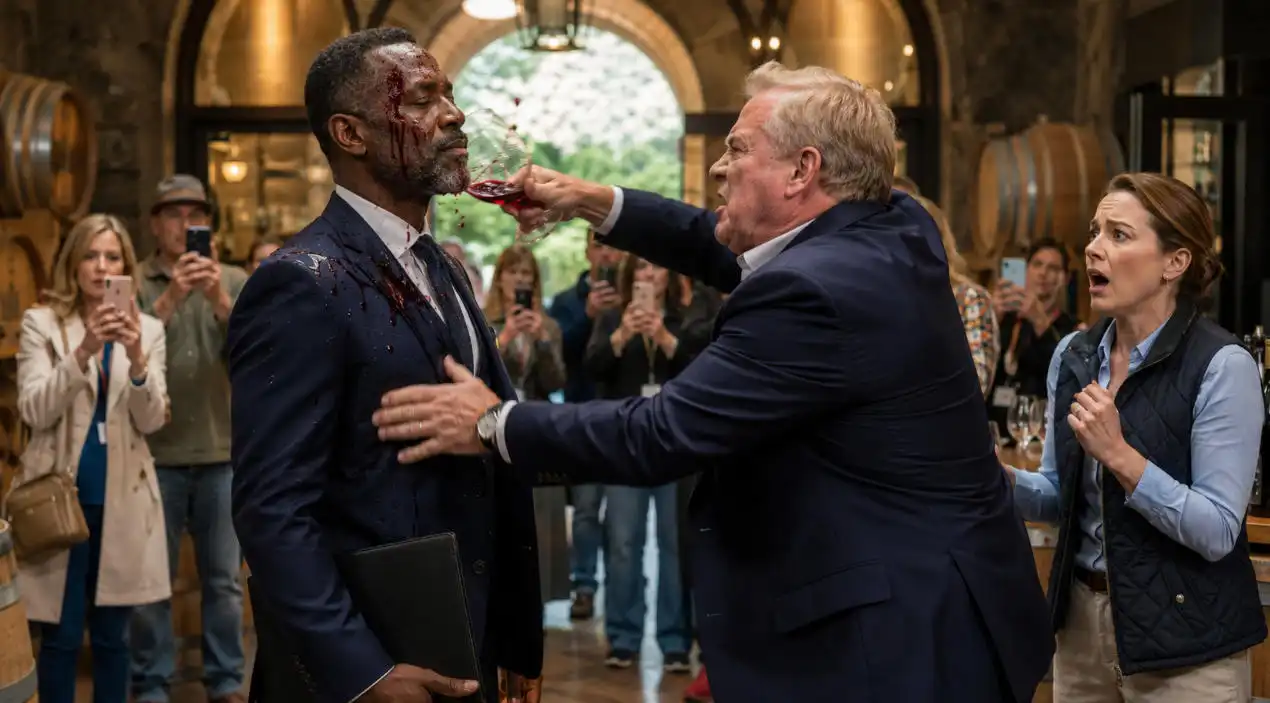
Red wine dripped from my chin onto the limestone floor.
I let it fall.
One drop.
Then another.
Because sometimes the most expensive room in the world still needs a cheap lesson.
My name is Marcus Ellington.
For most of that afternoon, everyone at Bellamont Ridge treated me like I was lost.
A Black man in an old dark jacket.
Scuffed shoes.
No designer watch.
No loud voice.
No need to prove I belonged.
And that seemed to offend them more than if I had kicked open the door.
Bellamont Ridge was one of the oldest wineries in Napa Valley.
Stone archways.
Private cellars.
Vines older than most family fortunes.
A place where people whispered about bottles like they were holy objects.
That day, I joined a public heritage tour before my private meeting.
I wanted to see the estate the way ordinary visitors saw it.
No announcement.
No entourage.
No name tag.
Just me, standing near the back, listening.
The tour guide, Claire, kept glancing at me.
Not warmly.
Checking.
Measuring.
Wondering whether I had paid for the premium tasting.
At the front of the group stood Preston Whitaker.
Everyone knew his type before he said a word.
Cream blazer.
Gold cufflinks.
Voice too loud for a cellar.
He kept interrupting Claire to explain wine terms he had half-memorized from auction catalogs.
“Actually, this vintage only matters because of the hillside exposure,” he said, swirling his glass like he was conducting an orchestra.
Claire laughed too hard.
A few tourists nodded like students.
I stayed quiet.
That bothered Preston.
At the private reserve table, Claire poured a small taste from a bottle with no public price tag.
Preston sniffed, sipped, then turned toward me.
“You understand what you’re drinking?” he asked.
I looked at the glass.
“Cabernet. Mountain fruit. Long skin contact. New French oak, but not too much. Likely from the east block.”
His smile tightened.
Claire blinked.
One of the tourists lowered her phone.
Preston gave a little laugh.
“You read that off the brochure?”
I said nothing.
That was when he made his first mistake.
He stepped closer.
“People come here and repeat fancy words because they think it makes them belong.”
Claire softly said, “Mr. Whitaker is one of our most valued allocation members.”
That sentence was not information.
It was a warning.
Know your place.
The group felt it.
A woman near the barrel rack looked away.
A man pretended to check his phone.
Nobody wanted trouble.
Preston enjoyed that.
He lifted his glass toward me.
“Tell us then,” he said. “What makes this wine special?”
I answered because the wine deserved better than him.
“The restraint,” I said. “Most wineries would chase power with fruit like this. Whoever made this understood patience.”
That made his face go cold.
Because I had praised the winemaker without praising him.
He chuckled.
“Cute.”
Then he turned to the group.
“This is what happens when tasting rooms become too accessible.”
A few people shifted uncomfortably.
Claire said, “Sir, maybe you should step away from the private reserve table.”
She was talking to me.
Not him.
That landed harder than the insult.
Because she knew who had been rude.
She knew who had raised his voice.
But money was standing in front of her in a cream blazer, and dignity was standing quietly in scuffed shoes.
Preston saw the opening and took it.
He leaned close enough for me to smell the wine on his breath.
“You people always want the room before you earn the room.”
Then he threw the red wine in my face.
Gasps.
Phones came up.
Someone whispered, “Oh my God.”
Wine ran down my cheek, warm and sticky.
It stained my collar.
Preston shoved my shoulder with two fingers like I was something blocking a doorway.
“Go rinse off in the employee sink,” he said.
Claire did not defend me.
She looked terrified.
But not for me.
For the account.
For the allocation.
For the wealthy man whose yearly wine order probably made her manager smile.
I slowly wiped my cheek with a white napkin.
Then I folded it once.
Placed it on the table.
And looked straight at Claire.
“Did Mr. Whitaker sign the allocation agreement before or after he threatened a guest on recorded winery property?”
The air changed.
Preston laughed once.
“What did you say?”
I held up the black leather folder.
Claire saw the silver Bellamont Ridge seal on the front.
Her mouth opened.
No sound came out.
Because inside that folder were three things.
The final purchase agreement.
The transfer confirmation.
And the revised member conduct policy I had approved that morning.
At 9:17 a.m., Bellamont Ridge became mine.
Not partly.
Not through a partner.
Not through a fund with my name hidden in paperwork.
Mine.
The entire century-old estate.
The vineyards.
The tasting room.
The cellars.
The private reserve inventory.
The allocation list.
And the right to decide who represented the Bellamont name.
Preston still didn’t understand.
That was the beautiful part.
He pointed at me.
“You think a folder scares me?”
“No,” I said. “But the contract you signed might.”
The head of security, Luis, stepped beside him.
“Mr. Whitaker,” Luis said carefully, “please come with us.”
Preston snapped, “Don’t touch me. I spend more here in a year than you make in five.”
Luis didn’t flinch.
“That may have been true yesterday.”
The tourists heard that.
So did Claire.
So did Preston.
His face shifted from anger to confusion.
I opened the folder and removed one page.
Not the purchase agreement.
Not yet.
First, I handed Luis the incident clause.
Bellamont Ridge’s allocation membership had a morality and conduct provision.
Guests could lose buying privileges for harassment, threats, assault, intoxicated disorder, or behavior damaging to the estate’s reputation.
Preston had signed it three years earlier.
His signature was on file.
His behavior was now on eight phones, two ceiling cameras, and the tour guide’s own body mic.
That was the legal hammer.
Not revenge.
Rules.
The same kind of rules men like Preston loved when they protected private rooms from everyone else.
Now those rules were protecting the room from him.
Preston tried to laugh again, but it came out thin.
“You can’t cancel my allocation. I know the old owner.”
I looked at him.
“The old owner cashed my wire this morning.”
Silence.
Then one of the tourists whispered, “He owns it?”
Claire’s face went pale.
Preston turned toward her.
“Tell him who I am.”
Claire swallowed.
“Mr. Whitaker…”
Her voice cracked.
“I think he’s the new owner.”
That was when the room finally understood.
The man covered in wine was not a lost visitor.
Not an employee.
Not a charity guest.
Not someone who had wandered into the wrong tasting.
I was the person whose signature now sat above every private label, every member list, every employment contract, every barrel in that cellar.
Preston’s jaw moved, but no words came.
So I helped him.
“Your allocation is canceled effective immediately.”
His eyes widened.
“Excuse me?”
“Your pending shipment is void. Your reserved cases are returned to estate inventory. Your invitation to next month’s founder dinner is withdrawn. Your name will be removed from the collector wall by close of business.”
He looked like I had slapped him without raising a hand.
“You can’t do that.”
“I can,” I said. “You agreed I could.”
Then I turned to Luis.
“If Mr. Whitaker is intoxicated or unable to conduct himself safely, remove him from the guest area and wait for his driver by the service road.”
Preston exploded.
“This is insane! I was joking!”
A woman in the tour group said, “You threw wine in his face.”
Another man said, “And shoved him.”
The livestreamer near the barrels muttered, “I got all of it.”
That was the moment Preston’s power left him.
Not because I yelled.
Because witnesses spoke.
The same crowd he had used to humiliate me became the crowd that documented him.
Luis and another guard escorted him toward the back exit.
Preston pulled his arm away and stumbled.
Outside, rain had softened the service lane beside the vineyard.
He slipped near the muddy edge, caught himself badly, and landed on one knee in the wet dirt.
His cream blazer was ruined.
No one laughed.
That mattered.
The point was not cruelty.
The point was consequence.
He looked back through the open door, mud on his pants, wine still on his breath, and for the first time that day, he looked small.
Claire began crying before I even turned to her.
“Mr. Ellington, I am so sorry. I didn’t know—”
I raised one hand.
“That’s the problem.”
She froze.
“You shouldn’t need to know a man owns the building before you treat him with respect.”
The words landed harder than shouting would have.
She nodded.
Tears running.
“I understand.”
“No,” I said gently. “You’re going to.”
I did not fire Claire in front of the tour.
That would have been easy.
Too easy.
Instead, I asked the general manager to pull the visitor reports, the member complaints, and the footage from the last six months.
What we found was worse than one bad moment.
Preston had been bullying staff for years.
He had mocked younger servers.
Threatened bad reviews.
Demanded bottles held back from other members.
Called delivery workers “temporary people.”
And Claire, chasing approval from wealthy guests, had learned to laugh at the wrong jokes.
Not always because she was cruel.
Sometimes because she was afraid.
But fear does not excuse joining the powerful against the quiet.
Two days later, Preston received formal notice.
His allocation was permanently revoked.
His founder dinner seat was canceled.
His prepaid private tasting deposit was refunded with a written trespass warning.
His corporate club, which had used Bellamont Ridge for executive retreats, quietly moved its event elsewhere after the video spread among members.
He tried to claim he had been “provoked.”
The footage said otherwise.
The contracts said otherwise.
The witnesses said otherwise.
And in rooms where he once bragged about his cellar, people began asking the one question he could not stand:
“Are you the guy from the winery video?”
As for Claire, I gave her a choice.
Resign quietly or enter a full retraining period under a new hospitality director, starting from general tour duty with no private member commissions for ninety days.
She chose the training.
On her first day back, she apologized to the staff before she apologized to me.
That told me there might still be something decent to rebuild.
But the winery changed.
Immediately.
We rewrote the guest code in plain English.
We trained every employee to protect dignity before profit.
We ended the private habit of treating big spenders like kings and ordinary visitors like furniture.
Then my winemaker, Elena, said something I didn’t expect.
“You know,” she told me, “the east block Cabernet from this year has teeth. Elegant, but angry.”
I laughed for the first time since the incident.
“What are you suggesting?”
She smiled.
“A limited release.”
I said no at first.
I didn’t want my humiliation turned into a gimmick.
But Elena shook her head.
“Not humiliation,” she said. “A reminder.”
So we created a small-batch wine from the east block.
A serious bottle.
Deep fruit.
Firm tannins.
A finish that refused to disappear.
We called it The Quiet Table.
Not because I stayed silent forever.
Because silence, used correctly, can make the truth louder.
We donated part of the release to hospitality scholarships for workers who never get protected by rich rooms.
The bottles sold out in forty-eight hours.
Collectors called it brilliant.
Staff called it justice.
I kept the first bottle unopened in my office.
Not to remember Preston.
To remember the napkin.
The wine on my face.
The tourists who finally spoke.
And the moment I learned ownership means nothing if you don’t use it to protect people with less power than you.
Months later, I walked through that same tasting room during a public tour.
No announcement.
No spotlight.
Just checking.
A young dishwasher stepped near the doorway carrying a crate of glasses.
A wealthy guest bumped him and nearly made him drop it.
The old Bellamont Ridge might have looked away.
This time, Claire stepped forward.
“Sir,” she said firmly, “we treat everyone with respect here.”
The guest apologized.
The dishwasher looked stunned.
Then grateful.
Claire glanced at me from across the room.
I nodded once.
That was the real victory.
Not Preston in the mud.
Not the canceled allocation.
Not even the sold-out wine.
The real victory was watching the room become safer for the next quiet person who walked in without looking rich enough to matter.
So choose a side:
Was I wrong for canceling his entire wine allocation over one public insult…
Or did he simply get the exact vintage of karma he ordered? 🍷
Share this if you believe respect should never depend on someone’s bank account.
Disclaimer: Mention of any brand or trademark is for identification only and does not imply partnership or endorsement
The Tavern Owner Set A Trap To Make Paul Drink Again… But He Had NO IDEA The Entire Town Was Watching 👀
They Laughed When Mark Announced He Was Running for Office… Then One Sealed Envelope Made the Whole Room Go Silent 😳
My Stepdaughter Thought Her Real Father Paid for Her Golf Club Wedding… Then I Showed the Guests the Letter He Sent Me