


The glass doors opened, and the first badge stepped inside.
For one second, nobody moved.
Not the brides holding champagne flutes.
Not the mothers pretending they had not been whispering.
Not Brittany, the bridal clerk who had just ripped a veil off my daughter’s head and shoved me onto the marble floor.
Even the manager froze with his mouth open, one hand still clutching the velvet rope he had tried to use to block the entrance.
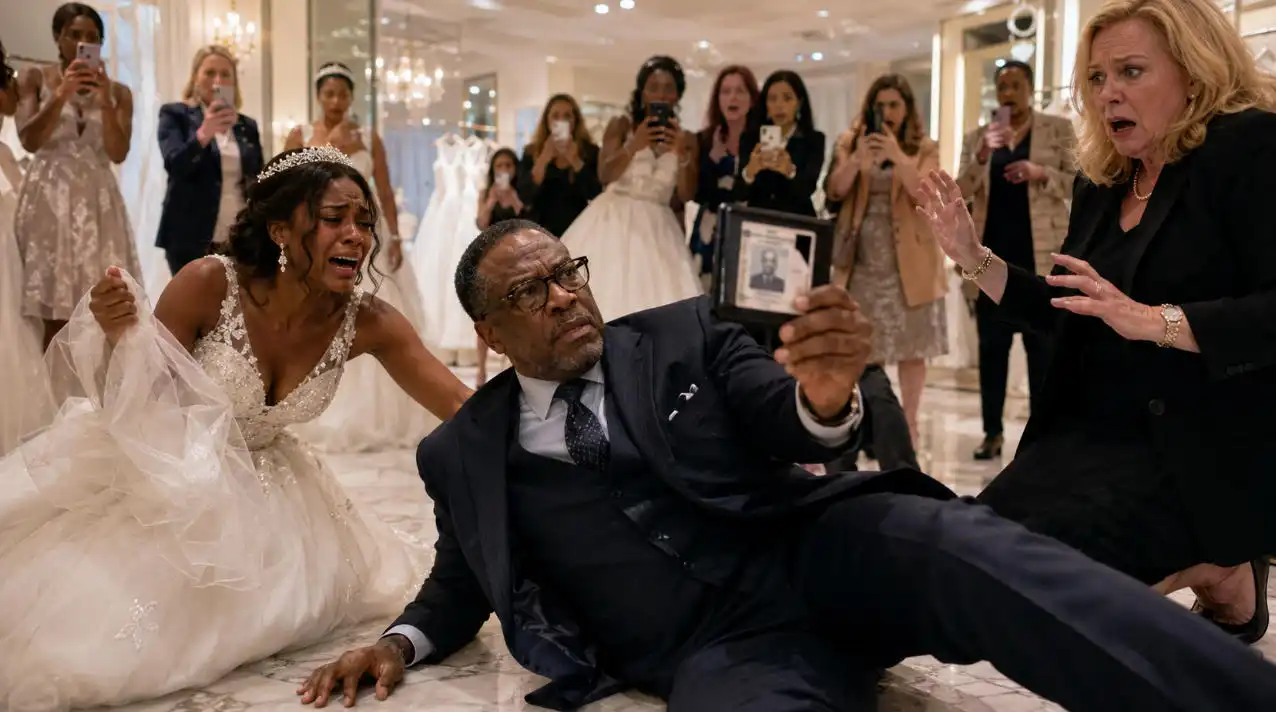
I stood beside my daughter, Maya, with dust on my suit sleeve and a federal judicial ID in my hand.
And I said nothing.
Because the room had already started telling on itself.
Thirty minutes earlier, Maya had been smiling.
Not a polite smile.
Not the kind of smile you wear when you want strangers to like you.
It was the kind of smile a father waits twenty-seven years to see.
She stood outside Bellavue Bridal Couture on Chicago’s Magnificent Mile, looking through the tall glass windows at gowns displayed like museum pieces.
White silk.
French lace.
Pearl buttons.
Veils so delicate they seemed to float instead of hang.
“Dad,” she whispered, squeezing my arm, “is it too much?”
I looked at her.
My daughter, who had worked nights through nursing school.
My daughter, who had once used her grocery money to buy her mother’s medication.
My daughter, who never asked for the biggest room, the newest phone, or the most expensive anything.
“No,” I said. “Not today.”
She laughed under her breath. “You always say that like you’re about to make trouble.”
“I’m retired from making trouble.”
She raised one eyebrow.
I smiled. “Professionally.”
That was our little joke.
Most people who saw me that day saw a quiet Black father in a simple navy suit.
No driver.
No jewelry.
No expensive watch.
Just a man carrying his daughter’s coat, her little purse, and a folder with printed dress photos.
They did not see the title I had spent decades carrying.
They did not see the courtroom.
They did not see the oath.
They did not see the years of being called “Your Honor” by people who smiled in public and lied under oath.
And I liked it that way.
That day belonged to Maya.
Not to me.
We stepped inside, and the temperature changed.
Outside was Chicago wind and car horns.
Inside was perfume, polished marble, soft music, and women speaking in low voices as if money itself were sleeping nearby.
A young receptionist glanced up.
Her smile appeared, then paused.
“Name?”
“Maya Reed,” my daughter said. “Eleven-thirty appointment.”
The receptionist checked the tablet.
Before she could answer, a woman in a cream blazer walked over.
Blonde hair.
Sharp smile.
Name tag: BRITTANY.
She looked at Maya’s shoes first.
Then her purse.
Then my suit.
Not my face.
My suit.
“Do you have an appointment?” Brittany asked.
Maya nodded. “Yes, ma’am. Maya Reed.”
Brittany tapped the tablet with one red fingernail.
“Hmm.”
That was the first insult.
Not a word.
A sound.
The kind of sound people make when they want you to know they expected less from you and still feel disappointed.
“We’re very busy today,” Brittany said.
The salon was not busy.
Three brides were trying gowns.
Two mothers sat near the champagne bar.
A manager in a charcoal suit stood by the back office speaking quietly into a headset.
Maya stayed sweet.
“I understand. I called last month. I’m here to try the Ellington gown.”
At the name, Brittany’s smile sharpened.
“The Ellington starts at twenty-eight thousand dollars.”
Maya swallowed.
“I know.”
“Before alterations.”
“I know.”
“And before veil, understructure, custom fitting, preservation, rush fees, and tax.”
Maya nodded again. “I know.”
Brittany leaned slightly closer.
“Many brides don’t.”
A mother nearby looked over her champagne glass.
Another bride whispered something to her friend.
Then both of them looked at Maya’s purse.
I felt my daughter’s fingers tighten around the folder.
I wanted to step in.
But Maya had asked me in the car, “Dad, please don’t do your judge voice unless somebody commits a felony.”
So I held my tongue.
Brittany turned toward the hallway.
“Mr. Dalton,” she called.
The manager looked up.
His name tag read EVAN DALTON — STORE MANAGER.
He took one look at us and did the same scan.
Shoes.
Purse.
Suit.
Skin.
Then he smiled like a man deciding whether helping us was worth his time.
“Is there an issue?” he asked.
Brittany did not lower her voice.
“They’re here for the Ellington.”
Evan gave a tiny laugh through his nose.
Not loud.
Worse.
Controlled.
The kind of laugh people use when they want witnesses to understand the joke without being brave enough to say it.
Maya’s cheeks reddened.
I said, “My daughter has an appointment.”
Evan nodded too quickly.
“Of course. Of course. I’ll just check inventory.”
Then he turned and walked into the back.
He did not check inventory.
I watched him through the reflection in the mirror.
He stood behind the wall, pulled out his phone, and started texting.
Ten minutes passed.
Then fifteen.
Maya sat on a white couch with her hands folded in her lap.
Brittany walked past us twice, helping another bride who had arrived after us.
“Oh my gosh, you look like royalty,” Brittany said to that bride.
Then, louder than necessary, she added, “Some gowns are meant for a certain kind of room.”
The bride giggled.
Her mother said, “You’re terrible.”
Brittany smiled.
“I’m honest.”
Maya looked down.
That hurt worse than the words.
I have sentenced men who showed less cruelty in open court.
Not because they stole.
Not because they lied.
But because they enjoyed watching someone shrink.
Finally, Maya stood.
“Excuse me,” she said. “Should we reschedule?”
Brittany turned around, annoyed, as if my daughter had interrupted surgery.
“I already told you we’re checking.”
Maya took a breath.
“I don’t want to waste anyone’s time. If the dress isn’t available—”
“It is available,” Brittany said.
The salon went quiet again.
Evan’s office door cracked open.
So he was listening.
Brittany walked to a rack, pulled a gown from behind a curtain, and held it like she was doing us a favor from heaven.
The Ellington.
Even I knew it.
Maya had shown me the photo so many times I could have identified that dress in a blackout.
Her eyes filled.
“Oh,” she whispered.
For a moment, the ugliness disappeared.
She ran her fingers over the lace sleeve.
Brittany snatched the hanger back slightly.
“Careful.”
Maya’s hand dropped.
Brittany sighed.
“Fine. Fitting room two.”
I waited outside while an assistant helped Maya change.
The assistant was younger, quieter, and looked ashamed.
When Maya stepped out, I forgot every insult.
She looked like her mother.
Not exactly.
Maya had my eyes.
But the way she held her shoulders, the way she turned toward the mirror slowly, the way she touched the lace at her wrist like she was afraid happiness might tear…
That was her mother.
My late wife, Denise, would have cried.
So I did it for both of us.
Maya saw my face in the mirror.
“Dad.”
“I’m fine.”
“You’re not.”
“I’m a federal judge. I can handle lace.”
She laughed.
And that laugh should have been the whole story.
That should have been the memory.
A father crying quietly in a bridal shop while his daughter found the dress.
But Brittany could not let us have even that.
She appeared behind Maya with a long veil.
“The veil is separate,” she said.
Maya nodded. “May I try it?”
Brittany hesitated.
Then she placed it on Maya’s head with stiff, irritated fingers.
The veil fell down Maya’s back.
The entire salon changed.
Even the whispering brides stopped.
Maya looked radiant.
Not rich.
Not poor.
Not judged.
Just beautiful.
One of the mothers murmured, “Oh, that is lovely.”
Brittany heard it.
Her face tightened.
Maya turned slightly and looked at me.
“Dad,” she whispered, “this is it.”
I smiled.
“Then this is it.”
Brittany laughed.
Sharp.
Small.
Cruel.
“I’m sorry,” she said, “but we do require proof of purchasing ability before allowing photos or extended handling.”
Maya blinked.
“What?”
Brittany stepped closer.
“Sweetheart, this is a couture piece. We can’t have people coming in here for a dress-up experience.”
Maya’s lips parted.
“I didn’t ask for photos.”
“You were going to.”
“No, I wasn’t.”
Brittany looked at me.
“Sir, you understand, right?”
I said, “I understand that my daughter has been polite.”
Brittany’s smile vanished.
That was my mistake.
Bullies hate witnesses.
They hate calm even more.
She turned back to Maya.
“Take it off.”
The quiet assistant whispered, “Brittany, maybe Mr. Dalton should—”
“Take it off,” Brittany repeated.
Maya reached carefully for the veil pins.
But Brittany did not wait.
She grabbed the veil with one hand and yanked.
Maya cried out.
The pins pulled loose.
The veil came off sideways.
A few strands of Maya’s hair came with it.
I stepped forward.
“Do not touch my daughter again.”
Brittany spun toward me.
“Oh, please.”
Then she said it.
Not loudly.
But clear enough for everyone near the mirrors to hear.
“There are stores for people like you.”
Maya froze.
The assistant covered her mouth.
One bride looked down at the floor.
Another lifted her phone.
Evan Dalton appeared from the back office.
He did not ask if Maya was okay.
He did not ask why his employee had put hands on a customer.
He said, “Let’s all calm down.”
I looked at him.
“Your employee just assaulted my daughter.”
Brittany scoffed.
“I removed merchandise.”
“She was wearing it.”
“She should not have been.”
Maya’s voice shook.
“I had an appointment.”
Brittany looked her up and down.
“With what deposit?”
That was when I stepped between them.
Not aggressively.
Not even quickly.
Just enough to put my body between a bully and my child.
Brittany pushed me.
Both hands.
Hard.
I was not expecting it.
My heel caught the edge of the fitting platform.
I fell backward onto the marble floor.
The sound echoed.
My daughter screamed, “Dad!”
The phones came up.
All of them.
That is the part people never understand about public humiliation.
It is not just the act.
It is the audience.
The little gasps.
The pretending not to stare.
The people recording because your worst moment is more interesting than their conscience.
Maya rushed toward me, gown bunched in her hands.
“I’m okay,” I said.
But I felt the hit in my shoulder.
Brittany stood above me, breathing hard.
For the first time, she looked unsure.
Evan finally moved.
Not to help me.
To block the phones.
“Ladies, please,” he said. “No recording inside the salon.”
I stood slowly.
I brushed my sleeve.
I looked at Brittany.
Then at Evan.
Then at the small leather folder sitting open on the front desk.
Inside were handwritten receipts.
Cash deposits.
Different totals than the printed invoices clipped beside them.
I had noticed them when we walked in.
I notice documents the way some men notice sports cars.
It is an old habit.
Brittany folded her arms.
“Are you calling security?”
“No,” I said.
I reached into my jacket.
Evan stepped forward.
“Sir—”
I held up my identification.
The gold seal caught the salon light.
United States Federal Judiciary.
Brittany squinted.
The assistant saw it first.
Her face changed.
Evan’s face went pale.
I said calmly, “My name is Marcus Reed. Senior Federal Judge, United States Court of Appeals.”
Nobody spoke.
Brittany’s mouth opened, then closed.
Maya whispered, “Dad…”
She knew who I was, of course.
But she also knew I hated using it outside the courtroom.
Power should not be a toy.
It should be a last resort.
Brittany tried to laugh.
It came out broken.
“Well, that doesn’t mean you can threaten a business.”
“I’m not threatening you,” I said.
I turned the phone so Evan could see the number I was dialing.
“I’m reporting one.”
Evan’s hands lifted.
“Judge Reed, please. There has clearly been a misunderstanding.”
I looked at Maya’s red scalp where the pins had been pulled.
Then at the marble floor where I had fallen.
Then at the two sets of receipts.
“No,” I said. “There has been a pattern.”
The call connected.
I knew the special agent in charge.
Not socially.
Professionally.
Years earlier, his office had presented evidence in a tax fraud case involving luxury retailers hiding cash transactions through “private fittings” and false alteration fees.
Bellavue Bridal Couture had been a name mentioned in testimony.
Not as a defendant then.
As a possible related entity.
A loose thread.
Judges remember loose threads.
Especially when they are attached to arrogant men with two ledgers on a front desk.
“This is Judge Marcus Reed,” I said into the phone. “I’m at Bellavue Bridal Couture on Michigan Avenue. I believe your office may want to preserve records here immediately.”
Evan whispered, “Oh God.”
Brittany turned to him.
“What records?”
He snapped, “Be quiet.”
That was the first time she looked truly afraid.
Not when she hurt my daughter.
Not when she shoved me.
Only when she realized her own people might blame her for exposing something bigger.
I ended the call.
Then I called Chicago police.
For the assault.
For the battery.
For the possible civil rights violation.
I did not shout.
I did not make a speech.
I simply gave facts.
That is the thing about the law.
It does not need volume.
It needs a record.
While we waited, the salon became a courtroom with mirrors.
The brides stopped pretending not to watch.
The mothers whispered.
The quiet assistant brought Maya a robe and said, “I’m so sorry.”
Maya’s hands were shaking.
I put my arm around her.
“You did nothing wrong.”
She nodded, but tears slid down her face.
“That was supposed to be my dress.”
My throat tightened.
“I know.”
And that was the moment I almost lost my calm.
Not when I hit the floor.
Not when Brittany insulted us.
When my daughter looked at a wedding gown like it had become contaminated by cruelty.
No father forgets that.
Thirty minutes after the call, the black SUVs pulled up.
Two IRS Criminal Investigation agents entered first.
Then Chicago police.
The first agent showed his badge.
“Mr. Dalton?”
Evan swallowed.
“Yes.”
“We need you to step away from the front desk.”
Brittany whispered, “What did you do?”
Evan did not answer her.
One officer walked to me.
“Judge Reed?”
I nodded.
He took my statement.
Then Maya’s.
Then the assistant’s.
And once one person told the truth, the whole room cracked open.
The assistant’s name was Lauren.
She was twenty-three.
She said Brittany had a habit of blocking certain customers from high-end gowns if she decided they “weren’t the image.”
She said Evan told staff to mark some cash deposits as “styling fees” so they would not appear in the same system as dress sales.
She said there was a safe in the back office.
She said there were two appointment books.
One for the official calendar.
One for “private clients.”
Evan shouted, “She’s lying!”
Lauren flinched.
I looked at the officer.
He saw it too.
Fear recognizes fear.
The agents asked Evan to open the office.
He refused.
Then he said he needed to call the owner.
Then he said he did not have the key.
Then one of the agents pointed to the key ring clipped to his belt.
“Is that not it?”
Evan’s face collapsed.
Brittany started crying.
Not apologizing.
Crying.
There is a difference.
“I didn’t know about taxes,” she said. “I just work here.”
Lauren turned on her.
“You pulled that veil off her head.”
Brittany looked around, searching for help from the same brides she had been performing for.
No one moved.
The agents opened the back office.
Inside were banker boxes.
Cash envelopes.
Handwritten client cards.
Alteration invoices.
A second laptop.
And a locked drawer full of receipts that did not match the store’s official system.
I watched Evan sit down like his bones had been cut.
The store owner arrived forty minutes later.
A woman named Celeste Moreau.
Elegant.
Diamond earrings.
Fur-trimmed coat.
She walked in furious.
Not embarrassed.
Furious.
“This is harassment,” she announced. “Do you know who my clients are?”
One IRS agent said, “Ma’am, please step to the side.”
She pointed at Maya.
“This is because of them?”
That was the worst thing she could have said.
Because six phones caught it.
Six angles.
Six witnesses.
Them.
Not “the incident.”
Not “my employee’s conduct.”
Them.
The officer asked Celeste if she wanted to clarify.
She did not.
She doubled down.
“My store has standards.”
Maya stood straighter.
Still in the robe.
Still with red eyes.
But straighter.
“So do courts,” she said.
I looked at her.
That was my daughter.
The clerk who had mocked her now stared at the floor.
The manager who had ignored her now begged agents not to take the computers.
The owner who thought reputation could buy silence now watched her reputation leave the building in evidence bags.
By evening, Bellavue Bridal Couture was closed.
Not for remodeling.
Not for a private event.
Closed.
A notice was placed on the front door.
Records seized pending investigation.
Brittany was arrested on suspicion of battery.
After review of the recorded statements and witness videos, prosecutors added a hate-crime enhancement based on the targeted language, the pattern described by staff, and her conduct toward Maya.
Evan Dalton was taken in for questioning related to financial records and obstruction.
Celeste Moreau’s attorneys arrived too late to stop the seizure.
Within forty-eight hours, local news picked up the story.
Not because I was a judge.
I did not give an interview.
Not because Maya wanted attention.
She did not.
The story spread because ordinary people recognized the scene.
A customer judged by appearance.
A father humiliated for staying calm.
A daughter’s joyful moment turned into a public lesson.
And a business that thought luxury meant immunity.
But the part that healed me did not happen on television.
It happened four days later.
Maya was at my kitchen table, wearing one of my old sweatshirts, pretending she was fine.
She had canceled two bridal appointments.
Her fiancé, David, had been gentle with her, but I could see the wound.
Every bride wants to feel chosen.
That salon had made her feel inspected.
Rejected.
Reduced.
There was a knock at the door.
I opened it.
A woman stood on the porch with silver hair, black glasses, and a rolling garment case behind her.
“Judge Reed?” she asked.
“Yes.”
“My name is Elise Hartwell.”
Maya gasped behind me.
I turned.
Her hand was over her mouth.
Apparently, Elise Hartwell was not just a designer.
She was the designer.
The kind of name bridal magazines put on covers.
Elise smiled softly.
“I saw what happened,” she said. “My studio would be honored to make your daughter’s wedding gown.”
Maya shook her head.
“I can’t afford—”
Elise lifted one hand.
“I didn’t mention money.”
Maya started crying before she could stop herself.
Elise stepped inside, not like a celebrity, but like a grandmother entering a sickroom.
She took Maya’s hands.
“No woman should have a wedding memory like that,” she said. “Let’s make a better one.”
The fitting happened in my living room.
My dining table became a sketch station.
Elise measured Maya herself.
David’s mother brought coffee.
Lauren, the quiet assistant from the bridal shop, came too.
Maya had asked for her.
Lauren had lost her job when Bellavue was sealed, but Elise offered her a position at her studio before the afternoon was over.
“You told the truth when it cost you something,” Elise said. “That matters in my business.”
Lauren cried in my hallway.
Maya hugged her.
That was justice too.
Not the loud kind.
The kind that puts a good person back on her feet.
Months passed.
The investigation widened.
Bellavue’s owners eventually faced federal tax charges tied to underreported income, falsified sales categories, and hidden cash deposits.
Evan cooperated after realizing loyalty was not going to save him.
Celeste’s society friends stopped answering her calls.
Brittany entered a plea on the assault charge and the enhanced allegation was addressed as part of the final agreement. She was ordered to complete community service, pay restitution, attend bias education, and stay away from Maya.
Some people online said that was not enough.
Maybe they were right.
But I have worn a robe too long to confuse vengeance with justice.
Justice is not always a lightning strike.
Sometimes it is a paper trail.
A witness statement.
A badge at the door.
A business license suspended.
A woman who thought she could humiliate strangers discovering that every stranger has a name.
And sometimes justice is your daughter standing in a custom gown, smiling again.
On Maya’s wedding day, I saw the dress for the first time.
Elise had kept the final design secret from me.
The gown was nothing like the Ellington.
It was better.
Soft ivory silk.
Long sleeves.
Tiny hand-sewn pearls at the cuffs.
A veil that moved like light.
When Maya stepped into the room, everyone went quiet.
David cried before I did.
Which I appreciated.
Took the pressure off me.
Maya walked toward me and whispered, “Dad, please don’t cry before the aisle.”
I said, “I make no promises.”
She laughed.
That laugh came back.
The one Brittany had tried to steal.
Before we walked out, Maya touched my sleeve.
“Were you scared that day?”
I thought about lying.
Then I told her the truth.
“Yes.”
Her eyes widened.
“You?”
“Yes.”
“Of what?”
I looked at the doors opening toward the aisle.
“Of becoming the kind of man who cared more about punishing her than protecting you.”
Maya squeezed my arm.
“You protected me.”
“No,” I said. “You protected yourself. I just made sure the rules finally showed up.”
She smiled.
Then the music started.
We walked.
Everyone stood.
No phones out.
No whispering.
No one measuring her worth by a purse, a shoe, or the color of her skin.
Just love.
Just family.
Just the quiet victory of a woman getting the moment she deserved.
At the reception, Elise sat with Lauren.
David danced with his mother.
Maya laughed so hard during the speeches that she nearly dropped her bouquet.
And for the first time since Denise passed, I felt something inside me unclench.
Not because the bridal shop had been shut down.
Not because Brittany had cried.
Not because Evan and Celeste lost the empire they built on arrogance and hidden books.
But because my daughter’s joy survived them.
That is the part people like Brittany never understand.
Cruelty can ruin a moment.
It cannot own the ending unless you let it.
So yes, I stayed calm when that clerk shoved me.
Yes, I used the law instead of my temper.
And yes, I would make that same call again.
Because when someone humiliates your child in public, staying silent is not always weakness.
Sometimes it is the sound of the hammer being lifted.
And when it falls, everyone hears it. ⚖️
So pick a side:
Was Judge Reed right to stay calm and let the law destroy that salon piece by piece…
Or should he have confronted Brittany the second she touched his daughter?
Share this if you believe dignity is not weakness — and nobody should ever judge a family by what they look like when they walk through the door.
Disclaimer: Mention of any brand or trademark is for identification only and does not imply partnership or endorsement
The Tavern Owner Set A Trap To Make Paul Drink Again… But He Had NO IDEA The Entire Town Was Watching 👀
They Laughed When Mark Announced He Was Running for Office… Then One Sealed Envelope Made the Whole Room Go Silent 😳
My Stepdaughter Thought Her Real Father Paid for Her Golf Club Wedding… Then I Showed the Guests the Letter He Sent Me