

The auctioneer’s hammer stopped in midair.
Not because of a bid.
Not because of a phone ringing.
Because the president of the auction house had just rushed down the center aisle with two security guards behind him.
And every millionaire in that golden Manhattan room turned to look at the old man in the wet, stained suit.
Walter did not move.
He stood beside the front row with tea dripping from his bidder card, one sleeve damp, one knee bruised from the fall.
Julian was still smiling when the president shouted:
“Stop the sale.”
The smile disappeared one inch at a time.
The auction house was the kind of place where people lowered their voices even when they were angry.
Gold walls.
Soft lights.
Polished marble.
Paintings worth more than most neighborhoods.
And in the front row sat the kind of people who believed money made them invisible to consequences.
Julian Vale believed that most of all.
He owned a Madison Avenue gallery.
He wore a midnight-blue velvet jacket.
He laughed like every room belonged to him.
That night, he wanted the final lot.
Everyone knew it.
A World War II relic.
A sealed field command case connected to one of the most decorated American rescue missions in Europe.
Collectors had flown in from London, Zurich, Dallas, and Palm Beach.
The estimate was twelve million dollars.
Julian had already told three reporters near the champagne table:
“That piece belongs in my gallery.”
Not “I hope to win it.”
Not “I’d be honored.”
Belongs.
Then Walter arrived.
He was early.
He wore an old brown suit that had been pressed with care but not replaced in years.
His tie was narrow and faded.
His shoes had deep creases.
On his lapel was a small Vietnam service pin.
He walked slowly, with the quiet stiffness of a man whose body remembered old injuries even when he refused to mention them.
A young usher checked his card and said politely:
“Mr. Walter Hayes, front row, seat four.”
Walter nodded.
“Thank you, ma’am.”
He sat down with both hands around his bidder paddle.
For twenty minutes, nobody bothered him.
Then Julian saw the empty space beside the aisle.
His space, in his mind.
He came over with two assistants, a private banker, and a woman holding a tablet.
Julian looked down at Walter.
“You’re in my seat.”
Walter looked at the card on the chair.
“I believe this is seat four.”
Julian laughed.
Not loudly.
Worse.
Softly.
Like Walter was a stain on the carpet.
“Sir, this is a major evening sale. The back rows are open to guests.”
Walter answered calmly.
“I’m registered.”
Julian’s assistant leaned closer and whispered, “Mr. Vale, we should ask staff.”
Julian raised one finger.
“No. I know exactly what this is.”
He bent down until his face was close to Walter’s.
“You people come to these events because someone gives you a charity invitation, and suddenly you think you’re part of the room.”
A woman behind them gasped.
Someone else whispered, “Is that necessary?”
Julian heard it and smiled wider.
He liked being watched.
Walter looked at him.
“I’m not here for charity.”
Julian glanced at Walter’s old cuffs, then at the worn bidder paddle.
“You’re here for warmth and free tea.”
A few people snickered.
The auctioneer, standing on stage, looked over.
He saw the confrontation.
He looked at Julian.
Then he looked away.
Because Julian spent millions there every year.
Walter did not raise his voice.
“Please step aside.”
That one sentence did something to Julian.
It offended him.
A quiet old man had refused to shrink.
Julian put one hand on Walter’s shoulder.
“You don’t tell me where to stand.”
Walter tried to rise.
Julian shoved him.
Hard.
Walter fell sideways against the chair arm, then dropped to one knee on the marble.
The bidder paddle slipped from his hand and skidded under the front row.
The room made that terrible sound a crowd makes when it knows something is wrong but does not yet know whether it is brave enough to say so.
No one moved.
Julian stepped over Walter’s leg and took the seat.
“Now we’re arranged properly.”
Walter reached under the chair and picked up his paddle.
The number was still visible.
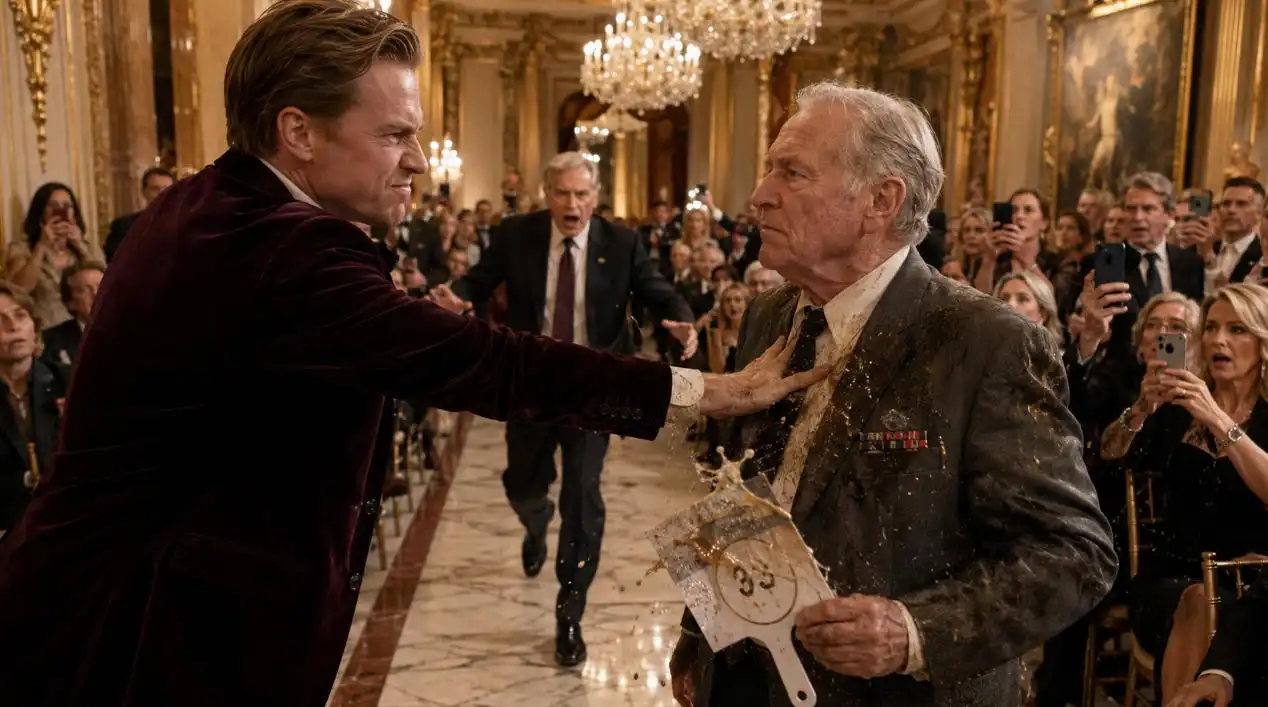
Then Julian lifted the porcelain cup from the side table.
Hot tea.
Steam still rising.
Walter looked up.
“Don’t do that.”
Julian tilted the cup.
The tea spilled over Walter’s bidder card, his sleeve, and the corner of his lapel.
The paper curled.
The black number blurred.
Julian set the empty cup down.
“There. Now it matches the suit.”
Silence.
A woman in diamonds covered her mouth.
A younger man pulled out his phone.
The auctioneer tightened his jaw but still said nothing.
Walter took one breath.
Then another.
His hands shook, but not from fear.
He wiped tea from the bidder paddle with a folded handkerchief.
Julian leaned back and crossed his legs.
“Security can escort him out whenever they’re ready.”
Walter looked toward the stage curtains.
Behind them, the final lot was waiting.
He did not speak.
He only folded the ruined bidder card once and placed it inside his coat.
That calm bothered Julian more than anger would have.
“What, no speech?” Julian said. “No veteran lecture? No story about sacrifice?”
Walter’s eyes lifted.
“Not to you.”
That was the first time Julian looked uncomfortable.
Only for a second.
Then the president of the auction house appeared at the side of the stage.
His name was Richard Ellery.
He was known for never hurrying.
That night, he ran.
He came down the steps, crossed the aisle, and stopped beside Walter.
“Mr. Hayes,” he said, out of breath. “Are you hurt?”
Julian blinked.
The room shifted.
Because Richard Ellery did not use that tone for ordinary guests.
Walter said, “I’m all right.”
The president looked at the wet sleeve.
Then the bruised knee.
Then the ruined bidder card.
His face changed.
He turned to Julian.
“What did you do?”
Julian gave a polished laugh.
“Richard, there was a seating confusion. This gentleman became difficult.”
A woman in the second row spoke up.
“That’s not what happened.”
Julian snapped his head toward her.
She lifted her phone.
“I recorded it.”
Another man said, “I did too.”
A third voice from the back:
“He pushed him.”
The auctioneer finally stepped away from the podium, pale as paper.
Richard Ellery held out his hand to Walter.
“Sir, may I have the card?”
Walter removed the folded, soaked bidder paddle from his pocket.
The president opened it carefully, like it was evidence in court.
Then he turned to the staff.
“Replace this immediately. Same registration. Same authority.”
Julian stood.
“Authority? Richard, what is going on?”
The president did not answer him yet.
He faced the room.
“Ladies and gentlemen, before the final lot, I need to address a serious incident.”
Julian’s banker whispered, “Sit down.”
Julian ignored him.
“No, I’d like to know why we’re stopping a twelve-million-dollar auction because an old man spilled tea on himself.”
That sentence finished him.
The room went cold.
Walter’s jaw tightened.
Richard Ellery stepped closer to Julian.
“You will not speak about Mr. Hayes that way in this house.”
Julian scoffed.
“This house? I’ve bought more from this house than half this room combined.”
Richard said:
“And tonight, you have humiliated the donor of the final lot.”
The room stopped breathing.
Julian stared at him.
“What?”
Richard turned toward the stage.
“The World War II field command case, the letters, the rescue documents, and the medal group scheduled as tonight’s final lot were donated without compensation by Mr. Walter Hayes.”
Whispers exploded across the hall.
Julian’s face lost color.
Walter looked down.
He had not wanted applause.
That was never why he came.
Richard continued:
“Mr. Hayes inherited the archive from his late uncle, Captain Thomas Hayes, whose unit helped rescue wounded Allied soldiers in 1944. Mr. Hayes donated the collection so the proceeds could establish a permanent veterans’ medical fund.”
The phones rose higher.
The banker beside Julian stepped back.
The woman with the tablet slowly closed the case file in her hands.
Julian tried to laugh again, but there was no sound in it.
“That’s impossible. The donor was listed as anonymous.”
Walter finally spoke.
“That was the point.”
Julian swallowed.
“Mr. Hayes, I didn’t know—”
Walter looked at him.
“No. You didn’t.”
Two words.
Quiet.
Clean.
Deadly.
Richard Ellery turned to security.
“Remove Mr. Vale from the sales floor.”
Julian’s arrogance came back in panic.
“You can’t remove me. I’m registered to bid. My gallery has a guaranteed client. My deposit is cleared.”
Richard said:
“Your bidding privileges are suspended pending review.”
Julian pointed at Walter.
“Because of him?”
“No,” Richard said. “Because of you.”
Julian stepped forward.
Security blocked him.
“You people need me,” Julian snapped. “Do you understand what I bring into this building?”
Richard’s expression hardened.
“You brought disgrace into it.”
Then Julian made one last mistake.
He reached toward Walter’s coat, as if to grab the ruined bidder card.
Walter stepped back.
A security guard caught Julian’s wrist.
The room gasped again.
Richard looked at him with complete disgust.
“Get him out.”
Julian shouted all the way up the aisle.
“This is a misunderstanding!”
No one believed him.
At the doors, rain beat against the glass.
Security escorted him into the storm without his overcoat.
His velvet jacket darkened almost instantly under the rain.
For the first time that night, Julian looked small.
But the consequences did not stop at the door.
Because auction houses run on reputation.
And reputation runs faster than any car in Manhattan.
By midnight, three videos had reached collectors, museum boards, private clients, and every major art advisor Julian had ever bragged to.
By morning, two consignors withdrew from his gallery.
By noon, a museum canceled a planned partnership.
By the end of the week, the auction house’s ethics committee issued a permanent ban.
Julian Vale was barred from bidding through the firm, through affiliates, and through proxy representatives.
That last part hurt most.
Men like Julian always think they can send someone else to do their dirty work.
This time, the contract closed that door.
Then came the financial hammer.
Julian’s gallery had borrowed heavily against expected commissions from the World War II artifact sale.
His investors had believed he could secure the piece, resell exhibition rights, and use the publicity to save a failing quarter.
Instead, his name became poison.
Clients asked for their art back.
Lenders called.
A private collector sued over misrepresented provenance on a separate painting, suddenly willing to talk because Julian’s protection had cracked.
Within six months, the velvet-jacket king of Madison Avenue had sold his gallery furniture at liquidation.
Even the brass nameplate came off the wall.
Not because Walter cursed him.
Not because Walter chased him.
Because Julian finally met a rule he could not charm, buy, or bully his way around.
The final lot still went to auction that night.
But before it did, Richard Ellery returned to the stage.
He did not ask Walter’s permission loudly.
He walked down to him and said softly:
“Mr. Hayes, would you allow us to honor the reason this collection is here?”
Walter hesitated.
“I don’t need a fuss.”
An older woman in the front row stood.
Then a man behind her.
Then another.
Within seconds, the entire room rose.
The same room that had gone silent when Walter fell…
Now stood for him.
Not perfectly.
Not soon enough.
But fully.
Walter’s eyes lowered.
His hand went to the small Vietnam pin on his lapel.
Richard said into the microphone:
“Mr. Hayes asked for no recognition. He requested no fee. He only asked that the proceeds support medical care for veterans and their families.”
The auctioneer looked ashamed.
He stepped forward and said:
“Mr. Hayes, I owe you an apology.”
Walter looked at him for a long moment.
Then said:
“Next time, look sooner.”
The auctioneer nodded.
He deserved that.
The room did too.
Walter was escorted to the highest honor seat beside the auction house president.
A new bidder paddle was placed in his hand, though Walter had not come to buy anything.
He held it anyway.
Clean.
Dry.
Unbent.
The final lot opened at eight million.
Then ten.
Then twelve.
Then fifteen.
A foundation representative in the back raised her paddle.
A private museum raised theirs.
The price climbed until the room felt almost afraid to breathe.
When the hammer finally fell, the collection sold for eighteen million dollars.
Every penny went into the Hayes Veterans Medical Fund.
Walter closed his eyes.
Not for the money.
For the men whose names were inside those letters.
For his uncle.
For the boys who never got old enough to wear worn suits in fancy rooms.
After the sale, people approached him carefully.
Some apologized.
Some thanked him.
Some only nodded because shame had taken their words.
The woman who recorded the shove said:
“I’m sorry I didn’t stand sooner.”
Walter gave her a tired smile.
“You stood when it counted.”
Outside, the rain had softened.
Richard offered Walter a private car.
Walter accepted, but only after asking if the young usher could ride down in the elevator with him.
She had been crying near the coat check.
“I should have stopped him,” she said.
Walter shook his head.
“You were the first person who treated me like I belonged.”
She wiped her eyes.
“You did belong.”
Walter looked back toward the auction room.
“No,” he said softly. “I belonged before they knew what I gave.”
That line stayed with her.
Years later, she would repeat it when training new staff:
People do not become worthy when you discover their money.
They were worthy when they walked in.
The Hayes Veterans Medical Fund opened the following spring.
Its first grants paid for prosthetics, trauma counseling, home care, and transportation for aging veterans who could no longer drive.
Walter attended the opening in the same brown suit.
Pressed again.
Still old.
Still his.
This time, no one laughed at it.
Richard tried once to convince him to let the auction house buy him a new one.
Walter smiled.
“This one has made it through worse rooms than yours.”
Richard laughed, then nodded.
Fair enough.
As for Julian, he sent three apology letters.
The first blamed stress.
The second blamed misunderstanding.
The third finally used the words “I was wrong.”
Walter read it once.
Then folded it and placed it in a drawer.
He did not answer.
Forgiveness, he believed, did not require giving a cruel man access to you again.
One year after the auction, Walter returned to the same Manhattan hall.
Not as a bidder.
Not as a donor.
As the guest of honor at a benefit dinner for the medical fund.
When he walked in, the room stood immediately.
No hesitation.
No whispers.
No pretending.
Walter paused at the doorway.
For just a second, he saw himself on the floor again.
Tea on his sleeve.
Julian laughing.
The auctioneer looking away.
Then he saw the new plaque near the entrance.
It read:
Dignity is not assigned by wealth. It is revealed by character.
Walter touched the edge of the plaque.
Then he walked to the front row.
His seat was waiting.
Not because he was rich.
Not because he had donated something valuable.
Because the room had finally learned the lesson Julian never did.
An old suit can cover a hero.
A quiet man can carry history.
And the person you step over today may be the reason the whole room exists tomorrow.
So choose:
Was Walter right to stay calm and let the rules destroy Julian…
Or should someone in that room have stood up the moment the old veteran hit the floor?
Share this if you believe dignity should never depend on how expensive someone looks. 🇺🇸
Disclaimer: Mention of any brand or trademark is for identification only and does not imply partnership or endorsement
The Tavern Owner Set A Trap To Make Paul Drink Again… But He Had NO IDEA The Entire Town Was Watching 👀
They Laughed When Mark Announced He Was Running for Office… Then One Sealed Envelope Made the Whole Room Go Silent 😳
My Stepdaughter Thought Her Real Father Paid for Her Golf Club Wedding… Then I Showed the Guests the Letter He Sent Me