
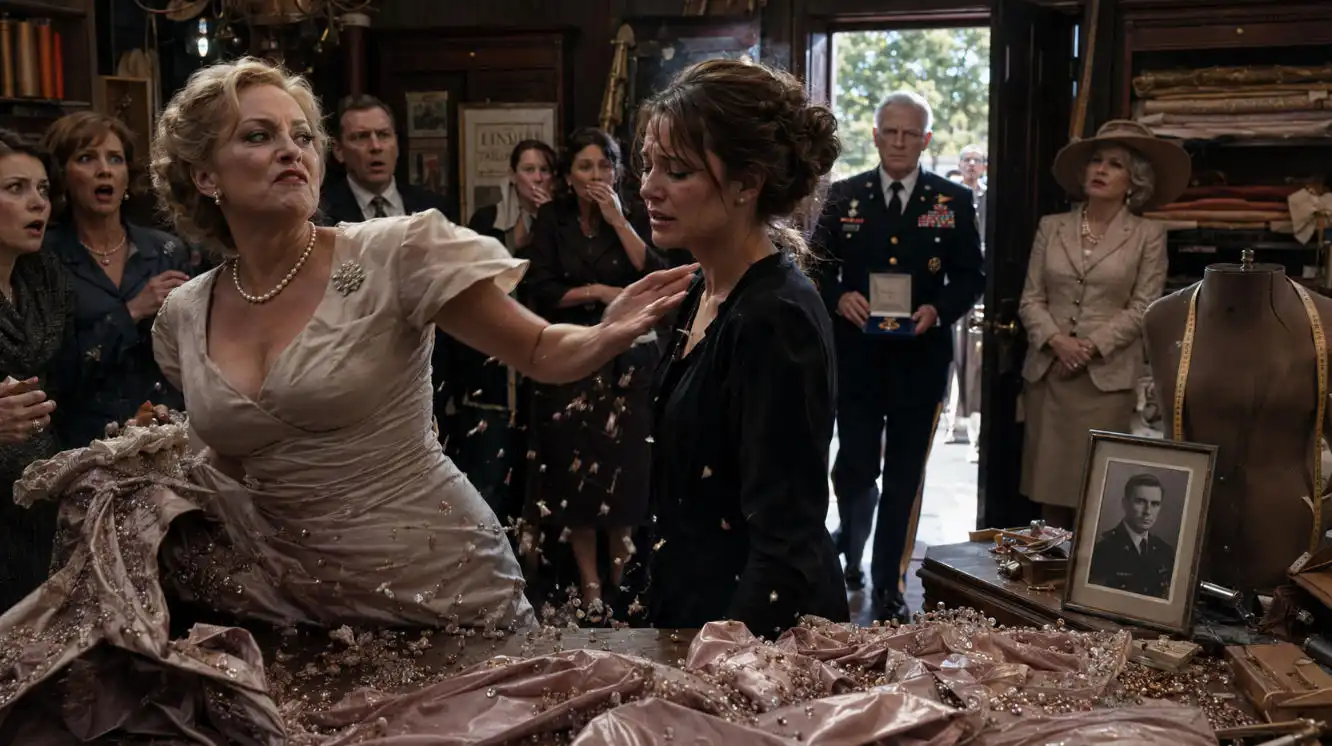
“The man her husband trusted to bring her honor home.”
Colonel James Whitaker said it with such control that the entire tailor shop went silent.
Linda stayed on her knees among torn silk and scattered beads, one hand pressed to her burning cheek, the other still trying to smooth the ruined gown out of habit.
Victoria Ashford stood above her in pearls and perfume, holding a ripped piece of fabric like she had not just destroyed six weeks of another woman’s life.
At the doorway, Linda’s neighbor, Mrs. Bell, stopped smirking.
And in the middle of the dim little shop, under the yellow lamp beside the old sewing machine, James Whitaker held a Presidential Medal in a velvet case like the room itself had become a ceremony.
Linda looked at him through tears.
“You knew Robert?”
James’s expression softened.
“I served under fire with him. And I lived because he refused to leave me behind.”
Linda’s breath caught. 💔
Robert had spoken of James only in quiet fragments.
A brilliant officer.
A loyal friend.
A man who carried responsibility like armor.
Robert used to say, “If James ever walks into a room for you, Linda, listen. He doesn’t waste footsteps.”
Now James had walked into her little tailor shop at the worst moment of her life.
Victoria recovered first.
“This is absurd,” she snapped. “I’m a paying customer.”
James looked at the destroyed gown.
“No. You are a thief wearing manners.”
Victoria’s face reddened.
“I wore that gown once. It fell apart.”
Linda lifted her head.
“It did not fall apart. You tore it.”
Mrs. Bell scoffed from the doorway.
“Linda, don’t embarrass yourself. People like Mrs. Ashford can ruin a business with one call.”
James turned toward the neighbor.
“One more word, and you can explain to every reporter at the State Dinner why you helped mock the widow of a decorated soldier.”
Mrs. Bell went pale.
The shop had always been small.
Too small for luxury clients.
Too small for society women.
Too small, people said, for big dreams.
But Robert had loved it.
He had painted the front sign himself.
He had repaired the old sewing table.
He had told Linda, night after night, that her hands made plain fabric feel like courage.
After he died, the shop became both shelter and wound.
She worked there because she had to survive.
She stayed there because Robert’s laughter still seemed tucked between the fabric bolts.
Victoria crossed her arms.
“I want my refund.”
James closed the medal case.
“Then let’s make a deal.”
The air changed.
He placed a folder on Linda’s cutting table.
“If Mrs. Harper’s craftsmanship failed, if you did not wear the gown successfully, and if you are legally entitled to a refund, I will personally pay you twice what you claim.”
Victoria’s smile returned.
Then James continued:
“But if you wore her work, collected praise, returned it damaged on purpose, assaulted her, and tried to destroy her reputation because you thought a widow had no defender, then you will leave this shop with no refund, no invitation, and no access to any diplomatic event connected to my office.”
Victoria’s smile vanished.
“You can’t blacklist me.”
James’s eyes went cold.
“I can. And I will.”
Then came the micro miracle.
A tiny chime sounded from the old sewing machine.
Linda turned.
Robert had installed a little camera above the fitting mirror years ago after a customer falsely claimed Linda ruined an heirloom jacket.
Linda had forgotten it still worked.
When Victoria tore the gown, she had knocked the mirror light switch hard enough to wake the backup power.
The little camera screen flickered on.
A red recording icon blinked.
Linda covered her mouth. 😱
James looked at the screen.
“May I?”
Linda nodded.
He pressed playback.
The video showed Victoria entering the shop in the same gown three nights earlier before the gala, spinning in front of the mirror, saying to Mrs. Bell:
“It looks expensive enough that no one will know it came from this sad little place.”
Then another clip from minutes before the slap.
Victoria whispering:
“I’ll ruin it myself. She’ll refund me before I ruin her name.”
The shop went dead silent. 🤯
Not rumor.
Not emotion.
Proof.
Victoria’s face turned white beneath her makeup.
Linda stared at the screen, her whole body trembling.
For years, she had swallowed shame from women who praised her work in public and insulted her shop in private.
She had accepted late payments.
Unfair complaints.
Quiet disrespect.
Because she needed the money.
Because grief had made survival feel like a room with no exits.
But now the truth had thread and timestamp.
James looked at Victoria.
“You tore her work because you believed her dignity was cheaper than your vanity.”
Victoria stepped backward.
“I was joking.”
Linda stood slowly, torn silk in her hands.
“No,” she said, voice shaking. “You were counting on me being too poor to fight back.”
James’s jaw tightened.
Victoria lifted her chin anyway.
“You still struck me.”
James did not deny it.
When Victoria lunged toward Linda again, James moved once and stopped her wrist before she could touch her.
Then, with one sharp controlled slap across the hand that had torn the gown, he knocked the ripped fabric from her fingers and sent her stumbling back against the fitting-room curtain.
Not a beating.
Not cruelty.
A public end to arrogance.
“You will not touch her again,” he said.
Victoria clutched her hand, stunned.
James turned to his aide at the door.
“Remove Mrs. Ashford from the guest list. Notify protocol. Notify embassy wardrobe staff. Notify every official partner atelier.”
Victoria gasped.
“You’re insane.”
James looked at the torn gown.
“No. I am late.”
That sentence made Linda look up.
James reached into the folder and pulled out an envelope.
Robert’s handwriting waited across the front.
For Linda, when the needle feels too heavy.
Linda’s knees nearly gave out.
James steadied her with one hand, careful and respectful.
“He gave this to me before his last operation,” James said. “He told me if I ever had influence, I was to use it properly.”
Linda opened the letter with trembling fingers.
My Lin, If James is standing in your shop, then I did not come home the way I promised, but I found one last way to stand near you. Do not let cruel people make you think your hands are small. You stitched my uniforms. You stitched my torn sleeves. You stitched me back into a man after war. One day, someone powerful will need your gift. When that day comes, do not hide in the back room. Walk forward. You were always my finest work. — Robert
Linda pressed the letter to her heart and sobbed.
The shop blurred.
The torn gown.
The cruel woman.
The neighbor.
The medal.
The man Robert had trusted.
All of it folded into one impossible truth:
Robert had seen this future before Linda could.
James opened the velvet medal case again.
“This medal belongs to Robert,” he said. “It was awarded after a classified mission. The paperwork was delayed for years.”
Linda stared at it.
Robert’s medal.
His honor.
Returned not in a grand hall, but in the small shop where she had kept his memory alive with thread and trembling hands.
James lowered his voice.
“I came today to ask you to create two formal gowns for the State Dinner. One for a diplomatic guest. One for a military family honoree.”
Linda laughed once through tears.
“I can’t sew for the State Dinner.”
James looked around the shop.
At the perfect seams.
The hand-beaded trim.
The old dress forms.
The way even the torn gown looked beautiful in pieces.
“You already have.”
His aide opened a tablet and showed Linda photographs from Victoria’s gala.
Multiple guests had asked who designed the gown.
One foreign ambassador’s wife had written:
Find this designer immediately. The handwork is extraordinary.
Victoria had returned the dress not because it failed.
Because it succeeded too well.
The truth struck Linda so hard she had to sit.
James turned toward Victoria.
“You wore her art into rooms that praised you, then came back to spit on the artist.”
Victoria’s social confidence finally cracked.
Mrs. Bell tried to slip out.
Linda saw her.
“No,” Linda said.
Mrs. Bell froze.
Linda stepped forward, Robert’s letter in one hand.
“You told everyone my shop was dying.”
Mrs. Bell swallowed.
“I only repeated what people said.”
“You helped them say it.”
The neighbor looked down.
Good.
Some shame should lower its eyes.
Victoria was removed from the shop by James’s security aide and local officers after Linda chose to file a report for assault and property destruction.
The video was preserved.
The refund demand died.
So did Victoria’s public image.
By evening, her removal from the State Dinner guest list had become quiet but vicious society news.
By morning, the clip of her boasting about ruining the gown spread through donor circles.
Her charity board removed her.
Her social circle pretended not to know her.
Her name was blacklisted from official diplomatic events tied to James’s office.
Mrs. Bell stopped speaking loudly in public.
That alone improved the street.
But Linda did not feel victorious at first.
She felt exhausted.
After everyone left, she stood alone beside the ruined gown.
James remained near the doorway.
Not crowding her.
Not claiming victory.
Just waiting.
Linda touched the torn silk.
“I worked on this until two in the morning for weeks.”
“I know,” James said.
“I thought if I made it perfect, they’d respect me.”
His voice softened.
“Cruel people don’t respect perfection. They exploit it.”
Linda closed her eyes.
“I’m tired.”
James stepped closer.
“Then let me carry the next part.”
She looked at him.
Robert’s letter warmed in her hand.
“Did he ask you to say that?”
A faint smile touched James’s face.
“No. He mostly asked me not to be insufferable.”
“He failed.”
James laughed softly.
For the first time that day, Linda did too.
That laugh became the first stitch in something new.
The State Dinner commission changed everything.
Not overnight.
But fast.
James brought official measurements, security requirements, fabric access, and a quiet confidence that made Linda feel less like she was pretending to belong.
She worked like a woman possessed by purpose.
Her hands shook on the first cut.
Then steadied.
She selected silk the color of moonlit ivory for the diplomatic gown, with hand embroidery inspired by American wildflowers and military ribbon geometry.
For the military family honoree, she chose deep navy satin with silver thread so subtle it only shimmered when the wearer moved.
James came by every evening.
At first, officially.
Then with coffee.
Then with dinner when he realized she forgot to eat.
He never took over.
Never corrected what he did not understand.
Never spoke of couture like it was decoration.
He watched Linda work as if every stitch was a form of testimony.
One night, she caught him staring at Robert’s measuring tape.
“You miss him,” she said.
James looked down.
“Yes.”
“He saved you?”
“More than once.”
“And you feel guilty.”
He gave a quiet, painful laugh.
“Robert warned me you saw too much.”
“He married me. Of course he warned you.”
James smiled, then looked away.
“He told me your work saved him after deployment. That when he wore a jacket you repaired, he felt like a man again instead of a collection of wounds.”
Linda’s eyes filled.
“He never told me that.”
“He told everyone else.”
That broke something tender inside her.
Not in a bad way.
In a way that let warmth in.
The gowns were finished three days before the State Dinner.
When the ambassador’s wife tried hers on, she stood in silence for almost a full minute.
Then she said:
“This was made by someone who understands dignity.”
Linda had to leave the room before she cried.
The military family honoree, an elderly Gold Star mother, touched the silver-thread hem of her navy gown and whispered:
“My son would have loved this.”
Linda held her hand and said:
“Then it’s right.”
That evening, James returned with another envelope.
Robert’s handwriting.
For James, if Linda starts believing again.
Linda looked at him.
“He wrote one for you too?”
James nodded.
His hands were not steady when he opened it.
James, If Linda is sewing for rooms you used to hate, remind her she is not entering them as decoration. She is entering as proof. Do not treat her like a mission. She is not a debt. She is the woman who made my life beautiful even after war made me ugly inside. If you love her someday, do it slowly. Let my name stay warm in the room. And if you escort her anywhere grand, make sure she knows she belongs there before the doors open. — Robert
James folded the letter slowly.
Linda’s heart beat too hard.
“You love me?” she whispered.
James looked at her with the face of a man who had commanded rooms full of soldiers but feared one honest sentence.
“I came because Robert asked me to.”
“And now?”
He swallowed.
“Now I stay because when you sew, the world looks less broken.”
Linda’s eyes filled.
“I still love him.”
“You always will.”
“I’m scared.”
“I know.”
“I don’t want to be rescued like some poor widow in a story.”
James stepped back slightly, giving her space even in confession.
“Then don’t be rescued. Walk in beside me.”
That was the line she needed.
The night of the State Dinner arrived cold and bright.
Black cars.
Flag-lined entrance.
Press cameras.
Diplomats.
Officers.
Formal gowns.
Polished floors.
Linda stood in the dressing room wearing a soft silver gown she had made for herself from leftover fabric no one else would have known how to save.
James stood at the door in full formal uniform.
Robert’s Presidential Medal rested in a velvet case to be displayed during the military honor tribute.
Linda looked at the mirror and saw the woman she had almost forgotten.
Not young.
Not untouched by grief.
But beautiful.
Composed.
Alive.
James offered his arm.
“Ready?”
She looked down.
“My hands are shaking.”
He covered them gently.
“Good. It means the moment matters.”
Then he leaned closer and said:
“Before those doors open, remember this. You do not belong here because I brought you. You belong here because your work did.”
Linda breathed.
Then took his arm.
They walked in together.
The room turned.
Cameras flashed.
The ambassador’s wife wore Linda’s ivory gown.
The Gold Star mother wore Linda’s navy gown.
Both were radiant.
People whispered Linda’s name.
Not as gossip.
As discovery.
The President himself paused beside Robert’s medal display and thanked Linda for her husband’s service.
Then he looked at her hands and said:
“And for your own.”
Linda nearly cried right there.
James steadied her with the smallest touch at her elbow.
The next week, everything changed.
Orders came from embassies.
Then formal military families.
Then visiting foreign dignitaries.
Then royal households who had seen photographs of the gowns and wanted the same handwork, the same dignity, the same quiet strength sewn into fabric.
Linda’s little tailor shop became a destination.
Not because it became flashy.
Because it stayed true.
The old machines remained.
Robert’s measuring tape stayed beside the register.
The sign was repainted:
LINDA HARPER ATELIER HANDMADE WITH HONOR
Mrs. Bell moved away six months later after no one cared for her gossip anymore.
Victoria Ashford disappeared from society circles and was remembered mostly as the woman who tried to destroy the seamstress who ended up dressing people she could never reach again.
Linda hired apprentices.
Widows.
Veterans’ spouses.
Young artists who thought their work was too small to matter.
She taught them the first rule Robert had taught her:
“Never sew like someone is merely being covered. Sew like someone is being restored.”
James continued visiting.
Then stopped pretending visits were necessary.
He walked Linda to official fittings.
Picked her up after late work.
Sat quietly while she stitched, reading reports he barely turned pages on.
Sometimes he would read Robert’s letters aloud when grief was kind enough to let them smile.
Their love grew slowly.
Properly.
With the dead honored and the living allowed to breathe.
One evening, after a royal diplomatic commission arrived, Linda stood in the doorway of her shop watching apprentices work under warm light.
James stood beside her.
“You built this,” he said.
She touched Robert’s measuring tape.
“We did.”
James nodded.
“Yes.”
She looked at him.
“All of us.”
His eyes softened.
That was the beauty of it.
Robert had not been replaced.
He had been woven in.
Into the shop.
Into the gowns.
Into James’s loyalty.
Into Linda’s new courage.
Months later, James escorted Linda to another state event.
This time, she did not tremble at the door.
She placed her hand on his arm and smiled.
“Do I belong?”
James looked at her as if the answer were the easiest truth in the world.
“Linda, half the room is wearing your courage.”
She laughed through tears.
Then they walked forward together.
The widow once slapped in her dim little shop, standing over torn silk and broken pride, became the woman whose stitches entered palaces, embassies, and presidential halls.
Not because wealth rescued her.
Because honor finally recognized her.
And in the arms of the man her husband trusted, Linda walked into the rest of her life with her head high, her hands steady, and her heart stitched back together one brave thread at a time. 🙏
🚨 Share this if you believe widows, artisans, and every hardworking woman mocked by the rich deserves a moment when the whole world finally sees the dignity in her hands.
Disclaimer: Mention of any brand or trademark is for identification only and does not imply partnership or endorsement
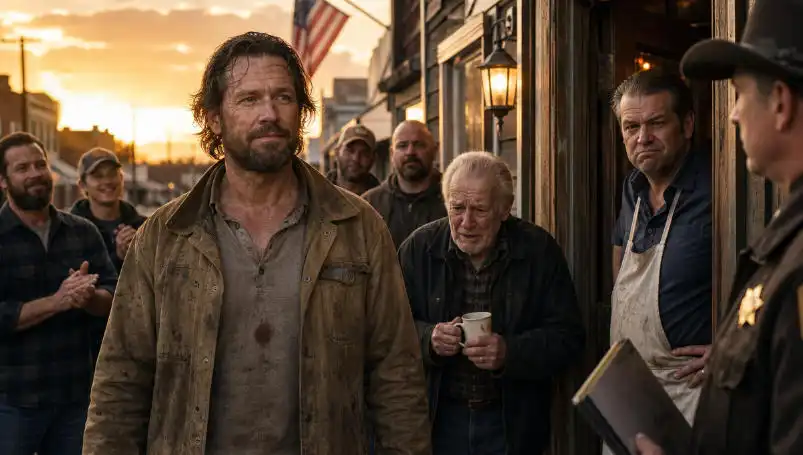
The Tavern Owner Set A Trap To Make Paul Drink Again… But He Had NO IDEA The Entire Town Was Watching 👀
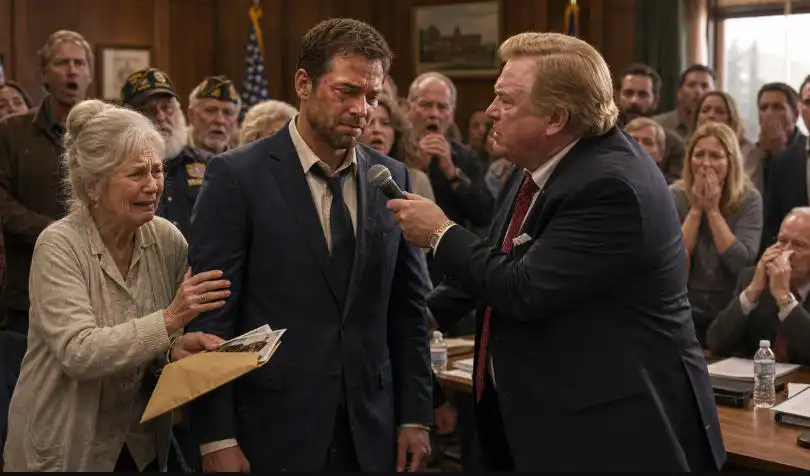
They Laughed When Mark Announced He Was Running for Office… Then One Sealed Envelope Made the Whole Room Go Silent 😳
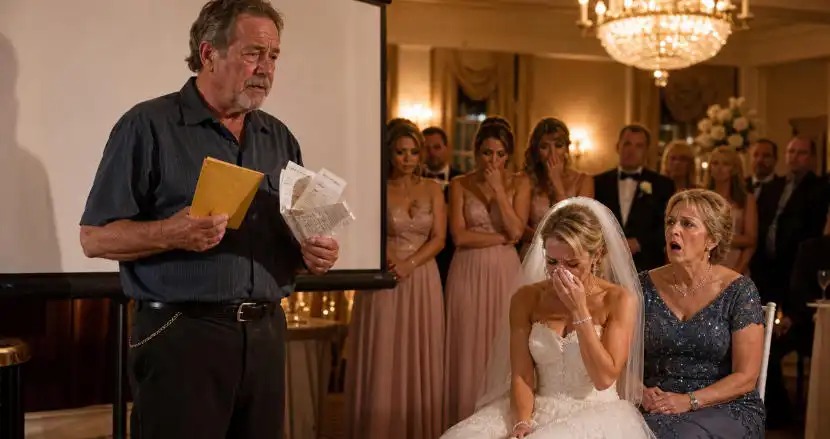
My Stepdaughter Thought Her Real Father Paid for Her Golf Club Wedding… Then I Showed the Guests the Letter He Sent Me