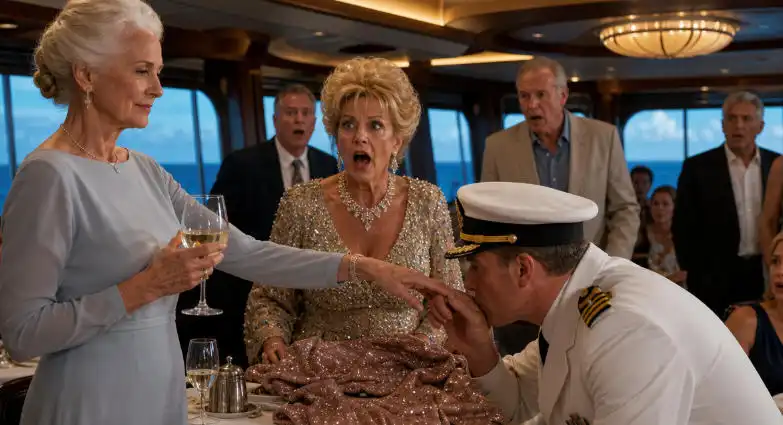


The old billionaire lifted the microphone, and for the first time that night, Julian looked poor.
Not in money.
In courage.
His face went pale under the golden Miami sunset. His hand tightened around Blair’s waist, but she pulled slightly away from him, like fear had made him contagious.
The live broadcast camera swung toward the boarding deck.
The red light blinked.
Everyone on that private yacht party stopped pretending they were too important to stare.
I stood near the champagne table in a thrift-store dress with caramel macchiato dripping down my chest.
My cheek burned from the slap.
My shoulder ached from where Julian had shoved me into a waiter.
My broken heel was still lying under a chair.
And somehow, I had never stood taller in my life.
The silver-haired man in the white dinner jacket looked straight at me.
Then he looked at Julian.
His voice was calm.
Deadly calm.
“Before this celebration continues,” he said, “I need everyone here to know exactly who Rachel is to me.”
Blair tried to laugh.
It came out like a cough.
Julian whispered, “Don’t do this.”
The old man smiled.
“Son, you should have thought of that before you let your mistress throw coffee on my heir.”
The yacht went silent.
Then the whole deck exploded.
“What?”
“His heir?”
“Did he say heir?”
Someone dropped a champagne flute.
Blair’s father, the same man who had slapped me ten minutes earlier, stepped back as if the deck had tilted beneath him.
Julian stared at me like he was seeing me for the first time.
But the truth was, he had seen me for twelve years.
He had just never looked.
My name is Rachel Monroe.
Six years ago, I helped Julian open his first art gallery in a rented storefront with cracked floors and leaking pipes.
I handled the invoices.
I packed the paintings.
I wrote the donor letters.
I stood beside him at shows when nobody cared who he was.
Then he became “Julian Vale, visionary gallery owner.”
And I became “Rachel, the wife who didn’t fit the image.”
When our son was born, I stayed home.
When Julian’s business grew, he told me I was lucky.
When he started traveling with Blair Caldwell, a famous art critic with perfect hair and cruel eyes, he told me I was paranoid.
Then he divorced me.
He moved money.
He delayed support.
He told the court his galleries were “under financial strain.”
He told friends I was unstable.
He told donors I had spent him into debt.
And when my credit collapsed, when my car was repossessed, when I moved into a roadside motel with my little boy, Julian let people believe I had failed because I was weak.
That night on the yacht, he invited me for one reason.
To humiliate me.
The party was supposed to celebrate his “historic expansion” into luxury coastal galleries.
Miami.
Palm Beach.
Naples.
A whole empire built on charm, stolen labor, and hidden debt.
I only came because Julian said he wanted to discuss a better custody schedule.
He wrote, “Be reasonable for once, Rachel. Show up dressed respectfully.”
So I bought a navy dress from a thrift store.
Thirty-nine dollars.
I ironed it in the motel bathroom while my son watched cartoons on the bed.
“Mom,” he asked, “will Dad be nice?”
I kissed his forehead.
“I hope so, baby.”
I should have known better.
The moment I stepped onto that yacht, Blair looked me up and down like I had crawled out of a drain.
She wore a white silk dress and diamonds that could have paid my motel bill for a year.
Julian stood beside her in a cream linen suit, smiling for the cameras.
Around us were collectors, critics, investors, influencers, and local TV reporters covering the glittering party.
Blair raised her cup.
“A caramel macchiato?” she said. “How funny. This looks exactly like Rachel’s life. Cheap, sticky, and impossible to clean up.”
People laughed.
Julian didn’t stop her.
I tried to walk past.
Blair stepped in front of me.
“You know,” she said, loud enough for everyone nearby, “Julian told me you begged him for money last week.”
I looked at Julian.
“That was child support.”
He smiled without warmth.
“You always make everything sound dramatic.”
Blair tilted her cup.
Then she smashed the coffee against my chest.
It soaked through the front of my dress.
Hot.
Sticky.
Humiliating.
The crowd gasped.
Then someone giggled.
A phone came up.
Then another.
I heard Blair say, “Oh no. Did I ruin it? I hope it wasn’t expensive.”
My hands shook.
Not from fear.
From restraint.
I turned to leave.
Julian grabbed my arm.
“You’re making a scene.”
“I didn’t throw coffee on myself.”
“You came here to embarrass me.”
“I came because you mentioned our son.”
His eyes turned cold.
“Don’t use him as a weapon.”
Then he shoved me.
Hard.
I stumbled backward and crashed into a waiter carrying champagne.
Glasses shattered.
Cold champagne splashed my hair.
The young waiter looked horrified.
“I’m so sorry, ma’am.”
Before I could answer, Blair’s father stepped forward.
Charles Caldwell.
A rich man with a red face, a country club voice, and the confidence of someone who had never been told no.
He pointed at me.
“You ruined my daughter’s evening.”
I stared at him.
“Your daughter threw coffee on me.”
He slapped me.
Not a small slap.
A full, sharp crack across the face.
The kind that turns a crowd into animals.
Some people gasped.
Some looked away.
Some kept filming.
Julian said nothing.
Blair smiled.
And that was when I stopped feeling ashamed.
Because shame only works when you believe you deserve it.
I didn’t.
I lifted my phone and pressed one button.
Blair smirked.
“Calling a cab?”
I looked at Julian.
“No,” I said. “Calling the man who already owns your silence.”
That was the moment Julian froze.
Just slightly.
But enough.
Because Julian knew things the others didn’t.
He knew his company was drowning.
He knew someone had been buying his gallery debt through shell entities.
He knew several investors had asked strange questions that week.
He knew his lawyers had been panicking.
What he didn’t know was that I knew everything.
Three months earlier, I had been sitting in a motel lobby at 1:12 in the morning, trying not to cry over a declined debit card.
My son was asleep upstairs.
I had $18 in my purse.
The motel manager had given me until morning.
That was when a man in a charcoal suit walked in and asked, “Are you Rachel Monroe?”
I almost called the police.
Then he handed me a sealed envelope.
Inside was a letter from my late mother’s employer.
Mr. Conrad Whitmore.
A billionaire investor.
A Wall Street legend.
A man my mother had worked for as a private nurse for the last eight years of her life.
I had met him once, briefly, after my mother’s funeral.
He had taken my hand and said, “Your mother saved my life twice. I do not forget debts.”
I thought it was a kind sentence.
I didn’t know it was a promise.
The letter said he had been searching for me.
It said my mother had left documents in his care.
It said she had named me in a private trust.
It said I was not charity.
I was family by oath, by gratitude, and by law.
At first, I didn’t believe it.
People like me do not wake up and become heirs.
People like me count quarters for gas.
People like me apologize when rich people step on us.
But Conrad Whitmore did not speak in fairy tales.
He spoke in contracts.
Within a week, his attorneys confirmed everything.
My mother had helped him through two strokes.
She had protected him from a former partner trying to manipulate medical decisions.
She had testified quietly when his own relatives tried to take control of his estate.
He had repaid her loyalty by creating a trust.
When she died, that trust passed to me.
Not publicly.
Not loudly.
Not yet.
Conrad asked me one question.
“What do you want, Rachel?”
I could have said money.
I could have said revenge.
But I thought of my son sleeping beside a broken motel heater.
I thought of Julian telling a judge he couldn’t afford proper support while buying Blair a diamond bracelet.
I thought of every invoice I had signed, every donor I had called, every client I had charmed when Julian was still nobody.
So I said, “I want the truth to have teeth.”
Conrad smiled.
“That,” he said, “is something Wall Street understands.”
For three months, I did not attack Julian.
I did not post online.
I did not cry in public.
I gathered documents.
Old emails.
Bank transfers.
Hidden gallery accounts.
Messages proving Julian had moved assets before our divorce.
Records showing Blair had received “consulting fees” from gallery funds while publicly reviewing Julian’s exhibitions.
Evidence that Charles Caldwell’s investment firm had quietly propped up Julian’s expansion while pressuring smaller artists into unfair contracts.
It wasn’t just adultery.
It wasn’t just cruelty.
It was fraud.
It was financial manipulation.
It was reputation laundering dressed in champagne.
Conrad’s team bought Julian’s debt.
Then they bought supplier liens.
Then they purchased the yacht party venue contract through a hospitality holding company.
By the time Julian stepped onto his own “celebration yacht,” he was celebrating inside a trap he did not know I owned.
And now the trap had cameras.
Conrad turned toward me on the deck.
“Rachel,” he said, “come here.”
For one second, I couldn’t move.
My cheek hurt.
My dress was ruined.
My heart was pounding.
Then the young waiter, still soaked in champagne, quietly offered me his hand.
“Ma’am,” he whispered, “you deserve this walk.”
I took his hand.
I walked across the deck.
Every phone followed me.
Blair’s face twisted.
“This is ridiculous,” she snapped. “She’s nobody.”
Conrad looked at her.
“You spilled coffee on a woman whose mother kept me alive, whose work helped build the company your boyfriend stole credit for, and whose trust now controls the debt securing his gallery empire.”
Blair’s mouth opened.
No sound came out.
Julian stepped forward.
“Conrad, let’s talk privately.”
Conrad’s smile disappeared.
“No. You humiliated her publicly. You will answer publicly.”
A reporter raised her microphone.
“Mr. Whitmore, are you saying Rachel Monroe has financial control over Julian Vale’s company?”
Conrad nodded.
“I am saying Ms. Monroe is the sole beneficiary of the Whitmore Legacy Trust. I am also saying that, as of 4:00 p.m. today, the trust completed acquisition of the hospitality group that owns this event venue.”
Julian looked around.
“This yacht?”
Conrad said, “The yacht, the marina contract, the security team, and the broadcast rights for tonight’s event.”
Blair whispered, “Oh my God.”
Conrad continued.
“And I am announcing that Rachel Monroe has just purchased the entire event venue.”
A sound moved through the crowd like thunder.
Julian turned to me.
“Rachel, come on. Don’t do this.”
I looked at him.
There it was.
Not apology.
Not remorse.
Fear.
The first honest thing I had seen from him in years.
“Don’t do what?” I asked.
He swallowed.
“Destroy everything.”
I stepped closer.
“You did that when you lied in court.”
He shook his head. “I was under pressure.”
“You did that when you hid money from your son.”
“Rachel—”
“You did that when you let her call me trash.”
Blair snapped, “I never said trash.”
The waiter spoke up.
“You said poor people don’t belong on yachts.”
Blair spun toward him. “Stay out of this.”
Conrad lifted one finger.
Security moved closer.
Charles Caldwell tried to regain control.
“This is absurd. I don’t know what kind of stunt this is, but I am calling my attorney.”
A woman in a navy suit stepped from behind Conrad.
“My name is Evelyn Hart, counsel for Whitmore Capital. Mr. Caldwell, your attorney is already aware. Federal agents requested copies of your investment communications this morning.”
Charles went gray.
Blair grabbed his arm.
“Daddy?”
He didn’t answer.
That was when two uniformed officers and three federal agents walked onto the dock.
The party stopped breathing.
Julian backed up.
“No. No, no. This is a misunderstanding.”
The lead agent opened a folder.
“Julian Vale, you are being taken into custody regarding allegations of wire fraud, investor deception, asset concealment, and financial misrepresentation tied to Vale Gallery Group.”
Julian looked at me like I had stabbed him.
“You did this?”
I shook my head.
“No. You did.”
The agent continued.
“You have the right to remain silent.”
The cameras pushed closer.
Julian’s mother screamed from the upper deck.
His sister dropped her glass.
Blair started crying, but not in a sad way.
In a calculating way.
“I didn’t know,” she said quickly. “Julian handled the business.”
I laughed once.
Not because it was funny.
Because it was perfect.
I pulled a folder from the table beside me.
It was black.
Slim.
Already waiting.
“Blair,” I said, “you sent Julian the invoice schedule yourself.”
Her tears stopped.
The reporter turned toward her.
“What invoice schedule?”
I opened the folder.
“Payments labeled as art criticism consulting fees. Paid through the gallery. Hidden under marketing expenses. Then you published glowing reviews without disclosing the money.”
Blair’s face crumpled.
“That’s private.”
“No,” I said. “That’s evidence.”
Charles lunged half a step toward the folder.
Security blocked him.
“Sir,” one guard said, “step back.”
He pointed at me.
“You ungrateful little—”
Conrad’s voice cut through the air.
“Choose your next word carefully.”
Charles stopped.
For years, men like him had scared women like me with volume.
But money recognizes money.
Power recognizes power.
And that night, his power had found a locked door.
Julian was handcuffed in front of the same donors he had invited to worship him.
His family screamed.
His mother fainted into a deck chair.
Blair kept saying, “I need my lawyer,” while trying to hide from the cameras behind a floral centerpiece.
Charles Caldwell demanded medical attention for his blood pressure.
Nobody moved fast for him.
The young waiter looked at me and gave the smallest smile.
I turned to the head of security.
“Please remove Julian Vale, Blair Caldwell, and Charles Caldwell from this property. Permanently. They are not welcome at any venue owned by this group.”
The guard nodded.
“Yes, Ms. Monroe.”
Ms. Monroe.
Not Julian’s ex-wife.
Not the broke single mom.
Not the woman in the cheap dress.
Ms. Monroe.
Julian heard it too.
He stopped struggling.
For one tiny second, I saw the man I had once loved.
Not the polished gallery owner.
Not the liar.
Just a scared man who finally understood that cruelty is expensive.
“Rachel,” he said, voice cracking, “please. Think about our son.”
That almost got me.
Almost.
I stepped close enough that only he could hear me.
“I think about him every time I choose not to become you.”
His eyes filled.
Then the agents led him down the dock.
The TV cameras followed.
The broadcast caught everything.
The arrest.
The screaming.
The panic.
The fall of Julian Vale in real time, during his own victory party.
By midnight, every major business site had the story.
By morning, his investors had fled.
By the end of the week, Vale Gallery Group was no longer his.
The trust took control through the debt agreements.
Artists Julian had underpaid were compensated.
Employees who had been bullied into silence received severance and legal help.
The young waiter from the yacht was offered a management-track job after he gave a statement.
Blair lost her column.
Every review tied to undisclosed payments was pulled.
Charles Caldwell’s firm came under investigation.
And Julian’s lawyers suddenly found the money he had sworn did not exist.
Child support was corrected.
Custody was reviewed.
My son got stability.
Not because a billionaire saved us.
Because the truth finally had teeth.
A month later, I stood in a new office overlooking Biscayne Bay.
No gold walls.
No giant portrait.
No fake artistic suffering.
Just sunlight, clean desks, and a name on the door:
MONROE ARTS & INVESTMENTS.
I built it for artists who had been used by people like Julian.
Single mothers.
Young painters.
Older sculptors no one trendy wanted to notice.
People with talent and no powerful last name.
Conrad became my mentor.
Not my savior.
My fiancé, eventually.
Yes, the tabloids had a field day with that.
They called me lucky.
They called me ruthless.
They called me the woman who rose from a motel to a business empire.
Let them.
They did not see me ironing a thrift-store dress in a motel bathroom.
They did not see my son eating cereal from a paper cup because I couldn’t afford bowls.
They did not see me stay silent when silence was strategy.
The first time my son visited my office, he ran his fingers over the nameplate.
“Mom,” he said, “is this really yours?”
I knelt in front of him.
“Yes, baby.”
“Did Dad lose because he was mean?”
I thought about that.
Then I said, “Your dad lost because he thought being powerful meant he could hurt people without consequences.”
My son nodded seriously.
Then he hugged me.
That was the moment I finally cried.
Not on the yacht.
Not when Julian was arrested.
Not when Blair begged reporters to stop filming.
I cried when my little boy hugged me in a room nobody could take from us.
Six months later, I hosted my first charity exhibition.
No yacht.
No cruel invitations.
No staged humiliation.
Just artists, families, music, and sunlight.
At the entrance, a young woman in a black server’s uniform dropped a tray.
Red wine splashed across the floor.
She froze in horror.
“I’m so sorry,” she whispered.
I walked over.
Everyone turned.
Maybe they expected me to snap.
Maybe they expected the newly rich woman to become the old rich people.
Instead, I picked up a napkin and helped her clean it.
“Accidents happen,” I said.
Her eyes filled with tears.
“Thank you.”
I smiled.
“People matter more than stains.”
Across the room, Conrad watched me with quiet pride.
Later that night, he took my hand.
“You could have become cruel,” he said.
I looked around at the people laughing freely under warm lights.
“No,” I said. “Cruelty is what small people use when they have nothing real.”
Julian eventually pleaded guilty to reduced charges after cooperating in the larger investigation.
He lost the galleries.
He lost the mansion.
He lost the circle that had clapped while I was humiliated.
He did not lose access to our son completely, because I refused to use my child as revenge.
But every visit was supervised until the court said otherwise.
Blair moved out of Miami.
Charles Caldwell retired quietly, which is what rich men call disappearing when shame finally finds them.
And me?
I stopped apologizing for surviving.
I built my own business empire.
I bought the building that once rejected my loan application.
I funded legal aid for women whose ex-husbands hid assets.
I created a scholarship in my mother’s name for nurses who protect patients nobody else listens to.
And every year, on the anniversary of that yacht party, I take my son to breakfast.
Not somewhere fancy.
A little diner with good pancakes and sticky tables.
Because wealth is nice.
Freedom is better.
But peace?
Peace tastes like coffee you bought for yourself, wearing a dress nobody can use to measure your worth.
So choose a side.
Was Rachel right to take everything after they humiliated her in public…
Or should she have shown mercy to people who never showed her any?
Disclaimer: Mention of any brand or trademark is for identification only and does not imply partnership or endorsement
The Tavern Owner Set A Trap To Make Paul Drink Again… But He Had NO IDEA The Entire Town Was Watching 👀
They Laughed When Mark Announced He Was Running for Office… Then One Sealed Envelope Made the Whole Room Go Silent 😳
My Stepdaughter Thought Her Real Father Paid for Her Golf Club Wedding… Then I Showed the Guests the Letter He Sent Me