



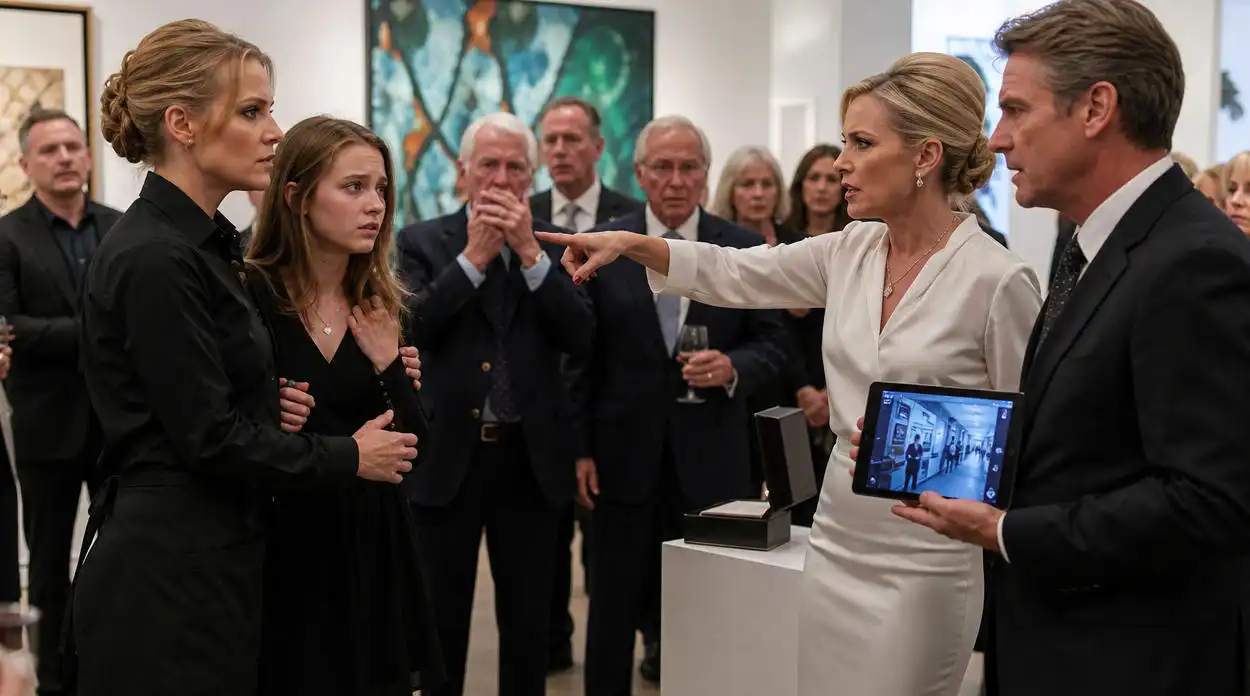
“Before anyone calls the police on this child…”
The director’s voice cut through the gallery like a dropped glass.
Caroline Whitmore’s smile froze.
The lawyers stopped walking.
My daughter Lily squeezed my hand so hard I felt her nails press into my palm.
The director lifted the tablet higher and said, “I think everyone needs to watch what your son did.”
Nobody moved.
Not the board members in their tailored suits.
Not the donors holding champagne.
Not the photographers near the sculpture wall.
Not Caroline, who had spent the last ten minutes treating my daughter like dirt stuck to the bottom of her designer heel.
And not me.
I was Tiffany Hayes.
A waitress.
A single mother.
The woman people waved over when their wine glass was empty, then looked through when I stood beside them in a room full of money.
That night, I had been hired as event staff for the Whitmore Club’s private opening of the city’s fall art exhibition.
But I wasn’t there only to serve coffee.
And Lily wasn’t there because she wanted to touch “beautiful things,” like Caroline had sneered.
We were there because Lily had been invited.
Quietly.
Officially.
By the director himself.
For a reason Caroline did not know yet.
The trouble started before the first painting was unveiled.
The gallery was one of those places where even the silence felt expensive.
White walls.
Black marble floors.
Soft gold lights.
Security guards at every archway.
A string quartet near the center fountain.
Every woman looked like she had been poured into silk.
Every man looked like he had practiced being important in the mirror.
I came in through the service entrance wearing my black catering shirt and flat shoes, carrying a tray of coffee cups.
Lily came with me because the director had told us to arrive early.
She wore a simple navy dress from a resale shop and a silver necklace shaped like a small music note.
It cost seven dollars.
She loved it like it was made of diamonds.
“Mom,” she whispered, “do I look okay?”
I tucked a curl behind her ear.
“You look like yourself. That’s better than okay.”
She smiled.
That smile disappeared twenty minutes later when Caroline Whitmore entered.
Caroline was the kind of woman everyone noticed before she spoke.
Tall.
Blonde.
Perfect posture.
A diamond bracelet on one wrist and a phone in the other hand like both were weapons.
Her husband’s family had donated to the gallery for years.
Her name was on the club board.
Her picture had been in society magazines.
And she had learned that if she said something cruel with a soft voice, people called it “standards.”
Her son Bryce walked behind her, twenty-two, bored, expensive, and mean in the careless way of young men who have never had to apologize properly.
I knew him because I had served him at club dinners before.
He once snapped his fingers at me for water.
Then laughed when Lily, who was helping me that summer, dropped a napkin.
Caroline saw Lily first.
Her eyes moved from Lily’s shoes to her dress to the little music-note necklace.
Then she saw me.
“Oh,” she said. “Tiffany.”
Not hello.
Not good evening.
Just my name, like finding a stain on linen.
“Mrs. Whitmore,” I said politely.
She looked at Lily.
“And this is?”
“My daughter, Lily.”
Caroline’s smile got thinner.
“Is staff bringing guests now?”
Lily’s face flushed.
I kept my voice steady. “She was invited.”
Caroline gave a tiny laugh.
“By whom? The coatroom?”
A few people nearby heard it.
One woman covered her mouth, but I saw her smile behind her fingers.
A board member named Mr. Ellison looked over, then looked away.
That was the first lesson of that room.
Cruelty does not need a crowd to survive.
It only needs decent people to stay quiet.
I turned to Lily.
“Stay close to me.”
But Caroline wasn’t done.
She stepped toward my daughter and tilted her head at the necklace.
“What is that?”
Lily touched it nervously.
“It’s just a necklace.”
“Just a necklace,” Caroline repeated. “How charming.”
Bryce came closer.
His eyes narrowed.
Then he smiled.
“That looks familiar.”
I felt Lily stiffen beside me.
Caroline turned to him.
“What do you mean?”
Bryce pointed at the necklace.
“The music-note prop from the film installation. The one in the backstage display.”
My stomach dropped.
Not because he was right.
Because his voice was too ready.
Too smooth.
Like he had been waiting for his line.
Caroline gasped loudly enough for people ten feet away to turn.
“Oh my God.”
“Mom,” Lily whispered, “I didn’t—”
Caroline snapped her fingers toward a security guard.
“Check her pockets.”
The guard hesitated.
“She’s a guest,” I said.
Caroline’s eyes flashed.
“She is the daughter of a waitress wearing what appears to be gallery property.”
Every word landed hard.
Daughter.
Waitress.
Property.
Like Lily was not a person.
Like I was not a mother.
Like our place in that room had already been decided.
A small circle formed around us.
That is how public humiliation works.
People pretend they are concerned.
But their feet move closer.
A young donor lifted her phone.
Someone whispered, “Is that the catering woman?”
Another said, “How embarrassing.”
Lily’s eyes filled with tears.
“Mom, I swear I didn’t take anything.”
“I know,” I said.
Caroline leaned down toward her.
“Sweetheart, people like you don’t get to touch beautiful things just because you’re near them.”
Something in me went cold.
The old me would have cried.
The tired me would have begged.
The mother in me wanted to shout so loudly the marble walls cracked.
But I had learned something after years of serving rich people.
The loudest person in the room usually thinks silence means weakness.
Sometimes silence means you are letting them walk all the way into the trap they built themselves.
I looked at Bryce.
He was not looking at Lily anymore.
He was looking toward the side hallway.
The backstage hallway.
The one with the red recording light.
That was my first clue.
Then two lawyers appeared beside Caroline.
I recognized one of them from club lunches.
Her name was Dana.
She carried a leather folder and wore the expression of someone who billed by the minute.
“Mrs. Hayes,” Dana said, “it may be best for you and your daughter to cooperate.”
“With what?” I asked.
“With the investigation into stolen property.”
Lily whispered, “Stolen?”
Caroline crossed her arms.
“The prop is part of a film installation insured for a significant amount.”
I looked at the seven-dollar necklace around my daughter’s neck.
Then at Caroline.
“You believe my daughter stole an insured film prop and wore it openly into the gallery?”
Caroline smiled.
“I believe desperation makes people bold.”
That got a few soft laughs.
Bryce laughed the loudest.
I watched him.
Still nervous.
Still glancing toward that hallway.
That was when the exhibition director, Martin Vale, came out from behind the installation curtains.
Martin was not famous to the donors, but in the art world, he mattered.
He had directed documentary pieces for museums, Olympic cultural programs, and film archives.
He was soft-spoken, gray-haired, and impossible to rush.
He looked at Lily.
Then at me.
Then at Caroline.
“What’s happening here?”
Caroline turned on her society voice.
“Martin, thank God. We may have a theft situation. This young woman appears to be wearing one of your props.”
Martin looked at the necklace.
He did not gasp.
He did not accuse.
He simply said, “That is not our prop.”
Caroline blinked.
Bryce’s face tightened.
Dana the lawyer cleared her throat.
“Mr. Vale, perhaps you should confirm inventory before making that statement.”
Martin’s eyes moved to her.
“I already did.”
Caroline laughed sharply.
“Well, it certainly resembles the prop. My son noticed it immediately.”
Martin looked at Bryce.
“Interesting.”
One word.
But Bryce swallowed.
The room shifted.
I felt it before anyone said anything.
The crowd that had leaned toward Caroline began to lean toward Martin.
That is the thing about power.
People do not follow the truth first.
They follow whoever they think can punish them.
Martin turned to me.
“Tiffany, may I ask Lily to wait with you near the director’s table?”
Caroline cut in.
“No. Absolutely not. They should not be moved out of sight.”
Moved out of sight.
As if my daughter were evidence.
As if she were a purse on a security table.
Lily’s tears spilled over.
“Please,” she said, barely audible. “I didn’t steal.”
Caroline looked pleased by the tears.
That was the part I would never forget.
Not the accusation.
Not the lawyers.
Not the board members watching.
The pleasure.
Caroline enjoyed watching my child shrink.
And that was when I stopped being polite.
Not loud.
Not rude.
Just done.
I looked at Martin and said, “You said the cameras were running all afternoon?”
Caroline’s head turned.
Bryce went pale.
Martin nodded slowly.
“For the documentary reel.”
I said, “Then maybe we should see who touched the backstage display.”
The room went quiet.
Caroline laughed again, but this time the sound cracked.
“Are you suggesting my son has something to do with this?”
I did not answer her.
I looked at Bryce.
He looked away.
Martin motioned to an assistant near the camera station.
“Pull the backstage footage from camera two. Start at 4:15 p.m.”
Caroline’s voice sharpened.
“Martin, this is unnecessary and frankly insulting.”
He did not look at her.
“Insulting is accusing a guest’s child without evidence.”
That was the first time anyone in that room defended Lily out loud.
Her grip tightened around my hand.
The assistant connected the tablet to a small preview monitor near the director’s table.
People pressed closer.
Phones rose higher.
Mr. Ellison, the board member who had looked away earlier, suddenly stepped forward as if he had cared all along.
Caroline whispered to Dana, “Stop this.”
Dana said, “We can object to public display of—”
Martin cut her off.
“This is my exhibition footage, recorded in my backstage area, during my installation prep.”
He tapped the screen.
The video began.
There was the backstage hallway.
The film prop table.
The real music-note prop, larger than Lily’s necklace, antique-looking, attached to a velvet display card.
A minute passed.
A technician walked by.
Then Bryce appeared.
The room inhaled.
On the screen, Bryce looked around.
He picked up the prop.
He smirked.
Then he walked out of frame.
Caroline said quickly, “He was probably checking it.”
Martin said nothing.
The assistant scrubbed forward.
The next clip showed Bryce near a storage alcove.
He opened a black equipment case.
Dropped the prop inside.
Closed it.
Then took out his phone and texted someone.
Martin paused the video.
“Would you like me to continue?”
No one spoke.
Caroline’s face had lost all color under her makeup.
I looked at Lily.
Her tears had stopped.
She stared at the screen like she could not believe the truth had a shape.
Bryce muttered, “It was a joke.”
A joke.
That word.
The favorite hiding place of cowards.
Caroline snapped, “Bryce.”
But he was already unraveling.
“I didn’t think it would go this far.”
Martin’s voice was calm.
“How far did you think it would go?”
Bryce looked at his mother.
And that was when the second truth walked into the room.
He had not acted alone.
Caroline’s eyes warned him.
Every mother in that room saw it.
Maybe the men did too.
But mothers know the look that says: do not embarrass me.
Bryce shut his mouth.
Dana stepped between Caroline and the crowd.
“This is a misunderstanding. We should discuss this privately.”
I almost laughed.
Privately.
When they thought my daughter was guilty, Caroline wanted pockets checked in front of donors.
When her son was caught on camera, suddenly dignity mattered.
Martin turned to security.
“Please secure the prop.”
The guard went backstage and returned with the black equipment case.
Inside was the real film prop.
Not on my daughter.
Not in my bag.
Not near us.
Hidden exactly where Bryce had put it.
A murmur rolled through the gallery.
Someone said, “Oh my God.”
Someone else said, “She framed that girl.”
Caroline spun around.
“No one framed anyone.”
I stepped forward.
My voice shook, but I did not lower it.
“You accused my daughter of theft. You called her desperate. You told security to check her pockets.”
Caroline lifted her chin.
“Because the necklace looked suspicious.”
“It looked inexpensive,” I said. “That is what you meant.”
The words landed.
Even Caroline could not dress them up.
Martin’s assistant spoke from behind the monitor.
“There’s more.”
Caroline froze.
Martin looked at the assistant.
“What do you mean?”
The assistant hesitated.
“Camera one has audio near the side hallway.”
Dana said, “Do not play that.”
Martin looked at her.
“Why?”
Dana had no answer.
The assistant played it.
The screen showed Caroline and Bryce in the hallway before the accusation.
Caroline’s voice came through low but clear.
“Just make it look convincing. The board needs a reason to get that girl out before the announcement.”
Bryce said, “Because of the song thing?”
Caroline replied, “Because I will not have a waitress’s daughter standing on that stage while my donors are here.”
My chest tightened.
Lily went still.
The song thing.
There it was.
The reason we had been invited.
The reason Caroline wanted us gone.
The reason this entire performance had been staged.
Martin stopped the video.
The room had gone dead quiet.
Caroline whispered, “That’s taken out of context.”
Martin’s face hardened.
“No, it isn’t.”
Now everyone knew.
But they did not know everything.
Months earlier, Lily had submitted a small piano composition to a youth arts program connected to Martin’s exhibition.
She had written it on an old keyboard with two broken keys.
She called it “Light After Rain.”
She wrote it after my mother died.
I had worked double shifts that winter.
Lily had cooked dinner when I came home too tired to stand.
At night, she played music softly so I could sleep.
I did not know she had submitted the piece until Martin called.
He said her composition had been selected for the gallery’s opening film.
Not as background filler.
As the closing theme.
He also told us something bigger, but asked us to keep it private until the official announcement.
An Olympic cultural committee had heard the piece through Martin’s program.
They were considering it for a major international performance package.
Caroline had found out.
Her own son Bryce had submitted a digital art piece to the same program.
It had not been selected.
Neither had Caroline’s preferred composer, a club donor’s nephew.
So Caroline decided the easiest way to protect her circle was not to improve their work.
It was to remove my daughter.
A waitress’s daughter.
A girl in a resale dress.
A girl with a seven-dollar necklace.
A girl Caroline believed no one would defend.
That was her mistake.
Martin turned to the board members.
“This is no longer an internal matter.”
Caroline’s voice rose.
“Martin, be careful.”
He ignored her.
“To publicly accuse a guest of theft, coordinate a false accusation, and attempt to use legal intimidation against a young artist at my exhibition is not a misunderstanding.”
Dana whispered, “Caroline, stop talking.”
But Caroline could not stop.
People like Caroline never think the rules are real until they feel them close around their own wrists.
“You have no idea what my family has done for this gallery,” she snapped.
Martin said, “I know exactly what your family has done. That is why the foundation’s auditors are already reviewing restricted donations.”
The word auditors changed the air.
Caroline heard it too.
Her eyes flicked to the board members.
Mr. Ellison stepped back.
Another board member suddenly became fascinated with the floor.
I did not understand at first.
Then Martin said something that made Caroline’s lips part.
“Federal tax authorities requested records this morning regarding several Whitmore charitable vehicles.”
Caroline whispered, “You wouldn’t.”
Martin said, “I didn’t. The records did.”
That was the legal hammer.
Not revenge.
Not shouting.
Records.
Footage.
Insurance logs.
Donation filings.
The kind of things rich people use to build walls around themselves—until the walls become evidence.
Two uniformed officers entered the gallery ten minutes later.
No sirens.
No drama.
Just quiet consequences walking across polished marble.
Martin gave them the footage.
Security gave them the recovered prop.
Dana tried to speak for Caroline, but the officers asked Bryce to step aside.
He looked like a child then.
Not because he was innocent.
Because he was finally afraid of something his mother could not buy.
Caroline kept saying, “This is absurd. This is a private event.”
One officer replied, “False theft allegations and evidence tampering are not private, ma’am.”
Ma’am.
Not Mrs. Whitmore.
Not donor.
Not board chair.
Ma’am.
The word hit her harder than any insult.
Bryce admitted enough that night to protect himself and damage his mother.
He told the officers Caroline had ordered him to move the prop and “create concern” around Lily’s necklace.
He said she wanted Lily removed before Martin announced her composition.
He said Caroline had already told the club’s legal team to prepare a civil claim if we resisted.
The lawyers denied knowing the accusation was false.
Maybe that was true.
Maybe it wasn’t.
But the footage showed them moving toward my daughter before anyone had verified anything.
That was enough for the gallery to suspend their access.
Enough for the club to distance itself.
Enough for donors to start asking what else Caroline had controlled.
And once rich people start asking questions about money, the kindness disappears quickly.
By the next morning, the story was everywhere.
Not because I posted it.
I didn’t.
The donors did.
The same people who had watched my daughter cry now shared clips with captions like, “Unbelievable scene at gallery opening.”
Some meant well.
Some wanted attention.
Either way, the truth moved faster than Caroline’s lawyers could bury it.
Then came the real fall.
The tax investigation that Martin mentioned was not about the prop.
It was bigger.
Much bigger.
Caroline had spent years running “charity events” through club foundations and private art funds.
Money came in as donations.
Some of it went where it should.
Some did not.
Investigators found inflated invoices.
Fake consulting fees.
Artwork “storage costs” paid to companies connected to her relatives.
Luxury travel marked as donor outreach.
Designer purchases hidden as auction expenses.
And worst of all, funds meant for youth arts scholarships had been redirected into private accounts.
Youth arts.
The same kind of program that had discovered Lily.
When the IRS froze Caroline’s assets, she was at a luncheon.
I heard about it from another server who worked the event.
Caroline’s card declined.
Then another.
Then a third.
Her face apparently did the same thing it had done in the gallery.
First disbelief.
Then outrage.
Then fear.
The Whitmore Club removed her from the board within forty-eight hours.
The gallery banned her from future events.
Several donors publicly demanded repayment.
Bryce accepted a plea arrangement involving cooperation, restitution, and community service.
Caroline fought.
Of course she fought.
She hired attorneys.
She blamed staff.
She blamed accountants.
She blamed “administrative confusion.”
But paper does not care how expensive your shoes are.
The filings were clear.
The accounts were clear.
The video from the gallery made sure the public saw her character before the court saw her books.
She was charged with tax fraud, misuse of charitable funds, and conspiracy related to the staged accusation.
Her assets remained frozen while investigators traced the money.
The woman who had looked at my daughter and said people like us did not get to touch beautiful things lost access to every beautiful thing she had used to feel untouchable.
And Lily?
For two days, she did not play music.
She sat at the kitchen table with her necklace in front of her.
I asked if she wanted to throw it away.
She shook her head.
“No,” she said. “I want to wear it when I’m not scared anymore.”
That broke me.
Not loudly.
Not in a dramatic way.
I went into the bathroom, turned on the sink, and cried into a towel so she would not hear.
Mothers know that kind of crying.
The kind you do after being strong too long.
On the third day, Martin called.
He asked if we could come back to the gallery.
I said, “I don’t know if Lily is ready.”
He said, “Then we’ll come to you.”
That evening, Martin arrived at our apartment with two women from the Olympic cultural committee and a small speaker in a black case.
Our apartment was clean but tiny.
The kitchen table wobbled.
The couch sagged in the middle.
I apologized for the mess even though there was no mess.
Poor people apologize for space rich people would call charming if it had exposed brick.
One of the women smiled kindly.
“Please don’t apologize. We came to hear Lily.”
Lily looked terrified.
Martin placed a folder on the table.
Inside was the official notice.
Her composition, “Light After Rain,” had been selected as part of the Olympic closing ceremony music program.
Not “under consideration.”
Selected.
For a moment, Lily did not understand.
Then she covered her mouth.
“Mine?”
The woman nodded.
“Yours.”
I sat down because my knees stopped trusting me.
Lily cried.
This time, not from shame.
From relief.
The committee arranged for Lily to perform as part of the closing ceremony presentation with a youth ensemble.
They flew us out.
They gave us proper credentials.
They treated me like her mother, not her handler.
Not staff.
Not someone who had wandered into the wrong room.
The night of the performance, Lily wore a navy dress again.
Not the resale one.
A new one gifted by a designer who had seen the gallery footage and wrote a note saying, “No young woman should be made small for shining.”
But Lily wore the seven-dollar necklace.
The music note.
The cheap one.
The one Caroline had tried to turn into evidence of shame.
When Lily stepped onto that stage, the sound of her composition rose through the stadium like sunrise.
Soft piano.
Strings.
Then a choir.
I watched from the family section with my hands pressed over my heart.
On the giant screen, her name appeared.
Lily Hayes.
Composer.
My daughter looked so small from where I sat.
But her music filled the whole place.
Afterward, she ran into my arms.
“Mom,” she whispered, “they clapped.”
I held her as tightly as I could.
“They heard you.”
Months later, Caroline’s case ended with a sentence that included prison time, restitution, and permanent removal from the boards she had used like personal thrones.
Her family estate was sold.
Her accounts remained under government control until repayment orders were satisfied.
The club that once ignored me sent a formal apology.
The gallery created a scholarship in Lily’s name for working-class young artists.
Martin insisted on it.
I still work.
I still carry trays sometimes.
There is no shame in honest work.
But now, when I enter rooms like that, I do not shrink.
And Lily does not either.
She keeps the necklace framed above her piano.
Under it, she taped a small note:
“Cheap is what things cost. Worth is what people reveal.”
I think about that night often.
Not because Caroline humiliated us.
But because my daughter learned something I wish no child had to learn so publicly.
Some people will judge your shoes, your job, your address, your accent, your mother’s uniform.
Let them.
Their judgment is not a verdict.
It is evidence.
And if you stay steady long enough, the truth has a way of finding the room where everyone is watching.
So choose a side:
Was Tiffany right to stay calm and let the footage destroy Caroline publicly, or should a mother confront the bully the second her child is accused?
Share this if you believe no child should ever be shamed for where they come from. ⚖️
Disclaimer: Mention of any brand or trademark is for identification only and does not imply partnership or endorsement

The Tavern Owner Set A Trap To Make Paul Drink Again… But He Had NO IDEA The Entire Town Was Watching 👀
They Laughed When Mark Announced He Was Running for Office… Then One Sealed Envelope Made the Whole Room Go Silent 😳
My Stepdaughter Thought Her Real Father Paid for Her Golf Club Wedding… Then I Showed the Guests the Letter He Sent Me