



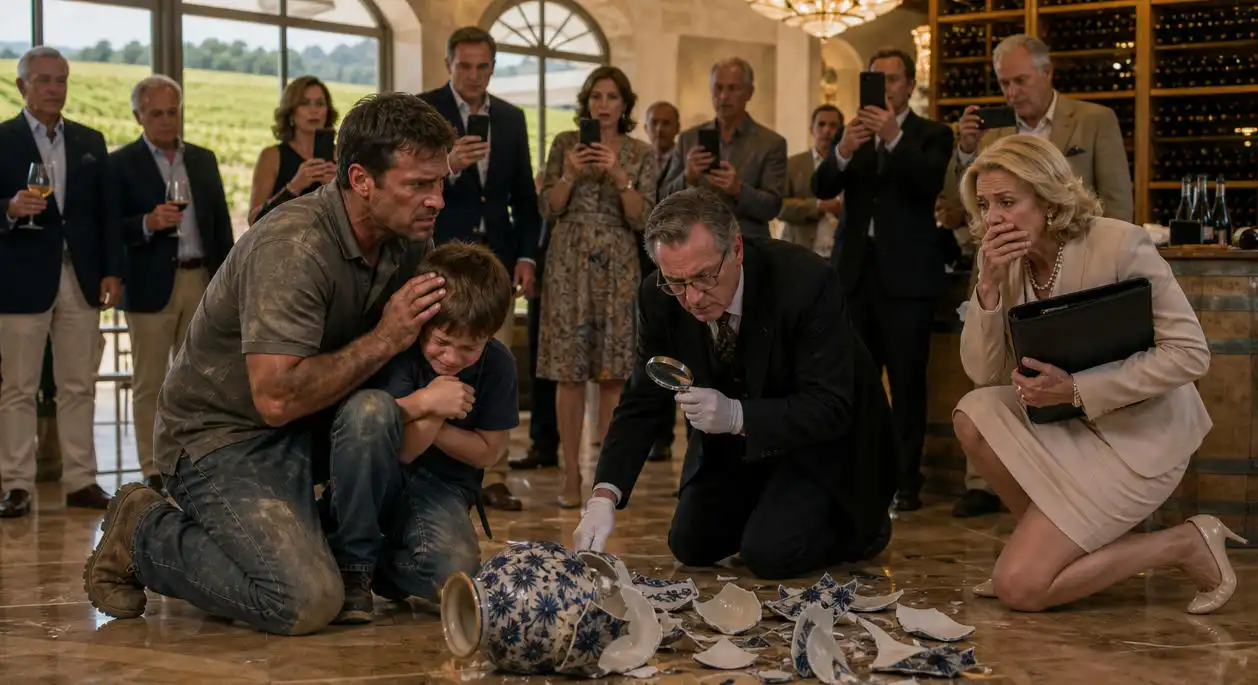
The expert opened the second page of his report.
Madam Dupont’s fingers tightened around the insurance binder like she could squeeze the truth back inside it.
Nobody moved.
Even the waiters stopped breathing.
And my son, Caleb, still trembling beside me, whispered, “Dad… did I really break something expensive?”
That question hurt more than anything Madam Dupont had said.
Because he wasn’t worried about the vase.
He was worried he had proven her right.
My name is Brian Whitaker.
I’m a bricklayer.
I have spent twenty-two years building other people’s walls, patios, fireplaces, and wine cellars. I know what rich people say when they think working hands cannot hear them. I know the little pause before they decide whether to call me “sir” or “the guy.”
That Saturday afternoon, I took my son to the Dupont Vineyard Club because he had won two charity tickets from his school counselor.
It was supposed to be a small victory.
Caleb had not had many of those.
He was eleven, soft-spoken, and carried himself like he was always trying not to take up too much space. After his mother died, his stutter got worse. Kids at school learned that if they laughed at him hard enough, he would stop talking altogether.
But antiques made him talk.
Old clocks.
Old coins.
Old pottery.
Anything with history.
The charity tasting was called “Vines for Young Minds,” raising money for children’s mental health programs. The brochure said there would be a private viewing of French porcelain from the Dupont family collection.
Caleb read that brochure until the corners wore soft.
“Dad,” he said that morning, standing in front of the mirror in a blazer two sizes too big, “do I look like I belong?”
I tied his little navy tie.
“You belong anywhere you stand with a good heart.”
He smiled.
For the first time in weeks, he smiled without checking whether someone was about to mock him.
The Dupont Vineyard Club looked like something cut out of a magazine.
White stone archways.
Trimmed hedges.
A tasting hall with high windows and chandeliers shaped like grapevines.
I parked my old pickup between two black SUVs and a silver Bentley.
Caleb noticed the valet looking at my truck.
“Maybe we should park somewhere else,” he whispered.
“No,” I said. “We paid for our tickets. We walk through the front.”
Inside, the air smelled like polished wood, flowers, and money.
VIP members stood in small circles with crystal glasses. Women wore pearls. Men wore jackets that probably cost more than my mortgage payment.
At the entrance table, I handed over our tickets.
The young woman checking names smiled politely until Madam Vivienne Dupont turned around.
Everyone knew her.
You could feel it before anyone said her name.
She was in her late sixties, tall, silver-haired, dressed in cream silk with a diamond brooch shaped like a grape leaf. Her family owned half the valley’s luxury hospitality properties. Her face had been on hospital donation plaques, school gala banners, and glossy magazine covers calling her “the patron saint of children’s wellness.”
She looked at my boots first.
Not my face.
My boots.
They were clean, but brick dust never fully leaves leather.
Her smile sharpened.
“Did someone leave the service entrance open?”
A few guests chuckled.
I held up the tickets.
“We’re here for the charity event, ma’am.”
She took them between two fingers like they were damp.
“These tickets were part of a school giveaway,” she said loudly enough for nearby guests to hear. “How sweet.”
Caleb moved closer to me.
Madam Dupont looked down at him.
“And who are you?”
“C-C-Caleb,” he said.
Her eyebrows lifted at the stutter.
That tiny expression told me everything I needed to know.
“Well, Caleb,” she said, “this is a private cultural event. You must be very careful. Some objects here are worth more than houses in certain neighborhoods.”
The VIPs laughed again.
Polite laughter.
Cruel laughter dressed in pearls.
I felt Caleb shrink beside me.
I wanted to leave.
But then I looked at him. He was staring past Madam Dupont at the porcelain display with such wonder that I swallowed my pride.
“Come on,” I said softly. “Let’s look.”
The porcelain collection sat along the east wall behind velvet ropes. Blue-and-white vases, painted plates, little figurines under glass.
Caleb leaned forward, hands behind his back the way I had taught him.
“That one has a repeating vine border,” he whispered.
“Yeah?”
“It’s like the old French pieces online, but the glaze looks too shiny.”
I glanced at it.
I knew masonry.
Tile.
Ceramic surfaces.
Restoration lines.
Not antiques, exactly. But when you spend decades laying stone and repairing old estate walls, you learn the difference between age and theater.
Caleb was right.
The glaze looked wrong.
Too even.
Too clean in the recessed areas.
Then a waiter passed behind us carrying a tray. A woman stepped backward to avoid him and bumped Caleb’s shoulder. Caleb stumbled. His heel caught the base of a brass stanchion.
The velvet rope snapped tight.
One vase tipped.
It hit the marble floor with a crack that rang through the hall.
Every conversation stopped.
Caleb froze.
The vase lay broken in three large pieces and several smaller shards.
Madam Dupont’s head turned slowly.
She walked toward us as if she had been waiting for this moment.
“What did you do?”
Caleb’s lips moved, but nothing came out.
“It was an accident,” I said. “He was bumped.”
Madam Dupont ignored me.
She pointed at Caleb.
“That piece is worth eighty thousand dollars.”
A woman gasped.
A man lifted his phone.
Caleb’s eyes filled.
“I’m s-s-sorry,” he whispered. “I didn’t mean—”
“Sorry does not repair antique porcelain,” Madam Dupont said. “Nor does it excuse poor supervision.”
She turned to the room.
“This is precisely why private events need standards.”
The words hit harder than if she had slapped me.
Standards.
Meaning us.
A waiter bent toward the broken pieces.
“Don’t touch it,” Madam Dupont snapped. “This will be documented for insurance.”
That was when I noticed the binder under her arm.
Black leather.
Gold corners.
A printed label slipped halfway out.
DUPONT HERITAGE PORCELAIN — INSURANCE SCHEDULE.
That was fast.
Too fast.
She had the insurance binder ready before anyone had cleaned the floor.
Then she looked at another waiter.
“Remove their things.”
The young man hesitated.
“Madam?”
“Their coats. Their bags. They are leaving.”
He reached for Caleb’s backpack.
Caleb grabbed the strap with both hands.
“Please,” he whispered. “My mom’s notebook is in there.”
That notebook was one of the only things he had left of her.
She used to write him little facts about old objects. After she passed, he carried it everywhere.
Madam Dupont rolled her eyes.
“Then perhaps your father should have taught you manners before bringing you into a room full of valuable objects.”
The waiter pulled.
Caleb stumbled.
I stepped between them.
“You will not touch my son’s bag again.”
The room went cold.
Madam Dupont smiled.
The kind of smile people use when they are daring you to become the villain they already decided you were.
“Careful, Mr…?”
“Whitaker.”
“Careful, Mr. Whitaker. You are already responsible for the destruction of a rare French porcelain vase. Do not add intimidation in front of witnesses.”
Witnesses.
That word mattered.
Because she thought the crowd protected her.
She thought the phones protected her.
She thought my anger would make her story believable.
So I did something that surprised even me.
I stayed calm.
I crouched beside Caleb.
“Look at me,” I said.
His chin shook.
“I broke it.”
“No,” I said. “You were bumped. And even if you had broken it, no adult has the right to humiliate you.”
Madam Dupont sighed theatrically.
“How noble. Unfortunately, nobility does not cover eighty thousand dollars.”
I stood up and looked at the broken porcelain.
The inside edge was too white.
The fracture was clean in a way that made my stomach tighten.
Real old porcelain often shows age in the body, tiny impurities, wear that cannot be painted on in a hurry. This looked like a recent reproduction with fake crackle glaze.
Then I saw the bottom mark on one broken piece.
Stamped.
Not hand-painted.
A reproduction factory mark partially scratched out.
Madam Dupont saw me looking.
Her face changed for half a second.
There it was.
Fear.
Not outrage.
Fear.
I looked at the insurance binder again.
Then at the display placard that read: “18th Century French Porcelain, Dupont Family Collection.”
I reached for my phone.
Madam Dupont’s voice hardened.
“What are you doing?”
“Calling someone who knows porcelain better than both of us.”
She laughed.
“You? A bricklayer? You have an antique expert on speed dial?”
“Not on speed dial.”
I found the number.
“But close enough.”
His name was Arthur Bellamy.
Three years earlier, I had rebuilt a collapsed brick arch in his restoration studio. He was a certified appraiser who worked with museums, auction houses, and insurance companies. I remembered him because he treated me like a craftsman, not a servant.
I called.
He answered on the fourth ring.
“Brian?”
“Mr. Bellamy, I’m sorry to bother you. I’m at Dupont Vineyard Club. A vase just broke. They’re calling it eighteenth-century French porcelain and saying my kid owes eighty thousand dollars.”
A pause.
Then Arthur said, “Send me a photo of the mark and the fracture.”
I did.
Thirty seconds later, he called back.
“Do not let them remove a single shard.”
My heart slowed.
“Can you come?”
“I’m ten minutes away.”
Madam Dupont folded her arms.
“How dramatic.”
I put my phone away.
“We’ll wait.”
“No,” she said. “You will leave now, and my attorney will contact you.”
“Then your attorney can meet the appraiser.”
A few guests murmured.
The club president, a man named Charles Harlan, approached nervously.
“Vivienne, perhaps we should settle this privately.”
Madam Dupont gave him a look so sharp he stepped back.
“There is nothing private about the destruction of family heritage.”
A woman in pearls whispered, “Poor child.”
Another whispered, “His father should have known better.”
Caleb heard both.
He pressed his hands over his stomach.
I wanted to take him outside.
But I knew if I left, Madam Dupont would own the story.
So I stayed.
Not loud.
Not angry.
Just present.
Arthur Bellamy arrived twenty minutes later in a tweed jacket, carrying a leather appraisal case.
Madam Dupont’s expression curdled.
“Mr. Bellamy,” she said. “I was not aware you had been invited.”
“I wasn’t,” he replied. “I was called.”
“By him?”
Arthur looked at me.
“By a craftsman I trust.”
That sentence moved through the room like a match striking.
Madam Dupont’s smile flickered.
Arthur knelt beside the shards.
He put on white gloves.
He examined the glaze.
The fracture.
The base mark.
He didn’t rush.
The room leaned toward him.
Phones were up now.
Not hidden.
Openly filming.
After a long minute, Arthur looked at Madam Dupont.
“This was never eighteenth-century French porcelain.”
The room erupted.
“What?”
“Are you serious?”
“Fake?”
Madam Dupont’s face went pale.
“That is absurd.”
Arthur held up a shard.
“The paste is modern. The glaze is artificially crackled. The maker’s stamp has been partially abraded, but not enough. This is a recent reproduction, likely purchased within the last twenty years.”
Charles Harlan put a hand to his mouth.
Madam Dupont snapped, “That is one man’s opinion.”
Arthur opened his case and removed a folder.
“No. It is also consistent with a prior appraisal request submitted to my office eighteen months ago.”
The hall went silent again.
Madam Dupont whispered, “You’re mistaken.”
Arthur opened the second page.
And pointed directly at her.
“The request came under the name Vivienne Dupont.”
Someone gasped so loudly it echoed.
Arthur continued.
“My office declined to certify the piece as antique because it was a reproduction. The submitted photographs match this vase.”
Madam Dupont reached for the binder.
I moved only one step.
Not toward her.
Toward the broken vase.
“Don’t touch the evidence,” I said.
Charles Harlan turned to her.
“Vivienne… what is in that binder?”
“It is none of your concern.”
“It became our concern when you accused a child in front of our members.”
Arthur looked at the binder.
“If that document lists this vase as an eighty-thousand-dollar antique for an active insurance claim, I would advise everyone here to stop speaking and call counsel.”
That was the legal hammer.
Not shouting.
Not revenge.
A sentence.
A rule.
A line Madam Dupont had crossed herself.
Charles took out his phone.
“Security. Lock the exterior doors. No one removes documents from the tasting hall.”
Madam Dupont’s voice cracked.
“You do not give orders in my club.”
Charles looked at her.
“The club is not yours, Vivienne. Your family has a seat. Not a throne.”
That hit her harder than Arthur’s appraisal.
For the first time, the woman who had made a career out of controlled elegance looked uncontrolled.
The insurance binder trembled in her hands.
A younger man stepped from the VIP crowd. Her nephew, I later learned. Philippe Dupont, chief financial officer of the family hospitality company.
“Aunt Vivienne,” he said quietly, “give him the binder.”
She turned on him.
“You weak little fool.”
Phones zoomed in.
The mask was gone now.
The charity queen.
The patron saint.
The elegant donor.
Gone.
In her place stood a frightened woman holding papers that could ruin her.
Security arrived.
Charles asked the staff to preserve the security footage from every camera in the hall.
That mattered, too.
Because the footage showed Caleb had been bumped by another guest before the vase fell.
It also showed something else.
Thirty minutes before the tasting began, Madam Dupont herself had adjusted the display rope around that exact vase. She had moved the stanchion closer to the walking path, making it easier to knock over.
The insurance binder revealed the rest.
The vase had been listed as an authenticated eighteenth-century heirloom with a declared value of $82,500. The policy rider had been updated just two weeks earlier.
Attached to the binder was a draft claim packet.
Draft.
As in, prepared before the vase ever broke.
And beside it was a handwritten note.
“Public witness preferred. Avoid staff handling.”
Arthur read that line twice.
Nobody spoke.
I looked at Caleb.
He looked confused.
Not because he didn’t understand.
Because he did.
“She wanted someone to break it?” he whispered.
I crouched.
“She wanted someone else to take the blame.”
His eyes filled again.
“Why me?”
That question broke something in the room.
Even a few VIP members looked away.
Because they knew why.
Because he looked nervous.
Because I looked poor.
Because Madam Dupont thought we were the kind of people the room would believe against.
The police arrived within the hour.
Madam Dupont tried to leave through the private cellar corridor. Security stopped her at the door.
“I have a medical condition,” she said.
An officer replied, “Ma’am, you can sit down while we review the evidence.”
She sat.
Not because she wanted to.
Because everyone was watching.
The same public room she had used to shame my son became the room where her own story collapsed.
Charles Harlan made a statement before anyone left.
He faced the guests, the staff, and the cameras still recording.
“On behalf of this club, I apologize to Brian Whitaker and his son Caleb. They were invited guests. They were treated shamefully. The club will cooperate fully with investigators.”
Then he turned to Caleb.
“Young man, your backpack is yours. No one here will touch it again.”
The waiter who had grabbed it came forward with tears in his eyes.
“I’m sorry,” he said. “I should have refused.”
Caleb hugged the backpack.
“It’s okay,” he whispered.
But it wasn’t okay.
Not yet.
The story spread by nightfall.
Not because I posted it.
Because the VIPs did.
The same people who had filmed my son’s humiliation filmed Madam Dupont’s exposure.
By Monday morning, local news called it the “Dupont Porcelain Scandal.”
By Tuesday, the state insurance fraud division confirmed an investigation.
By Friday, three charities removed Madam Dupont’s name from their donor boards pending review.
Then came the real fall.
Reporters discovered that the porcelain claim was not the only questionable insurance matter tied to Dupont family properties.
There were inflated valuations.
Suspicious damage reports.
Restoration invoices from vendors who no longer existed.
Philippe, the nephew, cooperated with investigators. He turned over emails showing Madam Dupont had pressured staff to “create loss events” during private functions, always around guests who would be easy to discredit.
A housekeeper.
A catering assistant.
A single mother.
And now, a bricklayer’s child.
She had built a reputation on charity while using vulnerable people as props in fraud.
That truth destroyed her faster than any insult could.
Sponsors pulled out.
Members resigned.
The Dupont hospitality company’s stock plunged after investors learned investigators were reviewing corporate insurance filings.
Banks froze lines of credit.
The family board removed Madam Dupont from all leadership roles.
Her portrait came down from the children’s wellness center she had once used for photo opportunities.
Months later, she pleaded guilty to insurance fraud conspiracy, attempted false claim submission, and obstruction related to the removal of documents from the club.
She avoided the cameras when she entered court.
But not all cameras can be avoided.
The footage of her pointing at Caleb and saying, “People like you don’t belong near expensive things,” became the line people remembered.
Not her charity speeches.
Not her silk suits.
Not her diamond brooch.
That line.
The sentence that revealed her heart.
She was ordered to pay restitution, fines, and damages connected to multiple fraudulent claims. Civil suits followed. The Dupont company collapsed under debt and scandal. Properties were sold. The vineyard club changed ownership.
The last time I saw Madam Dupont, she was outside a courthouse in a plain coat, trying to hide behind a folder while reporters shouted questions.
She looked smaller than I expected.
Not poor.
Not humbled in the pretty way people like to imagine.
Just exposed.
There is a difference.
As for Caleb, healing took longer than the headlines.
For weeks, he barely spoke.
He kept asking whether people were laughing at him.
Then one afternoon, Arthur Bellamy invited him to his restoration studio.
No cameras.
No VIPs.
Just shelves of old objects and a man with patient hands.
Arthur placed a cracked teacup on the workbench.
“Do you know what restoration teaches us?” he asked.
Caleb shook his head.
“That broken does not mean worthless.”
Caleb stared at the cup for a long time.
Then he said, slowly but clearly, “Sometimes broken things tell the truth.”
Arthur smiled.
“Yes, they do.”
That became the sentence Caleb carried with him.
Years passed.
He grew taller.
His stutter softened, though it never fully disappeared. He stopped trying to erase it. He said it taught him to listen before speaking.
In high school, he gave a presentation on shame and public humiliation. His hands shook, but he finished.
In college, he studied psychology.
In graduate school, he focused on childhood trauma, social anxiety, and the long-term effects of public ridicule.
Today, Dr. Caleb Whitaker is known around the world for helping children who shut down after bullying, humiliation, grief, or fear. He speaks at schools, hospitals, and family courts. He trains teachers to recognize the quiet kid in the corner before that child disappears inside himself.
On the wall of his office, he keeps three things.
His mother’s notebook.
A photo of us standing outside the old vineyard club.
And a small framed shard of blue-and-white porcelain, legally released after the case closed.
Under it, a plaque reads:
“Broken things tell the truth.”
People sometimes ask me whether I regret staying quiet at first.
Whether I should have shouted when Madam Dupont insulted my son.
Whether I should have grabbed the backpack back from the waiter.
Whether I should have defended Caleb louder.
I think about that often.
A father’s anger can be righteous.
But that day, anger was exactly what she wanted from me.
She needed me loud.
She needed me threatening.
She needed me to look like the kind of man her friends could blame.
So I gave her something she never expected from a man in dusty boots.
Patience.
Witnesses.
Evidence.
The law.
And I let the truth walk into the room wearing a tweed jacket and carrying an appraisal case. ⚖️
Madam Dupont thought dignity belonged to people with money.
My son learned dignity belongs to people who refuse to become cruel just because cruelty is aimed at them.
So choose a side:
Was Brian right to stay calm and expose Madam Dupont legally, or should any parent have confronted her the second she humiliated his child?
Share this if you believe a child’s dignity is worth more than any “priceless” vase. 🍷
Disclaimer: Mention of any brand or trademark is for identification only and does not imply partnership or endorsement

The Tavern Owner Set A Trap To Make Paul Drink Again… But He Had NO IDEA The Entire Town Was Watching 👀

They Laughed When Mark Announced He Was Running for Office… Then One Sealed Envelope Made the Whole Room Go Silent 😳

My Stepdaughter Thought Her Real Father Paid for Her Golf Club Wedding… Then I Showed the Guests the Letter He Sent Me