
Victor looked at the bucket.
Then at the cameras.
Then at Evelyn.
And for the first time all night, he looked scared.
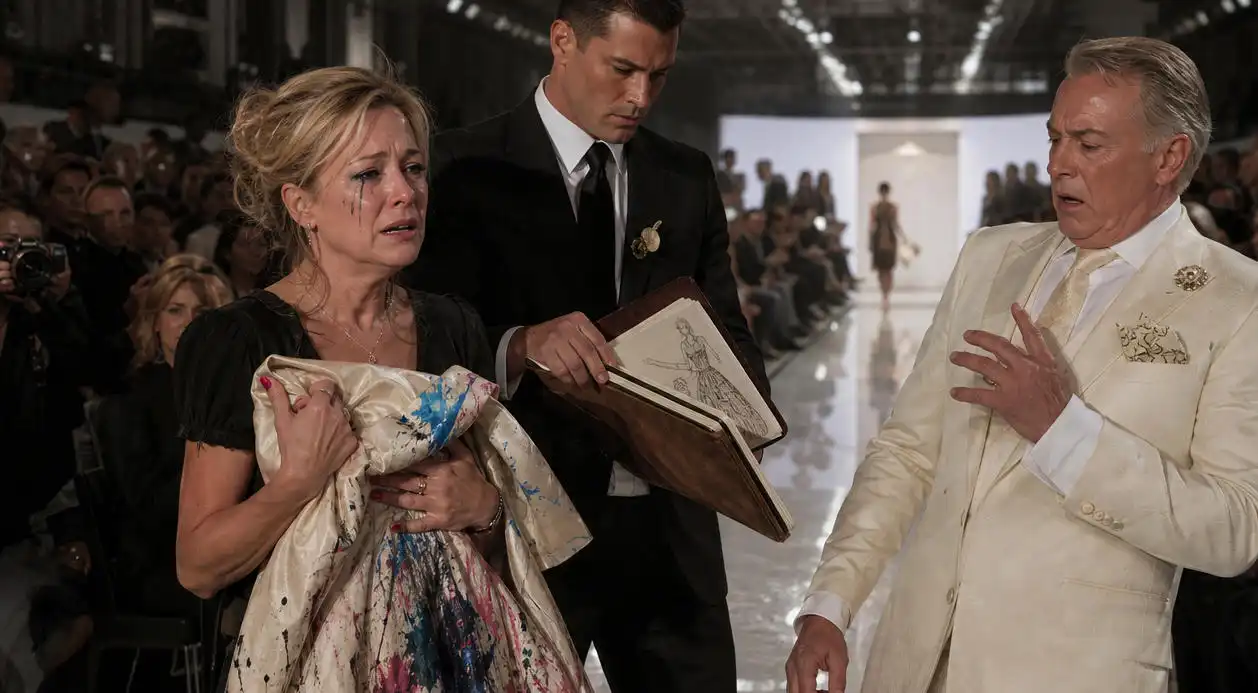
The entire runway hall went so quiet that the only sound was gray paint water dripping from Evelyn Carter’s ruined gown onto the glossy black floor.
Caleb Donovan did not raise his voice.
He did not have to.
“Put the bucket down,” Victor snapped, but his voice cracked halfway through the sentence.
Nobody moved.
The same security guard who had just tried to pull Evelyn’s garment bag out of her hands stood frozen, both palms wrapped around the handle of a five-gallon bucket of leftover stage paint.
The crowd waited.
The cameras waited.
Evelyn stood there shaking, one cheek still red from Victor’s slap, her fingers curled around the wet fabric like she was holding a wounded thing.
Victor Voss tried to laugh.
It came out thin.
“Ladies and gentlemen,” he said, turning toward the audience with that polished magazine-cover smile, “this is clearly some misunderstanding. I don’t know who this man thinks he is, but this is a professional design competition, not a military reunion.”
Caleb stepped onto the runway.
One slow step.
Then another.
He was fifty-two, broad-shouldered, clean-shaven, wearing a dark suit that looked expensive only because it fit like discipline. No flashy watch. No designer scarf. No entourage walking in front of him.
But behind him came something Victor could not ignore.
Six photographers.
Two legal officers.
A woman from the event’s corporate board.
And three reporters from international fashion media who had been waiting in the lobby until Caleb gave them the signal.
Victor’s eyes flicked from face to face.
That was when the room began to understand.
This was not some random angry man defending a widow.
This was someone who had arrived prepared.
Evelyn looked at Caleb, confused and breathless.
“Caleb?” she whispered.
He softened for one second.
Only one.
“Evelyn,” he said, “stand behind me.”
She didn’t argue.
For eight months, she had been teaching herself not to need protection.
For eight months, she had stitched through grief, bills, loneliness, and the hollow silence of a house that used to have boots by the door.
But in that moment, after being mocked, slapped, and accused of stealing her own work, she stepped behind the man who had carried her husband’s coffin with both hands and never once let it tilt.
Victor pointed at her.
“There it is,” he said loudly. “A sympathy act. That is what this is. She brings in a veteran friend, creates a scene, and suddenly we are supposed to ignore intellectual theft?”
A few people murmured.
Victor heard it and gained confidence.
He adjusted his ivory couture jacket, though the lapel was already flecked with gray paint from the splash that had ruined Evelyn’s gown.
“Miss Carter submitted a design that matches my unreleased winter collection. My legal team can confirm it.”
Caleb opened the leather notebook again.
The one Evelyn had carried in with her.
The one Victor had dismissed as “a widow’s little scrapbook” fifteen minutes earlier.
“You mean this design?” Caleb asked.
He held up a page.
The camera nearest the runway zoomed in.
A sketch of the gown appeared on the giant screen above the stage.
The room gasped.
It was unmistakable.
A midnight-blue evening gown with a structured naval collar, pearl-threaded internal seams, and a hidden lining pattern shaped like waves.
Victor smiled coldly.
“Yes,” he said. “Exactly. Thank you for displaying the copied material.”
Caleb turned the page.
Then another.
Then another.
Each page showed the same gown evolving over time.
Notes in Evelyn’s handwriting filled the margins.
“Lower shoulder line — too stiff.”
“Pearl seam must be hand-placed.”
“For Daniel. Make it look like the ocean at night.”
Evelyn swallowed hard when she saw her husband’s name on the screen.
Daniel Carter.
Marine.
Husband.
Best friend.
Gone for almost two years.
The crowd grew still again, but this time it was different.
Less entertained.
More ashamed.
Victor’s jaw tightened.
“Sketches can be fabricated,” he said.
Caleb nodded once.
“They can.”
Then he looked at the board representative.
“Marianne, please play file one.”
The woman stepped to a media console near the runway.
The screen changed.
A video appeared.
Evelyn, sitting alone in a small sewing room, hair tied back, glasses low on her nose, working the pearl stitching by hand.
A timestamp glowed in the corner.
Eight months earlier.
Another clip followed.
Evelyn measuring the lining.
Six months earlier.
Another.
Evelyn holding the gown up against morning light.
Four months earlier.
Then a still photograph appeared.
Daniel’s old Marine dress blues folded beside the first bolt of midnight-blue fabric.
The audience made a sound like one collective breath breaking.
Evelyn covered her mouth.
She had forgotten she even recorded some of those videos.
Back then, she had filmed them for Daniel.
Not because he could see them.
Because talking to the camera helped her survive the silence.
Victor’s assistant, a thin young man with silver glasses, whispered something in Victor’s ear.
Victor shook him off.
“Emotional videos don’t prove ownership,” he said. “Anyone can sew after seeing a leaked design.”
Caleb’s expression did not change.
“Correct again.”
He reached into the notebook’s back pocket and removed a clear plastic sleeve.
Inside were printed receipts, dated mailing confirmations, and a certificate with an official seal.
“Evelyn registered the design with the U.S. Copyright Office eleven months ago,” Caleb said. “Before your so-called private collection existed.”
The room erupted.
Not loud cheering.
Not yet.
More like disbelief cracking into anger.
People turned toward Victor.
Phones lifted higher.
A young woman in the third row said, “Oh my God.”
One of the new designers who had laughed earlier lowered his head.
Victor went pale.
But men like Victor Voss did not become powerful by surrendering early.
They became powerful by making everyone else afraid to speak.
So he did what he had always done.
He attacked harder.
“You expect us to believe this little sewing widow had the resources to create that level of couture?” he said. “Look at her. She doesn’t belong on this stage.”
That sentence did more damage to him than any document could have.
Because everyone heard it.
Every camera caught it.
Every reporter wrote it down.
Evelyn lifted her chin.
Her cheek was still red.
Her gown was still soaked.
But she stopped shaking.
Caleb looked at her.
“Do you want to answer that?”
Evelyn stared at Victor.
For a long second, she said nothing.
Then she stepped forward.
“I made that gown on a secondhand machine in my garage,” she said. “I used my husband’s last deployment bonus to buy the fabric. I worked nights altering church dresses and bridesmaid gowns to afford the pearls. I didn’t have a studio. I didn’t have interns. I didn’t have a famous name.”
She looked around the room.
“But I had time. Grief gives you a lot of that.”
No one laughed now.
Evelyn turned back to Victor.
“And I had my husband’s promise. He told me before his last deployment, ‘Evie, one day the world is going to see what your hands can do.’”
Her voice broke.
But she kept going.
“So I entered this contest because I thought maybe tonight would be that day.”
She looked down at the ruined gown.
“Then you stole it.”
Victor scoffed.
“I stole nothing.”
Caleb glanced toward the legal officers.
“Then let’s discuss how your assistant accessed her submission package.”
Victor froze.
The silver-glasses assistant took half a step backward.
Caleb nodded toward the big screen again.
“File two.”
The screen changed to a security log.
Dates.
Times.
Names.
An entry showed Evelyn’s digital submission being downloaded from the competition’s private portal twelve days before Victor’s “unreleased” design was presented to the judges’ preview committee.
The download came from an internal account.
Victor Voss Studio.
Then another record appeared.
A payment transfer.
Ten thousand dollars.
From a shell consulting company linked to Victor’s studio.
To one of the junior competition coordinators.
The room turned ugly.
Not violent.
Worse for Victor.
Moral.
People began whispering words rich men hate hearing in public.
“Fraud.”
“Setup.”
“Lawsuit.”
“Career over.”
Victor snapped toward the assistant.
“Fix this.”
The assistant’s face had gone white.
“I told you not to use the portal account,” he whispered, too loudly.
The microphone on the judge’s table caught every word.
The speakers carried it across the hall.
The audience gasped.
Victor slowly turned toward the microphone.
Then toward Caleb.
Caleb said nothing.
He didn’t need to.
The room had heard the confession.
Victor lunged toward the judge’s table and slapped his palm over the microphone.
Too late.
Reporters were already typing.
Phones were already live-streaming.
The global cameras were already running.
Victor’s world was no longer controlled by invitation-only dinners and whispered threats backstage.
It was happening in public.
In real time.
Under runway lights.
Evelyn looked at Caleb.
“How did you know?” she asked softly.
Caleb’s face tightened.
“Daniel sent me a letter before his last deployment,” he said.
Evelyn went still.
“What letter?”
Caleb reached inside his jacket and pulled out a folded envelope.
The edges were worn.
Not from age.
From being opened carefully, many times.
“He asked me to look after you if he didn’t come home,” Caleb said. “Not as charity. He hated that word. He said, ‘My wife doesn’t need saving. She needs one fair shot.’”
Evelyn’s eyes filled.
Caleb continued.
“When your submission was flagged for ‘suspicious similarity,’ the system notified the corporate office because I had ordered independent monitoring on all finalist designs.”
Victor stared at him.
“Corporate office?” he said.
Caleb finally turned fully toward him.
“Yes.”
Marianne, the board representative, stepped forward and handed Caleb a slim folder embossed with the logo of Aureon Luxe Group, the global fashion and luxury conglomerate that owned the event, half the sponsors, the licensing network, and the distributor Victor relied on for his overseas deals.
Caleb opened the folder.
“My name is Caleb Donovan,” he said. “Former Marine Recon. Current majority shareholder and executive chairman of Aureon Luxe Group.”
The room exploded.
Not with applause.
With shock.
Victor’s mouth opened.
Nothing came out.
The young designers who had mocked Evelyn looked like they wanted to disappear into the floor.
Security stepped away from Evelyn’s gown as if it had suddenly become sacred.
Caleb looked at Victor.
“You have spent years building a reputation as the man who discovers talent,” he said. “But our internal audit suggests you have been harvesting designs from unknown finalists, immigrant seamstresses, unpaid interns, and independent artists who could not afford to fight you.”
Victor’s face hardened.
“That is defamatory.”
Caleb raised one eyebrow.
“Then you’ll enjoy court.”
One of the legal officers handed Marianne another document.
She read it into the microphone.
“Effective immediately, Victor Voss is suspended from all Aureon Luxe Group partnerships, licensing programs, judging panels, mentorship boards, runway platforms, and retail distribution channels pending legal action.”
A sound rolled through the room.
It was half gasp, half justice.
Victor gripped the judge’s table.
“You can’t do that,” he said.
Caleb looked at him for a long moment.
“You slapped a contestant on a live runway after stealing her registered design.”
Victor’s lips tightened.
Caleb added, “I can do much more.”
The reporters moved closer.
Victor’s publicist tried to push through from the side aisle, phone pressed to her ear.
“I need everyone to stop recording,” she pleaded.
Nobody stopped.
That was the beautiful part.
For years, Victor had survived because people were afraid to be the first one to speak.
Now everyone had evidence at the same time.
There was no private room for him to control.
No nervous assistant to threaten.
No young designer to shame into silence.
Only the truth, bright and unforgiving under runway lights.
Caleb turned to the security guard holding the bucket.
The guard looked terrified.
Caleb spoke calmly.
“You embarrassed yourself tonight by following the wrong man’s order.”
The guard swallowed.
“Yes, sir.”
“You have two choices. Walk off this floor and write a statement about who instructed you to touch Mrs. Carter’s property…”
Caleb’s eyes shifted toward Victor.
“Or continue protecting a man who is about to become very expensive to stand beside.”
The guard immediately set down the bucket.
“I’ll write the statement.”
Victor pointed at him.
“You’re fired.”
Marianne leaned toward the microphone.
“He is not your employee.”
The audience reacted with a few sharp laughs.
Not joyful laughs.
The kind people give when a bully’s power finally misses its target.
Evelyn knelt beside her gown and tried to lift part of the skirt.
The paint water had soaked through the outer layer, but the inner lining still shimmered faintly where the pearls caught the light.
Caleb bent beside her.
“I’m sorry,” he said.
She shook her head.
“You didn’t do this.”
“No,” he said. “But I should have found him sooner.”
Evelyn looked toward Victor.
He was surrounded now by the consequences of his own arrogance: legal officers, cameras, board members, and former admirers who had suddenly remembered their ethics.
“I don’t want revenge,” she said.
Caleb studied her.
Victor heard it and seized on it like a drowning man.
“Yes,” he said quickly. “Good. Thank you. Mrs. Carter and I can discuss this privately. I am sure grief played a role in this misunderstanding.”
The room went cold.
Evelyn slowly stood.
“Grief?” she repeated.
Victor realized too late that he had chosen the wrong word.
Evelyn stepped toward him.
“My grief did not bribe a coordinator.”
One step.
“My grief did not access a private submission file.”
Another step.
“My grief did not put your name on my work.”
Another.
“And my grief did not slap me in front of a room full of people.”
The applause started in the back.
One person.
Then five.
Then fifty.
Then the whole runway hall rose around her.
Victor looked trapped inside the sound.
Evelyn did not smile.
Not yet.
She turned to Caleb.
“I don’t want revenge,” she said again. “I want the rules.”
Caleb nodded.
“That’s exactly what you’re getting.”
Marianne returned to the microphone.
“Under the competition rules, any finalist proven to have submitted stolen work is disqualified. Any judge proven to have interfered with the submission process is removed. The affected designer receives full review before an independent panel.”
Victor barked a bitter laugh.
“An independent panel? Tonight? How convenient.”
Caleb looked toward the side curtain.
“Actually, they’re already here.”
Three people stepped onto the runway.
A retired couture archivist from New York.
A textile professor from Chicago.
A former creative director from Milan.
They had been invited quietly after Caleb’s audit found irregularities in Victor’s judging history.
Victor stared at them.
“You planned this.”
Caleb’s voice was flat.
“No, Victor. You planned this. I documented it.”
That line landed like a hammer.
The independent panel approached Evelyn’s gown.
They did not treat it like trash.
They put on gloves.
They lifted the damaged fabric carefully.
They examined the seams, the pearl work, the naval collar, the interior wave pattern, the hidden stitching that no thief would have bothered to understand.
The textile professor looked at Evelyn.
“You hand-placed these?”
“Yes, ma’am.”
“How many hours?”
Evelyn hesitated.
“I stopped counting after four hundred.”
The retired archivist bent closer.
“This is not amateur work.”
Evelyn blinked hard.
The former creative director from Milan looked at Victor’s displayed copy on the rack behind the judges.
Then back at Evelyn’s original.
“The copy is colder,” he said. “Technically impressive, but empty. Hers has a language.”
Victor shouted, “This is theater!”
The archivist turned to him.
“No, Mr. Voss. This is authorship.”
The crowd applauded again.
Victor tried to leave.
Two event staff members blocked the side exit, not touching him, just standing where the door was.
Marianne spoke into the microphone.
“Mr. Voss, you are free to leave after legal counsel receives your event credentials, access badge, and signed conflict-of-interest disclosures.”
His publicist covered her face.
The young designers who had laughed earlier stood in a miserable little cluster near the edge of the stage.
One of them, a blond man in a black satin jacket, stepped forward.
“Mrs. Carter,” he said, voice shaking, “I’m sorry.”
Evelyn looked at him.
He swallowed.
“I said something cruel because I wanted Victor to notice me.”
She said nothing.
That silence did more than anger could have.
The young man looked down.
“I’ll give a statement too.”
Then another designer stepped forward.
And another.
Within minutes, the lie had witnesses against it.
Victor’s empire was not collapsing because one powerful man disliked him.
It was collapsing because the people he used had finally seen a safer side to stand on.
Caleb gave a quiet order to one of the legal officers.
The officer walked to Victor’s rack and removed the copied gown.
Victor lunged.
“Don’t touch that!”
The officer held up a document.
“Preservation order.”
Victor froze again.
Caleb said, “It will be held as evidence.”
Victor’s face twisted.
“You think this makes you noble?” he spat. “You bought your way into fashion. You’re a soldier playing king.”
Caleb stepped closer.
For the first time, there was fire in his eyes.
“No,” he said. “I’m a soldier who learned that uniforms don’t make people honorable. Actions do.”
He glanced at Evelyn.
“And tonight, a widow with a secondhand sewing machine showed more class than every coward who laughed at her.”
That was when the room truly turned.
People were no longer watching a scandal.
They were choosing a side.
Caleb looked at Marianne.
“Announce the correction.”
Marianne nodded.
“After review of the evidence, Victor Voss is permanently removed from tonight’s panel. His submitted preview piece is disqualified and referred for legal investigation. The original designer, Evelyn Carter, is reinstated for final judging.”
The crowd clapped.
But Evelyn looked down at the ruined gown.
“How?” she whispered. “It’s destroyed.”
The textile professor touched the wet fabric gently.
“Damaged,” she said. “Not destroyed.”
The archivist nodded.
“The outer layer is compromised. But the construction is visible. The workmanship is visible.”
The former creative director smiled.
“And sometimes damage tells the truth better than perfection.”
Evelyn’s lips trembled.
For the first time that night, she almost smiled.
Then Caleb turned toward the bucket on the floor.
The same bucket that had made Victor flinch.
He looked at it.
Then at Victor’s spotless ivory suit.
The crowd felt the shift.
Victor did too.
“You wouldn’t dare,” Victor said.
Caleb’s voice stayed calm.
“I won’t.”
He turned to Evelyn.
“This is your moment, not mine.”
Evelyn looked at the bucket.
Then at Victor.
Then at her gown.
For a few seconds, everyone believed she might do it.
Everyone could picture it.
The paint running down Victor’s perfect couture suit.
The great godfather of fashion reduced to the same humiliation he had poured onto her work.
But Evelyn walked past the bucket.
She picked up the microphone instead.
“No,” she said.
Victor exhaled, almost smiling.
Then she finished.
“Let the whole world see him clean.”
The room went silent again.
Evelyn turned toward the cameras.
“Let them see his perfect suit. His perfect hair. His perfect reputation. And then let them hear what he did.”
That was worse.
Victor understood it immediately.
Paint would wash out.
Video would not.
A ruined suit would become a joke.
A clean suit beside undeniable evidence would become a symbol.
The arrogant man who looked untouched while everyone else carried the damage he caused.
Caleb’s mouth curved slightly, not quite a smile.
“That,” he said softly, “is better.”
Victor tried to speak, but his words had lost their throne.
The independent panel took twenty-two minutes.
The audience stayed.
Nobody wanted champagne now.
Nobody cared about sponsor gift bags.
People stood in rows, whispering, filming, waiting for the one thing Victor had tried to prevent all night.
A fair judgment.
When the panel returned, the retired archivist held the scoring envelope.
Evelyn stood at center stage in a plain black dress, her hands clasped in front of her.
The ruined gown was displayed behind her on a form, still damp, still stained, still breathtaking.
The gray paint had changed the midnight-blue fabric in strange ways.
It looked storm-touched.
Like the ocean after battle.
The archivist spoke.
“Tonight’s Gold Award goes to the designer whose work demonstrates originality, technical mastery, emotional coherence, and unmistakable authorship.”
She turned.
“Evelyn Carter.”
The room stood.
This time the applause was not polite.
It was thunder.
Evelyn covered her face with both hands.
Caleb stepped back, letting the moment belong only to her.
For two years, people had introduced Evelyn as “Daniel’s widow.”
They meant it kindly.
But grief can become a cage even when love builds it.
That night, under the lights, she became something else too.
A designer.
An artist.
A woman whose hands had survived what her heart barely did.
Marianne approached with another envelope.
“Mrs. Carter,” she said, “Aureon Luxe Group would like to offer you a chief designer contract for a new independent capsule line, with full creative control, international distribution, and legal protection of all registered work.”
Evelyn stared at her.
“I don’t understand.”
Caleb spoke gently.
“It means one fair shot.”
Evelyn looked at him.
Then the letter in his hand.
Then the gown.
Then, finally, upward.
Not at the lights.
Higher than that.
“Daniel,” she whispered. “You were right.”
Victor was escorted out through a side corridor while the cameras followed from a legal distance.
No one touched him.
No one needed to.
By midnight, three major sponsors had suspended contracts with his studio.
By morning, former interns began posting their own stories.
By the end of the week, Victor Voss resigned from two boards, lost his distribution deal, and faced multiple civil claims from designers who had been too unknown to fight him alone.
Six months later, his studio filed for bankruptcy protection.
A year later, he was living quietly overseas, still insisting in rare interviews that he had been “misunderstood by the mob.”
But the industry understood perfectly.
He had not been destroyed by gossip.
He had been destroyed by receipts.
Evelyn’s capsule collection debuted in Paris the following spring.
She called it “One Fair Shot.”
The first piece on the runway was not the restored gown.
It was a new version.
Midnight-blue.
Pearl-seamed.
Naval collar.
Storm-gray underlayer.
And inside the lining, hidden where only the wearer would know, were three stitched words:
For Daniel. Always.
Caleb sat in the front row again.
This time, no one ignored him.
But he kept his eyes on Evelyn.
When the final model walked, the audience rose before the music ended.
Evelyn stepped onto the runway, older than most overnight success stories, quieter than most celebrity designers, and stronger than any room that had tried to shame her.
She did not wave like a star.
She placed one hand over her heart.
Then she looked down the runway, right into the cameras.
And smiled.
Not because Victor lost.
Because she had not.
That is the part people forget about justice.
It is not only watching the villain fall.
It is watching the person he tried to break stand taller than before.
So choose a side:
Was Evelyn right to let the evidence ruin Victor instead of humiliating him with paint — or did he deserve the same public treatment he gave her?
Share this if you believe stolen work, public cruelty, and fake power should always meet real consequences. ⚖️
Disclaimer: Mention of any brand or trademark is for identification only and does not imply partnership or endorsement
The Tavern Owner Set A Trap To Make Paul Drink Again… But He Had NO IDEA The Entire Town Was Watching 👀
They Laughed When Mark Announced He Was Running for Office… Then One Sealed Envelope Made the Whole Room Go Silent 😳
My Stepdaughter Thought Her Real Father Paid for Her Golf Club Wedding… Then I Showed the Guests the Letter He Sent Me