
Jason was still smiling when my fist came down on the Ferrari key.
The crack was louder than it should have been.
Plastic snapped. Metal bent. The little red logo split under my knuckles.
For one second, nobody moved.
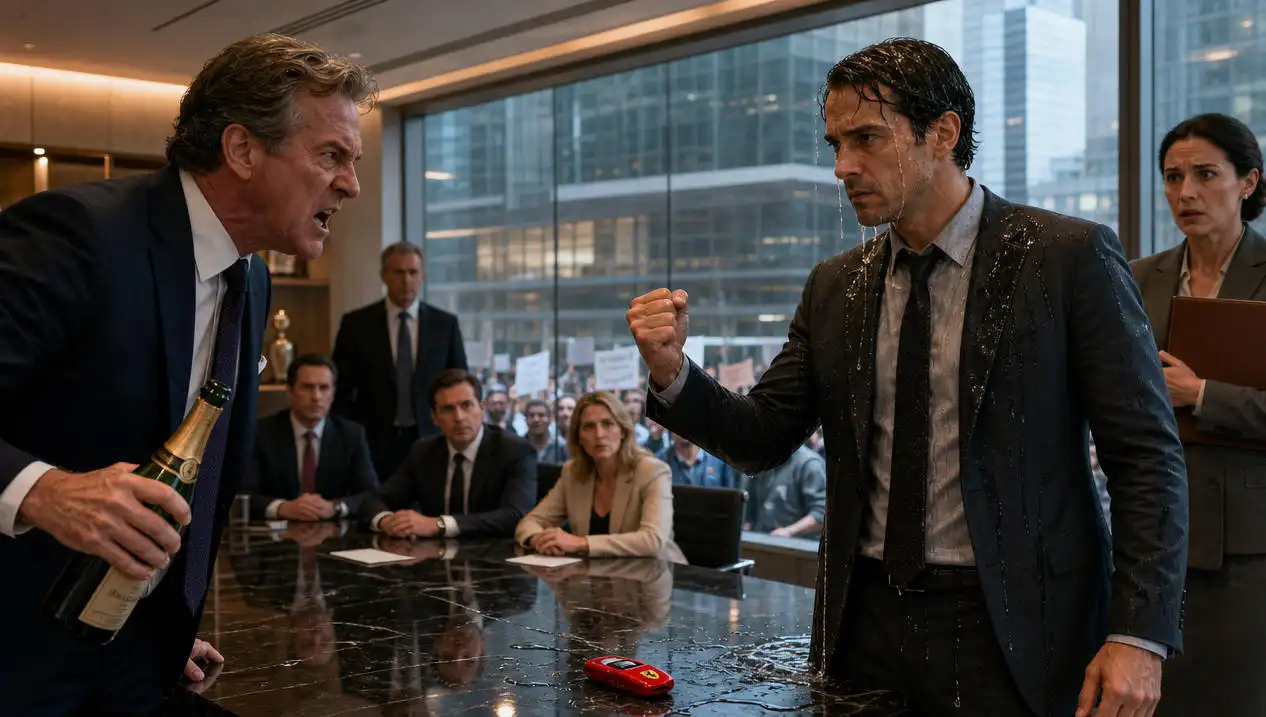
Champagne was still dripping from my chin onto the polished marble floor of the CEO office. Down below, through the glass walls, hundreds of employees were gathered in the courtyard, holding signs, staring up, some of them filming.
Jason’s smile finally twitched.
“Are you out of your mind?” he said.
Security stepped toward me.
Our general counsel, Melissa, shot out of her chair so fast her leather folder hit the floor.
“Do not touch him,” she said.
Jason turned slowly. “Excuse me?”
Melissa’s face had no color left in it.
“Jason,” she said carefully, “you need to sit down.”
That was the first time I saw fear enter the room.
Not from me.
From them.
Because arrogant people can survive anger. They can survive outrage. They can even survive being disliked.
But they cannot survive when the quiet person in the room knows exactly where the bodies are buried.
And I had spent five years being quiet.
My name is Steve Miller.
I was 42 years old when this happened. I was a single father to a 13-year-old girl named Lily, a project manager at a technology company called Velora Systems, and the man Jason Price loved to introduce as “one of our dependable middle guys.”
Not engineer.
Not inventor.
Not founder-level contributor.
Not the person who slept on office floors during product crashes.
Just “middle guy.”
That was Jason’s favorite trick.
He turned people smaller before he stepped on them.
Velora made industrial automation software. Not glamorous to most people, but in our field, it mattered. Our core system helped factories predict equipment failure before machines broke down. Hospitals used some of our adapted models. Food plants used it. Energy companies used it.
The company was worth billions on paper because of one thing:
Its predictive engine.
Jason told investors he had “reimagined the future of machine intelligence.”
He said it on podcasts. He said it on conference stages. He said it in front of cameras while wearing watches that cost more than some of our employees’ cars.
What he never said was that the engine began as a patent portfolio I built in my garage after my wife died.
Her name was Karen.
She had been a mechanical engineer. Brilliant. Warm. Stubborn in the best way. When she got sick, she worried more about Lily and me than herself.
One night, near the end, she touched my hand and said, “Promise me you won’t let anyone take your work and make you feel grateful for scraps.”
I promised her.
After she passed, I buried myself in work because grief had nowhere else to go. I designed a fault-prediction method using equipment vibration, heat signatures, and maintenance logs. I filed the first provisional patents through a tiny holding company called Northstar IP.
I named it after Lily’s favorite bedtime phrase.
“When you’re lost,” Karen used to tell her, “find the North Star.”
Years later, Velora licensed those patents.
Not bought. Licensed.
There is a difference.
Most people in the office never knew. Jason certainly acted like he didn’t. The original founder knew. The board knew. Legal knew. A few old engineers knew.
And every year, while Velora grew, the license agreement renewed with conditions.
One condition was simple: Velora had to maintain the engineering retention pool tied to the patent-derived product line. That meant the people who built, maintained, debugged, secured, and improved the engine received year-end bonuses when the company hit agreed revenue targets.
We hit those targets.
Actually, we crushed them.
My team worked nights. Weekends. Holidays. I watched a 61-year-old systems architect named Don miss his granddaughter’s recital because a hospital network needed a patch. I watched Maria, a QA lead with two kids, take calls from her car outside a pediatric clinic. I watched junior engineers eat vending machine dinners while Jason gave interviews about “grit.”
The bonus mattered.
For some employees, it was debt. For others, Christmas. For some, medical bills. For me, it was Lily’s braces and the last overdue payment on our house.
The Monday before Christmas, Jason called an all-hands meeting.
He stood on the lobby stairs in a navy suit, smiling like he was about to announce a miracle.
Behind him was a giant screen that said:
BUILDING A LEANER FUTURE.
Everyone knew that phrase was bad news.
Jason tapped the microphone.
“I want to thank every one of you for an extraordinary year,” he said.
People clapped politely.
Then he continued.
“Because we believe in long-term strength over short-term entitlement, the executive team has decided to suspend all year-end bonuses.”
The lobby went silent.
Then the whispers began.
“What?” “He can’t do that.” “My offer letter says…” “We hit the targets.”
Jason held up one hand like a king quieting peasants.
“I know some of you may be disappointed,” he said. “But disappointment builds character.”
Then someone near the front asked, “Are executive bonuses suspended too?”
Jason’s jaw tightened.
“That’s not an appropriate question.”
That was answer enough.
By lunch, employees were standing outside with signs.
PROMISES MATTER. PAY THE TEAM. WE BUILT THIS.
I did not organize the protest.
But I understood it.
At 2:15 p.m., I received a calendar invite.
Executive Conference Room. Immediate Attendance Required.
When I got off the elevator to the top floor, I saw the Ferrari first.
It was parked right outside the front glass entrance, in the visitor circle, bright red, polished like candy, engine still ticking.
Jason had bought it that morning.
His assistant, Claire, was standing by the reception desk, eyes red.
“He wants you in there,” she whispered.
“Are you okay?” I asked.
She looked toward the conference room.
“He told payroll to mark the bonuses as discretionary.”
My stomach dropped.
“Did Melissa approve that?”
Claire swallowed.
“She argued.”
That told me everything.
Inside the executive conference room, the city spread out beneath us. Jason liked that view. It made him feel above consequences.
The executives sat around the table.
CFO Nolan Briggs looked at his hands. COO Denise Park stared out the window. Melissa, general counsel, had a legal pad open but wasn’t writing. Two board observers joined by video, their cameras on, faces stiff.
Jason stood by the bar cart pouring champagne.
Actual champagne.
While employees downstairs protested.
He turned when I entered.
“Steve,” he said brightly. “The people’s champion.”
I closed the door behind me.
“You canceled earned bonuses.”
He laughed.
“No. I suspended discretionary compensation in response to market conditions.”
“Our revenue is up 38 percent.”
“Our culture,” Jason said, “is down about 90 percent.”
A few people shifted uncomfortably.
I placed a folder on the table.
“These are the retention pool terms tied to Product Line A.”
Jason didn’t look at it.
“Do you know your problem, Steve?”
I said nothing.
“You think because you’ve been around a long time, that makes you important.”
He walked closer, champagne glass in hand.
“You are useful. There’s a difference.”
Nolan whispered, “Jason…”
Jason ignored him.
He pointed toward the glass wall overlooking the courtyard.
“Look at them. Grown adults with cardboard signs. This is what happens when middle managers start telling employees they’re owed things.”
“I told them the truth,” I said.
“No,” Jason snapped. “You fed them entitlement.”
Then he smiled again.
That smile was worse than his anger.
“Let me guess. Single dad, right? Christmas pressure? Mortgage pressure? Daughter needs something expensive?”
The room went colder.
My hand tightened around the back of a chair.
Jason leaned in.
“I sympathize. Really. But don’t confuse your personal life with corporate strategy.”
Melissa said, “Jason, stop.”
He didn’t.
He lifted the champagne bottle.
“You want your bonus so badly?”
Then he poured it over my head.
Cold liquid hit my hairline, ran into my eyes, down my shirt, under my collar.
For half a second, I heard nothing but the fizz.
Then the room reacted.
Claire gasped from the doorway.
Denise covered her mouth.
One of the board observers said, “What the hell was that?”
Downstairs, people saw.
Phones went up.
Jason stepped close enough that only I could smell the champagne on his breath.
“There,” he whispered. “Now you’ve had something expensive.”
I wanted to hit him.
I am not proud of that, but it is true.
I thought about Lily.
I thought about Karen.
I thought about every person downstairs who had done the work while this man bought toys and called sacrifice “discipline.”
But I also thought about the promise I made my wife.
Don’t let anyone take your work and make you feel grateful for scraps.
So I did not hit Jason.
I looked at his Ferrari key on the table.
Then I looked at Melissa.
She knew.
Her eyes told me she knew.
Jason snapped his fingers.
“Security.”
Two guards moved from near the elevator.
That was when I picked up the key.
Jason laughed.
“Careful. That key costs more than your month.”
I placed it on the table.
Then I raised my fist.
“Jason,” I said, “before security touches me, ask your lawyer what happens when the first inventor revokes authorization.”
Melissa whispered, “Jason, don’t.”
Jason smirked.
So I smashed the key.
The sound cracked through the room like a judge’s gavel.
Then I opened my briefcase.
Inside was not one folder.
It was six.
Each had a tab.
PATENT LICENSE. RETENTION COVENANT. DEFAULT NOTICE. BOARD NOTICE. EMPLOYEE DECLARATIONS. TERMINATION TRIGGER.
Jason stared at them.
“What is this supposed to be?”
“The part you skipped,” I said.
Melissa closed her eyes.
Nolan muttered, “Oh God.”
I removed the first document.
“Velora does not own the predictive engine patents. Northstar IP does. Velora has an exclusive license, renewed annually, as long as certain conditions are met.”
Jason rolled his eyes.
“I know how licensing works.”
“No,” I said. “You know how bragging works.”
Denise coughed into her hand.
I kept going.
“The license requires Velora to maintain the engineering retention pool for employees assigned to Product Line A, provided revenue targets are met. We exceeded the target by 31 percent.”
Jason looked at Melissa.
She didn’t save him.
I took out the second folder.
“You canceled the bonuses anyway and instructed payroll to reclassify the pool as discretionary.”
Jason’s mouth tightened.
“That is an internal compensation decision.”
“No,” Melissa said quietly. “Not under this license.”
The room turned toward her.
Jason’s voice dropped. “Melissa.”
She sat up straight.
“I warned you three times. In writing.”
Nolan looked sick.
I placed another paper on the table.
“Last month, I sent a cure notice after payroll missed the preliminary bonus funding deadline.”
Jason blinked.
“You sent that to legal.”
“And the board.”
One of the board observers leaned closer to his camera.
“We received it,” he said.
Jason looked like he had just discovered the floor was not there.
“You didn’t tell me that.”
The board observer’s face hardened.
“Your office acknowledged it.”
Claire, still at the doorway, spoke so softly we almost missed it.
“He told me to mark it as routine correspondence.”
Jason spun toward her.
“Be careful.”
That did it.
Something changed in the room.
People who had been afraid of Jason began to realize Jason was afraid of paper.
Not drama. Not shouting. Paper.
I slid the termination trigger page forward.
“Today, in front of witnesses, you confirmed the cancellation. You also publicly humiliated the first inventor and authorized security to remove me from the premises while I was presenting a contractual default issue.”
Jason scoffed.
“You think a little champagne changes a billion-dollar license?”
“No,” I said. “Your breach does. The champagne just gave everyone a clear view of who caused it.”
Melissa stood.
“Jason, under Section 14.3, Northstar IP can suspend Velora’s authorization to commercially deploy the patented engine if the retention covenant is breached and uncured after notice.”
Jason’s face went red.
“You’re my lawyer.”
“I’m the company’s lawyer,” she said.
That sentence landed hard.
Downstairs, the crowd had grown louder.
Someone had seen enough through the glass to understand something was happening.
I took out my phone.
At 2:31 p.m., I sent one email.
To Melissa. To the board. To Velora’s outside counsel. To Northstar IP’s attorney.
Subject: Notice of License Suspension — Effective Immediately.
Jason lunged toward the table.
Security moved again.
Melissa shouted, “Nobody touches him!”
The guards froze.
Jason pointed at me.
“You are done. You will never work in this industry again.”
I wiped champagne from my eyebrow with a napkin.
“You said I was just a middle manager.”
He said nothing.
I packed my folders slowly.
Not because I wanted drama.
Because after years of being rushed, dismissed, interrupted, and talked down to, I wanted that room to wait on me for once.
Then I turned to the executives.
“Everyone downstairs earned what they were promised. If this board honors the retention pool by close of business tomorrow, Northstar will consider a limited cure.”
Jason laughed, but it came out thin.
“You don’t dictate terms.”
The board observer said, “Actually, Jason, at this moment, he does.”
That was the first public crack.
The second came six minutes later.
Velora’s product servers did not shut off. I was not reckless. Hospitals, factories, and clients still needed continuity. Northstar’s suspension did not break existing safety obligations.
But it froze new deployments, new sales, new enterprise renewals, and all use of the engine in pending investor demonstrations.
And that week, Velora had three major investor demos scheduled.
All three depended on the licensed patents.
By 5:00 p.m., the board called an emergency session.
By 6:30 p.m., the video of Jason pouring champagne on me had spread through employee group chats.
By 8:00 p.m., an industry reporter had it.
By morning, it was everywhere.
Not because of me.
Because people know the look of a bully when they see one.
The headline was brutal:
CEO Cancels Worker Bonuses, Celebrates With Champagne, Then Dumps It On Employee.
The Ferrari part made it worse.
Someone had filmed him arriving in the car that same morning.
Another employee posted the bonus memo.
Another posted a screenshot from Jason’s internal message:
“Do not fund the bonus pool until I approve revised executive liquidity planning.”
Executive liquidity.
That was corporate language for: make sure the rich people get theirs first.
At 9:12 a.m., Velora’s stock began to slide.
At 10:45 a.m., two enterprise customers paused renewals.
At noon, three engineers resigned.
By 3:00 p.m., the board placed Jason on administrative leave.
He sent an all-company email that made everything worse.
“I regret that certain internal compensation matters were misrepresented by disgruntled individuals.”
Disgruntled.
That word lit the fire again.
Maria from QA replied-all.
“Disgruntled? I worked 62 hours last week keeping your biggest client live.”
Don replied-all.
“My granddaughter asked why I missed her recital. I told her my company needed me. Turns out only the CEO’s Ferrari needed us.”
Then Claire replied.
She attached screenshots.
Jason had instructed payroll to delay bonuses while approving executive “special performance awards.”
The CFO had pushed back.
Legal had warned him.
Jason had done it anyway.
The board could no longer pretend this was a misunderstanding.
They voted that night.
Jason was terminated for cause.
But that was only the beginning.
Without the patent authorization, Velora’s investor confidence collapsed. Analysts started asking how much of the company’s valuation depended on technology it did not actually own.
The answer was ugly.
Almost all of it.
Within one week, the stock fell roughly 90 percent.
Jason’s personal loans were tied to his equity. His Ferrari, his vacation house, his “founder lifestyle,” all of it leaned on the belief that Velora would keep rising.
When the stock cratered, the banks came calling.
I heard he tried to blame me in private.
Then outside counsel reminded him that the license suspension followed written notice, written breach, and board-documented warnings.
There was no conspiracy.
Just consequences.
The board asked me to come back.
They offered money. A title. A formal apology. Even Jason’s old office.
I looked through the glass at the courtyard where my coworkers had stood with signs.
Then I said, “No.”
Melissa nodded like she had expected it.
Nolan looked exhausted.
Denise asked, “What would it take?”
I said, “Pay every employee the bonus. With interest. Then release anyone who wants to leave from noncompetes or retaliation threats.”
Nolan said, “That would be a mass exit.”
I said, “Then maybe you should have treated them like people before they had choices.”
To the board’s credit, they paid.
Not because they suddenly became saints.
Because the whole country was watching.
The money hit accounts two days before Christmas.
Maria cried when she called me.
Don sent me a photo of himself at his granddaughter’s next recital.
Claire texted one sentence:
“I slept through the night for the first time in months.”
As for me, I went home that night still smelling faintly like champagne.
Lily opened the door and froze.
“Dad?”
“I’m okay,” I said.
She stared at my shirt.
“Did someone spill something on you?”
I sat on the couch, suddenly more tired than I had ever been.
“Someone tried to.”
She sat beside me.
“Did you let them?”
That question hurt.
Because children notice more than we think.
I looked at my daughter, at her mother’s eyes in her face, and I told her the truth.
“For a little while,” I said. “Then I remembered who I was.”
She leaned her head on my shoulder.
“Mom would’ve liked that.”
I cried then.
Not loudly.
Just enough that Lily put her hand over mine and let me be human.
Two months later, I started Northstar Applied Systems.
Not in a glass tower.
In a renovated brick building near the river, with bad parking, great coffee, and no executive champagne cart.
The first people I hired were not recruiters or branding consultants.
They were my old team.
Maria joined. Don joined. Claire joined. Two dozen engineers joined within the first month. By the end of the quarter, almost everyone who had built Velora’s real product had followed.
I did not steal them.
I did not beg them.
I simply offered what Jason never understood:
Clear contracts. Shared upside. Respect in writing. Respect in public. Bonuses that could not be erased by one man’s ego.
Our first client signed in April.
Our fifth signed in June.
By the end of the first year, Northstar Applied Systems was profitable enough that I paid off my house, funded Lily’s college account, and gave every employee a year-end bonus before I paid myself anything extra.
At the holiday party, Don raised a glass of grocery-store sparkling cider.
“To expensive lessons,” he said.
Everyone laughed.
Maria added, “And cheap champagne.”
Claire said, “And keys that deserved it.”
I smiled, but I did not laugh right away.
Because across the room, Lily was standing near the window, looking at the little North Star logo on the wall.
Karen would have loved that logo.
Simple. Quiet. Steady.
A few weeks later, I received a letter from Jason.
Not an email.
A real letter.
The handwriting looked angry even on the envelope.
He said I had destroyed him. He said I had humiliated him. He said I had taken “his” company away.
He ended with one line:
“You could have handled it privately.”
I stared at that sentence for a long time.
Then I wrote back.
One paragraph.
“You poured champagne on me in front of my coworkers, my board, my employees, and hundreds of people watching from below. You made it public. I made it accurate.”
I never heard from him again.
Last I knew, Jason had sold the Ferrari at a loss and was fighting creditors over personal guarantees. Velora survived, but smaller, humbled, and no longer pretending one man’s ego was innovation.
Northstar grew.
Not overnight.
Not magically.
Through work.
Through trust.
Through people who had been told they were replaceable finally realizing they were the engine.
The best moment did not happen in a boardroom.
It happened the next Christmas.
I walked into the office with Lily beside me. We had envelopes ready for the team. Real bonuses. Written, earned, and already funded.
Before I could say anything, the employees started clapping.
I shook my head.
“No speeches,” I said.
Don yelled, “Too late.”
So I stood there, embarrassed and grateful, looking at the people who had followed me out of the wreckage.
“I know what it feels like,” I told them, “to have someone powerful treat your dignity like a cost they can cut.”
The room went quiet.
“So here is my promise. As long as my name is on the door, nobody here will ever have to beg for what they earned.”
Maria wiped her eyes.
Claire smiled.
Lily squeezed my hand.
And for the first time in years, I felt something I had not felt since Karen died.
Peace.
Not revenge.
Peace.
Because Jason thought power was a Ferrari key on a conference table.
He thought power was champagne, glass walls, silent executives, and security guards waiting for his finger snap.
He was wrong.
Power is ownership.
Power is patience.
Power is knowing the rules so well that the bully accidentally hands you the hammer.
And dignity?
Dignity is what remains when the champagne dries.
So choose a side:
Was I wrong for smashing Jason’s Ferrari key in front of everyone…
Or did a CEO who humiliated his workers finally get exactly what he earned?
Share this with someone who believes promises still matter. ⚖️
Disclaimer: Mention of any brand or trademark is for identification only and does not imply partnership or endorsement
The Tavern Owner Set A Trap To Make Paul Drink Again… But He Had NO IDEA The Entire Town Was Watching 👀
They Laughed When Mark Announced He Was Running for Office… Then One Sealed Envelope Made the Whole Room Go Silent 😳
My Stepdaughter Thought Her Real Father Paid for Her Golf Club Wedding… Then I Showed the Guests the Letter He Sent Me