
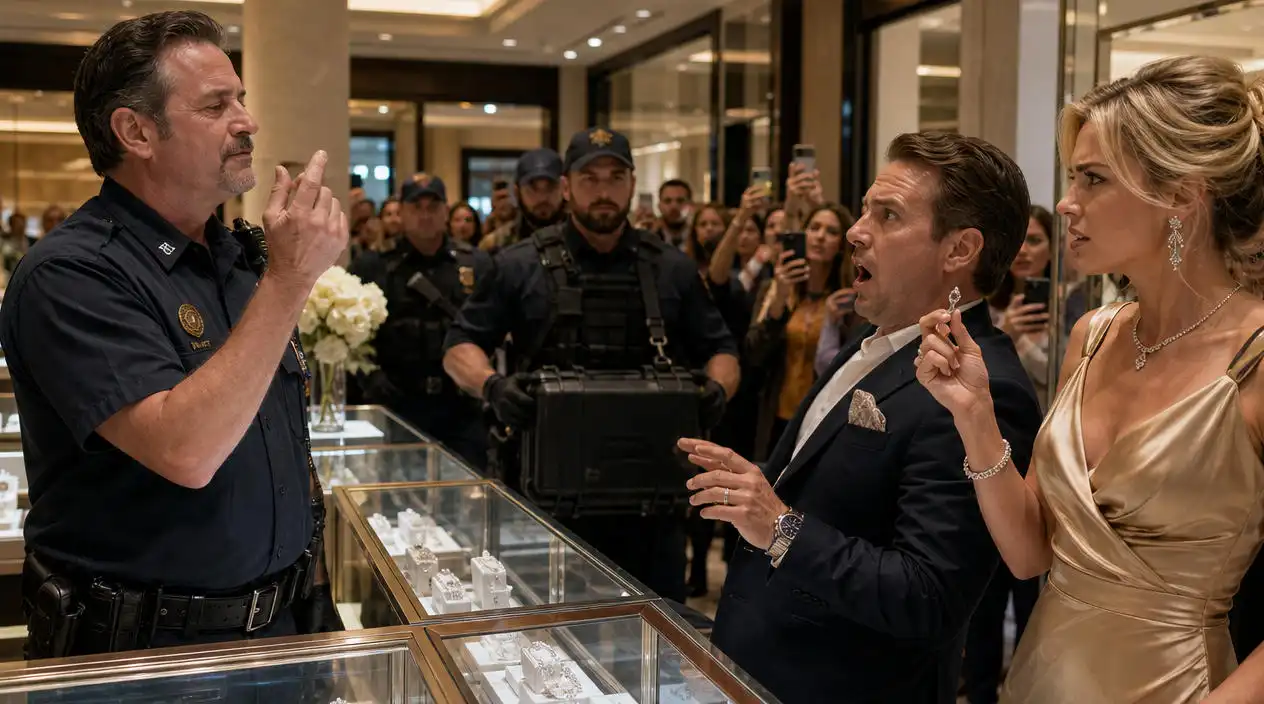
“Mr. David, shall we open it here?”
The words landed harder than any slap Charles Whitmore could have given me.
For three seconds, nobody moved.
The mall was still loud behind us — fountains running, escalators humming, kids laughing somewhere near the pretzel stand — but inside Whitmore & Co. Jewelers, everything froze.
Emma’s fingers were still in the air, showing off the little ring Charles had given her.
Charles still had that rich-boy smirk on his face.
The store manager was still holding the tissue she had used to wipe the glass counter after my sleeve brushed it, like I had dragged mud across a church altar.
And I was still standing there in my security uniform.
A forty-eight-year-old man in polished black shoes, a navy jacket, and a name tag that simply said:
DAVID.
The funny thing was, everyone thought the uniform explained me.
They thought it proved my worth.
Emma thought it proved she was right to leave me.
Charles thought it proved I belonged by the door.
The manager thought it gave her permission to talk to me like I was furniture.
That was their first mistake.
Their second mistake was doing it where everyone could see.
And their final mistake was believing diamonds only had value when they were locked behind their glass.
Earlier that afternoon, I had arrived at the mall twenty minutes before my shift.
Not because I needed the money.
Not because I was trying to impress anyone.
I arrived early because habits save men from becoming careless.
My grandfather used to say, “A man who owns the mine should still know how the gate is guarded.”
He said that in Kimberley, South Africa, after crawling out of a shaft with bleeding hands and a spine that never healed straight.
He spent half his life below ground.
My father spent half his life negotiating above it.
I spent my life learning both sides.
By the time I turned forty, our family company controlled several of the rarest diamond extraction and export pipelines in southern Africa.
By forty-five, I had quietly bought out two failing luxury distribution firms in New York and Antwerp.
By forty-eight, one signature from me could decide whether a North American jewelry chain had inventory for Christmas… or empty display cases and angry investors.
But I hated boardrooms.
I hated men who wore $9,000 watches and spoke about workers like numbers.
So whenever my company considered a major contract, I did something my attorneys hated.
I put on a uniform.
Warehouse loader.
Driver.
Night guard.
Floor security.
I watched how people behaved when they thought nobody important was watching.
Whitmore & Co. had been on my list for months.
Charles’ father wanted our pink, blue, and high-clarity white stones. He wanted exclusivity. He wanted the right to say his family’s chain had direct access to my mines.
On paper, it was a strong deal.
In person, it smelled rotten.
Inventory reports didn’t match shipping logs.
Customer complaints had been buried.
Store employees were pressured to misrepresent grades.
And Charles, the golden son, had a reputation for treating staff like disposable paper cups.
Still, I needed proof.
So I accepted a temporary security assignment at their flagship mall store.
That was where Emma came in.
Emma and I had been engaged for eleven months.
At least, I thought we were.
She told people I was “private.”
She told her friends I was “old-fashioned.”
She told me she didn’t care about money, only loyalty.
Then, slowly, her words changed.
“Why do you always wear that cheap watch?”
“Why don’t you drive something nicer?”
“Why are you always so vague about work?”
I told her the truth in pieces.
I said I had investments.
I said I worked in security and logistics.
I said I had business ties overseas.
She heard “security guard” and stopped listening.
When Charles began flirting with her during her visits to the store, she didn’t hide it very well.
He would lean against the counter, showing her stones under bright white lights.
“See this?” he told her one afternoon. “A woman should never have to settle for ordinary.”
Emma glanced at me.
Then at my uniform.
Then back at him.
“Some women do,” she said.
That one hurt.
I didn’t answer.
Instead, I kept saving evidence.
Copies of mislabeled certification cards.
Photos of stones being sold as higher clarity than they were.
Audio of Charles telling staff to “dress up the truth.”
Emails accidentally printed and left in the office tray.
And finally, a private message Emma sent Charles from a store tablet:
“After David signs whatever paperwork your dad needs, I’m done pretending. He doesn’t even know you’re using me to get closer to his suppliers.”
That was the sentence that changed everything.
She knew more than I thought.
Not everything.
But enough.
She didn’t know I owned the supply chain.
She didn’t know my “paperwork” was the final approval for Whitmore’s diamond contract.
But she knew Charles wanted access to someone behind me.
She thought she was trading up.
She thought she was moving from a guard to an heir.
She thought I was the fool standing between her and the life she deserved.
So on the day Charles gave her that ring, I let the scene play out.
The mall was packed.
Saturday afternoon.
Families with shopping bags.
Older couples sitting near the fountain.
Teenagers filming everything.
The jewelry store was bright enough to make every lie sparkle.
Emma walked in wearing a cream coat I had bought her for our anniversary.
Charles came out from behind the counter with a small velvet box.
The manager whispered, “Oh my goodness,” like she was watching royalty.
I stood near the entrance, hands folded, eyes forward.
Charles opened the box.
Inside was a ring made of tiny diamond fragments arranged around a cloudy center stone.
Not worthless.
But nowhere near what he pretended it was.
Emma gasped anyway.
“Oh, Charles…”
He slid it on her finger.
Then he looked directly at me.
“Fits better than disappointment, doesn’t it?”
A few shoppers chuckled.
Emma turned toward me, and for one second, I saw her hesitate.
That was her last chance.
She could have said, “Don’t.”
She could have walked away.
She could have remembered the man who stayed up with her when her mother was in the hospital, the man who paid off her brother’s emergency debt without wanting credit, the man who never once embarrassed her in public.
Instead, she lifted her hand and laughed.
“David, don’t look so serious. You couldn’t even afford the setting.”
A woman in pearls laughed behind her.
Another woman touched her husband’s sleeve and whispered, “How humiliating.”
The store manager stepped forward, frowning at the display case.
“David, your sleeve smudged the glass.”
I looked at the counter.
There was barely a mark.
She held up a tissue.
“Clean it, please. Or stand outside. Our clients expect a certain environment.”
Charles smiled wider.
“Actually, he should stay. I want him to learn something.”
Then he reached over and flicked my name tag.
Not hard.
Just enough to make the metal click against my chest.
“Men like you guard beautiful things,” he said. “Men like me give them to women.”
The people around us made that little sound people make when cruelty feels entertaining because it isn’t aimed at them.
Somebody started recording.
Emma saw the phone.
That made her worse.
She stepped closer to me, lowering her voice but not enough.
“Please don’t make this awkward. You were sweet, David. But sweet doesn’t pay for a life.”
I looked at the tiny stones on her finger.
Then at Charles.
“Is that your final choice?” I asked.
Emma rolled her eyes.
“Oh, don’t be dramatic.”
Charles put his arm around her waist.
“She made her choice.”
I nodded.
Not angry.
Not loud.
Just finished.
Then Charles said the sentence that sealed his family’s future.
“A man like you should know his place. Guard the door. Don’t dream about owning what’s inside.”
That was when I snapped my fingers.
The sound was small.
The reaction was not.
At the mall entrance, six licensed armored couriers walked in wearing dark uniforms, each carrying a black security case.
Behind them came my regional compliance director, a quiet woman named Grace Harlan, who had spent thirty years dismantling men who thought expensive shoes made them untouchable.
Charles saw her first.
His smile flickered.
Then he saw the logo on the cases.
Not Whitmore’s.
Mine.
Kalahari Crown Holdings.
The largest independent supplier of high-end colored diamonds to private North American jewelers.
His father had been chasing my approval for eight months.
The lead courier, Marcus, stepped to the center of the store.
He didn’t look at Charles.
He didn’t look at Emma.
He looked at me.
“Mr. David, shall we open it here?”
The store manager’s mouth fell open.
Emma whispered, “Mr. David?”
Charles gave a sharp laugh.
“No. No, that’s not—”
Grace held up a tablet.
“Charles Whitmore, under Section 14 of your pending supplier agreement, Kalahari Crown Holdings reserves the right to cancel all negotiations if a contracting party engages in misrepresentation, abusive labor practices, fraudulent grading, or conduct damaging to brand integrity.”
Charles’ face changed from confusion to fear.
That fear told me he understood.
I said, “Open the first case.”
Marcus placed it on the counter.
The click of the locks sounded like a judge’s gavel.
Inside was a sealed packet of documents.
Grace removed them one by one.
“Customer complaint logs,” she said.
The manager whispered, “Those are internal.”
Grace continued.
“Altered grading disclosures. Staff coercion statements. Shipping discrepancies. A recorded instruction from Mr. Whitmore telling an employee to describe an SI2 stone as VS quality to a customer who ‘wouldn’t know the difference.’”
The woman in pearls slowly lowered her phone.
Charles snapped, “That’s privileged business material.”
Grace looked at him calmly.
“No. It is evidence voluntarily provided by your staff, verified by independent auditors, and cross-checked against supplier invoices.”
Then she turned the tablet around.
On the screen was Charles’ message to Emma.
The one about using me.
Emma’s face drained of color.
The crowd leaned in.
Someone said, “Oh, wow.”
Charles pointed at me.
“You set me up.”
“No,” I said. “I observed you.”
That made people quiet.
Because there is a difference.
A setup is when someone tricks you into becoming ugly.
Observation is when they simply stop hiding the mirror.
Charles grabbed Emma’s wrist.
“We’re leaving.”
But Emma didn’t move.
She was staring at me like she had never seen my face before.
“David,” she said, voice shaking, “what is this?”
I reached into my jacket and removed a folded document.
“Our engagement agreement.”
Her eyes widened.
She remembered it then.
When we got engaged, my attorney asked us both to sign a simple prenuptial disclosure form before any wedding planning began.
Emma had laughed at it.
“Rich men make women sign things like this,” she said.
I told her, “So do careful men.”
She signed without reading carefully.
That document didn’t give me revenge.
It gave me clarity.
It stated that any gifts, accounts, travel cards, or credit lines connected to my private trust could be revoked immediately in the event of fraud, infidelity tied to financial exploitation, or intentional misrepresentation.
She thought those cards were “our lifestyle.”
They were not.
They were my trust’s temporary courtesy accounts.
I looked at Grace.
“Proceed.”
Grace tapped her phone.
Emma’s phone buzzed.
Then buzzed again.
Then again.
Her face crumpled as she looked down.
Card suspended.
Card suspended.
Account access revoked.
Travel authorization canceled.
Charles tried to laugh.
“You can’t just ruin people because your feelings got hurt.”
“My feelings,” I said, “are not the issue.”
Grace stepped beside me.
“The issue is that your family’s pending agreement is terminated effective immediately. All current supply negotiations are canceled. All future shipments are suspended. Existing consignment review is frozen. Our legal department has notified your board, your lenders, and your insurers.”
Charles blinked.
“Your legal department?”
I finally removed the name tag from my uniform.
Not dramatically.
Just slowly.
Under it was the badge I wore for official site inspections.
DAVID MASEKO CHAIRMAN KALAHARI CROWN HOLDINGS
The store went silent.
Then the whispers hit all at once.
“Oh my God.”
“He owns it?”
“The guard?”
“Did she know?”
Emma covered her mouth.
Charles stepped back as if the counter had caught fire.
The manager began crying.
“I didn’t know. Mr. Maseko, I swear, I didn’t know who you were.”
I looked at her.
“That is exactly the problem.”
She flinched.
“You thought kindness was optional depending on who I was.”
That line traveled through the crowd like electricity.
An older man near the entrance nodded slowly.
A teenage girl still filming whispered, “That’s it. That’s the whole thing.”
Charles tried one last time.
“My father will sue you.”
Grace smiled the smallest smile.
“Your father called us this morning, Mr. Whitmore. He was informed of the audit results.”
Charles went still.
“He wouldn’t—”
“He has already resigned as CEO pending board review.”
For the first time, Charles looked young.
Not rich.
Not powerful.
Just young and terrified.
The manager whispered, “What happens to the store?”
Grace looked at the documents.
“Corporate review. Public correction notices. Customer reimbursements. Potential regulatory referral depending on the final grading audit.”
The woman in pearls suddenly removed a receipt from her handbag.
“I bought my anniversary necklace here.”
Another shopper said, “So did I.”
Then another.
And another.
Phones rose again, but now they were not filming me.
They were filming Charles.
His empire didn’t collapse because I yelled.
It collapsed because the truth finally had witnesses.
That is what men like Charles never understand.
Humiliation is loud.
Justice is paperwork.
Emma stepped toward me.
“David, please.”
I held up one hand.
She stopped.
“I loved you,” she whispered.
“No,” I said. “You loved the life you thought someone else could give you.”
Tears filled her eyes.
“I made a mistake.”
“You made a choice.”
Charles suddenly dropped to one knee.
Not proposing.
Begging.
“David, listen. We can fix this. I’ll apologize publicly. I’ll step down. Just don’t cut the supply. My family’s stores can’t survive the quarter without your stones.”
Emma, seeing him kneel, dropped too.
Right there on the marble floor in front of the glass counter.
The same place they had wanted me to stand like a servant.
Customers gasped.
The manager covered her face.
“Please,” Emma cried. “I’ll give the ring back. I’ll tell everyone I lied. I’ll do anything.”
I looked at the ring.
Then I looked at Marcus.
“Second case.”
The lead courier opened the second black case.
Inside was a pink diamond so pure and bright that even the mall lights seemed to bow to it.
Ten carats.
Fancy vivid pink.
Internally flawless.
One of the rarest stones my company had ever handled.
The kind of diamond Charles would have built an entire advertising campaign around.
The kind Emma thought made a woman valuable.
The crowd made a sound like a wave.
Emma stared at it like salvation.
Charles looked at it like oxygen.
Grace said, “This was scheduled for private presentation today, pending final contract approval.”
Charles swallowed.
“To us?”
“To Mr. Maseko,” Grace said. “For final disposition.”
I picked up the stone.
It felt cool.
Small.
Almost absurdly small for the damage people were willing to do over it.
Charles reached out without thinking.
I closed my fist.
“No.”
He pulled his hand back.
I turned toward the mall entrance.
Near the fountain stood a man I had noticed every day for two weeks.
Gray beard.
Worn army jacket.
Plastic bag at his feet.
Most shoppers walked around him like sadness was contagious.
But on my second day working security, he had helped an elderly woman pick up spilled groceries when nobody else stopped.
On my fourth day, I watched him give half a sandwich to a young mother whose toddler was crying.
On my sixth, I spoke to him during my break.
His name was Raymond.
Vietnam-era family.
Former maintenance worker.
Lost his wife.
Then his apartment.
Then most people’s respect.
But not his manners.
That afternoon, when Emma and Charles were laughing at me, Raymond had been standing outside the store, watching with quiet eyes.
I walked over to him.
The crowd parted.
Charles shouted, “What are you doing?”
I placed the pink diamond pouch in Raymond’s hand.
Emma gasped.
“No!”
Charles lunged forward, but Marcus stepped between us with one firm arm.
No violence.
No drama.
Just a wall he could not buy his way through.
Raymond looked terrified.
“Sir, I can’t take this.”
I leaned closer.
“You’re not taking it for yourself.”
He blinked.
I spoke loudly enough for the cameras.
“Raymond, yesterday you told me the downtown shelter lost its funding for winter beds. You said forty-seven people were going to be turned away when the temperature dropped.”
He nodded slowly.
I turned back to the crowd.
“This stone will be transferred through a legal charitable trust in Raymond’s name. The proceeds will fund winter housing, medical care, and job placement for people this mall walks past every day.”
Raymond’s lips trembled.
I closed his fingers gently around the pouch.
“Some men guard diamonds,” I said. “Some men are diamonds.”
For a second, nobody spoke.
Then the older man near the entrance began clapping.
One clap.
Then another.
Then the teenage girl.
Then the woman who had been checking her receipt.
Then half the store.
The applause rolled into the mall until people outside turned to see what had happened.
Emma was sobbing now.
Charles was still on one knee, but no one was looking at him with pity.
That was the part he could not stand.
Not losing money.
Not losing the contract.
Losing the room.
The next twenty-four hours moved faster than gossip and slower than grief.
Videos spread across Facebook before dinner.
By Monday morning, Whitmore & Co. stock was in free fall.
By Tuesday, lenders froze expansion credit.
By Wednesday, three class-action firms announced investigations into gemstone misrepresentation.
By Friday, Charles resigned from every public-facing role.
Within two weeks, the chain was delisted from a major retail index after emergency disclosures revealed deeper liabilities than investors had been told.
It wasn’t magic.
It wasn’t revenge.
It was the bill coming due.
Emma called me thirty-one times.
I answered once.
Not because I wanted to hear her cry.
Because I wanted to end it cleanly.
She said she was staying with a friend.
Her cards were frozen.
Her social circle had vanished.
Charles wouldn’t speak to her.
“Everything is gone,” she said.
“No,” I told her. “Everything borrowed is gone. What was yours is still yours.”
“What do I have?”
I paused.
“Your choices.”
She cried harder at that.
Maybe it sounded cruel.
Maybe it was the first honest thing anyone had said to her in years.
A month later, I received a letter.
Not from Emma.
From Raymond.
He wrote it on lined paper.
The shelter had secured emergency funding through the trust.
Seventy-two beds by winter.
A mobile medical clinic twice a week.
A job program partnered with three maintenance companies.
He had moved into transitional housing.
He said people kept asking him about the diamond.
He told them the same thing every time:
“It wasn’t the stone. It was being seen.”
I kept that letter in my desk.
Not the headlines.
Not Charles’ resignation notice.
Not screenshots of strangers calling me a legend.
Raymond’s letter.
Because the ending that mattered was not that Charles fell.
It was that someone else stood up.
Six months later, I walked through that same mall again.
No uniform this time.
Just a plain gray coat.
The Whitmore store was closed, covered with temporary white panels.
A new sign said another jeweler would be opening soon.
The fountain was still running.
People still walked too fast.
Someone still ignored a janitor cleaning spilled coffee near the escalator.
I stopped, picked up a fallen stack of napkins, and handed them to him.
He looked surprised.
“Thank you, sir.”
I smiled.
“No. Thank you.”
Because dignity is not something rich people hand down.
It is something decent people recognize in each other.
Emma never got the life Charles promised her.
Charles never got the empire his father built.
The manager never worked in luxury retail again.
And me?
I went back to doing what my grandfather taught me.
Watch the gate.
Know the mine.
Judge character before contracts.
And never mistake a uniform for a man’s worth.
So pick a side and say it plainly:
Was David too cold for letting them beg in public…
Or did Emma and Charles finally get exactly what they earned? 💎
Disclaimer: Mention of any brand or trademark is for identification only and does not imply partnership or endorsement

A Pop Star Slapped A Quiet Woman In The VIP Section While Fans Filmed… Her REGRET Started Before The First Song Ended
A Big-Bellied Fisherman Was Laughed Off A Miami Yacht Dock By A Snobby Club President… But Chad Had NO IDEA What Gary Had Signed That Morning 😳

He Slapped A Quiet Housewife In Front Of Food Critics… Minutes Later, KARMA Walked Into His Own Kitchen ⚖️