
The banquet hall doors burst open so hard the crystal glasses trembled.
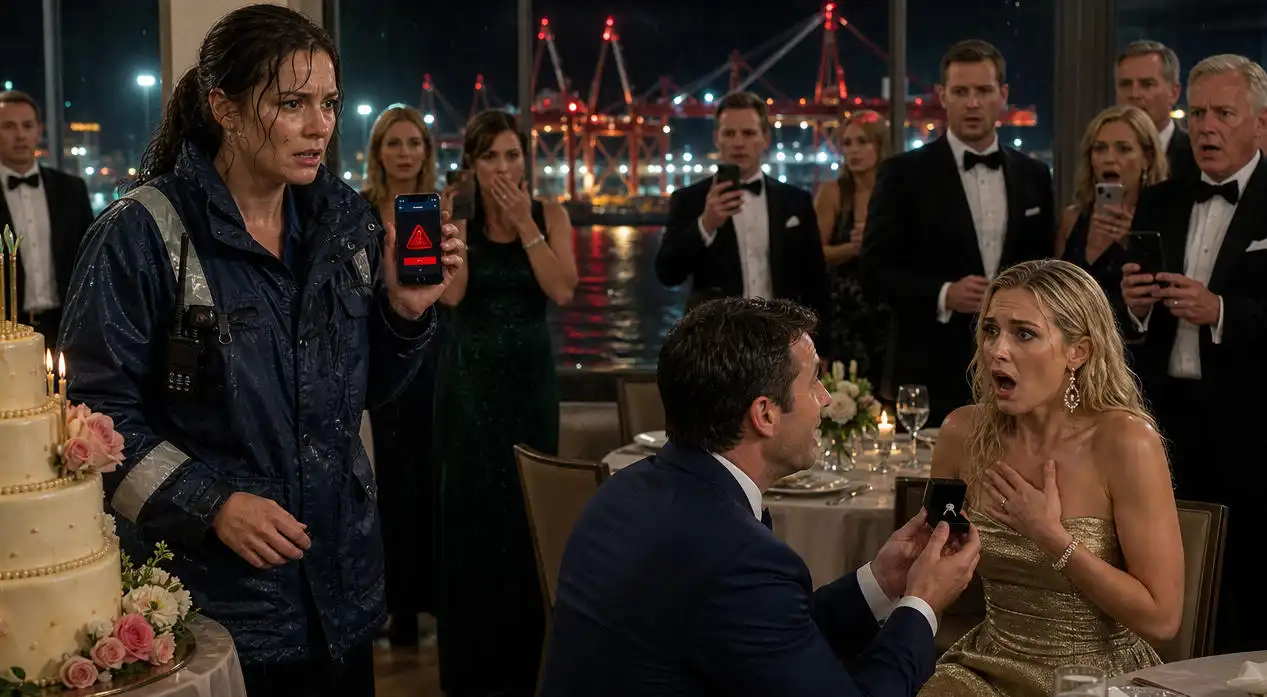
John was still on one knee.
Megan’s hand was still halfway to the diamond ring.
And I was still sitting beside my own birthday cake, soaked from the dock earlier, with everyone’s pity burning hotter than the candles.
Nobody knew what the red lights outside meant yet.
Nobody knew why every crane in the harbor had stopped moving.
Nobody knew why my phone had just gone silent after one tap.
John looked at the men entering the room and laughed nervously.
“Is this some kind of joke?”
The man in front did not laugh.
He wore a dark port command jacket, and behind him came federal customs officers, port police, and two state investigators.
The room changed instantly.
People who had been whispering about me suddenly stopped breathing too loudly.
Megan lowered her hand.
John slowly stood up.
I remained seated.
Because for once, I did not have to explain myself.
I just watched the room learn.
My name is Natalie Harper.
To most people at Pier 14, I was the quiet dock statistics clerk.
The woman with a clipboard.
The woman who wore steel-toe boots.
The woman who checked container weights, gate times, customs holds, vessel manifests, and crane logs.
The woman nobody invited upstairs unless a report was missing.
John used to say my job was “glorified counting.”
He said it in front of people.
He said it at parties.
He said it to make himself feel bigger.
John was a logistics supervisor.
Not an owner.
Not an executive.
Not a man with real authority.
But he had a badge, a pressed shirt, and enough confidence to make small people nervous.
That was his talent.
He could smell insecurity and charge rent on it.
For two years, I let him talk.
At first, I told myself he was stressed.
Then I told myself ambition made people ugly sometimes.
Then I told myself love required patience.
But love does not humiliate you for sport.
And patience is not the same as permission.
The morning everything began, I was at Berth 6 before sunrise.
A cold wind came off the water, dragging the smell of diesel, salt, and wet metal through the yard.
A vessel from Southeast Asia had docked late, and the unloading schedule was already behind.
I had been tracking a strange pattern for months.
Certain containers tied to Whitmore Imports kept coming in overweight, but not enough to trigger immediate panic.
Their seals were valid.
Their paperwork looked clean.
Their routes were ordinary.
Too ordinary.
That is what bothered me.
Real international shipping is messy.
Storm delays.
Customs notes.
Weight discrepancies.
Bad scans.
Human errors.
But Whitmore containers moved like they had invisible hands clearing every obstacle.
And those invisible hands kept leaving fingerprints.
A gate entry altered by twelve minutes.
A weight ticket duplicated from a different container.
A customs hold mysteriously removed after John logged into the system.
Three times, his credentials appeared where they had no business appearing.
The first time, I thought it was a mistake.
The second time, I took screenshots.
The third time, I stopped sleeping well.
That morning, I bent down to check a seal number on a Whitmore container when a forklift rolled past too close.
A wave of brown puddle water sprayed across my legs and coat.
It hit my face.
My clipboard slipped.
Papers scattered across the wet concrete.
I heard laughter before I even stood up.
“Careful,” a dock worker called out, grinning. “Wouldn’t want the queen of spreadsheets to drown.”
Another man said, “She probably can’t even open a container door without a tutorial.”
Then John walked over.
My boyfriend.
The man who had kissed my forehead the night before and told me to be ready for a “special birthday surprise.”
He saw the water dripping from my coat.
He saw the men laughing.
He saw me bend down to collect soaked reports with shaking hands.
And he smiled.
Not kindly.
Not awkwardly.
Amused.
“Come on, Natalie,” he said. “Don’t be dramatic. You work on a dock.”
I looked at him.
“Did you tell them to move that forklift?”
His expression sharpened.
“What?”
“That driver had no reason to come through this lane.”
John lowered his voice.
“You’re embarrassing yourself.”
That sentence hit harder than the water.
Not because it was loud.
Because he meant it.
To him, my humiliation was not the problem.
My reaction was.
A dispatcher named Carl leaned against the office door and said, “Maybe she’s upset because she has a fancy dinner tonight.”
The men laughed again.
John turned toward them and smirked.
“She does. I told her to dress up for once.”
I should have said something.
I should have thrown the ruined clipboard at his chest.
I should have walked away from him right there.
But I did what women like me are trained to do when men with power laugh in public.
I swallowed it.
I took photos of the soaked documents.
I took photos of the forklift number.
And while everyone was busy enjoying my embarrassment, I wrote down the three container numbers behind them.
WXMU-771204.
WXMU-771311.
WXMU-771509.
All Whitmore Imports.
All marked as luxury home goods.
All tied to John’s unauthorized system access.
That afternoon, I sent one encrypted file to Port Authority Compliance.
Then I sent a second to Customs Enforcement.
Then I waited.
Because the trick with powerful people is this:
You do not interrupt them while they are building the case against themselves.
You let them keep talking.
You let them keep smiling.
You let them believe your silence is weakness.
That night, I went to my birthday dinner.
I almost did not.
My dress was simple, navy blue, the only one I owned that looked expensive from a distance.
My hair still smelled faintly of harbor water no matter how many times I washed it.
I stood outside the banquet hall for a full minute, looking through the windows.
Inside, the room glittered.
White tablecloths.
Gold candles.
A harbor view.
Men in suits.
Women in diamonds.
A three-tier cake with my name written in silver icing.
For one foolish second, I thought John had actually planned something beautiful.
Then I saw Megan Whitmore standing beside him.
Her blonde hair was curled perfectly.
Her white dress looked bridal.
Her hand rested on John’s arm like she owned the sleeve and everything inside it.
Megan was the daughter of Conrad Whitmore, owner of Whitmore Imports.
Her family donated to museums, sponsored charity galas, and appeared in business magazines under headlines about “American enterprise.”
At the port, their name meant pressure.
If a Whitmore shipment got delayed, phones started ringing.
If customs requested extra inspection, somebody higher up asked why.
If a clerk like me questioned a manifest, people suddenly became concerned about my “attitude.”
John had told me Megan was “just a client.”
I believed him until belief became embarrassing.
When I walked in, the first thing Megan did was look at my shoes.
Dock shoes.
Clean, but not elegant.
Then she smiled like she had already won.
“Oh,” she said loudly enough for the closest table to hear. “This is Natalie.”
Not “Happy birthday.”
Not “Nice to meet you.”
This is Natalie.
Like I was a rumor that had finally wandered indoors.
John came over and kissed my cheek.
It was dry.
Careful.
Performed.
“You made it,” he said.
“To my birthday dinner?” I asked.
His jaw tightened.
“Don’t start.”
That was when I knew.
I sat at the center table, beside the cake, surrounded by people who did not know me but had apparently been invited to watch something.
Megan’s friends whispered.
John’s colleagues avoided my eyes.
Carl the dispatcher was there too, in a blazer that did not fit.
That surprised me.
Carl hated formal events.
But smug men will wear anything if they think they are going to witness a woman being put in her place.
Dinner was served.
Nobody mentioned my birthday.
Nobody asked about my life.
Megan told a long story about buying a villa in Italy.
John laughed too hard.
Carl said, “Must be nice being around people who understand global business.”
Megan tilted her head at me.
“Natalie works at the port too, right?”
John answered for me.
“She counts boxes.”
Several people chuckled.
I smiled into my water glass.
Megan leaned forward.
“That must be exhausting. All those numbers.”
“Not really,” I said. “Numbers are honest if you know where to look.”
John’s eyes flicked toward me.
There it was.
A tiny crack.
Fear.
Megan missed it.
She lifted her champagne glass and said, “Well, here’s to knowing your place.”
The table went quiet for half a second.
Then John laughed.
So everyone else laughed too.
That is how cruelty works in polite rooms.
One person throws the knife.
Everyone else pretends it is confetti.
Then John stood.
He tapped his glass with a knife.
“I want to thank everyone for coming tonight,” he began.
My hands went cold.
He did not look at me.
“Life is about growth. About ambition. About becoming the person you were meant to be.”
Megan lowered her eyes, smiling.
I heard someone behind me whisper, “Oh my God.”
John continued.
“For a long time, I tried to convince myself that loyalty was enough. But a man building something real needs a partner who understands his world.”
He finally looked at me.
Not with sadness.
With warning.
Do not make a scene.
That was what his eyes said.
Then he turned away from me, reached into his jacket, and pulled out a ring box.
Megan gasped.
A woman at the next table covered her mouth.
Phones came up.
My birthday cake sat between us like a witness.
John got down on one knee in front of Megan Whitmore.
“Natalie is a good person,” he said, as though giving a reference for a dismissed employee. “But Megan… you are my future.”
The room blurred for one second.
Only one.
Then it became very clear.
Every fork.
Every candle.
Every face waiting to see whether I would cry.
Megan whispered, “John…”
He opened the ring box.
“Marry me.”
People gasped.
One woman actually clapped before realizing nobody else had moved.
John looked back at me.
“Don’t make this awkward,” he said softly.
That was the line that saved me from grief.
Because the moment he said it, I stopped feeling heartbroken.
I felt awake.
I picked up my phone.
John noticed immediately.
“What are you doing?”
I entered my passcode.
Megan laughed. “Calling a ride?”
I opened the emergency compliance portal.
The one John did not know I had access to.
The one he thought belonged only to “people upstairs.”
He had no idea that six months earlier, after the previous Port Authority chairman resigned, I had been appointed interim director of North Atlantic Terminal Oversight.
Quietly.
Legally.
Strategically.
My public role stayed small because the investigation required it.
To the men on the dock, I was a statistics clerk.
To federal agencies, I was the only person with enough clean data to prove a smuggling pipeline running through five deepwater ports.
John thought I counted containers.
He never asked who owned the system that counted them.
I selected the three container numbers from that morning.
Then the nine connected containers already flagged in Savannah, Newark, Norfolk, Houston, and Long Beach.
Then the emergency authority code.
A warning appeared:
FULL TERMINAL LOCKDOWN WILL FREEZE ACTIVE CARGO MOVEMENT AND NOTIFY FEDERAL PARTNERS.
I pressed confirm.
Outside, the harbor lights turned red.
Inside, all the phones began buzzing.
John’s smile collapsed.
Megan looked toward the windows.
“What did you do?”
I set the phone beside my plate.
“I closed the port.”
John actually laughed.
It was desperate and ugly.
“You can’t close a port.”
Before I could answer, the banquet hall doors burst open.
That is where the room finally caught up to the truth.
The port commander entered first.
Captain Ellis was a tall man with gray hair, a calm voice, and the kind of presence that made liars check their pockets.
Behind him came customs officers carrying sealed folders.
Two port police officers moved to the exits.
Nobody shouted.
Nobody tackled anyone.
That made it worse.
Real authority does not need to perform.
Captain Ellis looked directly at me.
“Director Harper,” he said. “The lockdown is active. All Whitmore-linked containers are frozen pending federal inspection.”
A sound moved through the room.
Not a gasp.
More like the air leaving a punctured tire.
John stared at me.
Director.
Megan whispered, “No.”
I stood slowly.
My knees were weak, but my voice was not.
“Thank you, Captain.”
John turned pale.
“Director?” he said.
Carl dropped his champagne glass.
It shattered under the table.
Megan looked from me to John.
“What is he talking about?”
I looked at her.
“Your family’s containers.”
Her face hardened.
“You have no idea what you’re accusing us of.”
Captain Ellis opened a folder.
“Actually, she does.”
One of the customs officers stepped forward.
“Whitmore Imports is under investigation for misdeclared cargo, tariff evasion, falsified routing documents, and suspected movement of prohibited goods through bonded facilities.”
Megan’s father, Conrad Whitmore, stood from the far table.
He had been quiet all night.
Too quiet.
His face was red, but his voice tried to remain wealthy.
“This is a private event,” he said. “You people can contact our attorneys in the morning.”
Captain Ellis looked at him.
“Mr. Whitmore, your attorneys are welcome to meet us at the federal inspection bay.”
Then he turned to John.
“John Mercer, we also have questions about unauthorized access to port logistics systems.”
John backed up one step.
“No. No, I only processed what I was told to process.”
Megan snapped, “John.”
That one word told everyone everything.
It was not concern.
It was command.
Carl suddenly raised both hands.
“I didn’t know what was in them.”
Nobody had asked him yet.
That is the funny thing about guilt.
It volunteers.
The room became a courtroom without a judge.
Guests turned their phones toward John now.
Not toward me.
Megan’s friends stopped smiling.
The import brokers stared at their plates as though eye contact might be contagious.
I looked at John and remembered all the times he told me not to worry my “pretty little head” about business.
I remembered him using my laptop when he thought I was asleep.
I remembered him asking casual questions about customs hold codes.
I remembered the night he said Megan’s family could “change our lives” if I stopped being difficult.
And I remembered blaming myself for feeling suspicious.
Captain Ellis nodded to one investigator, who handed me a printed document.
I did not need to read it.
I had written the summary.
Still, I held it up so everyone could see.
“Three months ago,” I said, “I noticed a repeating mismatch between declared cargo weights and crane load data on Whitmore containers. The paperwork said luxury home goods. The weight profiles did not.”
Megan crossed her arms.
“That proves nothing.”
“No,” I said. “That alone proves nothing.”
I turned to Carl.
“But then dispatch logs were altered.”
Carl’s face went gray.
I turned to John.
“And access credentials belonging to a logistics supervisor were used to clear holds after customs review.”
John shook his head.
“My login was stolen.”
“Maybe,” I said.
Then I tapped my phone again.
The banquet hall’s large presentation screen, which had been showing a slideshow of harbor photos, changed.
A security clip appeared.
John, at 11:42 p.m., entering the restricted dispatch office.
Carl letting him in.
Megan standing behind them, holding a folder.
The room went dead silent.
The clip had no dramatic music.
No narration.
Just three people who thought nobody important was watching.
John looked like he might be sick.
Megan’s mouth opened, then closed.
Her father sat down very slowly.
I said, “You used Carl’s terminal after hours. You removed two customs inspection holds. Then you rerouted flagged containers to off-site bonded storage controlled by a Whitmore subsidiary.”
John whispered, “Natalie…”
I hated the way he said my name then.
Soft.
Pleading.
As though tenderness was a door he could still open.
I continued.
“The same containers were connected to shipments in four other ports. Same pattern. Same false descriptions. Same family of shell companies.”
Megan pointed at me.
“You were spying on us.”
“No,” I said. “I was doing my job.”
John finally lost control.
“Your job?” he shouted. “You were a clerk!”
There it was.
The truth underneath everything.
Not “I loved you.”
Not “I’m sorry.”
Not even “I was scared.”
You were a clerk.
The room heard it.
So did I.
I stepped closer to him.
“I let you believe that because arrogant people are careless around people they think don’t matter.”
Someone in the back murmured, “Damn.”
Megan turned on John.
“You told me she was nobody.”
John looked at her like a drowning man reaching for a stone.
“You said your father had protection.”
Conrad Whitmore stood again.
“Shut up.”
Too late.
Phones were still recording.
Federal officers were still listening.
And John, who had spent years thinking charm could replace character, had just placed the last brick on his own prison wall.
Captain Ellis gave a quiet order.
Two officers approached John.
He lifted his hands.
“Wait. I can explain.”
Megan stepped backward.
“Oh, now you can explain?”
John looked at me.
“Natalie, please. Tell them I didn’t know.”
I almost laughed.
Not because it was funny.
Because the audacity was almost beautiful.
This man had drenched me in public humiliation all day.
He had proposed to another woman beside my birthday cake.
He had called me small.
He had tried to erase me in front of a room full of people.
And now he wanted me to make him look innocent.
I said, “I already told them everything I know.”
His face crumpled.
“That’s not what I meant.”
“I know.”
Megan’s father tried to walk toward the exit.
A port police officer blocked him.
“Sir, you need to remain available.”
“This is outrageous,” Conrad said.
Captain Ellis replied, “So is using American ports like private tunnels.”
That line traveled around the room fast.
People love a clean sentence when the powerful are bleeding dignity.
Megan’s mother began crying quietly.
Megan did not cry.
She stared at me with pure hatred.
“You ruined us.”
I shook my head.
“No. I counted.”
For the first time that night, a few people laughed.
Not at me.
At the truth.
The officers escorted John out first.
He did not look handsome anymore.
Without arrogance, he looked unfinished.
His expensive jacket pulled crooked at the shoulder.
His face was wet with sweat.
As he passed the birthday cake, he stumbled.
His knee hit the floor.
Megan, trying to step away from him, caught her heel in the tablecloth and dropped down too.
For one frozen second, they were both kneeling in front of my cake.
The diamond ring box lay open between them.
Phones rose again.
John whispered, “Natalie, please.”
Megan hissed, “Get up.”
But neither of them looked powerful anymore.
They looked exactly like what they were:
Two people who mistook access for ownership.
Two people who confused money with immunity.
Two people who thought a woman in work boots could not read the room, the law, or the ledger.
I picked up the cake knife.
Everyone watched.
I cut the first slice.
Then I placed it on a small plate and handed it to the young server standing frozen by the wall.
“You’ve been standing all night,” I said. “Have some cake.”
She blinked, then smiled.
It broke something open in the room.
A few guests clapped.
Then more.
Not wild applause.
Not a movie scene.
Just ordinary people finally deciding which side of the room they wanted to stand on.
The next months were not glamorous.
They were depositions.
Audits.
Frozen accounts.
International calls at 3 a.m.
Lawyers with perfect ties trying to muddy simple facts.
Whitmore Imports fought hard.
People like that always do.
They called the investigation politically motivated.
They called the evidence incomplete.
They called me disgruntled.
That one made me smile.
A woman can produce three terabytes of records, multi-port shipping data, customs timelines, badge logs, camera footage, and signed compliance memos…
And some man in a conference room will still call it emotion.
But paper does not blush.
Data does not get intimidated.
And video does not forget.
One by one, the shell companies collapsed.
Customs confirmed that multiple Whitmore containers carried prohibited undeclared cargo hidden behind legitimate goods.
The tariff fraud alone was enormous.
The international penalties climbed past ten billion dollars once allied port authorities joined the case.
Whitmore Imports declared bankruptcy before the year ended.
Conrad Whitmore resigned from every board that still wanted to pretend it had standards.
Megan’s engagement announcement never made it to society pages.
Her family’s attorneys negotiated for months.
The name Whitmore, once printed in gold on charity banners, became a punchline whispered at import compliance seminars.
Carl cooperated early.
He admitted he had altered dispatch logs for cash payments and favors.
He lost his license, his job, and most of his friends.
John did not cooperate early.
That was his last bad decision.
He insisted he was manipulated by Megan.
Then Megan’s legal team produced messages showing John had requested payment for moving flagged containers.
Then Carl produced recordings of John bragging that “Natalie signs off on numbers all day and still has no idea what real business looks like.”
That recording was played in court.
I sat in the third row and listened.
It did not hurt the way I expected.
It felt like hearing a ghost describe a house I no longer lived in.
John pleaded guilty to conspiracy, unauthorized system access, and assisting smuggling operations.
The sentence was heavy.
Years, not months.
When the judge spoke, John kept staring at the floor.
Not once did he look back at me.
I was grateful.
Some endings do not need eye contact.
After the hearing, Megan passed me in the courthouse hallway.
She wore black.
No diamonds.
No smile.
For a moment, I thought she would insult me.
Instead, she said, “You must be proud.”
I looked at her for a long second.
Then I said, “No. I’m free.”
That was the truth.
Pride is loud.
Freedom is quiet.
A week later, I returned to Pier 14.
The same cranes moved against the morning sky.
The same gulls screamed over the water.
The same concrete smelled like salt and diesel.
But nothing felt the same.
Men who used to talk over me now stepped aside.
Dispatchers answered my emails in complete sentences.
Dock supervisors stopped calling me “sweetheart.”
Respect that comes from fear is not my favorite kind.
But it is better than contempt.
And sometimes fear is the first language arrogant people learn before they become decent.
Captain Ellis met me near Berth 6.
“Director Harper,” he said, handing me a hard hat.
It was new.
White.
My name printed on the front.
Not Natalie.
Not Clerk.
HARPER.
I put it on.
Then I walked the yard.
At the far end, near the same puddle where the forklift had soaked me months earlier, a young woman in a reflective vest was arguing with a driver twice her size.
He was waving paperwork in her face.
She held her ground.
I heard him say, “Just clear it. It’s not a big deal.”
The old me might have watched for a few seconds too long.
The new me walked straight over.
“Is there a problem?” I asked.
The driver looked me up and down.
Then he saw the hard hat.
His voice changed.
“No, ma’am.”
The young woman glanced at me with relief she tried to hide.
I took the paperwork, reviewed it, and handed it back.
“Rejected,” I said. “Seal number mismatch.”
The driver muttered something under his breath.
I looked at him.
“Would you like to repeat that for the compliance log?”
He left.
The young woman exhaled.
“Thank you.”
I smiled.
“Don’t thank me for enforcing the rules. Learn them so well nobody can use them against you.”
Her eyes widened a little.
I recognized that look.
The moment a woman realizes power does not always arrive wearing pearls.
Sometimes it wears boots.
That evening, I finally celebrated my birthday.
Not in a banquet hall.
Not with imported champagne.
Not beside people waiting to see me break.
I celebrated on my apartment balcony with my sister, two real friends, takeout seafood, and a grocery store cake that leaned slightly to the left.
It was perfect.
My sister lit one candle.
“Make a wish,” she said.
I looked out at the harbor.
The cranes moved slowly under the sunset, steady and enormous.
For years, I had made myself smaller so other people could feel comfortable.
I lowered my voice.
I softened my words.
I laughed at jokes that cut me.
I stayed in love with a man who liked me best when I did not challenge him.
That night, I did not wish for revenge.
Revenge had already done its job and gone home.
I wished for something better.
I wished that every woman who had ever been called “just a clerk,” “just a waitress,” “just a mom,” “just a worker,” “just a nobody,” would remember that small titles do not mean small lives.
I blew out the candle.
The next morning, I wore a custom camel wool coat to the annual Port Authority board meeting.
Not because I needed to prove anything.
Because I liked it.
As I stepped through the lobby, a group of executives turned.
One whispered my name.
Another straightened his tie.
I kept walking.
Outside, reporters were waiting for comments about the Whitmore penalties.
One asked, “Director Harper, do you believe the punishment was too severe?”
I paused.
I thought of the filthy water on my dress.
The laughter at the dock.
The birthday cake.
The ring.
John’s voice saying, “Don’t make this awkward.”
Then I looked into the camera.
“No,” I said. “I believe consequences only feel severe to people who never expected to face them.”
That clip spread everywhere.
Not because I shouted.
Not because I cried.
Because I finally said what decent people already know:
Dignity is not granted by wealth.
Power is not proven by cruelty.
And the quiet person taking notes may be the one holding the whole room together.
So here is the side I choose:
Natalie did not ruin John.
Natalie did not ruin Megan.
Natalie did not ruin the Whitmore family.
They built the trap.
They decorated it.
They invited witnesses.
Natalie only locked the gate.
Share this if you believe public humiliation deserves public consequences. And pick a side: Was Natalie ruthless… or was she righteous?
Disclaimer: Mention of any brand or trademark is for identification only and does not imply partnership or endorsement
The Tavern Owner Set A Trap To Make Paul Drink Again… But He Had NO IDEA The Entire Town Was Watching 👀
They Laughed When Mark Announced He Was Running for Office… Then One Sealed Envelope Made the Whole Room Go Silent 😳
My Stepdaughter Thought Her Real Father Paid for Her Golf Club Wedding… Then I Showed the Guests the Letter He Sent Me